
Kids and teens · Updated 2026-11-07
Decision Making Activities for Teens (with Free Printable)
Ready-made printable: Executive Function Group Curriculum Holiday 20% off: about $11.04, was $14 (EUR 12) · instant digital download
Buy on EtsyTry it free first: download session 1 free (group at a glance, lesson plan and student page, PDF, 69 KB). Run it with your group, then get all 8 sessions. No email needed.

Decision making activities for teens are short, practical rounds that help middle and high school students pause before a rushed yes or no, clarify the real choice in one sentence, gather more than two options, weigh values with short and longer consequences and missing info, notice peer or group chat pressure without handing the choice over, pick one option, take a tiny first step, and review what helped. This guide is for school counselors, therapists, teachers and parents who work with teens about ages 12 to 18. It gives twelve activities you can run tomorrow: a pause the rush drill, a clarify the choice rewrite, a three options stretch, a values spotlight, a short vs longer consequence map, a missing info hunt, a peer pressure cross check, a digital / social decision lab (group chat pile-ons, posting, screenshots), a pick and tiny act round, a review without shame loop, a low stakes practice menu, and a peer decision teach-back. Each comes with timing, setup, debrief and adaptations, plus a free three page printable.
This page is distinct from our problem solving activities for teens (define, brainstorm, pick, try when the stuck point is how to solve a problem), decisional balance worksheet (MI style pros and cons grid only), circle of control worksheet, impulse control activities for teens (STOP / THINK for urges), peer pressure worksheets for teens, goal setting worksheet for students, flexible thinking worksheet, time management activities for teens and growth mindset activities for teens. Those pages go deep on neighboring skills. This one is about the decision making loop itself: pause, clarify the choice, gather options, weigh values plus consequences plus info, pick, act, and review. It is not a cure for ADHD or anxiety, not a way to force teens into adult decisions they do not own, and not a lecture on morals.
We credit the sources these activities lean on, without claiming any affiliation or endorsement: CASEL responsible decision-making (caring and constructive choices that consider ethical standards, safety, social norms and consequences for self and others); ASCA Student Standards B-LS 1 (critical thinking skills to make informed decisions), B-LS 9 (decision-making informed by gathering evidence, getting others' perspectives and recognizing personal bias) and B-SS 5 (ethical decision-making and social responsibility); Reyna and Farley (2006) fuzzy-trace / dual-process neighbors on adolescent risk and gist versus verbatim reasoning; Casey and colleagues (2011) and Steinberg dual-systems neighbors on reward sensitivity and still-developing cognitive control in adolescence. The printable is an original Lotus and Tulip layout, not a copy of any of their materials.
This guide is educational. It is not therapy and not a diagnosis. Decision making practice does not cure ADHD, anxiety or depression, and it does not replace parent, school or clinical judgment on high stakes choices. If a conversation turns up thoughts of ending a life, self harm, a plan to hurt someone, abuse or a medical emergency, stop the activity and get help now: in the US, call or text 988 (Suicide and Crisis Lifeline), text HOME to 741741 (Crisis Text Line), or call 911. Our safety plan worksheet is a better first tool in that moment.
Jump to the free decision making printable (PDF) · Activities · How to use decision making activities for teens, step by step · Worked examples · Comparisons
What decision making is (and is not) for teens
For this page, decision making means a repeatable loop: pause the rush to answer, clarify the choice in one fair sentence, gather at least three options, weigh values with short and longer consequences and missing information, notice peer or digital pressure as data rather than as the boss, pick one option, take a tiny first step, and review what helped without shame. Popular advice often stops at "think before you act." Useful teen practice makes the steps visible and repeatable on school, friend and phone choices.
It is not:
- Problem solving alone. Problem solving defines a stuck point and tries solutions. Decision making chooses among options when the choice itself is the work. Pair with problem solving activities for teens when the teen is stuck on how, not only which.
- A decisional balance grid only. Pros and cons matter. This page also trains pause, clarify, options, values, peer check, act and review. Use the decisional balance worksheet when a four box grid is the main need.
- Impulse control alone. Stopping a snap text is different from choosing which class to drop or whether to post. See impulse control activities for teens for STOP / THINK urge work.
- A cure for ADHD or anxiety. Scaffolds can help many teens, including some with ADHD or anxiety, but they do not treat those conditions. Prefer evaluation and clinical care when attention, worry or mood is the main barrier.
- Forcing adult decisions onto teens. Adults still own some choices (safety, legal, school policy). This page practices teen-owned decisions at a fair size, not dumping adult load onto a fourteen year old.
- Moralizing. The goal is skillful choice under pressure, not a lecture that labels teens as bad for past snaps.
Why teens need teen-shaped decision practice
Rush and freeze are both common. Some teens say yes in the group chat before they feel the choice. Others stall forever and miss windows. Pause plus clarify gives both groups a middle path.
Peer and digital contexts change the stakes. Group chat pile-ons, posting, screenshots and "everyone is doing it" raise social cost. Developmental neighbors (Casey, Steinberg) note that reward and social cues can weigh heavily while cognitive control is still maturing. That is context for practice, not a claim that teens cannot decide well.
Gist and values matter. Reyna and Farley (2006) fuzzy-trace neighbors suggest that bottom-line gist and retrieved values often support healthier choices than endless detail trading alone. This page borrows that idea as a teaching neighbor: clarify the choice, name values, then weigh consequences. Lotus and Tulip is not affiliated with the authors.
School counseling and SEL frames already name the skill. ASCA B-LS 1, B-LS 9 and B-SS 5, and CASEL responsible decision-making, give counselors a standards-aligned reason to teach the loop without inventing effect sizes.
Decision making activities teens will actually do
Each activity lists time, group size, setup and debrief. Run one or two per session. Early activities build pause and clarify; middle ones build options and weighing; later ones tackle peer and digital pressure, tiny acts and review.
1. Pause the rush drill
Time: 10 minutes. Group: whole group, then pairs. Setup: a timer and three low stakes prompts (reply to a group chat invite, join a side quest after school, lend a charger).
Teens notice the urge to answer in under five seconds, then practice a ten second pause with feet on floor and one breath. Pair share: what did the rush feel like in the body? Debrief: pause is not delay forever; it is space to clarify. Teaching point: CASEL responsible decision-making includes considering safety and consequences before acting; pause makes that possible.
2. Clarify the choice rewrite
Time: 15 minutes. Group: individual. Take a fuzzy complaint ("everything is a mess," "they are all mad") and rewrite it as one decision sentence ("Do I go to the party Friday or stay home to finish the lab?"). Debrief: what changed when the choice got clear? Teaching point: ASCA B-LS 1 neighbors critical thinking for informed decisions; clarity is the first cut.
3. Three options stretch
Time: 15 minutes. Group: individual or pairs. For one clarified choice, write option A, B and C. Ban "only yes or only no" unless those truly are the only legal or safety options. Debrief: which option appeared only after you forced a third? Teaching point: more options reduce false dilemmas without turning into endless brainstorming (save deep brainstorming for problem solving activities for teens).
4. Values spotlight
Time: 15 minutes. Group: individual. List three values that matter in this choice (honesty, friendship, grades, rest, kindness, privacy). Rank top two for this decision only. Debrief: which value was loudest in the rush, and which one got quiet? Teaching point: fuzzy-trace neighbors emphasize retrieving values as gist; name them on purpose.
5. Short vs longer consequence map
Time: 15 minutes. Group: individual. For each option, note one short-term consequence (tonight / this week) and one longer-term consequence (next month / reputation / trust). Debrief: which option looked best short and worst long? Teaching point: CASEL frames include anticipating consequences for self and others; keep it concrete, not scare tactics.
6. Missing info hunt
Time: 10 minutes. Group: pairs. List two facts you do not have yet and who could give them (teacher, coach, trusted adult, the other person). Decide whether you can wait for info or must choose with what you have. Debrief: waiting is sometimes wise; stalling forever is not. Teaching point: ASCA B-LS 9 names gathering evidence and getting others' perspectives.
7. Peer pressure cross check
Time: 15 minutes. Group: individual, optional share. For the choice, write: whose voice is loudest, what they want, and what you want. Mark pressure as data, not as automatic obedience or automatic rebellion. Debrief: when is asking friends wise, and when is it hijacking? Teaching point: use peer pressure worksheets for teens when peer pressure is the whole lesson; here it is one check inside the decision loop.
8. Digital / social decision lab
Time: 20 minutes. Group: small groups. Scenarios: group chat pile-on, posting a story about someone, forwarding a screenshot, leaving someone on read after a fight. Run pause, clarify, three options, values, short vs longer consequences. Debrief: what is permanent about digital choices? Teaching point: social reward cues can be strong in adolescence (Casey / Steinberg neighbors); practice does not shame teens for liking belonging.
9. Pick and tiny act
Time: 10 minutes. Group: individual. Choose one option and write a first step of ten minutes or less (send the email draft to yourself, text "I need tonight to think," put the phone in another room before posting). Do the step in session when possible. Debrief: deciding without acting leaves the loop unfinished. Teaching point: action is part of decision making, not a separate personality trait.
10. Review without shame
Time: 10 minutes. Group: individual. After a real or practice decision: What helped? What to adjust next time? Keep tone specific and kind. Debrief: reviews without blame stick better. Teaching point: skill grows from feedback, not from calling yourself stupid for a past snap.
11. Low stakes practice menu
Time: 15 minutes. Group: individual. Build a personal menu of five low stakes decisions to practice this week (lunch choice, which homework first, reply timing, outfit, which friend to sit with). Debrief: why practice small before high stakes? Teaching point: reps on small choices build the loop for bigger ones without dumping adult decisions onto teens.
12. Peer decision teach-back
Time: 15 minutes. Group: pairs. Each teen teaches their partner one pause, one clarified choice, and one weigh step from their own week. Debrief: teaching the loop deepens it. Teaching point: social accountability can help without public shaming.
How to run these activities in a group or session
Set norms first. Pass is always allowed. Nobody is labeled "bad" for a past rushed choice. Celebrate pause, clear choices and kind reviews, not only perfect outcomes. End each session with one carry over: one clarified choice, one three options list, or one tiny act.
Suggested six session sequence. Session 1: pause the rush and clarify the choice rewrite. Session 2: three options stretch and values spotlight. Session 3: short vs longer consequence map and missing info hunt. Session 4: peer pressure cross check and digital / social decision lab. Session 5: pick and tiny act plus low stakes practice menu. Session 6: review without shame, peer teach-back, and review of the practice log.
Classroom or advisory version. In one period, run pause the rush (8 minutes), clarify one real choice (10 minutes), and three options plus a tiny act (12 minutes). Send the printable home.
Adaptations
- Middle school (about 11 to 14): shorter scenarios, more concrete options cards, adult help clarifying what the teen owns versus what adults own, simple digital examples (group chat tone, posting).
- High school (about 14 to 18): add job, dating, college or course choices at a fair size; keep legal and safety decisions with adults; deepen digital permanence talk.
- ADHD: externalize the steps (written pause card, timer, visible three options), shorter rounds, and clear tiny acts. Do not claim decision making treats ADHD. Prefer evaluation and accommodations when attention or executive function is the main barrier.
- Anxious teens: cap options at three, allow written plans instead of public share, and separate "good enough for today" from "perfect certainty forever." Link anxiety activities for teens when worry is broader than the choice.
- Perfectionism: emphasize reversible small steps and "decide, then adjust" over endless research. Pair with perfectionism worksheet for teens so deciding does not become another impossible standard.
- Virtual groups: chat based pause timers, private messages for sensitive choices, breakout pairs for teach-back, camera-off think time with a return check-in.
How to use decision making activities for teens, step by step
- Safety sort. Check that this is a decision skill question and not a crisis. Thoughts of ending a life, self harm, a plan to hurt someone, abuse or a medical emergency come first: 988, HOME to 741741, or 911 when needed, plus a safety plan.
- Pause the rush. Notice the urge to answer now. Take a short pause before clarifying.
- Clarify the choice. Write one fair decision sentence. Separate what the teen owns from what adults own.
- Gather options. List at least three real options when possible. Avoid false yes / no traps.
- Weigh values, consequences and info. Name top values, short and longer consequences, and missing facts.
- Check peer and digital pressure. Whose voice is loudest? What do you want?
- Pick one option. Choose without waiting for perfect certainty when the choice is teen-sized.
- Act with a tiny first step. Do something in ten minutes or less that moves the choice.
- Review kindly and log. Note what helped and one adjust. Practice again on a low stakes choice.
Practice on small school week choices first. The same loop helps with bigger social and academic decisions later.
School counselor, therapist, teacher and parent tips
School counselors. Decision making fits ASCA-aligned work on B-LS 1, B-LS 9 and B-SS 5, and CASEL responsible decision-making. Keep groups practical: pause, clarify, three options, weigh, tiny act. Measure small changes such as more paused replies and clearer choice sentences, not perfect life outcomes.
Therapists. Use clarify and values weigh when teens freeze under social pressure. Watch for ADHD, anxiety or depression as the main driver and treat those directly. Decision language is a skill aid, not a stand-alone treatment.
Teachers. Offer real choice points in class (which task first, how to show learning) so students practice the loop. Model your own pause out loud. Avoid stacking fake choices that adults have already decided.
Parents and caregivers. Ask "what is the decision in one sentence?" and "what are three options?" Support evaluation if chronic impulsive harm or freeze looks like possible ADHD, anxiety or another clinical need rather than only "attitude." Keep adult-owned safety decisions with adults.
Worked fictional examples
The group chat pile-on (fictional). Maya, 15, felt her thumbs move toward a mean reply in a pile-on about a classmate. Pause the rush bought ten seconds. Clarify: "Do I join the pile-on, stay silent, or message the classmate privately later?" She chose silence plus a private check-in later. Carry over: pause made values (kindness, not pile-ons) audible.
The post that felt urgent (fictional). Devon, 16, wanted to post a story about a fight. Three options: post now, draft and wait until morning, talk to a trusted adult first. Short consequence of posting: relief. Longer: screenshots and trust damage. He drafted and waited. Carry over: digital permanence is part of weighing.
The endless freeze (fictional). Riley, 14, could not pick an elective. Clarify plus three options plus a missing info hunt (talk to two teachers) unstuck the freeze. Tiny act: email one teacher that day. Carry over: more info beats more rumination when the choice is school-sized.
The peer-as-boss moment (fictional). Jordan, 17, said yes to a late car ride because friends called them "scared." Peer pressure cross check separated friends' dare from Jordan's values (safety, sleep). They said no and offered a morning plan instead. Carry over: pressure is data; it is not automatic obedience.
Counselor small group note (fictional). In a six session ninth grade decision making group, the counselor banned "just be smarter next time." Students practiced pause and clarify on phone choices. One student shared hopeless talk about never belonging that went beyond a single decision; the counselor followed up privately with school protocol and a safety check.
Decision making activities for teens vs problem solving teens, decisional balance, circle of control, impulse teens, peer pressure, goal setting, flexible thinking, time management teens and growth mindset teens
| Decision making teens (this page) | Problem solving teens | Decisional balance | Circle of control | Impulse teens | Peer pressure | Goal setting | Flexible thinking | Time management teens | Growth mindset teens | |
|---|---|---|---|---|---|---|---|---|---|---|
| Main job | Pause, clarify, options, weigh, pick, act, review | Define, brainstorm, pick, try, review | Pros / cons grid (MI neighbor) | What I can / cannot control | STOP / THINK urges | Peer pressure skills | Longer-range SMART goals | Shift rigid thoughts | Estimate, prioritize, focus, buffer | Fixed thought to strategy |
| Best early use | Rushed yes, freeze, digital social choices | When the stuck point is how | When ambivalence needs a grid | When control worry dominates | When snap urges dominate | When peers are the theme | When goals need structure | When rigidity blocks options | When time / deadlines are the theme | When labels and setbacks dominate |
| Output | Decision plan, practice log, mini card | Problem solving plan | Pros / cons worksheet | Control circles | Impulse plan | Peer pressure pages | Goal builder | Flexible thinking sheet | Time management plan | Growth mindset plan |
| Link | This page | Problem solving teens | Decisional balance | Circle of control | Impulse teens | Peer pressure | Goal setting | Flexible thinking | Time management teens | Growth mindset teens |
These tools work together. This page is the teen activity layer for the decision loop. When the main need is problem solving steps, a pros / cons grid, control circles, urge control, peer pressure skills, long-range goals, flexible thinking, time loops or growth mindset language, go to the matching page.
What helps vs common myths
What often helps: short pauses, one clear decision sentence, three options, named values, short and longer consequences, missing info hunts, peer pressure as data, tiny first steps, kind reviews, and adults who keep adult-owned choices with adults.
Common myths: "Good teens just know what to do." (Skill is practiced.) "More analysis always helps." (Endless verbatim trading can raise risk taking in some fuzzy-trace accounts; gist and values matter too.) "Saying no to friends means you do not care." (Boundaries can sit next to belonging.) "Apps will decide for them." (Tools help only when the loop is practiced.)
Common mistakes
- Skipping pause. Rush answers feel clever until consequences land.
- Fuzzy choices. "Fix my life" is not a decision sentence.
- Only two options. False dilemmas hide middle paths.
- Weighing only short-term relief. Tonight's ease can cost next week's trust.
- Handing the choice to the chat. Peers are data, not automatic bosses.
- Shame reviews. Blame blocks learning; specific adjusts build skill.
- Skipping crisis checks. Hopeless or unsafe talk can hide self harm risk; know when to switch to a safety plan.
- Overselling research. Developmental neighbors explain context; they do not prove this printable as an RCT.
When decision making activities are not the right tool
- Crisis or safety concerns. Thoughts of ending a life, self harm, a plan to hurt someone or abuse come first. Use 988, HOME to 741741 or 911, a safety plan and your reporting protocol.
- Adult-owned decisions. Legal, medical and many safety choices stay with adults. Do not dump them onto teens as "practice."
- Suspected ADHD, anxiety or depression as the main driver. Prefer evaluation and clinical care. Decision scaffolds can sit alongside; they do not replace assessment or treatment.
- When the need is pure problem solving, urge control or peer pressure curriculum. Use the neighboring pages linked above instead of stretching this loop to cover everything.
What the research says (honestly)
CASEL responsible decision-making neighbor. CASEL defines responsible decision-making as the abilities to make caring and constructive choices about personal behavior and social interactions across diverse situations, including considering ethical standards and safety concerns and evaluating benefits and consequences for personal, social and collective well-being. This page uses that frame as a teaching neighbor. Lotus and Tulip is not affiliated with CASEL.
ASCA Student Standards neighbors. ASCA Student Standards include B-LS 1 (critical thinking skills to make informed decisions), B-LS 9 (decision-making informed by gathering evidence, getting others' perspectives and recognizing personal bias) and B-SS 5 (ethical decision-making and social responsibility). Those standards give school counselors a clear reason to teach pause, clarify, evidence and values without inventing outcome statistics. Lotus and Tulip is not affiliated with ASCA.
Fuzzy-trace / dual-process neighbor. Reyna and Farley (2006), in Psychological Science in the Public Interest, reviewed adolescent risk and rationality and discussed dual-process accounts including fuzzy-trace theory: gist-based meaning and retrieved values often support different choices than verbatim detail trading alone. Later fuzzy-trace work elaborates that idea for risk. Treat that as a reason to teach clarify, values and bottom-line consequences, not as a claim that this printable was tested in their lab.
Developmental risk / dual-systems neighbor. Casey and colleagues (2011), "Braking and Accelerating of the Adolescent Brain," describe an imbalance account: heightened sensitivity to motivational cues with still-maturing cognitive control, especially in emotionally charged situations. Steinberg's dual-systems writing similarly notes reward seeking and peer context alongside developing self-regulation. These neighbors explain why pause and peer checks matter in teen practice. They do not mean teens cannot make good decisions, and they are not a diagnosis.
Honest limits. No study tests this three page printable or this exact activity set. Treat this as a practical skill practice aid built on well known research and standards neighbors, not a standalone randomized curriculum and not a treatment for any condition. Do not invent meta-analysis numbers; do not claim it treats ADHD or anxiety.
Free decision making printable for teens (PDF)
The free decision making printable has three pages in US Letter size:
- Page 1: Teen Decision Making Steps. Nine loop steps matching the HowTo above: safety sort, pause the rush, clarify choice, gather options, weigh values, check peers, pick and act, review kindly, log practice.
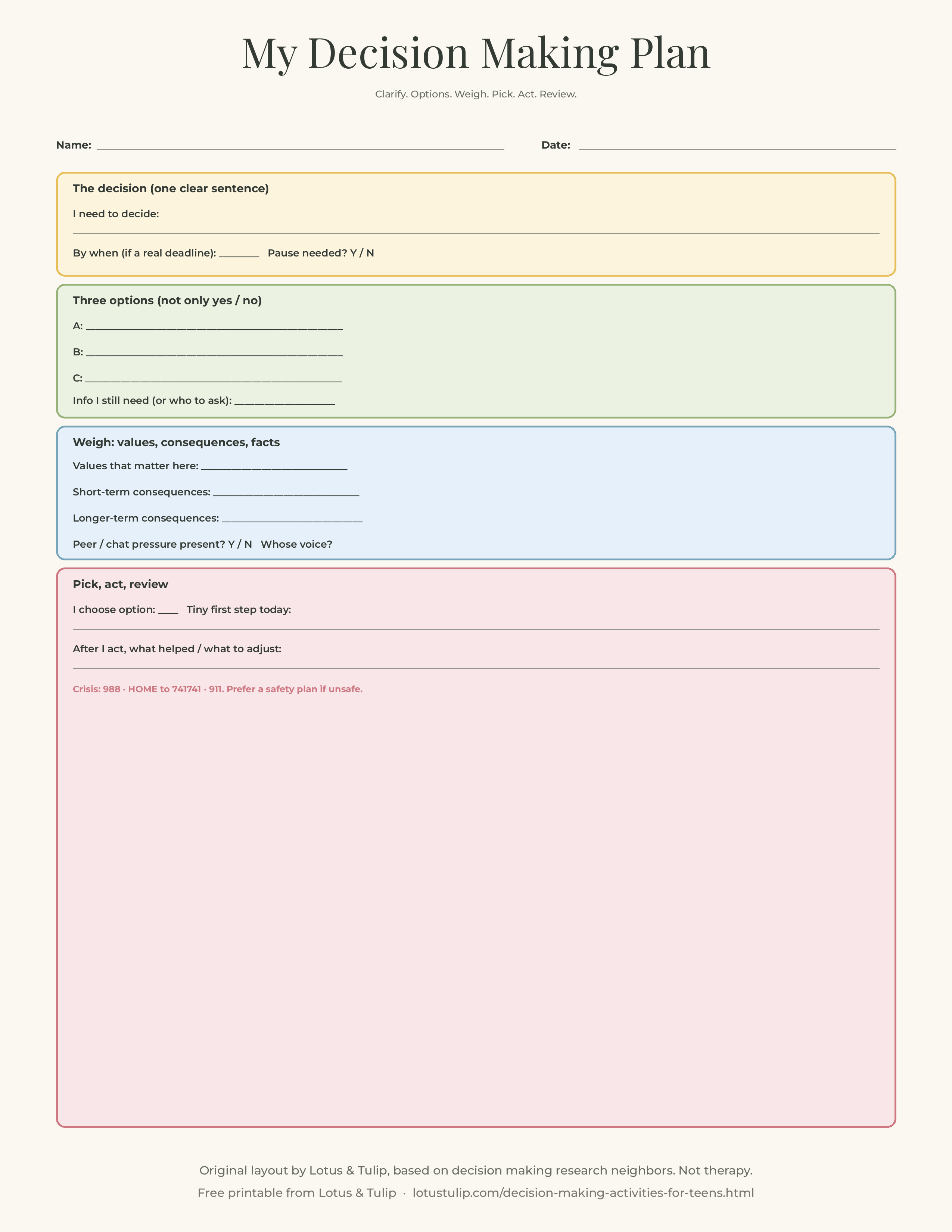
- Page 2: My Decision Making Plan. One clear decision sentence, three options, weigh values / consequences / info, pick and tiny act, review.
- Page 3: Practice Log + teen mini card. Seven days of pause, clarity, options and weighing, plus a cut out reminder card.
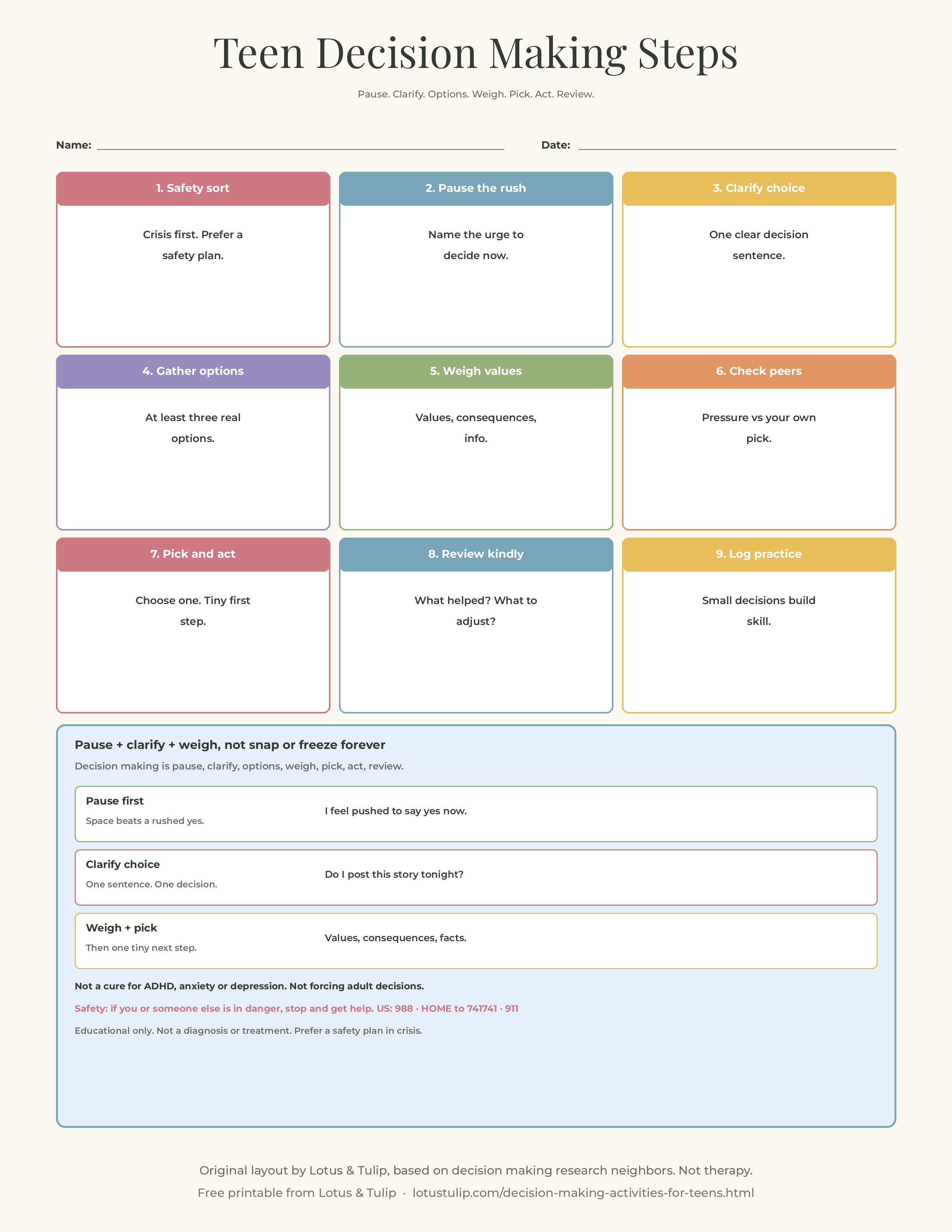
Download the free decision making printable for teens (PDF, 3 pages, US Letter)
Prefer single images? Page 1: Teen Decision Making Steps (PNG) · Page 2: My Decision Making Plan (PNG) · Page 3: Practice Log (PNG)
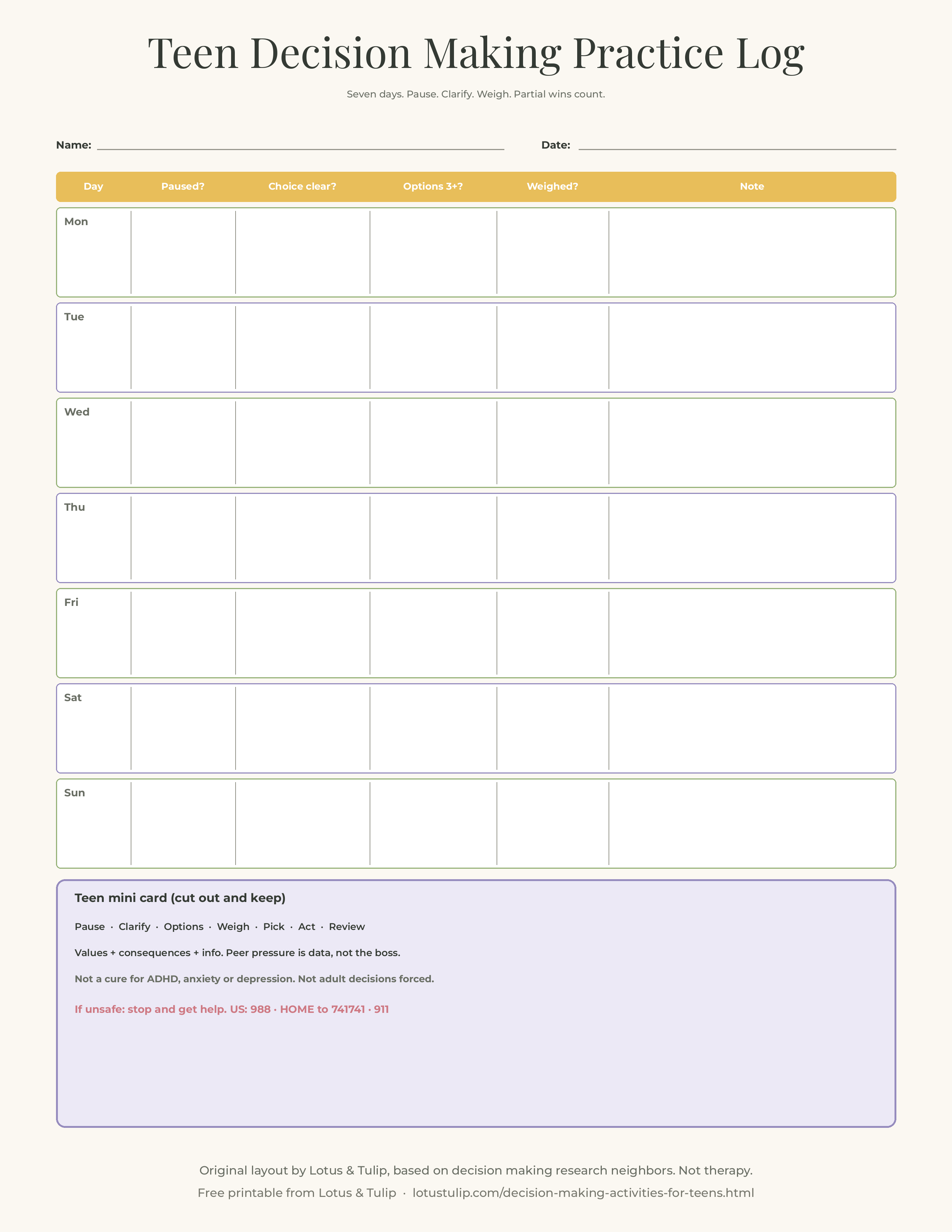
Free to print for your own use and for use with your own clients, students or groups. This is an original layout by Lotus & Tulip, drawing on widely cited decision making and adolescent development research neighbors (CASEL; ASCA B-LS 1 / B-LS 9 / B-SS 5; Reyna and Farley 2006; Casey et al. 2011 / Steinberg dual-systems neighbors). It is not affiliated with any author, agency, organization or curriculum named on this page, does not diagnose or treat any condition, and is not a substitute for therapy, evaluation or medical care. Please link to this page rather than re-uploading the file.
Related resources
- Problem solving activities for teens: when the stuck point is how, not only which.
- Decisional balance worksheet: MI style pros and cons grid.
- Circle of control worksheet: what I can and cannot control.
- Impulse control activities for teens: STOP / THINK for urges.
- Peer pressure worksheets for teens: when peers are the full lesson.
- Goal setting worksheet for students: longer-range goals next to single decisions.
- Flexible thinking worksheet: shifting rigid either / or frames.
- Time management activities for teens: when the theme is time, not choice.
- Growth mindset activities for teens: strategy after setbacks.
- Safety plan worksheet: when the moment is about staying safe.
Sources
- Collaborative for Academic, Social, and Emotional Learning (CASEL). Responsible decision-making competency (caring and constructive choices; ethical standards, safety, consequences).
- American School Counselor Association. ASCA Student Standards: Mindsets and Behaviors for Student Success (B-LS 1 critical thinking for informed decisions; B-LS 9 decision-making with evidence, perspectives and bias awareness; B-SS 5 ethical decision-making and social responsibility).
- Reyna, V. F., and Farley, F. (2006). Risk and rationality in adolescent decision making: implications for theory, practice, and public policy. Psychological Science in the Public Interest, 7(1), 1 to 44. (Fuzzy-trace / dual-process neighbor.)
- Casey, B. J., Jones, R. M., and Somerville, L. H. (2011). Braking and accelerating of the adolescent brain. Journal of Research on Adolescence, 21(1), 21 to 33. (Developmental risk / control neighbor.)
- Steinberg, L. (2008). A social neuroscience perspective on adolescent risk-taking. Developmental Review, 28(1), 78 to 106. (Dual-systems neighbor on reward seeking and developing self-regulation.)
Decision making activities for teens: FAQ
What are decision making activities for teens?
They are short practice rounds that help teens pause, clarify the choice, gather options, weigh values and consequences and info, notice peer pressure, pick, act and review. They fit classrooms, small groups and individual sessions.
How is this different from problem solving activities for teens?
Problem solving focuses on defining a stuck point and trying solutions. This page focuses on choosing among options when the decision itself is the work. Many teens need both.
How is this different from a decisional balance worksheet?
Decisional balance is a pros and cons grid (often MI inspired). This page trains the fuller loop: pause, clarify, options, values, peer check, act and review, with a three page printable.
Does decision making practice fix ADHD or anxiety?
No. Scaffolds can help many teens, including some with ADHD or anxiety, but they do not treat those conditions. Prefer evaluation and clinical care when those are the main issue.
Should teens make every adult decision as practice?
No. Practice teen-sized choices. Keep legal, medical and many safety decisions with adults. Forcing adult load onto teens is not skill building.
What should a school counselor measure?
Small behavior changes: more paused replies, clearer decision sentences, three options listed, tiny acts completed. Do not expect automatic life outcome jumps from a short skill group alone.
When are decision making activities not enough?
When there is crisis or self harm risk, an adult-owned decision, a suspected untreated ADHD or anxiety or depression as the main driver, or when the real need is pure problem solving, urge control or peer pressure curriculum. In a crisis in the US, call or text 988, text HOME to 741741, or call 911, and use a safety plan.