
Therapist practice · Updated 2026-11-09
Mental Status Exam Template: How to Document an MSE, with Examples (Free Printable)
Ready-made printable: Therapy Progress Notes and Intake Templates Fillable PDF: includes a mental status assessment page, plus intake, notes and safety plan pages (20 pages)
Holiday 20% off: about $7.36, was $9 (EUR 8) · instant digital download
Try it free first: download a fillable sample (SOAP note and DAP note, PDF, 226 KB). Type into it on screen, then get the full pack. No email needed.

The mental status exam (MSE) is one of the most useful paragraphs in a clinical record and one of the most rushed. Written well, it is a clear snapshot of how a client looked, spoke, felt, thought and understood their situation on a given day, in words another clinician can picture. Written badly, it is a row of copied phrases ("A&Ox3, WNL, denies SI/HI") that tells a reader almost nothing and can quietly contradict the rest of the note.
This guide is for counselors, therapists, social workers, psychologists, marriage and family therapists and trainees in the US who need to document a mental status exam at intake, in progress notes, at a change in presentation or at discharge. It covers what an MSE is and is not, the ten domains with plain descriptions and a word bank for each, how to document an MSE step by step, a full fictional mental status exam example, three short examples (a brief in session MSE, a telehealth MSE and a client with possible perceptual disturbance), words to watch, common mistakes, telehealth limits, and how MSE findings fit into the record under HIPAA. At the end you can download a free three page printable: a blank mental status exam form, a filled fictional example, and a descriptor word bank with a before you sign checklist.
Jump to the free mental status exam template
This is educational information about documentation for licensed clinicians and trainees. It is not clinical, diagnostic, legal or billing advice and it does not teach you to diagnose. A mental status exam is a clinical skill learned under supervision; use your training, your clinical judgment, your agency's policies and your supervisor's guidance. Scope of practice for assessment differs by license and state. Every client and clinician on this page is fictional.
What a mental status exam is
A mental status exam is a structured description of a person's mental functioning at the time you see them. The classic medical textbook chapter on the subject (David C. Martin, in Clinical Methods, 3rd edition, 1990) defines it as "a structured assessment of the patient's behavioral and cognitive functioning." It is often compared to the physical exam: the history tells you what has happened over weeks or years, while the MSE records what you observed and elicited today.
Two things make the MSE different from the rest of a note:
- It is mostly observation. Much of it comes from watching and listening during an ordinary conversation: how the client looks, moves and speaks, how their thinking flows, how their emotional expression shifts. A few parts come from direct questions, such as asking about mood, suicidal thoughts, hallucinations or orientation.
- It is a point in time. An MSE describes this session, not the client in general. A client who is tearful and slowed today may be bright and quick next month. That is the point: repeated MSEs show change.
What an MSE is not
- It is not a diagnosis. MSE findings are data. A diagnosis also needs history, duration, functioning, rule outs and often collateral information and formal measures. A restricted affect or a tangential thought process can have many causes, including medical ones, medication effects, fatigue, culture, language and simple nerves in a first session.
- It is not a cognitive test. The cognition section of an MSE is usually a brief, informal screen. Formal screening tools (such as the MMSE or MoCA, covered below) and neuropsychological testing are separate, have their own rules, and are not required for every MSE.
- It is not a risk assessment on its own. The MSE records whether you asked about suicidal and homicidal thoughts and what the client said. A full risk assessment weighs history, risk and protective factors, access to means and your clinical formulation, and usually lives in its own section or form.
When to do and document a mental status exam
Most clinicians observe mental status in every session, whether or not they write a full MSE. How much you document depends on the setting and the moment.
| Moment | How much to document |
|---|---|
| Intake or initial assessment | A full MSE covering every domain. It becomes the baseline you compare against later. |
| Routine progress notes | A brief MSE, often a few lines, focused on mood, affect, thought content (including risk when indicated) and anything that changed. Many agency note templates have a short mental status section built in. |
| A change in presentation | A fuller MSE when something is different: new confusion, unusual speech, signs of intoxication or withdrawal, possible psychotic symptoms, a sudden change in mood, or new risk. |
| Risk concern or crisis | A full MSE plus a separate risk assessment and the actions you took. Note the time, because mental status can change within hours. |
| Treatment plan review | A brief MSE that can be compared with the intake baseline, alongside any repeated measures. |
| Referral or transfer | A current MSE, so the receiving clinician or prescriber knows how the client presented most recently. |
| Discharge | A brief MSE at the last contact, which supports the status at discharge section of the discharge summary. |
Agencies, programs, payers and some state rules specify where an MSE must appear (for example, in an initial assessment for a given level of care). If you work in one of those settings, follow the required form. In private practice, a full MSE at intake and a brief one in each note is a common, defensible habit.
The ten mental status exam domains at a glance
Textbooks and agency forms organize the MSE in slightly different ways. StatPearls, the NCBI Bookshelf reference, notes that "each clinician organizes the mental status examination differently but has the same focus areas," and lists appearance, behavior, motor activity, speech, mood, affect, thought process, thought content, perceptual disturbances, cognition, insight and judgment. This guide and the free printable use ten domains, with motor activity inside behavior and mood and affect sharing a row.
| Domain | What it covers | How you usually get it | Example of an unremarkable line |
|---|---|---|---|
| 1. Appearance | Apparent vs stated age, dress, grooming, hygiene, build, notable features | Observation from the first moment | "Appears stated age, casually dressed, well groomed." |
| 2. Behavior | Attitude toward you, eye contact, psychomotor activity, abnormal movements | Observation throughout | "Cooperative and engaged, good eye contact, no psychomotor agitation or slowing." |
| 3. Speech | Rate, volume, rhythm, articulation, amount, spontaneity | Listening to natural conversation | "Normal rate, volume and rhythm; spontaneous." |
| 4. Mood | The client's own description of how they feel | Direct question; quote the answer | Mood: "pretty good this week." |
| 5. Affect | Your observation of emotional expression: quality, range, congruence, reactivity | Observation throughout | "Euthymic, full range, congruent with stated mood and content." |
| 6. Thought process | How thinking is organized and flows | Inferred from how the client talks and answers | "Linear and goal directed." |
| 7. Thought content | What the client is thinking about: preoccupations, worries, obsessions, delusions, suicidal and homicidal thoughts | Spontaneous content plus direct questions | "Focused on work stress; denies suicidal and homicidal ideation on direct inquiry; no delusions elicited." |
| 8. Perception | Hallucinations, illusions, depersonalization, derealization | Direct questions plus observation | "Denies hallucinations; does not appear to be responding to internal stimuli." |
| 9. Cognition | Alertness, orientation, attention, memory, and where relevant abstraction and fund of knowledge | Informal screening during the interview; a formal tool if indicated | "Alert, oriented to person, place, time and situation; attention and recent memory grossly intact in conversation." |
| 10. Insight and judgment | Understanding of one's own difficulties and need for help; quality of decisions | Inferred from the whole interview and recent history | "Insight good, describes symptoms and goals; judgment good based on recent decisions." |
Each domain in detail, with a word bank
For each domain below you will find what to look for, common descriptors, and a tip on writing it well. The descriptor lists are for documentation, not a diagnostic checklist. Use the plainest words that are accurate, and when in doubt describe what you saw instead of reaching for a technical term.
1. Appearance
What a stranger would notice when the client walks in or appears on screen. Record what is relevant and observable, not opinions about taste or attractiveness.
- Age: appears stated age, appears older than stated age, appears younger than stated age.
- Dress: casual, work clothes, appropriate to weather and setting, unusual for weather (for example, heavy coat in summer), disheveled.
- Grooming and hygiene: well groomed, fair grooming, unkempt hair, body odor noted.
- Build and features: slim, average, heavy build; visible injuries, bandages, healing cuts, tattoos or scars if clinically relevant; mobility aids.
Tip: Describe, then stop. "Wearing the same sweatshirt as the last two sessions, hair unwashed" is useful because it suggests a change in self care. "Sloppy" is a judgment and adds nothing.
2. Behavior and psychomotor activity
How the client relates to you and how they move. Some forms split "attitude" out as its own line.
- Attitude: cooperative, engaged, guarded, evasive, irritable, hostile, suspicious, withdrawn, overly familiar.
- Eye contact: good, intermittent, poor, avoids eye contact, intense or staring. (Eye contact norms differ widely across cultures and for neurodivergent clients; see the culture section.)
- Psychomotor activity: normal, psychomotor agitation (fidgeting, pacing, hand wringing), psychomotor slowing (slowed movements, long pauses before moving).
- Abnormal movements: tremor, tics, repetitive movements, unusual posture, gait abnormality.
Tip: Say what you saw rather than a conclusion. "Restless, shifted in chair and tapped foot throughout, stood once to look out the window" carries more information than "agitated."
3. Speech
How the client talks, not what they say. Listen to the mechanics: StatPearls lists quantity, fluency, rate, rhythm, volume and tone among the features to note.
- Rate: normal, slow, rapid, pressured (rapid and hard to interrupt).
- Volume: normal, soft, loud.
- Amount: spontaneous, talkative, minimal, responds only to direct questions, mute.
- Rhythm and articulation: fluent, monotone, slurred, stuttering, hesitant, latency of response (delay before answering).
Tip: Note anything that might explain speech features without a mental health cause: an accent, a second language, a hearing impairment, a stutter the client has always had, or recent dental work. "Speech slow with long pauses; client says she is tired after a night shift" is more accurate than "slowed speech" alone.
4. Mood
Mood is the client's own description of how they feel. StatPearls describes it as "a patient's subjective description of their feelings in their own words" and suggests asking directly. Ask an open question ("How would you describe your mood lately?") and record the answer in quotation marks.
- Write: Mood: "exhausted and on edge." Mood: "okay, I guess." Mood: "great, better than ever."
- If the client cannot or will not say, write that: "Client did not describe mood; said 'I don't know.'"
Tip: Some clinicians add a summary word after the quote (for example, "anxious" or "dysphoric"). If you do, keep the client's words too. The quote is the most valuable part, because it can be compared directly with your observation of affect.
5. Affect
Affect is your observation of the client's emotional expression during the session: face, voice, posture and how these shift with the conversation. Mood is what the client reports; affect is what you see. When the two do not match, say so.
- Quality: euthymic (within the normal range), dysphoric, sad, tearful, anxious, irritable, angry, euphoric, fearful, perplexed.
- Range: full, restricted (some narrowing), constricted, blunted (marked reduction), flat (little or no expression).
- Congruence: congruent with stated mood and topic, or incongruent (for example, smiling while describing a loss).
- Reactivity and stability: reactive (changes appropriately, brightens with humor), nonreactive; stable or labile (shifts quickly and strongly).
Tip: A complete affect line usually has at least quality, range and congruence: "Anxious, restricted range, congruent with stated mood; brightened briefly when talking about her daughter."
6. Thought process
How the client's thinking is organized, judged from how they talk and answer questions. StatPearls notes that "a normal thought process is typically linear and goal-directed" and describes the common irregular patterns:
- Linear and goal directed: answers follow from the question and reach a point.
- Circumstantial: thoughts stay connected but take a long detour with excess detail before returning to the point.
- Tangential: thoughts stay connected but drift away and do not return to the original question.
- Flight of ideas: rapid jumps between topics with connections that are hard to follow.
- Loose associations (disorganized): little or no logical connection between thoughts.
- Perseveration: returning to the same idea or answer regardless of the question.
- Thought blocking: sudden stops mid thought, sometimes with a long pause.
Tip: These words have specific meanings and can carry weight in a chart. If you are not sure which term fits, write a short example instead: "When asked about sleep, talked at length about a neighbor's dog and a childhood holiday, then said 'what was the question?'" A supervisor or prescriber can then judge it for themselves.
7. Thought content
What the client is thinking about. This domain includes themes and preoccupations, and it is where you record your direct questions about suicidal and homicidal thoughts.
- Themes and preoccupations: focused on a breakup, preoccupied with health worries, ruminating about a work mistake, hopelessness, guilt, worthlessness.
- Obsessions and compulsions: intrusive, unwanted thoughts and the urge to neutralize them, described in the client's words.
- Unusual or fixed beliefs: beliefs that seem out of keeping with the evidence and the client's cultural and religious background, such as believing they are being followed or that messages are being sent to them through the TV. Describe the belief and how firmly it is held; leave the label to your assessment.
- Suicidal ideation: denied on direct inquiry, or present (passive or active), with what the client said about intent, plan, timing, preparation, past attempts and access to means, documented in your risk section.
- Homicidal or violent ideation: denied on direct inquiry, or present, with target, intent and plan, documented in your risk section along with the actions you took.
Tip: Write "denies suicidal ideation on direct inquiry" only if you actually asked. If you did not ask, do not imply it. Many clinicians use a structured screen for the questions; for example, the Columbia Lighthouse Project says the Columbia Protocol (C-SSRS) is free to use in community and healthcare settings, with no mental health training required to ask the questions, though training is recommended. Any positive answer should lead to a fuller risk assessment and a safety plan where indicated. In the US, the 988 Suicide and Crisis Lifeline can be reached by call or text at 988.
8. Perception
Disturbances of perception, asked about directly and also observed.
- Hallucinations: perceptions without an external stimulus: auditory, visual, tactile, olfactory or gustatory. Note what, when and how the client relates to them.
- Illusions: misinterpretations of a real stimulus (for example, a coat on a chair mistaken for a person in dim light).
- Depersonalization and derealization: feeling detached from oneself or one's body, or feeling that surroundings are unreal.
- Observed behavior: appears to be responding to internal stimuli (for example, pausing as if listening, looking toward an empty corner, whispering), or does not appear to be.
Tip: Record exactly what the client said and what you saw. "Reports hearing her name called when falling asleep, two or three times a month, not distressing" and "Paused mid sentence several times and glanced to the left; when asked, said 'they're commenting again'" describe very different situations. Perceptual changes can also have medical, neurological, substance related or medication related causes, so note anything you know and follow your referral procedures.
9. Cognition
A brief screen of thinking abilities. In outpatient therapy this is usually informal: you notice whether the client follows the conversation, remembers what you discussed last time and knows the date. When there is a concern, you can test a little more directly or use a formal instrument within your training and scope.
- Level of consciousness: alert, drowsy, fluctuating.
- Orientation: to person, place, time and situation. Many clinicians write "oriented x3" (person, place, time) or "oriented x4" (adding situation). Because conventions differ, it is clearer to name the spheres, and to name any sphere that is impaired: "Oriented to person and place; gave the year as 2024."
- Attention and concentration: follows conversation, needs questions repeated, easily distracted; simple tasks such as spelling a word backward or serial subtraction if indicated.
- Memory: immediate recall, recent memory (events of the last days, content of the last session), remote memory (personal history).
- Other areas when relevant: fund of knowledge, abstract reasoning, estimated intellectual functioning, language comprehension.
Formal cognitive screening tools
Two well known tools have rules worth knowing before you use them or put them in a form:
- Mini-Mental State Examination (MMSE). Developed by Folstein, Folstein and McHugh in 1975, scored out of 30 points. It is copyrighted and published by PAR; PAR's licensing guidance says its test materials may not be reproduced, copied or adapted without permission, including free copies found online.
- Montreal Cognitive Assessment (MoCA). Also scored out of 30. The MoCA's publisher made training and certification mandatory from September 1, 2019, and says access to the test has been restricted to certified users since September 1, 2020.
For that reason the free printable on this page does not reproduce any formal test. It has a line to record which instrument you used, if any, the score and the version, alongside your informal cognition findings. A cognitive screen is a screen, not a diagnosis; unexpected results usually call for medical evaluation and, where appropriate, referral for neuropsychological assessment.
10. Insight and judgment
Insight is the client's understanding of their own difficulties: whether they recognize that something is wrong, how they explain it, and whether they see a need for help. Judgment is the quality of the client's decisions and their awareness of consequences. StatPearls notes judgment is often assessed "through a patient's history during an interview and observed actions," and is commonly described with terms such as poor, limited or fair, or as improving or worsening compared with a previous evaluation.
- Insight: good, fair, limited, poor, absent; or describe: "Recognizes that drinking worsens her anxiety but does not see it as a problem."
- Judgment: good, fair, impaired, poor; ideally with the evidence: "Judgment fair: kept appointments and took leave from work when overwhelmed; drove after drinking twice this month."
Tip: Insight and judgment are the domains most likely to read as opinion. Always pair the rating with a reason. Avoid using "poor insight" for a client who simply disagrees with you about a diagnosis or a treatment option; describe the disagreement instead.
How to document a mental status exam, step by step
- Start observing from the first moment. Appearance, behavior and speech are often clearest in the waiting room or the first minutes on video, before the client settles in. Make a quick note of anything that stands out.
- Let most of the MSE come from the conversation. You do not need to run through domains like a checklist. Affect, thought process and many cognition findings show up naturally as the client tells their story.
- Ask the direct questions. Ask about mood in an open way and record the answer in quotes. Ask directly about suicidal and homicidal thoughts and about unusual experiences such as hearing or seeing things others do not. Check orientation or memory where indicated.
- Add a formal screen only when indicated and within scope. If you use a standardized tool, follow its licensing and training rules, and record the tool, version and score.
- Write it soon after the session. Observations fade fast. Use the same domain order every time so a reader can find things, and so you notice when you skipped one.
- Describe, then summarize. For each domain, write the observable detail first and the descriptor second: "Spoke rapidly and was hard to interrupt (pressured)." Use quotes for the client's own words.
- Note mismatches and context. Record when mood and affect do not match, when the client's report differs from collateral information, and anything that could explain a finding: interpreter use, hearing loss, a medical condition, medication, intoxication, lack of sleep or a poor video connection.
- Link the MSE to the rest of the note. Make sure the MSE agrees with your assessment, risk section and plan. If thought content records passive suicidal ideation, the risk section and plan must address it.
- Review, sign and date. Read it once as a stranger would. Remove labels you cannot support, add the modality and the date and time, and sign with your credentials. Correct later errors with a dated addendum rather than overwriting.
Mental status exam example (fictional intake)
Below is a full MSE as it might appear in an initial assessment. The client, "R.M.," is a fictional 34 year old who came to an outpatient practice describing low mood after a job loss. The MSE is one section of the full assessment; history, risk assessment, formulation and plan appear elsewhere in the record.
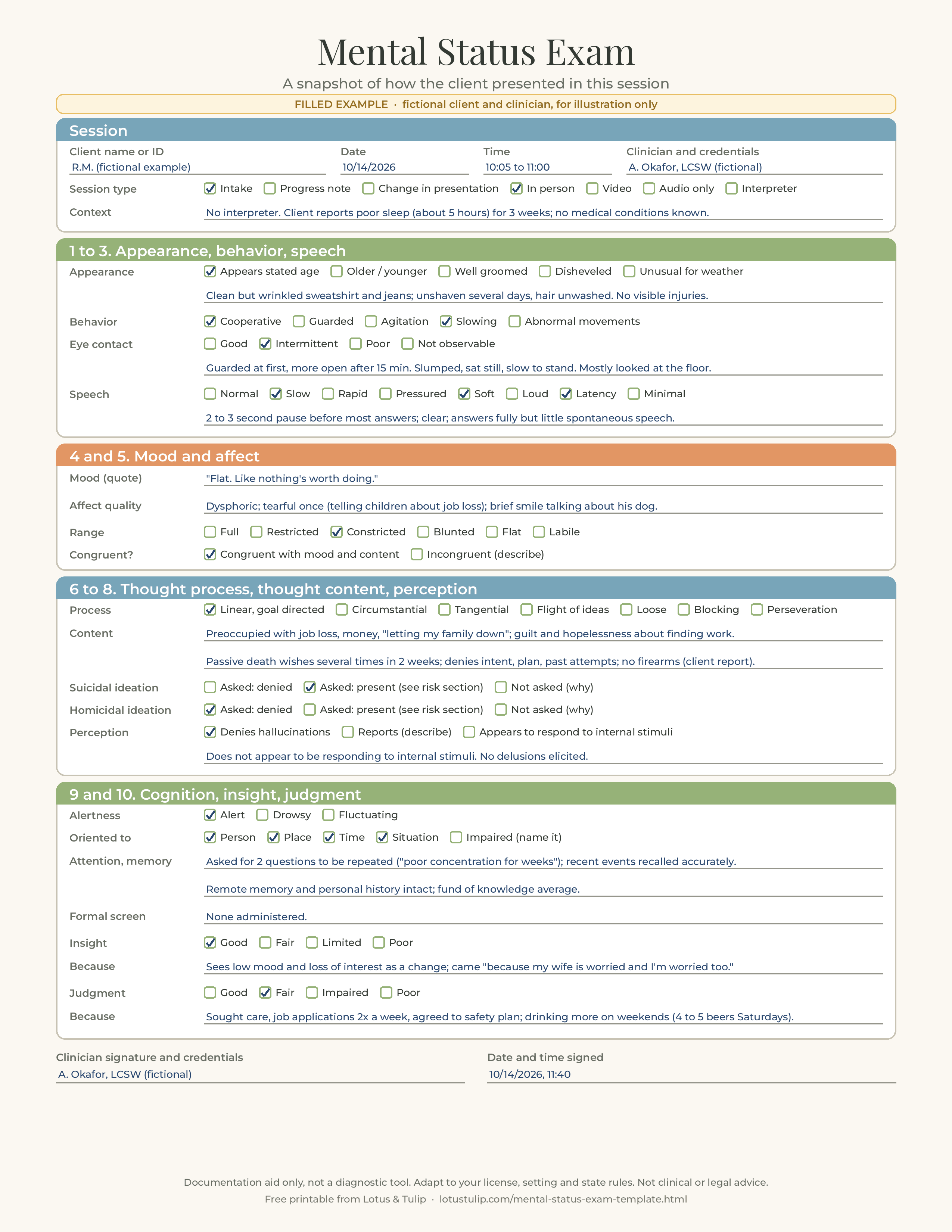
Mental status exam · R.M. (fictional) · intake, in person · 10/14/2026, 10:05 to 11:00
- Appearance: 34 year old man who appears stated age. Dressed in clean but wrinkled sweatshirt and jeans, appropriate to weather. Unshaven for several days; hair unwashed. No visible injuries.
- Behavior: Cooperative and polite, initially guarded, more open after 15 minutes. Intermittent eye contact, often looking at the floor. Psychomotor slowing: sat still with slumped posture, slow to stand at end of session. No tremor or abnormal movements.
- Speech: Soft volume, slowed rate, latency of 2 to 3 seconds before most answers. Clear articulation. Answered questions fully but offered little spontaneously.
- Mood: "Flat. Like nothing's worth doing."
- Affect: Dysphoric, constricted range, congruent with stated mood and content. Tearful once when describing telling his children about the job loss. Brief smile when talking about his dog.
- Thought process: Linear and goal directed. Slowed but organized; no tangentiality or loosening of associations.
- Thought content: Preoccupied with job loss, money and "letting my family down." Expressed guilt and hopelessness about finding work. On direct inquiry, reports passive death wishes ("sometimes I think everyone would be better off if I didn't wake up") several times in the last two weeks; denies intent or plan; denies past attempts; no firearms in the home (client report). Denies homicidal ideation. No delusions elicited. See risk assessment and safety plan.
- Perception: Denies auditory and visual hallucinations. Does not appear to be responding to internal stimuli.
- Cognition: Alert. Oriented to person, place, date and situation. Attention adequate for interview; asked for two questions to be repeated, attributes this to poor concentration "for weeks." Recalled details of the referral call and recent events accurately. No formal screen administered.
- Insight: Good. Identifies low mood and loss of interest as a change from his usual self and links them to the job loss; says he came "because my wife is worried and I'm worried too."
- Judgment: Fair to good. Sought treatment, has kept up with job applications twice a week, agreed to the safety plan. Reports drinking more on weekends (4 to 5 beers on Saturdays) since the job loss.
Signed: A. Okafor, LCSW (fictional) · 10/14/2026
Notice what makes this example useful: the mood is in the client's own words, the affect line has quality, range and congruence plus a detail, the passive death wishes are recorded exactly and point to the risk section, cognition names the spheres instead of "x4," and both insight and judgment come with reasons. Nothing in it is a diagnosis; it is the evidence a diagnosis and plan will rest on.
Three short MSE examples
Example 1: brief MSE in a routine progress note
Fictional client "K.L.," week 7 of treatment for generalized anxiety, in person. MSE: Well groomed, cooperative, good eye contact. Speech normal rate and volume. Mood "better, still worried about my dad." Affect mildly anxious, full range, congruent; laughed appropriately. Thought process linear. Thought content focused on father's surgery next week; denies SI and HI on direct inquiry. No perceptual disturbance noted. Alert and oriented, attention intact. Insight and judgment good.
A brief MSE does not need every descriptor. It needs enough to show what you observed today and that the key questions were asked, and it should change when the client changes.
Example 2: telehealth MSE
Fictional client "D.S.," telehealth video, client at home in a private room (client confirmed), clinician in office. MSE: Visible from chest up; appears stated age, casually dressed, groomed. Cooperative; eye contact difficult to judge on video, looked at screen consistently. Speech normal rate, somewhat loud, clear (audio good). Mood "stressed out." Affect irritable, full range, congruent; calmed noticeably when practicing paced breathing. Thought process linear, occasionally circumstantial when describing conflict with landlord. Thought content: worry about eviction notice; denies SI and HI on direct inquiry. Denies hallucinations. Alert, oriented to person, place, date and situation. Insight good; judgment fair (has not opened the landlord's letters for two weeks). Lower body, gait and fine motor movements not observable on video; brief connection drop at 10:22 (about 30 seconds).
Example 3: possible perceptual disturbance
Fictional client "T.V.," intake, in person. MSE (excerpt): Behavior: guarded, sat facing the door, glanced to the right several times mid sentence as if listening. Thought process: mostly linear; two episodes of stopping mid sentence for several seconds, then changing topic. Thought content: states coworkers "have been putting things in my coffee" and "everyone at the plant knows"; holds this firmly, says he has "no doubt"; cites no evidence beyond "the way they look at me." Perception: says he hears "a couple of voices talking about me" most evenings when alone, for about a month; denies voices telling him to do anything. Denies SI and HI on direct inquiry. Cognition: alert, oriented to person, place, date and situation. Insight: limited; does not see the experiences as connected to his health. Judgment: fair; has kept going to work, has not confronted coworkers.
In this example the clinician describes the experiences and the client's words without labeling them, records the direct questions about commands and risk, and would go on to document collateral information, medical and substance use history, and the referral for psychiatric and medical evaluation in the assessment and plan. What to do next is a clinical decision for your training, setting and supervisor, not something a template can make for you.
The brief MSE: what to keep in every progress note
A full ten domain MSE in every note is rarely needed and can bury what matters. A brief MSE in a progress note usually covers:
- Appearance and behavior, in a phrase, especially if changed.
- Mood in the client's words and affect with quality and congruence.
- Thought process, in a word if unremarkable.
- Thought content, including whether you asked about suicidal and homicidal thoughts and the answer, whenever indicated by your setting's policy or the client's risk.
- Anything new or different from the last session: a new perceptual experience, confusion, signs of intoxication, a sharp change in mood.
Avoid "MSE WNL" ("within normal limits") as the whole entry. It is fast, but it does not show what you looked at, and it can sit awkwardly next to a note that describes the client crying through the session. If your template uses checkboxes for unremarkable findings, add a free text line for anything notable and make sure the boxes are actually true today, not carried forward.
Telehealth mental status exams
Most of the MSE translates to video, and some of it does not. Be honest in the note about what you could and could not observe.
- What usually works well: facial expression and affect, speech (if audio is good), thought process and content, mood, orientation and many memory questions, insight and judgment.
- What is limited: gait and posture, lower body movements, fine tremor, hygiene and odor, eye contact (people look at the screen, not the camera), and signs of intoxication. Audio lag can mimic response latency, and a frozen picture can look like a flat affect.
- Document the setting. Note the modality (video or audio only), the client's location for that session as your setting requires, whether they were alone or who else was present, and connection problems that affected the exam.
- Audio only sessions leave out the visual domains entirely; write "appearance and behavior not observable, audio only session" rather than leaving the lines blank or carrying forward last week's text.
- Document the telehealth details. The telehealth progress note template covers modality, client location, consent and the backup plan in full.
- Know your risk plan before you need it. Location and an emergency contact recorded at the start of a telehealth session matter most when the MSE raises concern.
Culture, language, age and disability
Many MSE findings are only meaningful against what is typical for the person. Before you write a descriptor, consider:
- Cultural and religious context. Eye contact, emotional expressiveness, how distress is described (often physically), and beliefs about spirits, faith or family can all be normal for a client's background. MSE guides commonly ask whether a belief is consistent with the reality of the person's culture before treating it as unusual. When in doubt, ask the client, or with consent, family or a cultural consultant.
- Language. Speech, thought process and cognition findings are hard to judge in a client's second language or through an interpreter. Note interpreter use and the language of the session.
- Neurodivergence and disability. Reduced eye contact, monotone speech, literal answers to abstraction questions or repetitive movements may be a person's baseline rather than a change. Hearing, vision, speech and motor conditions can affect almost every domain.
- Children and adolescents. Use developmentally appropriate expectations for attention, speech, orientation and abstract thinking, and note who was present, since many young clients present differently with a parent in the room.
- Older adults. Sudden confusion, fluctuating attention or new perceptual disturbances can have medical causes and may need prompt medical evaluation, according to your training and setting.
Words to watch in a mental status exam
Clients can generally read their records, and other professionals will rely on yours. Replace vague or loaded words with observations.
| Instead of | Try |
|---|---|
| "Client was bizarre." | "Wore three winter hats indoors; laughed loudly at unrelated moments." |
| "Manipulative," "attention seeking" | Describe the behavior and context: "Asked three times to extend the session; became tearful when told time was up." |
| "Psychotic" | Describe the experience and the client's words; leave conclusions to the assessment section. |
| "Paranoid" | "Believes neighbors are recording him through the walls; holds this firmly." |
| "Poor hygiene, slob" | "Strong body odor; clothing stained; says he has not showered in a week." |
| "Denies SI" (when not asked) | Only write "denies" if you asked; otherwise write "suicidal ideation not assessed this session" and why. |
| "A&Ox4, WNL" | "Alert; oriented to person, place, date and situation; attention and recent memory intact in conversation." |
| "Poor insight" (client disagrees with you) | "Does not agree with the recommended referral; prefers to try exercise first." |
| "Inappropriate affect" (unexplained) | "Smiled and laughed while describing her father's death." |
| "Drunk" | "Smell of alcohol, slurred speech, unsteady gait; client reports 'a few beers' before session." |
Common mental status exam mistakes
- Copying forward last session's MSE. Cloned text is a classic audit and credibility problem. If nothing changed, write a fresh brief line that says so.
- Writing "denies" for questions you did not ask.
- Confusing mood and affect. Mood is the client's report; affect is your observation. Keep both.
- Diagnosing inside the MSE. "Depressed affect consistent with MDD" mixes data and conclusion. Keep the diagnosis in the assessment.
- Using technical terms loosely. "Tangential," "flight of ideas" and "delusion" mean specific things. If unsure, give an example.
- "Oriented x3" without saying which three. Name the spheres, especially when one is impaired.
- Ignoring context. Interpreter use, hearing loss, a migraine, a new medication or a bad night's sleep can change findings.
- An MSE that contradicts the note. "Euthymic, full range" next to a narrative of the client sobbing through the session.
- Risk findings with no follow through. Positive thought content on suicide or violence needs a risk assessment, actions and a plan elsewhere in the note.
- Reproducing a copyrighted test. Do not paste MMSE or MoCA items into your own forms; record the tool, version and score.
- Judgmental language. Words like "bizarre," "manipulative" or "noncompliant" without description.
- Blank lines. If a domain was not assessed, say so and why ("audio only session," "client declined").
MSE findings, the record and HIPAA
A mental status exam is part of the clinical record, not a psychotherapy note. Under HIPAA, psychotherapy notes are a narrow category of separately kept notes about the content of counseling conversations, and the definition (45 CFR 164.501) excludes "medication prescription and monitoring, counseling session start and stop times, the modalities and frequencies of treatment furnished, results of clinical tests, and any summary of the following items: Diagnosis, functional status, the treatment plan, symptoms, prognosis, and progress to date." MSE findings describe symptoms and functioning and often include screening results, so they belong in the regular record.
- Clients can generally see it. Under 45 CFR 164.524, clients generally have a right to inspect and get a copy of their designated record set, with limited exceptions. Write your MSE in words you would be comfortable with the client reading.
- Others may rely on it. Prescribers, hospitals, courts, payers and future clinicians read MSEs. Specific, descriptive, dated findings help them and protect you.
- Is HIPAA your rule? HIPAA applies to covered entities, which include health care providers who transmit health information electronically in connection with standard transactions such as insurance claims. State law, your license board, 42 CFR Part 2 for federally assisted substance use disorder programs, and FERPA for some school records can add or substitute rules.
A faster way to write good mental status exams
- Use the same order every time. Appearance to judgment, top to bottom. Your eye learns to spot a missing domain.
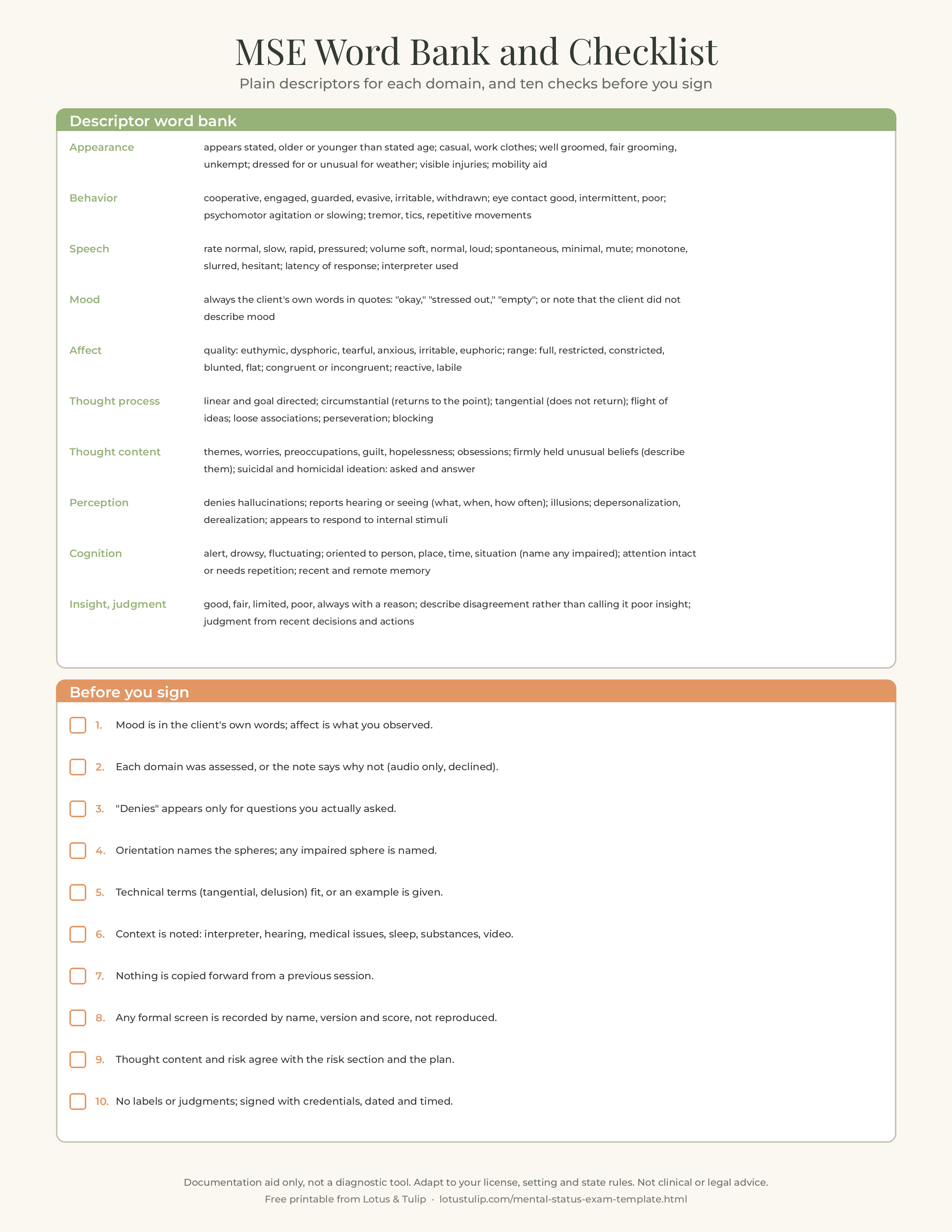
- Keep a word bank next to you. The third page of the free printable is a one page descriptor list, so you can find the accurate word quickly instead of defaulting to "WNL."
- Jot during or right after the session. A few words per domain on a paper form (or the margins of your note) is enough to write a full MSE later the same day.
- Write the intake MSE fully. It is your baseline; later brief MSEs can say "unchanged from intake except..." with confidence.
- Repeat a brief measure. A standardized symptom measure at intake and at plan reviews gives the MSE a number to sit next to.
- Read it back once. Check that mood and affect, thought content and risk, and insight and the plan all agree.
Free printable: mental status exam template, filled example and word bank
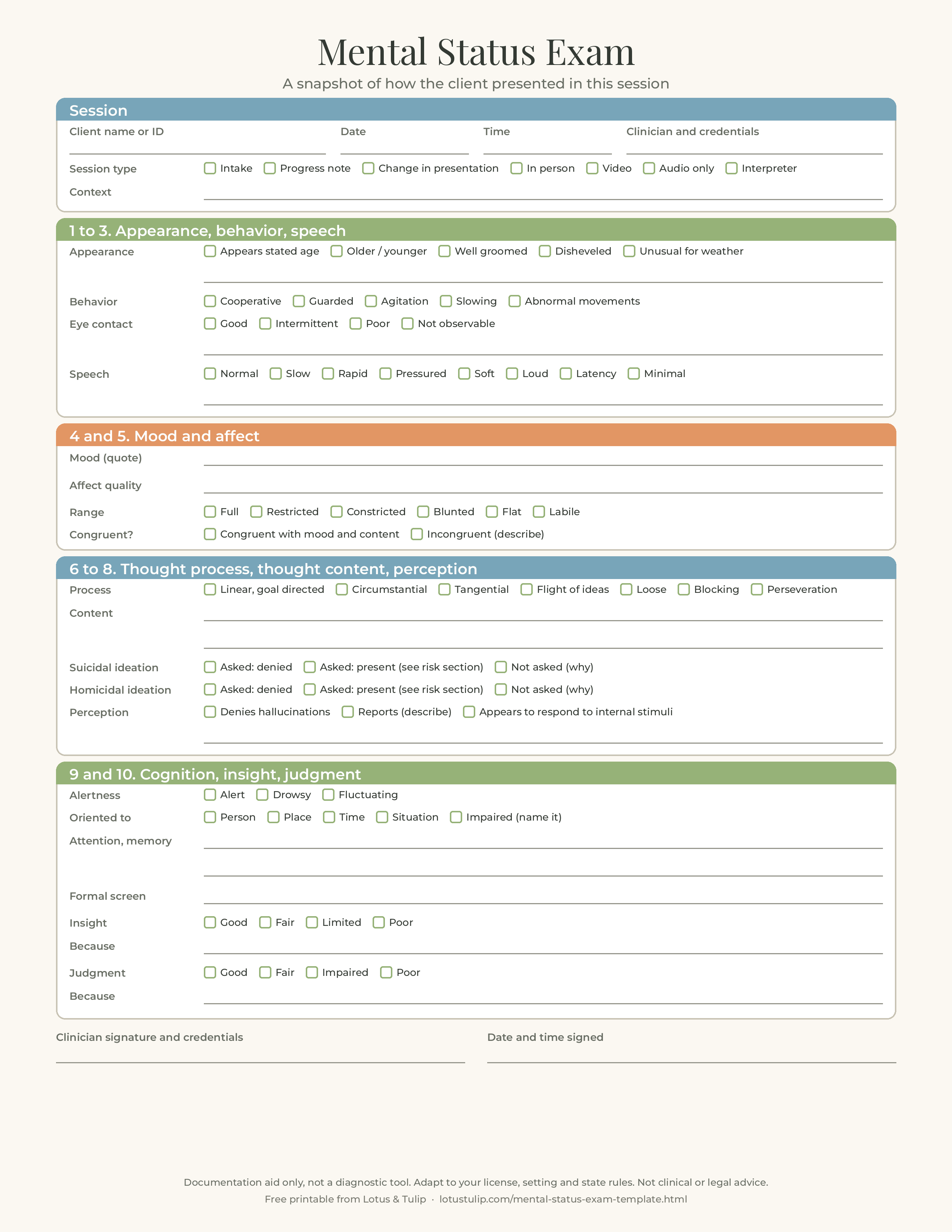
The free printable has three US Letter pages: a blank mental status exam form with sections for appearance, behavior and psychomotor activity, speech, mood (in the client's words) and affect, thought process, thought content with a suicide and violence inquiry line, perception, cognition (including a line to record any formal screen used, without reproducing it), insight and judgment, session details for in person, video or audio only sessions, and a signature line; a filled example for the fictional client "R.M." from this page; and a descriptor word bank for every domain with a ten point before you sign checklist.
Download the free mental status exam template (PDF, 3 pages)
Rather type than handwrite? The free PDF above is for printing. Therapy Progress Notes and Intake Templates comes as a fillable PDF you type straight into (604 fields in Adobe Acrobat Reader), plus the printable version: SOAP, DAP and BIRP notes, intake, treatment plan and safety plan, 20 pages. Holiday 20% off: about $7.36, was $9 (EUR 8) · instant digital download
Buy on EtsyPrefer single images? Page 1: blank mental status exam form (PNG) · Page 2: filled MSE example (PNG) · Page 3: descriptor word bank and before you sign checklist (PNG)
Free to print and use in your own practice or program. Please link to this page rather than re-uploading the file. The template is a documentation aid, not an assessment instrument or a diagnostic tool: adapt it to your license, setting, payer and state rules, and use your own clinical judgment. Using it does not guarantee that any payer, auditor or board will accept your documentation.
Related resources
- Duty to warn for therapists: Tarasoff, state laws, HIPAA and a free documentation worksheet
- Closing a therapy private practice: checklist, timeline, client letters, records plan and free printable
- HIPAA risk assessment for therapists: security risk analysis, filled example and free worksheet
- Business associate agreement for therapists: which vendors need a BAA, breach duties, filled vendor log and free printable
- Professional will for therapists: clinical executor, records custodian, client notification scripts, filled example and free printable
- Couples therapy informed consent form: no secrets policy, individual sessions, records access, safety screening, filled example and free printable
- Treatment summary template for therapists: how to write a treatment summary letter, transfer records under HIPAA, filled example and free printable
- Notice of privacy practices for therapists: HIPAA 164.520 elements, 2026 Part 2 update, filled example and free printable
- Parental consent form for therapy of a minor: who can consent, custody orders, state minor consent laws, HIPAA, filled example and free printable
- Credit card authorization form for therapists: card on file consent, PCI DSS rules, filled example and free printable
- Sliding scale fee policy for therapists: 2026 poverty guideline tiers, copay waiver rules, filled example and free printable
- Therapy cancellation policy template: late cancellation and no show fees, Medicare and Medicaid rules, filled example and free printable
- Release of information form for therapists: HIPAA authorization elements, psychotherapy notes, Part 2, filled example and free printable
- Superbill template for therapists: every field insurers need, CPT and POS codes, filled example and free printable
- Good Faith Estimate template for therapists: No Surprises Act rules, filled example and free printable
- Psychotherapy notes vs progress notes: what HIPAA says, what goes where and free printable
- Therapy termination letter template: how to end therapy ethically, sample letters and free printable
- Informed consent for therapy template: what to include, sample consent and free printable
- Biopsychosocial assessment template: example, 4 Ps formulation and free printable
- Telehealth progress note template: examples, checklist and free printable
- What to include in a therapy intake form (checklist)
- Therapy treatment plan template with SMART objectives (free printable)
- BIRP notes for therapists: template, 5 examples and free printable
- GIRP notes for therapists: template, 5 examples and free printable
- Group therapy progress notes: template, examples and free printable
- SOAP vs DAP notes for therapists, with examples
- Therapy discharge summary template: example and free printable
- Safety plan worksheet (free printable)
- Therapy progress notes and intake templates
Sources: Voss RM, Das JM, "Mental Status Examination," StatPearls (NCBI Bookshelf); Martin DC, "The Mental Status Examination," chapter 207 in Walker HK, Hall WD, Hurst JW (eds), Clinical Methods, 3rd edition (Butterworths, 1990, NCBI Bookshelf); PAR product and licensing pages for the MMSE; MoCA Cognition training and permission pages; The Columbia Lighthouse Project, About the Protocol and FAQ; eCFR 45 CFR 164.501 and 164.524. Descriptor lists are common clinical usage, not an exhaustive or official list. Rules and tool policies change; check the current versions.
FAQ
What are the components of a mental status exam?
Most MSEs cover appearance, behavior and psychomotor activity, speech, mood, affect, thought process, thought content (including suicidal and homicidal ideation), perception, cognition (alertness, orientation, attention and memory), insight and judgment. Forms group them differently, but the focus areas are the same.
What is the difference between mood and affect?
Mood is how the client says they feel, best recorded in their own words in quotation marks. Affect is the emotional expression you observe: its quality, range, congruence with mood and content, and how it changes during the session. Note it when the two do not match.
How do you write a normal mental status exam?
Describe each domain briefly instead of writing "WNL." For example: appears stated age, well groomed; cooperative, good eye contact; speech normal rate and volume; mood "good"; affect euthymic, full range, congruent; thought process linear; denies suicidal and homicidal ideation on direct inquiry; no perceptual disturbances; alert and oriented to person, place, time and situation; insight and judgment good.
What does "alert and oriented x4" mean?
It usually means the client is awake and alert and oriented to person, place, time and situation. Some clinicians use "x3" for person, place and time. Because conventions differ, naming the spheres (and any that are impaired) is clearer than a number alone.
Do I need to do a mental status exam in every session?
Most clinicians observe mental status every session, and many settings expect a brief MSE in each progress note, with a full MSE at intake and whenever presentation changes. Your agency, payer or state rules may set specific requirements, so check them.
Can I do a mental status exam over telehealth?
Yes, with limits. Mood, affect, speech, thought process and content, orientation, memory, insight and judgment usually translate well to video. Gait, lower body movement, hygiene and eye contact are harder to judge. Document the modality and what you could not observe.
Can I include the MMSE or MoCA in my own MSE form?
Not by copying them. The MMSE is copyrighted and published by PAR, which requires permission to reproduce or adapt it. The MoCA requires official training and certification to administer and is only available to certified users. Record the tool, version and score instead.
Is this mental status exam template free?
Yes. The three page printable (blank MSE form, filled example, and word bank with a before you sign checklist) is free to print and use in your own practice or program. Please link to this page rather than re-uploading the file, and adapt it to your setting.