
Therapist practice · Updated 2026-11-09
Release of Information Form for Therapists: HIPAA Authorization Elements, Psychotherapy Notes, 42 CFR Part 2 and a Filled Example (Free Printable)
Ready-made printable: Therapy Progress Notes and Intake Templates Fillable PDF, 20 pages: SOAP, DAP and BIRP notes, intake, treatment plan and safety plan
Holiday 20% off: about $7.36, was $9 (EUR 8) · instant digital download
Try it free first: download a fillable sample (SOAP note and DAP note, PDF, 226 KB). Type into it on screen, then get the full pack. No email needed.

Sooner or later every therapist gets the call. A client's psychiatrist wants to compare notes on a medication change. A school counselor asks how a teen is doing. An attorney faxes a records request. A parent wants an update. Before you say a word, you need to know two things: whether the law requires the client's written permission for this disclosure, and if it does, whether the form in your file would actually hold up. A release of information form that is missing one required statement is not a weaker release. Under HIPAA it is not a valid authorization at all.
This guide is for counselors, therapists, clinical social workers, marriage and family therapists and psychologists in the US. It explains when you need a signed release and when you do not, the six core elements and three required statements that every valid HIPAA authorization must contain (45 CFR 164.508), why a release cannot be tucked into your intake consent, the separate rules for psychotherapy notes, what changed for substance use disorder records under the 2024 Part 2 final rule, how revocation, expiration and redisclosure work, what to do with minors and personal representatives, a step by step process, a full fictional example and an FAQ. At the end you can download a free three page printable: a blank authorization form with every required element, the same form filled for a fictional practice, and a ten point before you release checklist with a disclosure log.
Jump to the free release of information form for therapists
This is educational information for licensed clinicians and trainees in the US. It is not legal advice and it does not create any professional relationship. HIPAA sets a federal floor; many states add stricter rules for mental health, substance use, HIV and minors' records, and your licensing board and professional code may ask for more. Have an attorney or your professional association review your final form. Every practice, clinician, client and identifier on this page is fictional.
The short answer
A release of information form (often shortened to ROI) is the document a client signs to let you share their health information with someone else, or to let someone else share information with you. Under the HIPAA Privacy Rule its formal name is an authorization, and 45 CFR 164.508(c) lists what it must contain. A valid authorization has six core elements: a specific description of the information; who may disclose it; who may receive it; the purpose of each disclosure; an expiration date or event; and the client's signature and date (plus a description of authority if a personal representative signs). It also has three required statements: the right to revoke in writing and how; that treatment, payment, enrollment or eligibility for benefits cannot be conditioned on signing (or the consequences of refusing, in the rare cases where conditioning is allowed); and that information disclosed may be redisclosed by the recipient and no longer protected by HIPAA. It must be written in plain language, and the client gets a copy.
Three special cases need extra care. Psychotherapy notes need their own authorization that can only be combined with another psychotherapy notes authorization. Records from a federally assisted substance use disorder program are governed by 42 CFR Part 2, whose consent has its own list of elements and its own notice that must travel with the records. And for minors, who signs depends on state law.
Release, authorization, consent: the words explained
Therapists use these terms loosely, and the rules use them precisely. Getting them straight saves a lot of confusion when an attorney or another clinic sends you their own form.
| Term | Where it comes from | What it means for you |
|---|---|---|
| Release of information (ROI) | Everyday clinical language | Not a legal term. Your ROI form needs to meet whichever rule applies: usually a HIPAA authorization, sometimes a Part 2 consent, a FERPA consent, or a stricter state form. |
| Authorization | HIPAA Privacy Rule, 45 CFR 164.508 | The client's signed permission for a use or disclosure that HIPAA does not otherwise permit. Must contain all the core elements and required statements. |
| Consent (Part 2) | 42 CFR 2.31 | The written permission a Part 2 program needs before disclosing substance use disorder records. Similar to a HIPAA authorization, with extra elements and statements. |
| Informed consent to treatment | State law, licensing rules, ethics codes | Agreement to receive therapy after learning about the process, risks, fees and limits of confidentiality. A different document from an authorization, and the two must not be merged (see compound authorizations below). |
| Request for access | 45 CFR 164.524 | The client's own right to see or get a copy of their records, including asking you to send a copy to a person they choose. Not an authorization, and the rules on timing and fees differ. |
| FERPA consent | 34 CFR 99.30 | Written consent to disclose education records held by a school. Relevant for school based counselors and when schools share records with you. |
When you need a signed release, and when you do not
The HIPAA Privacy Rule does not require an authorization for every disclosure. A covered provider may disclose protected health information for treatment, payment and health care operations without one (45 CFR 164.506(c)), and the rule lists other permitted disclosures, such as those required by law, for child abuse reporting, and to avert a serious and imminent threat (45 CFR 164.512). The authorization is for everything else.
That is only half the picture for a therapist. State mental health confidentiality laws are often stricter than HIPAA, and HIPAA does not override a more protective state law. Professional codes also expect written permission before most disclosures: the ACA Code of Ethics (standard B.6.g) asks counselors to obtain written permission from clients to disclose or transfer records to legitimate third parties, the APA Ethics Code (standard 4.05) allows disclosure with appropriate consent, the NASW Code of Ethics (standard 1.07(b)) with valid consent, and the AAMFT Code of Ethics (standard 2.2) by written authorization or waiver unless the law mandates or permits otherwise. So many practices get a signed release even where HIPAA alone would not demand one, especially before talking to another provider for the first time.
| Situation | HIPAA authorization needed? | What to keep in mind |
|---|---|---|
| Coordinating care with the client's psychiatrist or primary care doctor | No, a treatment disclosure (164.506(c)(2)) | State law, your code and the client's wishes often call for a signed release anyway. Psychotherapy notes still need their own authorization. |
| Sending claims or records to the client's health plan for payment | No, a payment disclosure | Send what the plan needs. Plans may not require psychotherapy notes as a condition of payment. |
| Talking with a referral source or new therapist when the client transfers | Usually no for treatment; many practices ask anyway | A signed release protects the relationship and documents the client's choice. |
| Letter or records for an attorney, a court case or a disability claim | Yes, unless a court order or qualifying subpoena applies (164.512(e)) | A subpoena from an attorney alone is not a court order. Call your liability insurer or attorney before responding. |
| Employer, life insurer, disability insurer, school or program | Yes | Limit the release to exactly what the third party needs. A letter confirming attendance is often enough. |
| Spouse, parent of an adult client or other family member | Not always: 164.510(b) allows limited sharing with people involved in care when the client agrees or does not object | In therapy, a signed release is the safer habit. State law may be stricter. |
| Client asks for a copy of their own record | No, a right of access request (164.524) | Respond within 30 days. Psychotherapy notes are excluded from the right of access. |
| Client asks you to send their record directly to someone | No, an access request directing a copy to a third party (164.524(c)(3)(ii)) | Must be in writing, signed, and clearly identify the person and where to send it. Many clients and attorneys use an authorization form instead; either can work if it is valid. |
| Releasing psychotherapy notes to anyone | Yes, a separate psychotherapy notes authorization (164.508(a)(2)) | Narrow exceptions only. See the section below. |
| Substance use treatment records from a Part 2 program | Part 2 written consent (42 CFR 2.31) | A general medical release is not enough. The Part 2 notice must accompany the disclosure. |
| Mandatory child abuse report or duty to warn situation | No (164.512(b), 164.512(j)) | Follow state law; document what you disclosed and why. |
The six core elements of a valid authorization
45 CFR 164.508(c)(1) says a valid authorization must contain "at least" the following elements. Each one is easy to get almost right, and "almost" is the problem: an authorization that has not been filled out completely with respect to a required element is defective under 164.508(b)(2)(ii).
1. A specific and meaningful description of the information
The rule asks for a description "that identifies the information in a specific and meaningful fashion." For therapy, that means naming categories the client can picture: dates of attendance, diagnosis, treatment plan and goals, a summary of progress, assessment results, discharge summary, or "a letter confirming that I attend weekly therapy." Tick boxes work well, with a line for limits such as "no details about my family history" or "information from sessions after June 1 only."
Avoid "any and all records." It is technically possible to authorize disclosure of an entire record, but in mental health it rarely serves the client, it invites disclosure of material the third party does not need, and it does not cover psychotherapy notes anyway. When the request comes from a third party with a blanket description, call the client and ask what they actually want shared.
2. Who may disclose the information
Name the person or organization authorized to make the disclosure: usually your practice and you as the clinician. If the release goes both ways (you send to the psychiatrist and the psychiatrist sends to you), it needs to name both as disclosers. Note that your form only authorizes disclosures by the parties it names. When you want records from another provider, that provider will often insist on its own form.
3. Who may receive the information
Name the recipient specifically: "Dr. M. Chen, psychiatrist, Riverside Psychiatry, 200 Example Street, fax 000 000 0000," not "my doctors." HIPAA allows a class of persons, such as "the claims staff of Example Life Insurance Company," but a therapy client is usually best served by a named person and a named method of delivery. If the recipient changes, get a new authorization.
4. The purpose of each disclosure
Describe why the information is being shared: coordination of care, a school support plan, a disability claim, a custody evaluation, at the client's request. The rule says "at the request of the individual" is a sufficient description when the client starts the process and does not want to give a reason. The purpose also limits you: if the release says "to coordinate medication management," it does not cover sending a progress summary to the same doctor for a disability claim.
5. An expiration date or expiration event
Every authorization needs a date ("December 31, 2027") or an event that relates to the client or the purpose ("when I finish treatment at this practice," "when my disability claim is decided"). "None" or "never" is acceptable only for research. Once the date passes or you know the event has happened, the authorization is defective and you may not rely on it. Match it to the purpose: one year or the end of treatment for care coordination, 90 days for a single letter, "when the claim is decided" for a disability claim, the end of the school year for school support. Write a real date rather than "one year from today," and check whether your state sets a maximum.
6. Signature and date, and a representative's authority
The client signs and dates the form. If a personal representative signs (a parent of a minor in many cases, a guardian, an agent under a health care power of attorney, or an executor for a deceased client), the form must also describe that person's authority to act, for example "parent of minor client" or "court appointed guardian, letters of guardianship on file." The Privacy Rule does not forbid electronic signatures on authorizations; they can work as long as they are valid under applicable law, and your portal or e-signature tool keeps an audit trail.
The three required statements, plain language and a copy
On top of the core elements, 164.508(c)(2) requires statements "adequate to place the individual on notice" of three things. A form that leaves out any one of them is not valid.
The right to revoke in writing
The form must say the client can revoke the authorization in writing, and either describe the exceptions and how to revoke, or refer to your Notice of Privacy Practices if those details are there. The exceptions under 164.508(b)(5) are that revocation does not undo anything you already did in reliance on the authorization, and, for authorizations obtained as a condition of getting insurance coverage, that other law may give the insurer a right to contest a claim. Plain wording works best: "You can cancel this permission at any time by writing to [practice name and address or secure email]. Cancelling will not undo information we already shared while this permission was in effect."
Conditioning: your care does not depend on signing
For almost every therapy release, the statement is that you will not condition treatment, payment, enrollment in a health plan or eligibility for benefits on whether the client signs. The rare exceptions in 164.508(b)(4) (research related treatment, certain health plan pre-enrollment underwriting, and services provided solely to create information for a third party, such as an evaluation an employer or court has requested) require a statement of the consequences of refusing instead. If you do a court ordered or employer requested evaluation, the consequence statement might read: "If you do not sign, we cannot complete the evaluation report for [third party]."
Redisclosure: the recipient may not be bound by HIPAA
The form must tell the client that the information may be redisclosed by the recipient and no longer protected by the Privacy Rule. This matters most when the recipient is not a health care provider or health plan: a school, employer, attorney or family member is generally not covered by HIPAA, so once they have the information, HIPAA no longer limits what they do with it. Clients often assume that whatever you send stays protected; say it plainly before they sign, and add any state law notice that restricts redisclosure of mental health information. Part 2 records carry their own redisclosure limits (see below).
Plain language and a copy for the client
The authorization must be written in plain language (164.508(c)(3)), and when you ask the client for the authorization you must give them a copy of the signed form (164.508(c)(4)). Keep the signed original, or a reliable scan, for at least six years from the date it was created or last in effect, whichever is later (164.508(b)(6) and 164.530(j)). State record retention rules for therapy records may be longer.
What makes an authorization invalid
Under 164.508(b)(2), an authorization is not valid if any of the following is true. Run through this list every time a form arrives from someone else, because third party forms are often written for medical records departments, not for therapy.
- It has expired. The date has passed, or you know the expiration event has happened.
- It is incomplete. A core element is blank or missing, such as a recipient with no name, or a purpose line left empty.
- It has been revoked, and you know it.
- It is an improper compound authorization, or it conditions care on signing when that is not allowed.
- It contains material information you know to be false, such as a signature you know is not the client's.
A missing required statement also means the document does not meet 164.508(c)(2), so it is not a valid authorization in the first place. Do not "fix" another organization's form by writing on it. Ask the client to sign your own form, or ask the requester for a corrected version.
Compound authorizations: keep the release separate from your intake consent
45 CFR 164.508(b)(3) says an authorization "may not be combined with any other document to create a compound authorization," with three exceptions. For therapists the practical rules are:
- Do not build the release into your informed consent or practice policies. A paragraph in the intake agreement that says "I authorize the therapist to share information with my doctors" combines an authorization with a non-authorization document. Give the release its own page with its own signature, even if it travels in the same intake packet.
- Several ordinary authorizations can share one document, as long as care is not conditioned on any of them. For example, one form can authorize sending a summary to a psychiatrist and an attendance letter to a school, each with its own recipient, purpose and expiration. In practice, one release per recipient is easier to track and revoke.
- A psychotherapy notes authorization can only be combined with another psychotherapy notes authorization. It cannot share a page with an authorization for progress notes, the treatment plan or a discharge summary.
Part 2 has a parallel rule: a consent for use and disclosure of SUD records in civil, criminal, administrative or legislative proceedings cannot be combined with a consent for any other purpose (42 CFR 2.31(d)), and SUD counseling notes need their own consent (2.31(b)(2)).
Psychotherapy notes need their own authorization
HIPAA defines psychotherapy notes narrowly: notes recorded by a mental health professional documenting or analyzing the contents of a counseling session, kept separate from the rest of the record. They exclude medication information, session start and stop times, the modalities and frequency of treatment, results of clinical tests, and any summary of diagnosis, functional status, treatment plan, symptoms, prognosis and progress to date (45 CFR 164.501). If you are unsure which of your notes qualify, read psychotherapy notes vs progress notes first.
Under 164.508(a)(2), you must obtain an authorization for any use or disclosure of psychotherapy notes, except a short list: your own use for treatment as the person who wrote them; your practice's supervised training programs; defending yourself in a legal action brought by the client; and certain disclosures required by law, to HHS for compliance reviews, to health oversight of the note's author, to coroners and medical examiners, and to avert a serious and imminent threat. Notice what is not on that list: other treating providers, health plans and the client's attorney. Each needs a specific psychotherapy notes authorization.
In practice:
- Most requests do not need psychotherapy notes: a psychiatrist wants the diagnosis, plan and progress, an insurer the progress notes behind a claim. Offer a treatment summary first; it is usually more useful to the recipient and protects the client.
- A health plan may not condition payment, enrollment or eligibility on a psychotherapy notes authorization (164.508(b)(4)).
- Use a separate form with "psychotherapy notes" written plainly in the description of information, and do not tick it as a box on your general release.
- Talk with the client before they sign. They should know what the notes contain, who will see them and that the recipient may not be bound by HIPAA.
Substance use disorder records: 42 CFR Part 2 consent
42 CFR Part 2 protects records that identify a patient as having a substance use disorder when the information comes from a Part 2 program: a federally assisted person or unit that holds itself out as providing, and provides, substance use disorder diagnosis, treatment or referral for treatment (42 CFR 2.11 and 2.12). "Federally assisted" is broad: it includes, among other things, Medicare participation, any federal financial assistance, and tax exempt status. A general private practice therapist who treats anxiety and occasionally addresses drinking is usually not a Part 2 program. A practice or clinic that advertises addiction treatment and accepts Medicare probably is. If you are not sure, ask a health care attorney; the answer changes your release forms, your notice and your record handling.
Even if you are not a Part 2 program, you may receive Part 2 records, for example a discharge summary from a residential treatment center. Those records arrive with a notice that limits what you may do with them, and you need to respect it.
What a Part 2 consent must include
Under 42 CFR 2.31(a), as amended by the 2024 final rule, a written consent may be paper or electronic and must include:
- The name of the patient.
- The name or specific identification of the person or class of persons authorized to make the use or disclosure.
- A description of the information that identifies it in a specific and meaningful fashion.
- The recipients, by name or class. For a single consent for all future treatment, payment and health care operations, the recipient may be described as "my treating providers, health plans, third-party payers, and people helping to operate this program" or similar. If the recipient is a covered entity or business associate receiving records for treatment, payment or health care operations, the consent must state that the records may be redisclosed under HIPAA, except for uses and disclosures in civil, criminal, administrative and legislative proceedings against the patient.
- A description of each purpose. "At the request of the patient" is sufficient when the patient starts the request, and "for treatment, payment, and health care operations" is sufficient for a single consent for all such future uses and disclosures.
- The patient's right to revoke the consent in writing, except to the extent that the program or other lawful holder has already acted in reliance on it, and how to revoke.
- An expiration date or event. "End of the treatment," "none" or similar is sufficient for a treatment, payment and operations consent.
- The signature of the patient, and where required for a minor, of a person authorized under 2.14; or for a patient adjudicated as lacking capacity, or deceased, of a person authorized under 2.15. Electronic signatures are allowed where not prohibited by law.
- The date signed.
- For a treatment, payment and operations consent, statements about the potential for redisclosure by the recipient so that the records are no longer protected by Part 2, and the consequences to the patient of refusing to sign.
What changed with the 2024 final rule
HHS published the final rule in February 2024 to align Part 2 more closely with HIPAA, as the CARES Act required. It took effect April 16, 2024, and compliance was required by February 16, 2026. The changes most relevant to release forms:
- A single consent for all future treatment, payment and health care operations is now allowed. HIPAA covered entities and business associates that receive records under it may redisclose them as HIPAA permits, except for use in proceedings against the patient. Programs are not required to use a single TPO consent; separate consents remain fine.
- SUD counseling notes are a new category, analogous to psychotherapy notes: notes analyzing the conversation in an SUD counseling session that the clinician keeps separately. They need their own consent, which can only be combined with another SUD counseling notes consent, and care cannot be conditioned on it (2.31(b)).
- Consent for legal proceedings must be separate from any other consent (2.31(d)).
- Each disclosure made with consent must be accompanied by a copy of the consent or a clear explanation of its scope (2.32(b)), plus one of two notices.
- Enforcement now follows the HIPAA civil penalty structure, and patients can complain directly to HHS. HHS began accepting Part 2 complaints and breach notifications on February 16, 2026.
The notice that must travel with Part 2 records
Every disclosure made with a Part 2 consent must carry one of two statements under 42 CFR 2.32(a). The short version is: "42 CFR part 2 prohibits unauthorized use or disclosure of these records." The longer version explains that the records cannot be used in proceedings against the patient without consent or a qualifying court order, and that "a general authorization for the release of medical or other information is NOT sufficient" to permit further use or redisclosure. That last sentence is the key point for therapists: if you hold Part 2 records and someone sends you a general HIPAA release, it does not cover the SUD records. You need a Part 2 compliant consent.
Minors and Part 2
Part 2 has its own minor rule (42 CFR 2.14). Where state law lets a minor obtain SUD treatment alone, only the minor can sign a consent, including for disclosures to a parent to get payment. Where state law requires parental consent to treatment, both the minor and the parent or guardian must sign. This is stricter than many therapists expect, so check your state law before you share anything with parents of a teen in SUD treatment.
Revocation: what to do when a client cancels a release
A client may revoke a HIPAA authorization at any time, in writing (164.508(b)(5)). Revocation does not reach back: anything you already disclosed while the authorization was valid stays disclosed. When a revocation arrives:
- Date stamp it and file it with the original authorization.
- Mark the authorization "revoked" with the date in your record and in any tracking log, so nobody in the practice relies on it.
- Stop any scheduled or recurring disclosures to that recipient, such as monthly attendance letters.
- If the recipient expects ongoing information, tell them only that you no longer have permission to share. Do not explain why.
- Give the client written confirmation if they ask.
If a client revokes by phone or in session, many therapists stop disclosing right away, document the conversation and ask for a short written note, since HIPAA requires revocation in writing.
Minors, parents and personal representatives
Under HIPAA, a personal representative stands in the client's shoes for HIPAA purposes, including signing authorizations (45 CFR 164.502(g)). For minors, the general rule is that a parent or guardian with authority under state law to make health care decisions is the personal representative. But there are important exceptions under 164.502(g)(3): when state or other law lets the minor consent to the care alone, when a court authorizes the care, or when the parent has agreed to a confidential relationship between the minor and the provider, the parent generally is not the personal representative for that care. What parents can access then depends on state law and, where state law is silent, on the provider's professional judgment.
State law varies a great deal. Many states let minors consent to outpatient mental health care at a certain age, often somewhere between 12 and 16, sometimes with conditions; others require parental consent. Who signs a release for a 15 year old therefore depends on who consented to the treatment and on your state's rules. Our parental consent form for therapy of a minor guide gives verified state examples and a free consent and confidentiality agreement. Practical habits that help:
- Agree on confidentiality and what parents will hear at the first session with both teen and parent, and write it into your informed consent.
- For a minor who consented to their own care, have the minor sign releases. Where both signatures are allowed, consider getting both.
- For divorced or separated parents, check the custody order. Unless a court order limits it, either parent with legal custody is usually a personal representative.
- For a guardian or agent under a health care power of attorney, keep a copy of the document that gives them authority and write that authority on the release.
- For a deceased client, the executor or administrator of the estate is usually the personal representative. HIPAA protects a deceased person's information for 50 years after death (164.502(f)).
- You may decline to treat someone as a personal representative if you reasonably believe the client has been or may be subjected to abuse or neglect by that person, or that doing so could endanger the client (164.502(g)(5)).
Sending the information: minimum necessary, verification and a disclosure log
HIPAA's minimum necessary standard does not apply to disclosures made under an authorization (164.502(b)(2)(iii)), because the authorization itself defines what may be shared. That does not mean you send everything the form allows. Ethics codes ask you to share only what is needed for the purpose, and a one page summary often serves the recipient better than fifty pages of notes. When the authorization says "progress summary," write a progress summary; the treatment summary template shows what to include and a full example.
Before you disclose, confirm who you are talking to. 164.514(h) requires you to verify the identity and authority of a person requesting information if you do not already know them. For a phone call from "the psychiatrist's office," call back on the number listed for the practice. For faxes, check the number against the release before you send, and use a cover sheet with a confidentiality notice. For email, use encrypted email or your portal.
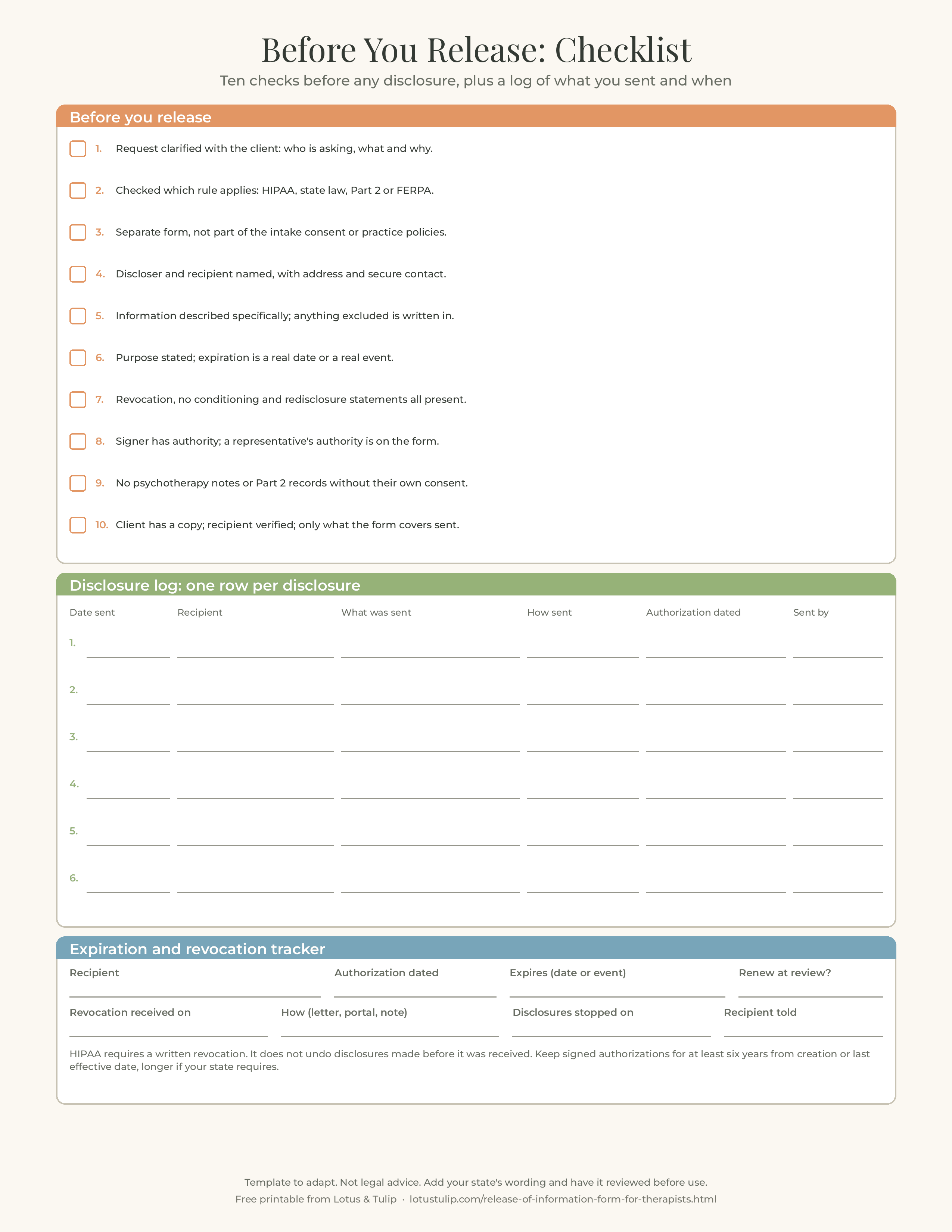
HIPAA does not require you to include disclosures made under an authorization in an accounting of disclosures (164.528(a)(1)(iv)), but a short disclosure log is still good practice. When a client asks "what did you send to my lawyer?", you can answer in a minute: date, recipient, what was sent, how, under which authorization, and who sent it. Page 3 of the free printable includes a log you can keep in the client file.
How to complete a release of information, step by step
- Clarify the request with the client. Who is asking, what do they need, and why? Explain what the release will allow and that the client does not have to sign for you to keep seeing them.
- Check whether a release is needed and which rule applies. Treatment and payment disclosures may not need a HIPAA authorization, but state law and your code may still call for one. Psychotherapy notes, Part 2 records and school records each need their own type of permission.
- Use a separate form, not your intake consent. One recipient per form keeps tracking and revocation simple. Psychotherapy notes always get their own form.
- Fill in every core element. Who may disclose, who may receive (name, organization, address and contact details), a specific description of the information, the purpose, and an expiration date or event written as a real date or event.
- Check the three required statements are present. The right to revoke in writing and how, no conditioning of care on signing, and the redisclosure warning. Add any state specific wording or Part 2 statements that apply.
- Get the signature and date, and the representative's authority if needed. Confirm that the person signing has authority under state law, and write that authority on the form.
- Give the client a copy and file the original. Keep the signed authorization for at least six years from the date it was created or last in effect, and longer if your state requires it.
- Disclose only what the form covers, securely. Verify the recipient, send through a secure channel, include any required notice (such as the Part 2 notice), and record the disclosure in your log.
- Review expiration and revocation regularly. Diary the expiration date, renew at the annual review if the client agrees, and act on any revocation right away.
Release of information example for therapy (fictional, full)
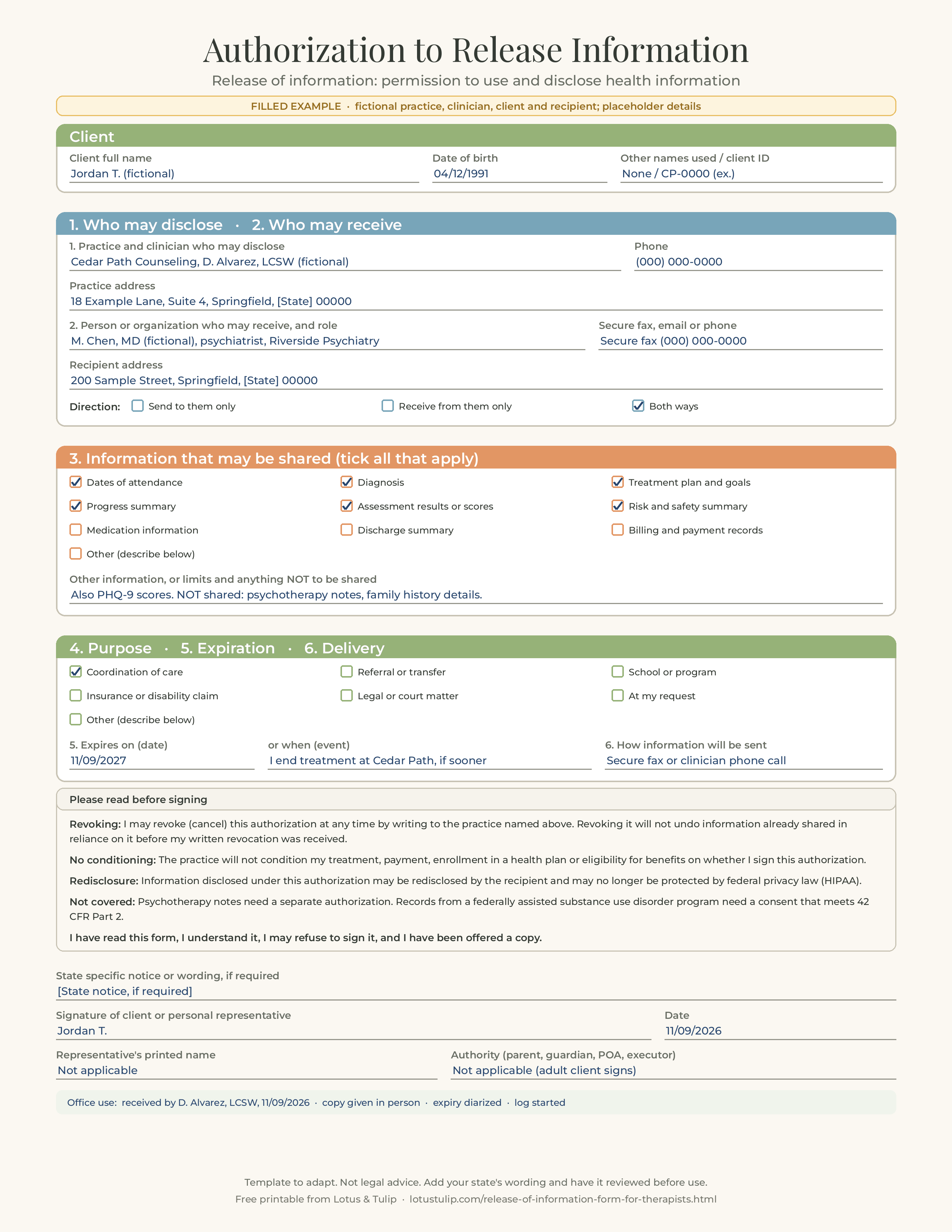
The fictional clinician D. Alvarez, LCSW, of Cedar Path Counseling sees a fictional adult client, Jordan T., for depression. Jordan's psychiatrist, Dr. M. Chen, is adjusting medication and asks for a summary of how therapy is going. HIPAA would allow this treatment disclosure without an authorization, but D. Alvarez's state mental health law and practice policy call for a signed release, and Jordan wants a say in what is shared. They complete this form together at the end of a session.
Cedar Path Counseling: Authorization to Use and Disclose Health Information
Client: Jordan T. (fictional). Date of birth: 04/12/1991. Other names used: none. Client ID: CP-0000 (example).
1. Who may disclose: D. Alvarez, LCSW (fictional), Cedar Path Counseling, 18 Example Lane, Suite 4, Springfield, [State] 00000, phone (000) 000-0000.
2. Who may receive: M. Chen, MD (fictional), psychiatrist, Riverside Psychiatry, 200 Sample Street, Springfield, [State] 00000, secure fax (000) 000-0000.
Direction: Both ways. Dr. Chen may also share medication information and her treatment recommendations with D. Alvarez.
3. Information to be disclosed: dates of attendance; diagnosis; treatment plan and goals; progress summary; PHQ-9 scores; current risk assessment summary. Not included: psychotherapy notes; details of family history discussed in sessions.
4. Purpose: coordination of care for medication management.
5. This authorization expires on: 11/09/2027, or when I end treatment at Cedar Path Counseling, whichever comes first.
6. Delivery method: secure fax or phone call between the clinicians.
Please read. I understand that I may revoke this authorization at any time by writing to Cedar Path Counseling at the address above or through the client portal. Revoking it will not affect any information shared before my written revocation was received. I understand that Cedar Path Counseling will not condition my treatment, payment, enrollment in a health plan or eligibility for benefits on whether I sign this authorization. I understand that information disclosed under this authorization may be redisclosed by the recipient and may no longer be protected by federal privacy law. I understand that this authorization does not cover psychotherapy notes, which require a separate authorization. I have been given a copy of this form. [State specific notice, if required.]
Signature of client: Jordan T. Date: 11/09/2026. Personal representative and authority: not applicable.
For office use: received by D. Alvarez, LCSW, 11/09/2026; copy given to client in person; expiration entered in calendar; disclosure log started.
Why this example works: it names a specific discloser and a specific recipient with a delivery address; it describes the information in categories Jordan understood and lists what is excluded; it states a purpose that limits use; it has a real expiration date and an event; it contains all three required statements in plain language; it makes clear that psychotherapy notes are not covered; it is signed, dated and copied to the client; and the office use line shows the practice can track it. The two-way box covers Dr. Chen sharing back with D. Alvarez as far as Jordan's permission goes, though Riverside Psychiatry may still ask Jordan to sign its own form.
What happens next in the fictional case: D. Alvarez faxes a one page summary to the verified number, logs it, and months later, when Jordan writes to limit sharing to attendance dates, marks the release revoked from that date and has Jordan sign a narrower one.
Five short release of information examples
School counselor for a 14 year old. The teen's parent consented to treatment, so in this fictional state the parent signs the release. The teen is involved in the conversation, and the release covers only attendance and "strategies the school can use in class," expiring at the end of the school year. The therapist tells the parent and teen that the school is not bound by HIPAA and is governed by FERPA for its own records.
Attorney requests "any and all records." The attorney sends a subpoena with no court order and a generic authorization. The therapist checks the form against 164.508(c), finds it has no redisclosure statement and no expiration, calls the client, and then calls their liability insurer's risk line. The client signs the practice's own release, limited to a treatment summary for a personal injury claim, with a 90 day expiration. Psychotherapy notes are not released.
Couples therapy. One partner asks for records for a divorce case. In joint therapy, the record contains both partners' information. The therapist checks state law and their policy, which requires both partners' written authorization to release joint session records, and explains this to the partner who asked. (See the couples therapy informed consent form for how to set this up at the start.)
Disability insurer. The client is applying for short term disability. The insurer's form asks for "all mental health records." The therapist and client agree on an attending provider statement and a functional summary instead. The release names the insurer's claims department, the claim number and "until the claim is decided."
Part 2 discharge summary arrives. A client's residential SUD program sends a discharge summary with the Part 2 notice. Later, the client's employer asks the therapist for "everything about the treatment." The therapist's general release does not cover the Part 2 records. The therapist explains that and suggests the client ask the program directly if they want those records shared.
Common release of information mistakes
- Burying the release in the intake agreement. That creates a compound authorization; give it its own signed page.
- Missing one of the three required statements. Revocation, no conditioning and redisclosure are all required for validity.
- Writing "any and all records." Describe the information in meaningful categories and share only what the purpose needs.
- Naming "my doctors" or "school staff." Name the person or organization and how to reach them.
- Leaving the expiration blank or writing "never." Use a real date or an event linked to the client or purpose.
- Ticking "psychotherapy notes" on a general release. Psychotherapy notes need a separate authorization.
- Treating a general release as Part 2 consent. Part 2 records need a consent that meets 42 CFR 2.31, and the 2.32 notice must accompany the disclosure.
- Letting a parent sign when the teen consented to their own care. Check state law on who the personal representative is.
- Responding to a subpoena as if it were a release. A subpoena without a court order needs satisfactory assurances or the client's authorization, plus legal advice.
- Not giving the client a copy. HIPAA requires it when you asked for the authorization.
- Sending by unverified fax or ordinary email. Verify the recipient and use secure channels.
- Not tracking expirations and revocations. A release you cannot find, or that quietly expired, is a release you cannot rely on.
Free printable: release of information form for therapists, filled example and before you release checklist
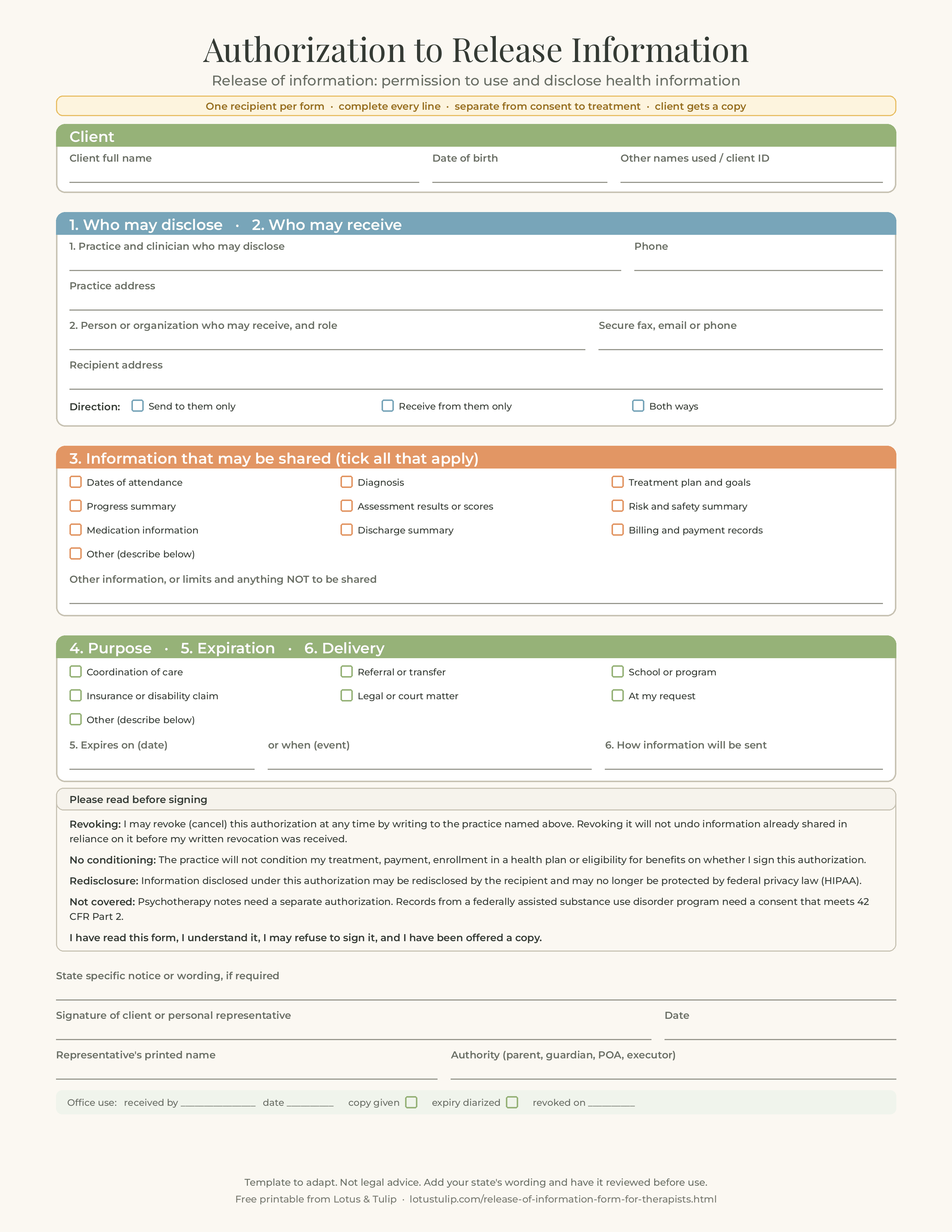
The free printable has three US Letter pages. Page 1 is a blank authorization to use and disclose health information with every HIPAA core element: client name, date of birth and other names, who may disclose, who may receive (with address and secure contact), direction of sharing, tick boxes for the information to be disclosed plus a line for anything excluded, purpose tick boxes, an expiration date or event, delivery method, the three required statements in plain language, a psychotherapy notes and Part 2 notice, a space for state wording, signature, date and personal representative authority, and an office use strip. Page 2 is the filled fictional example from this page (Cedar Path Counseling, D. Alvarez, LCSW, client Jordan T., recipient M. Chen, MD) with placeholder details. Page 3 is a ten point before you release checklist and a disclosure log with revocation and expiration tracking.
Download the free release of information form for therapists (PDF, 3 pages)
Rather type than handwrite? The free PDF above is for printing. Therapy Progress Notes and Intake Templates comes as a fillable PDF you type straight into (604 fields in Adobe Acrobat Reader), plus the printable version: SOAP, DAP and BIRP notes, intake, treatment plan and safety plan, 20 pages. Holiday 20% off: about $7.36, was $9 (EUR 8) · instant digital download
Buy on EtsyPrefer single images? Page 1: blank authorization form (PNG) · Page 2: filled fictional example (PNG) · Page 3: before you release checklist and disclosure log (PNG)
Free to print and use in your own practice. Please link to this page rather than re-uploading the file. The form is a starting point built on the federal HIPAA authorization requirements: add your state's required wording, use a separate form for psychotherapy notes, use a Part 2 compliant consent for substance use disorder program records, and have an attorney or your professional association review it before use.
Related resources
- Family therapy informed consent form: who the client is, secrets policy, minors and custody, records and court, with a free printable
- Duty to warn for therapists: Tarasoff, state laws, HIPAA and a free documentation worksheet
- Closing a therapy private practice: checklist, timeline, client letters, records plan and free printable
- HIPAA risk assessment for therapists: security risk analysis, filled example and free worksheet
- Business associate agreement for therapists: which vendors need a BAA, breach duties, filled vendor log and free printable
- Professional will for therapists: clinical executor, records custodian, client notification scripts, filled example and free printable
- Couples therapy informed consent form: no secrets policy, individual sessions, records access, safety screening, filled example and free printable
- Treatment summary template for therapists: how to write a treatment summary letter, transfer records under HIPAA, filled example and free printable
- Notice of privacy practices for therapists: HIPAA 164.520 elements, 2026 Part 2 update, filled example and free printable
- Parental consent form for therapy of a minor: who can consent, custody orders, state minor consent laws, HIPAA, filled example and free printable
- Credit card authorization form for therapists: card on file consent, PCI DSS rules, filled example and free printable
- Sliding scale fee policy for therapists: 2026 poverty guideline tiers, copay waiver rules, filled example and free printable
- Therapy cancellation policy template: late cancellation and no show fees, Medicare and Medicaid rules, filled example and free printable
- Psychotherapy notes vs progress notes: what HIPAA says, what goes where and free printable
- Informed consent for therapy template: what to include, sample consent and free printable
- What to include in a therapy intake form (checklist)
- Therapy termination letter template: sample letters and free printable
- Therapy discharge summary template: example and free printable
- Superbill template for therapists: every field insurers need, CPT and POS codes, filled example and free printable
- Good Faith Estimate template for therapists: No Surprises Act rules, filled example and free printable
- Telehealth progress note template: examples, checklist and free printable
- Biopsychosocial assessment template: example and free printable
- Therapy treatment plan template with SMART objectives (free printable)
- Mental status exam template: examples, word bank and free printable
- SOAP vs DAP notes for therapists, with examples
- BIRP notes for therapists: template, 5 examples and free printable
- GIRP notes for therapists: template, 5 examples and free printable
- Group therapy progress notes: template, examples and free printable
- Therapy progress notes and intake templates
Sources: 45 CFR 164.508 (uses and disclosures for which an authorization is required: (a)(2) psychotherapy notes, (b)(2) defective authorizations, (b)(3) compound authorizations, (b)(4) prohibition on conditioning, (b)(5) revocation, (b)(6) documentation, (c)(1) core elements, (c)(2) required statements, (c)(3) plain language, (c)(4) copy to the individual), eCFR current text; 45 CFR 164.501 (definition of psychotherapy notes); 45 CFR 164.502(b)(2), (f) and (g) (minimum necessary exceptions, deceased individuals, personal representatives including unemancipated minors); 45 CFR 164.506(c) (treatment, payment and health care operations); 45 CFR 164.510(b); 45 CFR 164.512(b), (e) and (j); 45 CFR 164.514(h) (verification); 45 CFR 164.524(c)(3)(ii) (access requests directing a copy to a third party); 45 CFR 164.528(a)(1)(iv) (accounting exclusions); 45 CFR 164.530(j) (six year retention); 42 CFR 2.11, 2.12, 2.14, 2.31, 2.32 and 2.33 as amended by the final rule at 89 FR 12472 (February 16, 2024); HHS, Fact Sheet 42 CFR Part 2 Final Rule (updated January 30, 2026) and Understanding Part 2 page (compliance required by February 16, 2026); HHS press release on the Part 2 civil enforcement program; 34 CFR 99.30 (FERPA consent); ACA Code of Ethics (2014) standard B.6.g; APA Ethical Principles of Psychologists and Code of Conduct standard 4.05; NASW Code of Ethics standard 1.07(b); AAMFT Code of Ethics (2015) standard 2.2. State law, payer rules and professional codes change and vary; check the current versions.
FAQ
What is a release of information form in therapy?
A release of information form is the document a client signs to allow their therapist to share health information with another person or organization, or to receive information from one. Under the HIPAA Privacy Rule it is called an authorization, and 45 CFR 164.508 lists what it must contain to be valid.
What must a HIPAA authorization to release mental health information include?
Six core elements: a specific description of the information, who may disclose it, who may receive it, the purpose, an expiration date or event, and the client's signature and date (with a description of authority if a personal representative signs). It must also state the right to revoke in writing and how, that care cannot be conditioned on signing, and that the recipient may redisclose the information without HIPAA protection. It must be in plain language and the client gets a copy.
Does a therapist need a release to talk to a client's psychiatrist?
HIPAA allows disclosures for treatment without an authorization, so federal law alone does not require one for coordinating care with another treating provider. Many state mental health laws and professional ethics codes expect written permission, and psychotherapy notes always need a separate authorization, so most therapists get a signed release before the first conversation.
Can a release of information be part of the intake paperwork?
It can travel in the intake packet, but it must be its own document with its own signature. HIPAA does not allow an authorization to be combined with another document, such as informed consent to treatment, to create a compound authorization, except in narrow research situations.
Do psychotherapy notes need a separate release?
Yes. A use or disclosure of psychotherapy notes needs an authorization under 45 CFR 164.508(a)(2), with narrow exceptions, and that authorization can only be combined with another psychotherapy notes authorization. Health plans may not condition payment, enrollment or eligibility on it.
How long is a release of information valid?
Until the expiration date or event written on it, unless the client revokes it in writing first. HIPAA does not set a maximum, but some states do. One year or the end of treatment is a common choice for care coordination, and shorter periods suit single letters or claims.
What changed for substance use disorder records under the 2024 Part 2 rule?
The 2024 final rule, with compliance required by February 16, 2026, allows a single consent for all future treatment, payment and health care operations, lets HIPAA covered recipients redisclose those records as HIPAA permits except in proceedings against the patient, creates separate consent for SUD counseling notes, requires separate consent for legal proceedings, and requires each disclosure to include a copy or explanation of the consent. A general medical release still does not cover Part 2 records.
Is this release of information form free?
Yes. The three page printable (a blank authorization form, a filled fictional example and a before you release checklist with a disclosure log) is free to print and use in your own practice. Please link to this page rather than re-uploading the file, add your state's wording and have it reviewed before use.