
Therapist practice · Updated 2026-11-09
Notice of Privacy Practices for Therapists: HIPAA 45 CFR 164.520 Requirements, 2024 Part 2 and Reproductive Health Updates, What to Include and a Filled Example (Free Printable)
Ready-made printable: Therapy Progress Notes and Intake Templates Fillable PDF, 20 pages: SOAP, DAP and BIRP notes, intake, treatment plan and safety plan
Holiday 20% off: about $7.36, was $9 (EUR 8) · instant digital download
Try it free first: download a fillable sample (SOAP note and DAP note, PDF, 226 KB). Type into it on screen, then get the full pack. No email needed.

Most therapists inherit their Notice of Privacy Practices. It came with the EHR, a supervisor's packet or a template found years ago, and it has sat in the intake bundle ever since, unread by clients and rarely by the clinician. Then something changes. Federal rules on substance use disorder records required updated notices by February 16, 2026; a 2024 rule on reproductive health privacy added new required statements, and a federal court then struck most of that rule down in June 2025; a practice moves fully online; a client asks what "health care operations" means and why it lets you share anything at all. Suddenly the notice matters, and it needs to say what your practice actually does.
This guide is for counselors, therapists, clinical social workers, marriage and family therapists and psychologists in the US who are HIPAA covered entities, or who are not sure whether they are. It covers every required element of a Notice of Privacy Practices (NPP) under 45 CFR 164.520, what changed in 2024, 2025 and 2026, how to give the notice and collect the acknowledgment of receipt (in the office, online and for telehealth), when to revise it, and how it fits with your other intake forms. At the end you can download a free three page printable: an NPP builder worksheet and acknowledgment of receipt, the same pages filled for a fictional practice, and a checklist with a version and distribution log.
Jump to the free notice of privacy practices printable
This is educational information for licensed clinicians and trainees in the US. It is not legal advice and does not create any professional relationship. The federal rules quoted here were checked against the current eCFR text of 45 CFR parts 160 and 164 and 42 CFR part 2 (up to date as of November 5, 2026) and against HHS Office for Civil Rights guidance on the date at the top of the page. State laws add their own requirements. Have an attorney, your professional association or your compliance adviser review your notice before you use it. Every practice, clinician and detail in the examples on this page is fictional.
The short answer
A Notice of Privacy Practices is the document HIPAA requires covered health care providers and health plans to give people, explaining how their health information may be used and shared, what rights they have over it, and what the practice's legal duties are. The rule is 45 CFR 164.520.
- If you are a HIPAA covered entity, you need one. A health care provider is covered if it transmits health information electronically in connection with a HIPAA standard transaction, such as an electronic insurance claim (45 CFR 160.103).
- It has eight required parts: a fixed header statement, uses and disclosures (with examples), separate statements for certain activities, individual rights, your duties, how to complain, a contact person and an effective date (164.520(b)(1)).
- Give it at the first session, including the first telehealth or online service, and make a good faith effort to get a written acknowledgment of receipt (164.520(c)(2) and (c)(3)).
- Post it. In your office if you have one, and prominently on your website if the site describes your services (164.520(c)(2)(iii) and (c)(3)(i)).
- Update it for Part 2. Since February 16, 2026, the notice must reflect the protections for substance use disorder treatment records covered by 42 CFR part 2, as HHS OCR confirms on its model notices page.
- Reproductive health statements are no longer required. On June 18, 2025, a federal court vacated most of the 2024 reproductive health privacy rule, including the three NPP statements it added (164.520(b)(1)(ii)(F), (G) and (H)), according to HHS. The other NPP changes from that rule remain in effect.
- Revise it promptly after any material change to your practices, give it a new effective date, and keep every version for six years (164.520(b)(3), (e) and 164.530(j)).
Do you even need a Notice of Privacy Practices?
HIPAA's Privacy Rule applies to "covered entities": health plans, health care clearinghouses, and health care providers who transmit any health information in electronic form in connection with a transaction covered by the HIPAA rules (45 CFR 160.103). For a therapist, the standard transactions that matter are electronic claims, eligibility checks, claim status inquiries and electronic remittance. If you, your biller or your clearinghouse sends even one electronic claim for your services, the whole Privacy Rule applies, including the NPP.
A therapist who only takes private pay, never bills insurance electronically and never has anyone do it on their behalf may not be a covered entity. Many still give clients a privacy notice: practices change (joining one insurance panel that bills electronically makes you covered), state confidentiality laws apply either way, and clients often assume every therapist follows HIPAA. If you are not covered and choose to use a HIPAA style notice, check that you are willing to be held to what it promises.
Less obvious cases, worth asking an attorney about: employees and contractors of a group practice or agency usually give clients the organization's notice; participants in an organized health care arrangement may use a joint notice (164.520(d)); federally assisted substance use disorder programs need a Part 2 patient notice (42 CFR 2.22); and school based records are often FERPA education records rather than HIPAA records (see the parental consent form guide).
What changed in 2024, 2025 and 2026: a timeline
The NPP rule was mostly stable from 2013 to 2024. Then two rules and a court decision arrived in quick succession, and much of what was written about them during 2024 is now out of date. Here is the sequence, with what each step means for a therapy practice today.
| Date | What happened | What it means for your notice now |
|---|---|---|
| February 16, 2024 | HHS published the Confidentiality of Substance Use Disorder (SUD) Patient Records final rule (89 FR 12472), effective April 16, 2024, with a compliance date of February 16, 2026. It did not itself finalize the HIPAA NPP changes. | Background: it changed the Part 2 patient notice (42 CFR 2.22). |
| April 26, 2024 | HHS published the HIPAA Privacy Rule To Support Reproductive Health Care Privacy (89 FR 32976), effective June 25, 2024. It amended 164.520 in two ways: Part 2 related changes required by section 3221 of the CARES Act, and three new reproductive health related statements. The compliance date for all the 164.520 changes was set to February 16, 2026, to match the Part 2 rule. | This is where the current Part 2 language in 164.520 comes from. |
| June 18, 2025 | In Purl v. HHS (N.D. Tex., No. 2:24-cv-00228-Z), the court declared unlawful and vacated most of the reproductive health privacy rule. For the NPP, HHS says the court vacated only 164.520(b)(1)(ii)(F), (G) and (H), and the other NPP changes remain in effect. | You do not need the reproductive health statements, the attestation statement or the new redisclosure statement those paragraphs required. You still need the Part 2 related changes. |
| February 16, 2026 | Compliance date for the remaining NPP changes. HHS published revised model notices (health care provider, health plan, and a Part 2 patient notice) dated February 2026. | Your notice should already include the Part 2 language. If it does not, update it now. |
| As of November 2026 | The eCFR text of 164.520 (up to date as of November 5, 2026) still prints paragraphs (b)(1)(ii)(F), (G) and (H); HHS has not published a rule removing them, and the eCFR shows no amendment to 164.520 after June 25, 2024. HHS's guidance page says it will determine next steps after reviewing the decision. | Follow HHS's statement on the vacatur, not the printed text alone. |
One practical consequence: if you bought or downloaded a "2024 compliant" or "2026 compliant" notice in late 2024 or early 2025, it probably contains the reproductive health paragraphs. They are no longer required. Whether you keep or remove them is a decision for you and your adviser; some states have their own reproductive health privacy laws, and some practices simply prefer to tell clients they will not disclose that information for investigations. If you remove them, treat it as a revision: new effective date, new version in your log.
The eight required elements of a Notice of Privacy Practices
Section 164.520(b)(1) lists what the notice must contain, and requires it to be written in plain language. The table follows the rule's own order and translates each part into what a small therapy practice actually writes.
| Element | Rule | What to write for a therapy practice |
|---|---|---|
| 1. Header | 164.520(b)(1)(i) | Copy it exactly, in capitals, at the top (see the next section) |
| 2. Uses and disclosures | 164.520(b)(1)(ii) | Therapy specific examples (consulting a psychiatrist, billing an insurer, supervision); the public safety and legal categories; psychotherapy notes; state law limits |
| 3. Separate statements | 164.520(b)(1)(iii) | Most private practices need only the Part 2 statement (if they receive or keep Part 2 records) and nothing on fundraising |
| 4. Individual rights | 164.520(b)(1)(iv) | Restrictions (including the self pay restriction you must accept), confidential communications, access, amendment, accounting of disclosures, paper copy |
| 5. Your duties | 164.520(b)(1)(v) | Three short statements plus your revision method ("posted in the office and on our website, available on request") |
| 6. Complaints | 164.520(b)(1)(vi) | Your privacy contact; the HHS OCR complaint route; a no retaliation sentence |
| 7. Contact | 164.520(b)(1)(vii) | "Privacy contact: the practice owner, [phone]." A title is enough |
| 8. Effective date | 164.520(b)(1)(viii) | An exact date, plus a version number for your own log |
Optional extras are allowed. If you choose to limit your uses and disclosures more tightly than HIPAA allows (for example, "we never use client information for marketing of any kind"), you may describe those limits, but you may not promise away disclosures that are required by law or the permission to disclose to prevent a serious and imminent threat under 164.512(j)(1)(i) (164.520(b)(2)).
The header statement, word for word
The notice must contain this statement as a header or otherwise prominently displayed (164.520(b)(1)(i)):
THIS NOTICE DESCRIBES HOW MEDICAL INFORMATION ABOUT YOU MAY BE USED AND DISCLOSED AND HOW YOU CAN GET ACCESS TO THIS INFORMATION. PLEASE REVIEW IT CAREFULLY.
Use it exactly. Therapists sometimes want to change "medical information" to "health information" or "mental health information" because it reads better for therapy clients. Keep the required wording as the header; if you want, add a short plain language line below it, such as "This notice explains how we protect what you share with us in therapy."
Uses and disclosures: what to say, with therapy examples
This is the longest part of any notice and the part clients understand least. The rule asks for a description, with at least one example each, of uses and disclosures for treatment, payment and health care operations (164.520(b)(1)(ii)(A)), and a description of each other purpose for which you may use or disclose information without written authorization (164.520(b)(1)(ii)(B)), in enough detail to put the person on notice (164.520(b)(1)(ii)(D)). Generic hospital examples ("we may share your X-rays with a specialist") make a therapy notice feel copied. Use examples from your own work.
Treatment, payment and health care operations
| Purpose | Therapy example you could use |
|---|---|
| Treatment | "With your knowledge, your therapist may speak with your psychiatrist about how a medication change is affecting your sleep and mood." |
| Payment | "We send your insurer the dates of your sessions, the type of service and a diagnosis code so that we can be paid." If you are private pay only: "We use your information to send you receipts and superbills." |
| Health care operations | "A licensed supervisor may review a case with your therapist to make sure you receive good care." "Our electronic record and scheduling vendors handle your information under written agreements that require them to protect it." |
If you are stricter than HIPAA, say so. Many therapists, for example, do not consult with other treating clinicians without the client's written permission, even though HIPAA would allow it for treatment. Writing "we will ask for your written permission before we speak with your other health care providers, except in an emergency" is allowed as an optional limitation, and it matches what clients expect from therapy. Only promise what you actually do, every time.
Other uses and disclosures without your authorization
Section 164.512 lists the public interest purposes for which a covered entity may disclose without authorization, and 164.510 covers involvement of family and friends. Your notice must describe each one that applies to you. For a therapy practice, the relevant ones usually look like this:
| Purpose | Rule | How it usually comes up in therapy |
|---|---|---|
| Required by law | 164.512(a) | A state law requires a specific report or disclosure |
| Public health, including child abuse reports | 164.512(b) | Reporting suspected child abuse or neglect to the authority authorized to receive such reports |
| Victims of abuse, neglect or domestic violence | 164.512(c) | Reports about adults, such as elder or dependent adult abuse |
| Health oversight | 164.512(d) | A licensing board or state agency audit or investigation |
| Judicial and administrative proceedings | 164.512(e) | A court order, or a subpoena with the required assurances |
| Law enforcement | 164.512(f) | Rare in therapy; limited circumstances such as a court ordered warrant |
| Decedents | 164.512(g) | A coroner or medical examiner after a client's death |
| Research | 164.512(i) | Only if you take part in approved research |
| Serious threat to health or safety | 164.512(j) | Disclosing, in good faith, to someone reasonably able to prevent or lessen a serious and imminent threat, including the target of the threat |
| Specialized government functions | 164.512(k) | Military and veterans activities, national security, and similar |
| Workers' compensation | 164.512(l) | Work injury claims that include mental health treatment |
| Family and friends involved in care | 164.510(b) | Talking with a spouse who drives the client to sessions, or an emergency contact in a crisis |
Uses that need your written authorization
The notice must describe the types of uses and disclosures that require an authorization under 164.508(a)(2) to (a)(4), state that other uses and disclosures not described in the notice will be made only with written authorization, and state that the person may revoke an authorization as provided in 164.508(b)(5) (164.520(b)(1)(ii)(E)). For a therapy practice, that means three short paragraphs:
- Psychotherapy notes. Most uses and disclosures of psychotherapy notes require the client's authorization (164.508(a)(2)). Explain in one or two sentences what psychotherapy notes are and that you need written permission to share them. If you do not keep them, say so.
- Marketing. Using or disclosing information for marketing requires authorization, with limited exceptions (164.508(a)(3)). A typical small practice line: "We do not use your information for marketing."
- Sale of health information. A disclosure that is a sale of protected health information requires authorization (164.508(a)(4)). Typical line: "We never sell your information."
Then the catch all: "Other uses and disclosures not described in this notice will be made only with your written authorization. You may revoke an authorization in writing at any time, except to the extent we have already acted on it." Revocation must be in writing under 164.508(b)(5); your release of information form should match.
Psychotherapy notes in your notice
Psychotherapy notes are the one HIPAA category written specifically for mental health. The definition in 45 CFR 164.501 covers notes recorded (in any medium) by a mental health professional documenting or analyzing the contents of conversation during a private, group, joint or family counseling session, that are kept separate from the rest of the record. It excludes medication prescription and monitoring, session start and stop times, the modalities and frequencies of treatment, results of clinical tests, and any summary of diagnosis, functional status, the treatment plan, symptoms, prognosis and progress to date. Those belong in the regular record, such as your progress notes.
Under 164.508(a)(2), a covered entity must obtain an authorization for any use or disclosure of psychotherapy notes, with a short list of exceptions: use by the originator of the notes for treatment; use or disclosure for the practice's own supervised training programs in mental health; use or disclosure to defend itself in a legal action brought by the client; and uses or disclosures required by HHS for compliance review, required by law under 164.512(a), for health oversight of the originator, to a coroner or medical examiner, or to prevent a serious and imminent threat under 164.512(j)(1)(i). Psychotherapy notes are also outside the HIPAA right of access in 164.524, although state law may give clients access.
What to write in the notice: a short, honest paragraph. "Some therapists keep separate personal notes about the content of sessions, called psychotherapy notes. If we keep them, they are stored apart from your record, and we will not share them without your written authorization except in the limited situations the law allows." See psychotherapy notes vs progress notes.
Individual rights: what the notice must explain
The notice must state each right and briefly describe how to exercise it (164.520(b)(1)(iv)). Clients rarely use most of these, but the day one does, your notice and your process need to match. The deadlines below come from the rights sections themselves; you do not have to print them in the notice, but your process has to meet them.
| Right | Rule | Your deadline or duty |
|---|---|---|
| Request restrictions | 164.522(a) | You do not have to agree, except one case: you must agree not to disclose to a health plan for payment or health care operations (when not otherwise required by law) if the client, or someone other than the plan, has paid in full for that service (164.522(a)(1)(vi)) |
| Confidential communications | 164.522(b) | A provider must accommodate reasonable requests; a practical example is texts to a personal cell phone instead of a shared home email |
| Inspect and get a copy | 164.524 | Act within 30 days of the request, with one extension of up to 30 days if you tell the person in writing why and when (164.524(b)(2)); psychotherapy notes are excluded |
| Amend | 164.526 | Act within 60 days, with one extension of up to 30 days (164.526(b)(2)); you may deny for listed reasons, in writing |
| Accounting of disclosures | 164.528 | Act within 60 days, with one extension of up to 30 days (164.528(c)(1)); many routine disclosures, such as for treatment, payment and operations, are excluded |
| Paper copy of the notice | 164.520(b)(1)(iv)(F) and (c)(3)(iv) | Keep printed copies or be ready to mail one |
For parents of minor clients, these rights are usually exercised by the parent as the minor's personal representative, with important exceptions under 164.502(g); see the parental consent form for therapy of a minor for how that works, and say in your notice that a personal representative may exercise these rights for the client.
The self pay restriction matters in therapy, because many clients pay out of pocket precisely so their insurer does not learn they are in therapy. Say clearly in the notice that if they pay in full for a service themselves, they may ask you not to tell their health plan about it, and you will agree unless a law requires the disclosure. Then make sure billing actually holds those sessions back.
Your duties, complaints, contact and effective date
Duties. The notice must state that you are required by law to maintain the privacy of protected health information, to give individuals notice of your legal duties and privacy practices, and to notify affected individuals following a breach of unsecured protected health information; that you must follow the terms of the notice currently in effect; and, if you want changes to apply to information you already hold, that you reserve the right to change the notice and make the new terms effective for all information you maintain, with a description of how you will provide the revised notice (164.520(b)(1)(v)). That last statement is what lets a revised notice cover records you already hold; without it, a change applies only to information created or received after the new notice (164.530(i)(2)(ii)).
Complaints. The notice must say that people may complain to you and to the Secretary of HHS if they believe their privacy rights were violated, briefly how to complain to you, and that you will not retaliate (164.520(b)(1)(vi)). Complaints to HHS go to the Office for Civil Rights, which runs an online complaint portal; under 45 CFR 160.306, a complaint must be filed in writing (on paper or electronically), name the entity and describe what happened, and be filed within 180 days of when the person knew or should have known of the problem, unless OCR waives the time limit for good cause.
Contact. The notice must give the name or title and telephone number of a person or office to contact for more information (164.520(b)(1)(vii)), matching the contact person or office you designate under 164.530(a)(1)(ii) to receive complaints. A title such as "Practice Owner" is enough, so staff changes need no reprint.
Effective date. The notice must carry the date it first takes effect, which may not be earlier than the date it is printed or otherwise published (164.520(b)(1)(viii)). Add a version number in the footer ("Version 2026-11") so you can match signed acknowledgments to the right version.
The Part 2 update: substance use disorder records
42 CFR part 2 protects records of federally assisted substance use disorder treatment programs ("Part 2 programs"). Most private therapy practices are not Part 2 programs. But many therapists receive Part 2 records: a client moves from an intensive outpatient SUD program into your care and signs a consent for the program to send you their records, or you coordinate with an opioid treatment program. The 2024 changes to 164.520 make sure HIPAA notices tell clients about the extra protection those records keep.
What the current rule says: an individual who is the subject of Part 2 records has a right to adequate notice about them, as provided in 42 CFR 2.22 (164.520(a)(2)); the required elements apply to "any covered entity receiving or maintaining records subject to 42 U.S.C. 290dd-2" (164.520(b)(1)); and where other law "such as 42 CFR part 2" limits a use or disclosure, the description must reflect it (164.520(b)(1)(ii)(C) and (D)). Two separate statements were added:
- A separate statement on legal proceedings. If you receive or keep Part 2 records, the notice must include a separate statement that SUD treatment records received from Part 2 programs, or testimony relaying their content, will not be used or disclosed in civil, criminal, administrative or legislative proceedings against the individual unless based on written consent, or on a court order after notice and an opportunity to be heard is given to the individual or the record holder, as provided in 42 CFR part 2, with a court order accompanied by a subpoena or other legal requirement compelling disclosure (164.520(b)(1)(iii)(D)). The example notice below shows the full wording.
- Fundraising with Part 2 records. If you create or keep Part 2 records and intend to use them for fundraising, the individual must first be given a clear and conspicuous opportunity to opt out (164.520(b)(1)(iii)(E)). Few therapy practices fundraise; if you do not, leave it out.
HHS OCR's model notices page states that as of February 16, 2026, HIPAA covered entities are required to include information about SUD patient records in their notice. If you are sure you will never receive or keep Part 2 records, ask your adviser whether to leave the separate statement out; many small practices include it anyway, because one transferred record is enough to make it apply.
If you are a Part 2 program. Part 2 programs have their own patient notice under 42 CFR 2.22, with its own header ("Notice of Privacy Practices of [Name of Part 2 Program]", followed by statements about how health information may be used and disclosed, the patient's rights and how to file a complaint) and its own required content, such as a description of the uses and disclosures that require written consent and a statement that a patient may give a single consent for all future uses and disclosures for treatment, payment and health care operations. HHS allows Part 2 programs that are also covered entities to use one combined notice, and published a model Part 2 patient notice in February 2026.
The reproductive health statements: required, then vacated
The 2024 reproductive health privacy rule added three items to the list of required NPP content: a description, with an example, of uses and disclosures prohibited under the new 164.502(a)(5)(iii) (disclosures for investigations into or liability for lawful reproductive health care); a description, with an example, of uses and disclosures that require a signed attestation under the new 164.509; and a statement putting the individual on notice that information disclosed under the Privacy Rule may be redisclosed by the recipient and no longer protected (164.520(b)(1)(ii)(F), (G) and (H)).
On June 18, 2025, the US District Court for the Northern District of Texas, in Carmen Purl, et al. v. HHS, No. 2:24-cv-00228-Z, declared unlawful and vacated most of that rule. HHS's guidance page on reproductive health care states that, for the NPP, the court vacated only 164.520(b)(1)(ii)(F), (G) and (H); the remaining NPP modifications are undisturbed, remain in effect and required compliance by February 16, 2026; and HHS will determine next steps after reviewing the decision.
What that means for a therapist in November 2026:
- You do not need the reproductive health, attestation or redisclosure paragraphs that many 2024 and early 2025 templates added.
- You do need the Part 2 related changes described above, which came from the same rule but were not vacated.
- State reproductive health privacy laws are separate and may still apply. Check HHS guidance again at each annual review.
How and when to give the notice
Covered health care providers with a direct treatment relationship, which is every therapist who sees clients, have specific delivery duties under 164.520(c)(2) and (c)(3).
| Situation | What the rule requires | Rule | How a therapy practice does it |
|---|---|---|---|
| First session in person | Provide the notice no later than the date of first service delivery | 164.520(c)(2)(i)(A) | Include it in the intake packet or portal before the first session; have paper copies in the office |
| First service is electronic (telehealth, online intake) | Provide electronic notice automatically and contemporaneously in response to the individual's first request for service | 164.520(c)(3)(iii) | Send it with the automatic booking confirmation or the portal invitation, not "later" |
| Emergency treatment | As soon as reasonably practicable after the emergency | 164.520(c)(2)(i)(B) | Rare in outpatient therapy; give it at the next contact |
| Acknowledgment of receipt | Except in an emergency, a good faith effort to get a written acknowledgment; if not obtained, document the effort and the reason | 164.520(c)(2)(ii) | A signature line or portal checkbox; a note when a client declines |
| Physical office | Have the notice available to take away, and post it in a clear and prominent location where clients can be expected to read it | 164.520(c)(2)(iii) | A framed copy in the waiting area and a stack of copies |
| Practice website | If you maintain a website that provides information about your services, prominently post the notice and make it available electronically through the site | 164.520(c)(3)(i) | A footer link labeled "Notice of Privacy Practices" on every page |
| Email delivery | Allowed if the individual agrees to electronic notice and has not withdrawn the agreement; if you know the email failed, give a paper copy | 164.520(c)(3)(ii) | Record the agreement; watch for bounces |
| Anyone who asks | Make the notice available on request to any person | 164.520(c) | Including prospective clients who call before booking |
| After a revision | Make it available on request on or after the effective date, and promptly update the office posting and copies | 164.520(c)(2)(iv) | Replace the posted copy and website file on the effective date |
Two points that trip up small practices. First, telehealth only practices have no "physical service delivery site", so the office posting duty does not apply, but the website and electronic first service rules do. Second, the notice goes to each new client once, not every year. Covered providers are not required to redistribute the notice to existing clients after a revision; they make it available and update the posting. (Health plans have separate redistribution duties in 164.520(c)(1).)
The acknowledgment of receipt
The acknowledgment is a separate, small document, and it is often confused with consent. Under 164.520(c)(2)(ii), except in an emergency, a covered provider with a direct treatment relationship must make a good faith effort to obtain the individual's written acknowledgment that they received the notice, and if it is not obtained, document the good faith effort and the reason. The rule requires the effort and the documentation; it does not require the signature itself.
A good acknowledgment is short and says only what it is:
- The practice name and the notice's version or effective date.
- One sentence: "I acknowledge that I received [Practice]'s Notice of Privacy Practices, effective [date]."
- The client's name, signature and date, or the personal representative's name, relationship and signature.
- An office use section: how the notice was given (paper, portal, email with agreement), and, if no signature, what was tried and why it was not obtained ("client declined to sign; notice given in person 11/09/2026").
Keep it separate from informed consent, or at least clearly separate on the page. Otherwise it is hard to show which version a client received. Store signed acknowledgments (or the documented efforts) with the client's administrative record; 164.520(e) requires you to keep them, as part of the documentation retained under 164.530(j).
Revising the notice: when, how and what to keep
When you must revise. You must promptly revise and distribute your notice whenever there is a material change to the uses or disclosures, the individual's rights, your legal duties or other privacy practices stated in the notice; except when required by law, a material change may not be implemented before the effective date of the notice that reflects it (164.520(b)(3)). Typical triggers in therapy: starting to bill insurance, adding associates or supervisees, adding or dropping a stricter practice ("we always ask before consulting"), a new state law, and the Part 2 update for any notice not yet revised.
How. Give the revised notice a new effective date (no earlier than the date it is published) and version number, post it in the office and on the website on that date, have it available on request, and use it for every new client from then on (164.520(c)(2)(iv)). Make sure your duties section contains the statement reserving the right to apply changes to all information you maintain, so the new terms cover existing records (164.520(b)(1)(v)(C) and 164.530(i)(2)(ii)).
What to keep. Keep a copy of every notice you issue, and the acknowledgments or documented efforts (164.520(e)), for six years from the date of creation or the date it was last in effect, whichever is later (164.530(j)(2)). A one page version log, like the one on page 3 of the free printable, makes this easy: version, effective date, what changed, where posted, and the date the old version came down. State record retention rules for the clinical record itself are separate and often longer.
State law: the layer your template does not know about
HIPAA is a floor. Where state law is more protective of privacy, the stricter law applies, and your notice must describe the stricter rule where it prohibits or materially limits a HIPAA permitted use or disclosure (164.520(b)(1)(ii)(C), with "more stringent" defined in 45 CFR 160.202). For therapists, the most common places state law changes the picture are:
- Mental health records statutes that limit disclosures more tightly than HIPAA, for example by requiring the client's consent for some disclosures HIPAA would allow.
- Testimonial privilege and subpoenas, where many states protect therapy communications from compelled disclosure without a court order or the client's consent.
- Duty to warn or protect laws, which decide whether you must, may or may not disclose to protect a third party; your 164.512(j) paragraph should not promise more or less than your state allows.
- Minors' rights, including when minors can consent to their own care and control their records.
- Special categories and access, such as HIV information, and client access to psychotherapy notes in some states.
Your board, state association chapter and malpractice carrier often publish state specific language; for telehealth across state lines, check the client's state too.
How the notice fits with your other intake forms
Therapists often ask whether the notice can replace informed consent, or the other way round. It cannot. Each document does a different job, and the table shows how they fit together.
| Document | Purpose | Who signs | Required by |
|---|---|---|---|
| Notice of Privacy Practices | Explains how information may be used and disclosed, the client's privacy rights and your duties | Nobody signs the notice itself | HIPAA, 45 CFR 164.520, for covered entities |
| Acknowledgment of receipt | Records that the client received the notice | Client or personal representative (good faith effort) | HIPAA, 164.520(c)(2)(ii) |
| Informed consent for therapy | Agreement to treatment: the service, fees, confidentiality limits in plain words, records, emergencies, ending therapy | Client (and clinician) | Ethics codes, state law and board rules |
| Release of information (HIPAA authorization) | Permission for one specific disclosure that is not otherwise allowed, such as to a school or attorney | Client or personal representative | HIPAA, 164.508, plus state law |
| Telehealth consent | Agreement to video or phone sessions, their risks, location and emergency plan | Client | State law, board rules, payer rules |
| Parental consent for a minor | Who may consent for a minor, custody, confidentiality with parents | Parent or guardian, and the young person's assent | State law and ethics codes |
Your informed consent and your notice must agree with each other. If your consent says "I will never share information with your insurer without asking you first" but your notice describes routine payment disclosures, a client who reads both will reasonably feel misled. Many therapists handle this by explaining confidentiality limits in plain therapy language in the consent (as the APA, ACA and NASW codes expect; APA standard 4.02(a), for example, asks psychologists to discuss the relevant limits of confidentiality), and pointing to the notice for the full legal detail.
Write it for therapy clients. The rule requires plain language (164.520(b)(1)). Use "we" and "you", put treatment, payment and the safety exceptions first, explain "health care operations" once, describe what you really do (no insurance, consult only with permission, no psychotherapy notes), and end with an invitation to ask questions. HHS publishes fill in model notices for health care providers, revised in February 2026 for the Part 2 changes; they are a sound starting point once you adapt the examples to therapy and your state.
How to create a notice of privacy practices, step by step
- Confirm your status. Decide whether you are a HIPAA covered entity (electronic claims or other standard transactions by you or on your behalf), part of a group practice notice, a Part 2 program, or none of these.
- Map your information flows. List who you share with and why: insurers, billers, EHR and telehealth vendors, supervisors, psychiatrists, schools, emergency contacts. Note which sharing you do only with written permission.
- Check your state's stricter rules: mental health records law, privilege and subpoenas, duty to warn or protect, minors, and any special categories, and note the ones that change a HIPAA permission.
- Start from a sound template, such as the HHS model provider notice, and work through the eight required elements of 164.520(b)(1) in order.
- Write therapy examples for treatment, payment and health care operations, and describe each other permitted purpose in plain language, adjusted for the stricter state rule.
- Add the authorization paragraphs for psychotherapy notes, marketing and sale of information, the catch all statement and written revocation.
- Add the Part 2 separate statement if you may receive or keep substance use disorder records from Part 2 programs, and leave out the vacated reproductive health paragraphs unless you choose to keep similar language for state law reasons.
- Finish the rights, duties, complaint, contact and effective date sections, with your title based contact and a version number.
- Publish and use it: post it in the office and on your website, add it to the intake packet and the automatic online booking response, collect acknowledgments, log the version, and set a yearly review date.
Notice of privacy practices example for a therapy practice (fictional, full)
The fictional clinician A. Brooks, LMFT, runs Harbor Light Counseling, a small private practice with an office and video sessions. The practice bills two insurance plans electronically through a clearinghouse, so it is a HIPAA covered entity. It does not keep separate psychotherapy notes, does not fundraise or market with client information, and occasionally receives records from a local intensive outpatient substance use program. It consults with other treating clinicians only with the client's written permission, except in an emergency. Below is a condensed example notice; replace the bracketed state law sentences with your own.
THIS NOTICE DESCRIBES HOW MEDICAL INFORMATION ABOUT YOU MAY BE USED AND DISCLOSED AND HOW YOU CAN GET ACCESS TO THIS INFORMATION. PLEASE REVIEW IT CAREFULLY.
Harbor Light Counseling (fictional): Notice of Privacy Practices. What you share in therapy is private, and we take protecting it seriously. This notice explains how we use and share your information, your rights, and our duties.
Our duties. We are required by law to maintain the privacy of your protected health information, to give you this notice of our legal duties and privacy practices, and to notify you if a breach of your unsecured protected health information occurs. We must follow the terms of the notice currently in effect.
Treatment. We use your information to provide your therapy. We will ask for your written permission before we speak with your other health care providers, such as your physician or psychiatrist, except in an emergency.
Payment. If you use insurance, we send your plan the dates of your sessions, the type of service and a diagnosis code so that we can be paid. If you pay yourself, we use your information to give you receipts and superbills.
Running our practice (health care operations). A licensed supervisor may review a case with your therapist to make sure you receive good care. Our electronic record, scheduling, billing and video vendors handle your information under written agreements that require them to protect it.
Without your written permission, when the law allows or requires. We may share information: when a law requires it; to report suspected child abuse or neglect, or abuse, neglect or domestic violence of an adult, as the law requires or allows; for health oversight, such as a licensing board investigation; in response to a court order [state: describe your state's rule for subpoenas of mental health records]; to a coroner or medical examiner; if we believe in good faith that it is necessary to prevent or lessen a serious and imminent threat to the health or safety of a person or the public, and only to someone reasonably able to prevent or lessen it, including the target of the threat [state: your duty to warn or protect rule]; for specialized government functions; and for workers' compensation as that law allows.
Family and friends. With your agreement, or in an emergency, we may share information relevant to your care with a family member or friend involved in it, such as your emergency contact. You may tell us not to.
Substance use disorder records. Substance use disorder treatment records we receive from programs subject to 42 CFR part 2, or testimony relaying their content, will not be used or disclosed in civil, criminal, administrative or legislative proceedings against you unless you give written consent, or a court orders it after you or the record holder have been given notice and an opportunity to be heard, as provided in 42 CFR part 2. A court order authorizing use or disclosure must be accompanied by a subpoena or other legal requirement compelling disclosure before the record is used or disclosed.
Uses that need your written authorization. We do not keep separate psychotherapy notes; if we ever do, we will not share them without your written authorization except where the law allows. We do not use your information for marketing and we never sell it. Any other use or sharing not described in this notice will happen only with your written authorization, which you may revoke in writing at any time, except to the extent we have already acted on it.
Your rights. Ask us to limit what we use or share: we are not required to agree, but if you pay for a service in full yourself, we will agree not to tell your health plan about it for payment or our operations unless a law requires it. Ask for confidential communications: for example, texts to your own phone only; we will agree to reasonable requests. See or get a copy of your record: ask in writing; we respond within 30 days. Ask us to correct your record in writing. Get a list of disclosures we made in the past six years, other than for treatment, payment, operations and certain other purposes. Get a paper copy of this notice at any time, even if you agreed to receive it electronically. A personal representative may use these rights for you where the law allows.
Changes to this notice. We reserve the right to change this notice and to make the new terms effective for all information we maintain. A revised notice will be posted in our office and on our website, and is available on request.
Questions and complaints. Contact our Privacy Contact, the practice owner, at (555) 010-0163. If you believe your privacy rights have been violated, you may complain to us in writing at the address on our website, and to the Secretary of the US Department of Health and Human Services through the HHS Office for Civil Rights. We will not retaliate against you for filing a complaint.
Effective date: 11/09/2026. Version: 2026-11. All names and numbers are fictional.
Common mistakes with therapy privacy notices
- A hospital template with hospital examples, such as facility directories and X-rays, that tells clients nothing about therapy.
- A missing or reworded header statement. Use the exact wording.
- No Part 2 statement in a notice still dated before February 16, 2026.
- Vacated reproductive health paragraphs kept by accident, or removed without a new effective date.
- HIPAA permissions your state does not allow, such as disclosing mental health records on a subpoena alone.
- Promising total secrecy, which ignores mandated reporting and safety exceptions.
- No website posting, or a notice reachable only from one buried page.
- Telehealth clients who never got the notice.
- Acknowledgment folded into consent, with no version or date, so you cannot show which notice a client received.
- Old versions thrown away. Keep every version for six years.
Free printable: notice of privacy practices builder, filled example and checklist
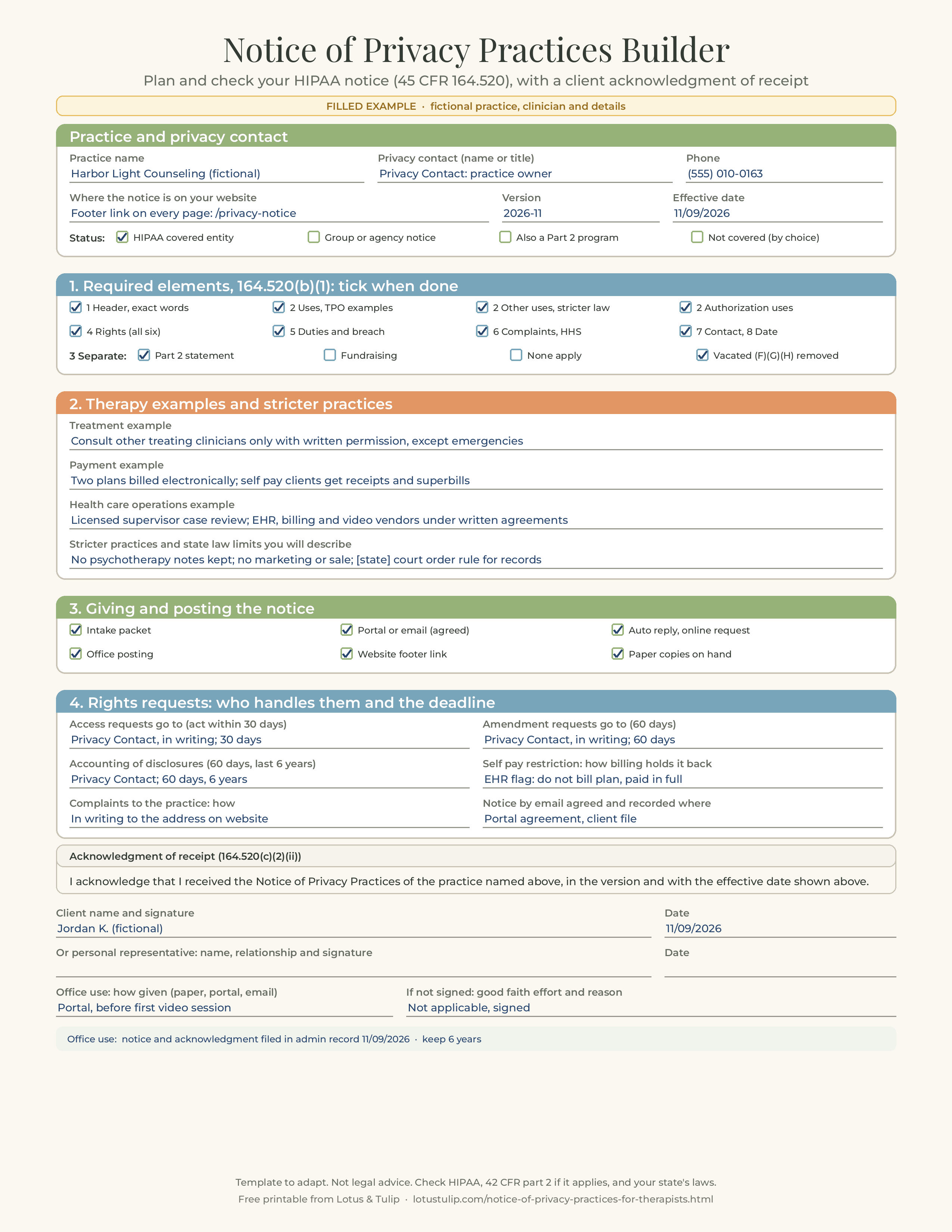
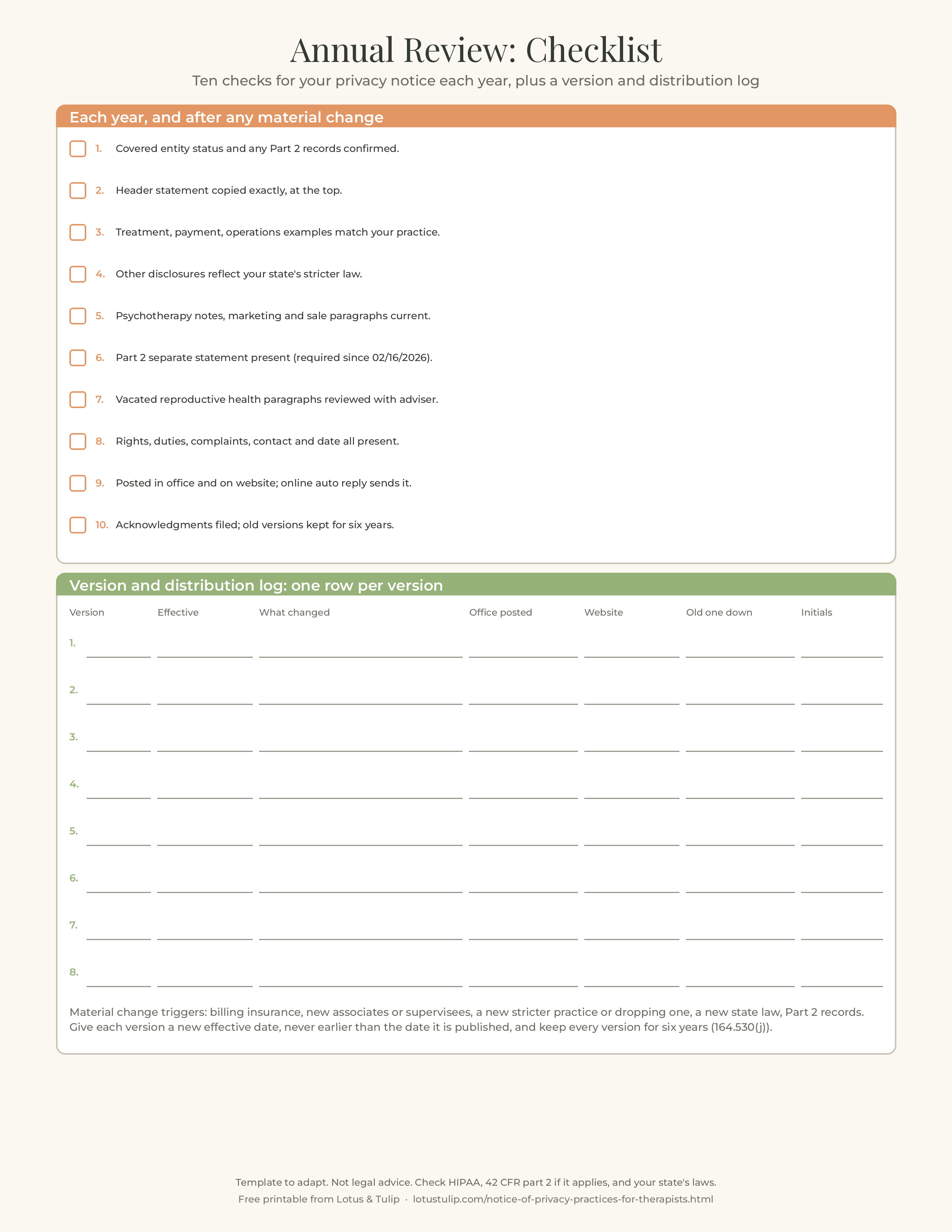
The free printable has three US Letter pages. Page 1 is a blank NPP builder worksheet and acknowledgment of receipt: practice details and privacy contact, your covered entity and Part 2 status, the eight required elements with check boxes, your therapy examples for treatment, payment and operations, your stricter practices and state law notes, delivery and posting, who handles rights requests and by when, and a client acknowledgment with an office use section for documenting good faith efforts. Page 2 is the same page filled for the fictional Harbor Light Counseling example. Page 3 is a ten point annual review checklist and a version and distribution log.
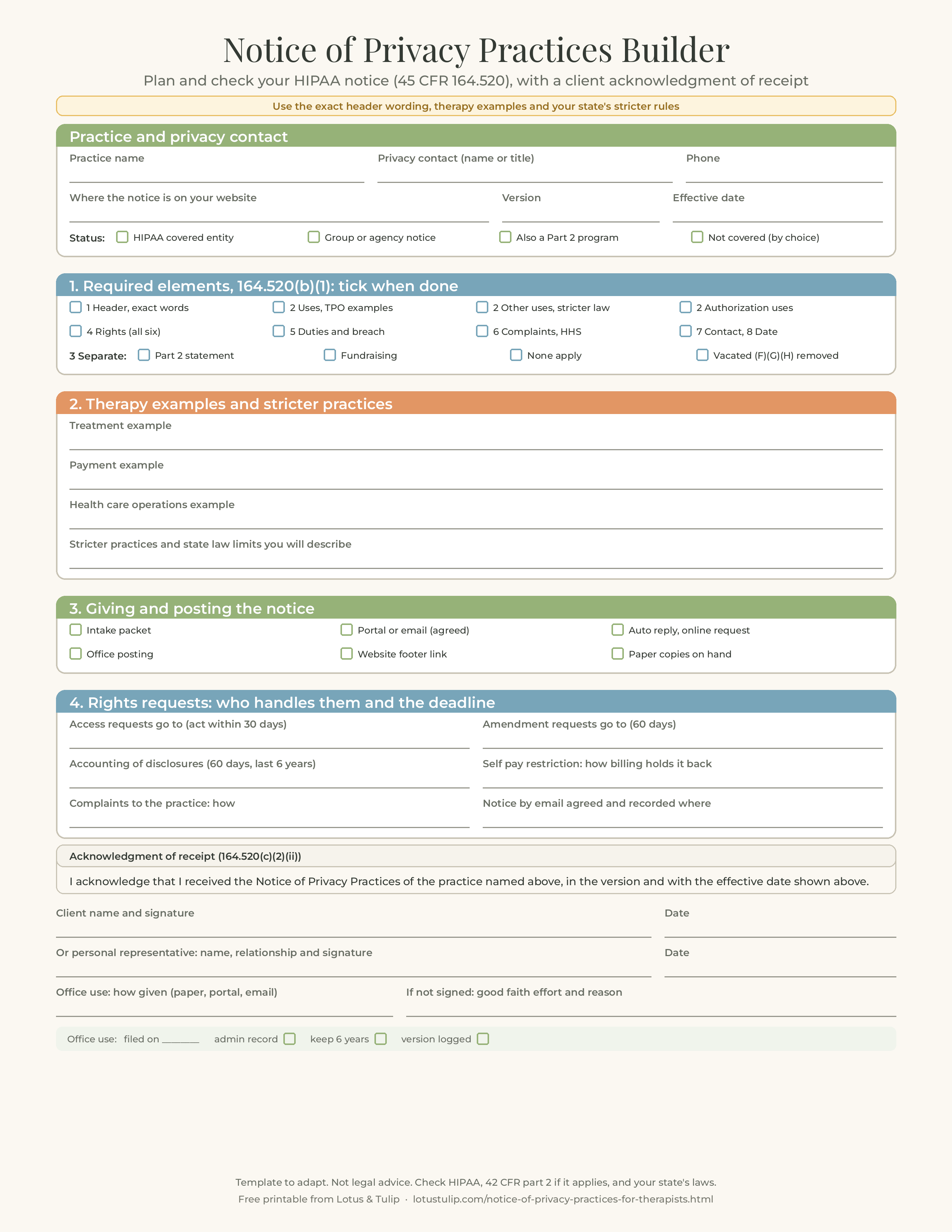
Download the free notice of privacy practices printable (PDF, 3 pages)
Rather type than handwrite? The free PDF above is for printing. Therapy Progress Notes and Intake Templates comes as a fillable PDF you type straight into (604 fields in Adobe Acrobat Reader), plus the printable version: SOAP, DAP and BIRP notes, intake, treatment plan and safety plan, 20 pages. Holiday 20% off: about $7.36, was $9 (EUR 8) · instant digital download
Buy on EtsyPrefer single images? Page 1: blank NPP builder and acknowledgment of receipt (PNG) · Page 2: filled fictional example (PNG) · Page 3: annual review checklist and version log (PNG)
Free to print and use in your own practice. Please link to this page rather than re-uploading the file. The builder helps you plan and check your notice; it is not a finished notice. Check your state's laws, your licensing board's rules and, if they apply, 42 CFR part 2, and have an attorney or your professional association review your notice before use.
Related resources
- HIPAA breach notification for therapists: the four factor risk assessment, 60 day deadlines and a free incident log
- Telehealth across state lines for therapists
- Duty to warn for therapists: Tarasoff, state laws, HIPAA and a free documentation worksheet
- Closing a therapy private practice: checklist, timeline, client letters, records plan and free printable
- HIPAA risk assessment for therapists: security risk analysis, filled example and free worksheet
- Business associate agreement for therapists: which vendors need a BAA, breach duties, filled vendor log and free printable
- Professional will for therapists: clinical executor, records custodian, client notification scripts, filled example and free printable
- Couples therapy informed consent form: no secrets policy, individual sessions, records access, safety screening, filled example and free printable
- Treatment summary template for therapists: how to write a treatment summary letter, transfer records under HIPAA, filled example and free printable
- Informed consent for therapy template: what to include, sample consent and free printable
- Release of information form for therapists: HIPAA authorization elements, psychotherapy notes, Part 2, filled example and free printable
- Psychotherapy notes vs progress notes: what HIPAA says, what goes where and free printable
- Parental consent form for therapy of a minor: who can consent, custody orders, state minor consent laws, HIPAA, filled example and free printable
- Telehealth progress note template and example
- What to include in a therapy intake form (checklist)
- Therapy progress notes and intake templates
Sources: 45 CFR 164.520 (notice of privacy practices), 164.501 (definition of psychotherapy notes), 164.502(g), 164.508(a)(2) to (a)(4) and (b)(5), 164.510, 164.512, 164.522, 164.524, 164.526, 164.528 and 164.530(a), (i) and (j), and 45 CFR 160.103, 160.202 and 160.306, eCFR text up to date as of November 5, 2026, with the eCFR version history for 164.520; 42 CFR 2.22, eCFR current text; Federal Register, Confidentiality of Substance Use Disorder (SUD) Patient Records final rule, 89 FR 12472 (February 16, 2024), and HIPAA Privacy Rule To Support Reproductive Health Care Privacy final rule, 89 FR 32976 (April 26, 2024), including its compliance date for 164.520; HHS OCR, Model Notices of Privacy Practices (revised February 2026); HHS OCR, HIPAA Privacy Rule and Disclosures of Information Relating to Reproductive Health Care (on Purl v. HHS, No. 2:24-cv-00228-Z, N.D. Tex. June 18, 2025); HHS OCR, Notice of Privacy Practices for Protected Health Information guidance; APA Ethical Principles of Psychologists and Code of Conduct, standard 4.02. Rules change; check the current versions.
FAQ
Do therapists need a Notice of Privacy Practices?
Yes, if they are HIPAA covered entities, which a therapist becomes by transmitting health information electronically in connection with a HIPAA standard transaction, such as an electronic insurance claim, directly or through a biller or clearinghouse. A strictly private pay therapist who never does that may not be covered, but many still use a privacy notice, and state privacy laws apply either way.
What must a HIPAA notice of privacy practices include?
Under 45 CFR 164.520(b)(1): the required header; uses and disclosures with examples, reflecting stricter law; separate statements for certain activities, including Part 2 records; the individual rights; your legal duties; how to complain to you and to HHS; a contact with a phone number; and an effective date.
Do I need to update my notice for the 2024 HIPAA and Part 2 changes?
Yes, for the Part 2 related changes. HHS says covered entities have been required since February 16, 2026 to include information about substance use disorder records protected by 42 CFR part 2. The reproductive health statements added in 2024 were vacated by a federal court on June 18, 2025, according to HHS, so they are no longer required.
Does a client have to sign the notice of privacy practices?
No. Clients do not sign the notice itself. A covered provider must make a good faith effort to get a written acknowledgment of receipt, and if the client does not sign, document the effort and the reason.
Is this notice of privacy practices printable free?
Yes. The three page printable (a blank NPP builder and acknowledgment of receipt, a filled fictional example and an annual review checklist with a version and distribution log) is free to print and use in your own practice. Please link to this page rather than re-uploading it.