
Kids and teens · Updated 2026-11-07
Empathy Activities for Teens (with Free Printable)
Ready-made printable: Social Skills Small Group Curriculum for School Counselors, Grades 2 to 5 Holiday 20% off: about $11.04, was $14 (EUR 12) · instant digital download
Buy on Etsy
Empathy activities for teens are short, structured practice rounds that help middle and high school students notice what someone else might feel, take that person's point of view without agreeing to harm, check the story before reacting, show care in a way that does not dump the whole emotional load on one friend, repair after they missed someone, and practice digital empathy in group chats, comments and screenshots. This guide gives school counselors, therapists, teachers and parents a set of activities you can run tomorrow: a perspective swap, a digital leave-out check, a friendship repair empathy script, a "care without carrying" boundary, and a harm-line sort. Each one comes with timing, setup, debrief questions and adaptations, plus a free three page printable.
Teen empathy work is different from a kids feelings lesson. A thirteen year old deciding whether to laugh at a mean comment under a classmate's photo, a sixteen year old whose friend texts crisis vibes at 1 a.m. every night, and a fifteen year old who wants to fix a fight without pretending the other person is always right all need empathy skills, but the scenes are higher stakes and less cartoon friendly. This page sits next to our empathy worksheets for kids (younger noticing and kind response cards), social skills activities for teens (cues, joining, perspective as one piece), friendship activities for teens (healthy friendship signals), communication skills activities for teens (listen, say it, repair), kindness activities for kids, conflict resolution activities for teens, bullying activities for teens, peer pressure worksheets for teens, assertiveness worksheet and I statements worksheet. Those pages go deep on neighboring skills. This one is about the empathy loop itself: notice, perspective take, check, care with limits, and repair.
We credit the people whose ideas these activities draw on, without claiming any affiliation or endorsement: Mark H. Davis, whose Interpersonal Reactivity Index (IRI) separates perspective taking, empathic concern, personal distress and fantasy; C. Daniel Batson, whose empathy-altruism research asks when feeling with someone leads to helping; Jean Decety and William Ickes, whose work on empathy and empathic accuracy highlights that "feeling with" and "getting it right" are not the same; and the ASCA Student Standards and CASEL framework, which both name relationship skills that include understanding others and showing care. The printable is an original Lotus and Tulip layout, not a copy of any of their materials.
This guide is educational. It is not therapy, not medical advice and not a diagnosis. If an empathy conversation turns up thoughts of ending a life, a plan to hurt someone, abuse, or a medical emergency, stop the activity and get help now: in the US, call or text 988 (Suicide and Crisis Lifeline), text HOME to 741741 (Crisis Text Line), or call 911. Our safety plan worksheet is a better first tool in that moment.
Jump to the free empathy printable (PDF) · Activities · How to use empathy activities for teens, step by step · Worked examples · Comparisons
What teen empathy practice is (and is not)
For this page, empathy means five teachable moves: noticing cues that someone else is having a feeling, taking their perspective with what they know and want (not only what you would feel), checking your story before you react, showing care in a way that fits the relationship and your capacity, and repairing when you missed them. Teens practice on low stakes scenes first, then carry one move into a real moment that week.
It is not:
- Agreeing with harm. Understanding why someone is angry does not mean joining a pile on, forwarding a private photo, or covering for a friend who is hurting someone. Empathy without a harm line becomes people pleasing or bystander silence.
- An emotional labor dump. Being a caring friend does not mean being on call 24/7, fixing every crisis alone, or holding secrets that put someone in danger. Care includes knowing when to loop in an adult.
- Feeling everything the other person feels. Flooding into personal distress often shuts helping down. Regulating your own body so you can stay present is part of usable empathy. Pair with emotional regulation activities for teens when the teen is too flooded to listen.
- A politeness script. Empathy is not smiling while ignoring what happened. It is accurate enough understanding plus a workable next step.
- A diagnosis or cure. Struggling with these skills does not mean a teen has autism, ADHD, conduct problems or a personality disorder, and practicing them does not treat any condition. If perspective taking or social cue reading looks unusually hard across settings, a clinical or school evaluation may be the right next step.
Why teens need teen shaped empathy practice
The scenes are different. Teens navigate group chats, screenshot culture, leaving people out without saying it out loud, friend breakups, dating respect, teacher conflict and family privacy. A worksheet with cartoon shoes will not survive contact with a ninth grade group chat at midnight.
Perspective taking gets harder and more needed. Adolescents can hold more than one point of view, which is a strength. It also means they can invent elaborate stories about what a friend "must have meant" and then react to the invented story. Checking the story is a core teen empathy skill.
Care without capacity is a real trap. Many teens, especially ones who are known as "the listener," absorb friends' distress until they burn out, then feel guilty. Teaching empathic concern with limits is not cold. It is how caring friendships last.
Digital empathy is its own skill. Tone, intent and impact split apart online. A joke that felt fine in a private chat can land as public humiliation when screenshotted. Practice includes: before I send, share or laugh, who is in the room and who might see this later?
Empathy activities teens will actually do
Each activity below lists time, group size, setup and debrief. Run one or two per session, not all of them at once. The first three build noticing and perspective, the middle three build care with limits and digital empathy, and the last ones build repair and the harm line.
1. Cue catch (notice before you guess)
Time: 10 minutes. Group: whole class or small group. Setup: short written scenes or silent video clips with no audio, never real student screenshots.
Students list three observable cues (face, posture, pace of texts, who went quiet) before they name a feeling. Then they offer two possible feelings, not one. Debrief: what do we skip when we jump straight to "they are mad at me"? Teaching point: noticing is separate from mind reading.
2. Perspective swap cards
Time: 15 minutes. Group: pairs. Setup: cards with the same event told from two seats (the friend left out of photos; the friend who posted; a sibling who borrowed something; a coach who sat someone).
Each student writes: What does this person know? Want? Fear? What would they say happened? Then partners switch cards and add one thing the first writer missed. Debrief: where did your story fill in gaps with assumptions? Link to Davis's perspective taking idea: trying to see from the other's seat is a skill you can practice, not a personality trait you either have or do not.
3. Story check before react
Time: 12 minutes. Group: individual or pairs. Students pick a recent "they must think..." moment and write three columns: My first story, Two other possible stories, A check move (ask, wait, look for more cues). Practice one check line out loud: "Hey, when you went quiet in the chat, I worried I said something wrong. Was it something else?"
Why it works: Empathic accuracy research (Ickes and colleagues) reminds us that people often overestimate how well they read others. Checking is skilled, not needy.
4. Care without carrying
Time: 15 minutes. Group: small groups. Present a fictional friend who vents every night about the same crisis. Students sort responses into: dump (absorb everything, never sleep), cut off (ghost, then feel guilty), and care with limits ("I care about you. I am not the right person for this at 1 a.m. Can we talk tomorrow, and do you have an adult you can text tonight?").
Debrief: Empathic concern is wanting the other person to be okay. Personal distress is drowning in their feeling. Teens need language for both. Pair with boundaries activities for teens when the hard part is holding the limit.
5. Digital leave-out check
Time: 15 minutes. Group: small groups. Setup: a fictional group chat plan for a hangout that somehow never includes one member, plus a screenshot about to be shared.
Groups answer: Who might feel left out, even if nobody said "we do not want you"? What would an empathic pause look like before sending the plan or the screenshot? Write three moves: include, explain privately, or do not share. Link to bullying activities for teens when the pattern is repeated and involves a power imbalance.
6. Comment before you comment
Time: 10 minutes. Group: pairs. Students rewrite three mean or "just joking" comments under a fictional photo so the impact matches a kinder intent, or choose not to comment. Debrief: intent is not the same as impact. Empathy asks about impact first when someone says they were hurt.
7. Friendship repair empathy
Time: 15 minutes. Group: pairs or individual. After a miss (forgot a birthday, snapped, shared something private), teens often apologize in a way that centers themselves ("I feel so bad") without showing they get the other person's experience. Teach a three part repair: name the impact on them, show you understand their seat, offer a next step. Example: "I shared that story when you asked me not to. That broke your trust. Next time I will keep it private, and I am sorry." Practice on fictional scenes first. Pair with friendship activities for teens for the wider friendship map.
8. Harm line sort (empathy is not agreement)
Time: 15 to 20 minutes. Group: small groups. Cards with requests from a friend: "Laugh at this comment with me," "Do not tell anyone I am cutting," "Cover for me skipping," "Help me get back at them." Groups sort into: okay to join, okay to understand but not join, must get an adult. Debrief: you can understand a feeling and still refuse the action. That is empathy with a spine, not betrayal.
9. Two seats in a conflict
Time: 15 minutes. Group: pairs. Using a low stakes fictional conflict (group project, shared locker, borrowed hoodie), each student writes both seats before any solution talk. Only after both seats are written do they brainstorm options. Bridges to conflict resolution activities for teens when the next need is a plan both can live with.
How to run these activities in a group or session
Set norms first. What is said here stays here (with the usual safety exception), pass is always allowed, practice on made up scenes first, and critique the move, never the person. Model a bad empathy move yourself ("At least it is not worse") so better moves are easier to see. Keep personal sharing optional. End with one carry over: check one story, use one care with limits line, or pause before a screenshot.
Suggested six session sequence. Session 1: cue catch and perspective swap. Session 2: story check. Session 3: care without carrying. Session 4: digital leave-out and comment pause. Session 5: friendship repair empathy. Session 6: harm line sort and practice log review.
Adaptations
- Middle school: more structure, sentence frames, shorter rounds, scenes about lunch, chats, siblings and teachers.
- High school: add jobs, dating respect, coaches and denser digital scenarios. Let students write their own cards.
- Individual sessions: rehearse a real repair or "care with limits" talk two or three times.
- Autistic and neurodivergent teens: teach empathy as options, not one required face or voice. Offer scripts and clear rules; many already care deeply and prefer direct language.
- Anxious or quiet teens: write first, observe, use the observer role. Pair with social anxiety worksheets for teens if fear of getting it wrong is the barrier.
- English learners / flooding / virtual: provide frames; calm the body before perspective work (emotional regulation activities for teens); use breakouts and shared docs online.
How to use empathy activities for teens, step by step
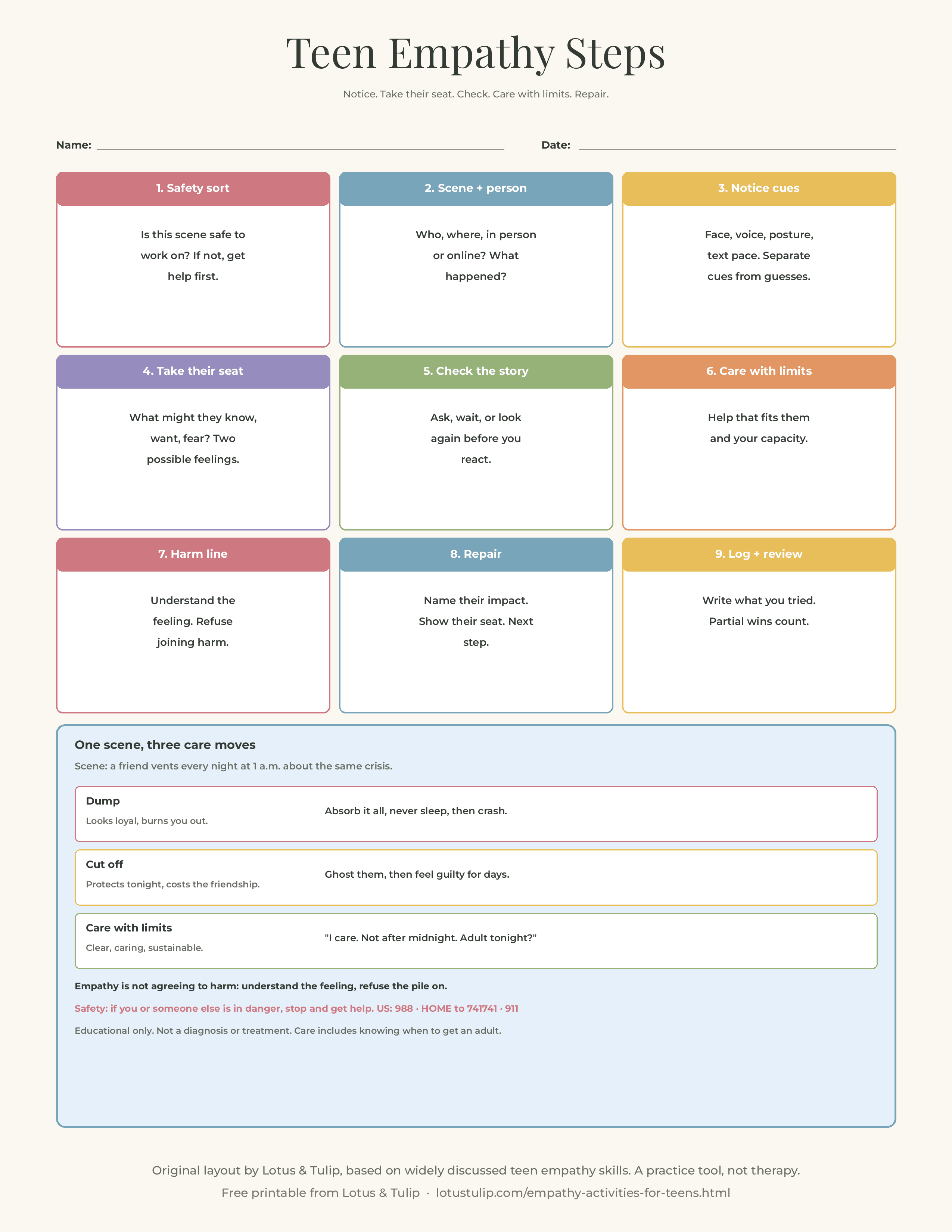
- Safety sort. Before practice, check that the scene is safe to work on. Threats, abuse, self harm or a controlling relationship come first: 988, HOME to 741741, or 911 when needed, plus a safety plan and a trusted adult. Do not coach a teen to "empathize better" with someone who is hurting them, or to hold a secret that keeps someone unsafe.
- Pick one scene and one person. Who is the other person, in person or online, and what happened? One scene at a time.
- Notice cues. List what you can observe: face, voice, posture, text pace, who went quiet. Separate cues from guesses.
- Take their seat. What might they know, want and fear? Write at least two possible feelings, not one locked story.
- Check the story. Ask, wait, or look for more information before you react. "I might be filling in gaps" is a skilled thought.
- Choose a care move with limits. What would help them and still fit your capacity? Include, listen, repair, loop in an adult, or step back from harm.
- Draw the harm line. Understanding a feeling is not the same as joining a harmful action. Sort: understand, refuse, get help.
- Repair if you missed them. Name the impact on them, show their seat, offer a next step. Keep it short and specific.
- Log and review. Record what you tried and what happened on the practice log. Celebrate partial wins. Bridge to friendship, communication, boundaries or conflict pages when one skill needs deeper work.
Practice on low stakes scenes first. Empathy used under stress is the kind rehearsed when calm.
School counselor, therapist, teacher and parent tips
School counselors. Empathy activities fit classroom lessons, small groups and short individual meetings, and sit near ASCA social skills behaviors on positive relationships and demonstrating empathy and compassion. Keep personal sharing optional, follow district crisis protocols, and avoid scenarios that mirror a known conflict in the room.
Therapists. Rehearse the real repair or "care with limits" talk. Notice when "lack of empathy" is trauma, depression, autism related social processing differences, or a family pattern where feelings were punished. Do not shame a teen for protecting themselves in an unsafe home.
Teachers. Use cue catch before discussions, two seats before mediation, and the digital leave-out check before group projects.
Parents and caregivers. Model more than you lecture. Reflect a teen's seat before you correct, repair out loud when you miss them, and skip forced apologies that skip understanding.
Worked fictional examples
Group chat leave-out (fictional). Sam, 14, noticed a weekend plan forming in a chat that somehow never tagged Jordan. In the digital leave-out check, Sam's group practiced three moves. Sam chose a private message to the planner: "Hey, is Jordan coming? Feels weird if we leave them out." The planner had genuinely forgotten. Carry over: pause and name the leave-out before it hardens.
Care with limits at 1 a.m. (fictional). Avery, 16, was the friend everyone vented to. After the care without carrying sort, Avery drafted: "I care about you. I cannot do heavy talks after midnight on school nights. Can we talk tomorrow, and do you want help finding an adult tonight?" Avery practiced the tone so it did not sound like rejection. The friend was hurt at first, then used a crisis line once with Avery's help. Carry over: care includes capacity.
Repair after a screenshot (fictional). Noah, 15, forwarded a private rant. In friendship repair empathy he wrote: "I shared what you said when you asked me not to. That broke your trust. I deleted it and I will not share private stuff again." The friend needed time. Carry over: repair names their seat, not only your guilt.
Harm line (fictional). Riley, 17, was asked to pile on a classmate in comments. Understanding the friend's anger did not mean joining. Riley said: "I get that you are mad. I am not commenting on that." Carry over: empathy with a spine.
Counselor small group note (fictional). In a six session eighth grade group, a counselor ran one or two activities per session on made up cards. By session five, students chose private practice targets on the log. Nobody was required to share real friend crises. One quiet student lived in the observer role for two weeks, then led a round of story check.
Empathy teens vs kids empathy, social skills, friendship, communication, kindness, conflict and bullying
| Empathy teens (this page) | Empathy kids | Social skills teens | Friendship teens | Communication teens | Kindness kids | Conflict teens | Bullying teens | |
|---|---|---|---|---|---|---|---|---|
| Main job | Notice, perspective take, check, care with limits, digital empathy, harm line, repair | Feelings detective, walk in shoes, kind response | Cues, joining, perspective as one piece, digital norms | Healthy friendship signals and repair | Listen, style, message, tone, repair | Kind acts and noticing needs | Cool down, both sides, options, agreement | Power imbalance, reporting, safety |
| Best early use | Missed feelings, leave-outs, over helping, online pile ons | Younger noticing and caring practice | Joining and reading peer scenes | When friendship patterns are the focus | When wording and listening keep going wrong | Younger prosocial practice | Ongoing disputes that need a plan | Repeated targeting with power imbalance |
| Output | Empathy plan and practice log | Kids empathy pages | Social skill plan | Friendship plan | Communication plan | Kindness tracker | Conflict plan | Safety and reporting steps |
| Link | This page | Empathy kids | Social skills teens | Friendship teens | Communication teens | Kindness kids | Conflict teens | Bullying teens |
These tools work together. Empathy is the understanding and care layer. When joining, wording, friendship patterns, conflict plans or bullying safety become the whole problem, go to the matching page.
What helps vs common myths
What often helps: short practice rounds, made up scenarios before personal ones, clear frames teens can adapt into their own voice, adults who model checking and repairing, a specific carry over each week, and permission to care with limits rather than burn out.
- Myth: "Empathy means always agreeing." Understanding a feeling is not endorsing a harmful action.
- Myth: "If I feel their feelings, I am good at empathy." Flooding into personal distress can block helping. Usable empathy includes regulation.
- Myth: "Some people just have empathy and some do not." Perspective taking and empathic concern are trainable skills. Traits differ, but practice still matters.
- Myth: "Digital meanness does not count." Leave-outs, screenshots and pile-on comments have real impact. Digital empathy is part of the skill set.
- Myth: "A good friend never sets limits." Care without capacity often ends friendships. Limits can be caring.
- Myth: "Research proves these exact activities work." No study has tested this printable. The ideas sit near known empathy research and school relationship skills frameworks; that is not a proven effect for one worksheet.
Common mistakes
- Spotlighting students with personal role plays before trust is built.
- Using real screenshots or real conflicts between students in the room as practice material.
- Teaching empathy as compliance ("just be nice") instead of accurate perspective plus a workable care move.
- Praising teens for absorbing everyone's crisis until they crash.
- Skipping the harm line so "understanding" becomes joining cruelty.
- Stacking every skill in one session. One or two activities with a carry over beats ten in an hour.
- Treating the worksheet as therapy. Paper supports practice. It does not replace a clinician or school support when problems are serious or lasting.
When not to use this worksheet
Good uses: everyday misses with friends, family and classmates; digital leave-outs and tone fails; teens who over help or under notice; group or class lessons; rehearsing a specific repair.
Use something else first when:
- There is danger, abuse or a controlling relationship. Safety and adult help come first: 988, HOME to 741741, 911, and a safety plan.
- The main issue is bullying with a power imbalance. Use bullying activities for teens and school reporting procedures.
- The teen is flooded. Calm the body first with emotional regulation activities for teens.
- Peer pressure to join harm is the core problem. Use peer pressure worksheets for teens alongside the harm line.
- The exercise is increasing shame. Stop, validate, and switch tools.
What the research says (honestly)
Measuring empathy facets. Mark H. Davis's Interpersonal Reactivity Index (IRI) separates perspective taking, empathic concern, personal distress and fantasy. It is a research tool, not a classroom test, and Lotus and Tulip is not affiliated with Davis. The teaching neighbor is that "empathy" is more than one skill.
Empathy and helping. C. Daniel Batson's empathy-altruism research asks when feeling for someone leads to helping aimed at their welfare, versus reducing your own discomfort. Classroom activities are not Batson experiments. The practical neighbor: notice whether a teen is helping the other person or escaping feeling bad.
Empathic accuracy. William Ickes and colleagues found people often overestimate how well they read others. Jean Decety's social neuroscience work treats understanding others as a set of processes, not a single feeling. Neither program endorses this printable.
School frameworks. ASCA Student Standards include social skills behaviors related to positive relationships and demonstrating empathy and compassion. CASEL's relationship skills competency includes communicating effectively, building relationships and showing care. Lotus and Tulip is not affiliated with ASCA or CASEL.
Honest limits. No study tests this three page printable or this activity set. Treat it as a skill practice aid built on widely discussed empathy ideas, not a standalone randomized controlled trial.
Free empathy printable for teens (PDF)
The free empathy printable has three pages in US Letter size:
- Page 1: Teen Empathy Steps. Nine step card matching the HowTo above: safety sort, pick the scene, notice cues, take their seat, check the story, care with limits, harm line, repair, log and review.
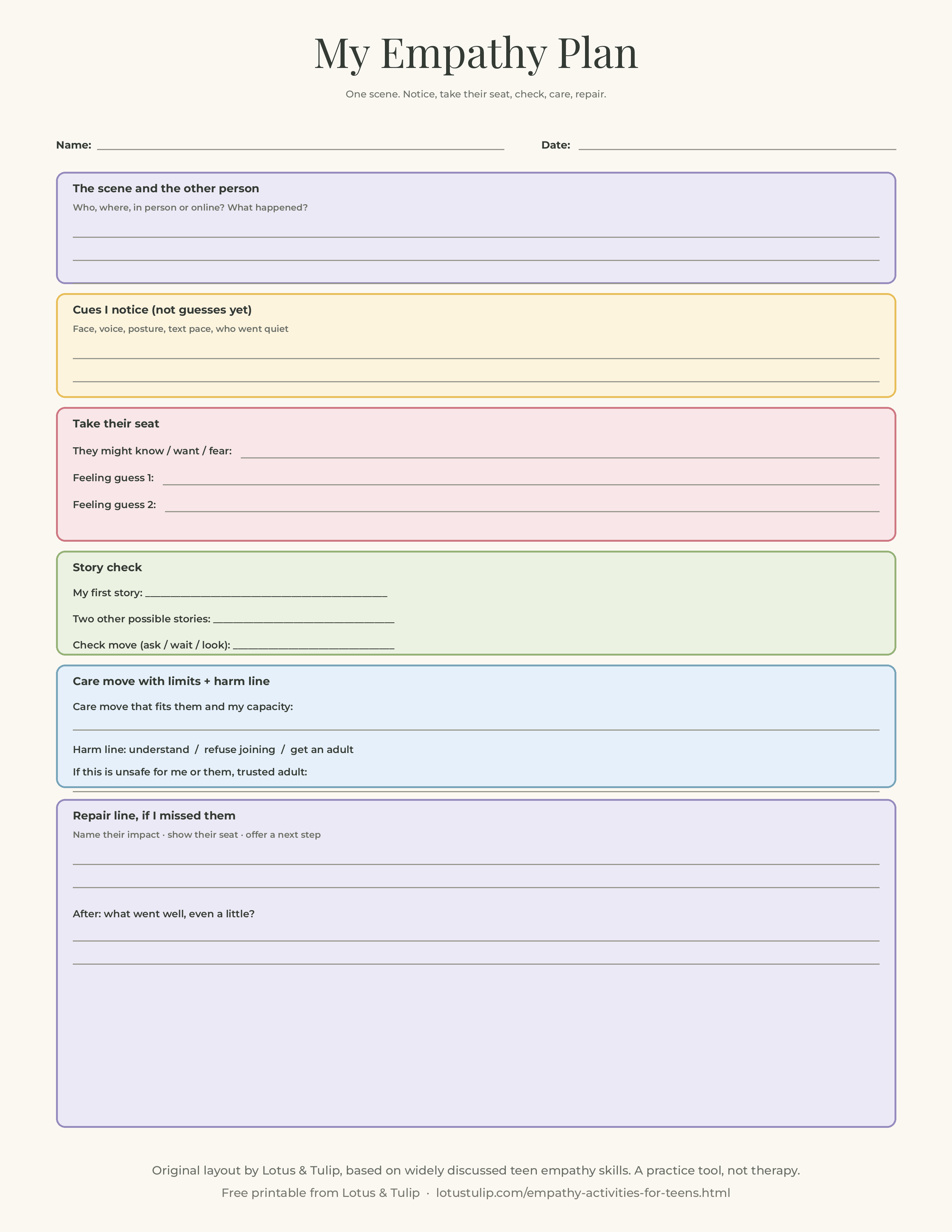
- Page 2: My Empathy Plan. Fill in the scene, cues, their seat, story check, care move with limits, harm line, and a repair line.
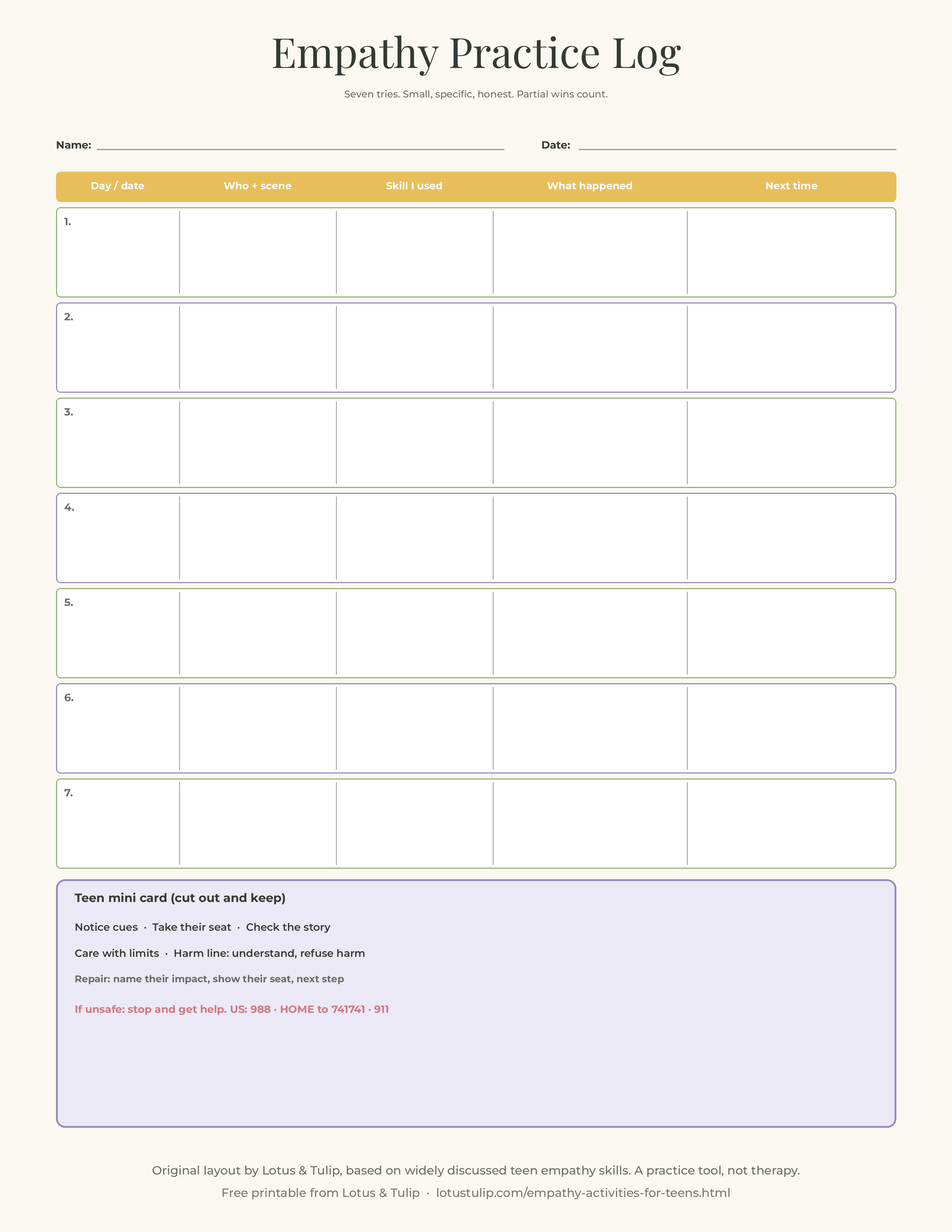
- Page 3: Practice Log + teen mini card. Seven rows to track what you tried and how it went, plus a cut out reminder card.
Download the free empathy printable for teens (PDF, 3 pages, US Letter)
Prefer single images? Page 1: Teen Empathy Steps (PNG) · Page 2: My Empathy Plan (PNG) · Page 3: Practice Log (PNG)
Free to print for your own use and for use with your own clients, students or groups. This is an original layout by Lotus & Tulip, drawing on widely discussed empathy ideas (perspective taking, empathic concern, personal distress, empathic accuracy and school relationship skills). It is not affiliated with any author, organization or curriculum named on this page, does not diagnose or treat any condition, and is not a substitute for therapy. Please link to this page rather than re-uploading the file.
Related resources
- Empathy worksheets for kids: younger noticing and kind response practice.
- Social skills activities for teens: cues, joining, perspective and digital norms.
- Friendship activities for teens: healthy friendship signals and repair.
- Communication skills activities for teens: listen, say it, match tone, repair.
- Boundaries activities for teens: deciding and holding limits.
- Conflict resolution activities for teens: cool down, both sides, options and repair.
- Bullying activities for teens: when the problem is a power imbalance.
- Peer pressure worksheets for teens: when the ask is to join harm.
- Kindness activities for kids: younger prosocial practice.
- Assertiveness worksheet: clear and respectful no.
- I statements worksheet: feeling plus request.
- Safety plan worksheet: when the moment is about staying safe.
Sources
- Davis, M. H. (1980). A multidimensional approach to individual differences in empathy. JSAS Catalog of Selected Documents in Psychology, 10, 85. Davis, M. H. (1983). Measuring individual differences in empathy: Evidence for a multidimensional approach. Journal of Personality and Social Psychology, 44(1), 113 to 126.
- Batson, C. D. Empathy-altruism hypothesis research program (overview in Batson's published work on empathic concern and helping).
- Ickes, W. Empathic accuracy research (edited volumes and studies on inferring others' thoughts and feelings).
- Decety, J., and Ickes, W. (Eds.). (2009). The Social Neuroscience of Empathy. MIT Press.
- American School Counselor Association. ASCA Student Standards: Mindsets and Behaviors for Student Success (social skills / relationship related behaviors).
- CASEL. The CASEL 5 framework, relationship skills competency.
Empathy activities for teens: FAQ
What are empathy activities for teens?
They are short practice rounds that teach noticing cues, taking another person's perspective, checking your story before you react, showing care with limits, digital empathy in chats and comments, drawing a harm line, and repairing after you miss someone. They work in classrooms, small groups and individual sessions.
How is teen empathy different from kids empathy worksheets?
Teen pages focus on perspective taking with incomplete information, digital leave-outs and screenshots, friendship repair, care without emotional labor dump, and refusing to join harm while still understanding feelings. Kids pages focus more on noticing feelings and basic kind responses.
What is a good first empathy activity for a teen group?
Cue catch or perspective swap cards. Both are low risk, use made up scenes, and make the difference between guessing and checking obvious.
Does empathy mean I have to agree with my friend?
No. You can understand why someone is angry or hurt and still refuse to pile on, share a private photo, or cover for harm. That is empathy with a harm line.
How do I teach digital empathy?
Use a leave-out check and a comment rewrite with fictional chats. Ask who might feel left out, what a pause before screenshotting looks like, and whether intent matches impact.
Can school counselors use this printable in groups?
Yes. It fits classroom lessons, small groups and individual meetings, and sits near ASCA and CASEL relationship skills language. Keep personal sharing optional and follow district crisis protocols when risk appears.
When should I not use empathy practice?
Not as the first step when a teen is in danger, being abused, or in a controlling relationship, when bullying with a power imbalance is the issue, or when a teen is too flooded to think. Safety and adult help come first: in the US call or text 988, text HOME to 741741, or call 911.