
Kids and teens · Updated 2026-11-08
K-2 Coping Skills Group Activities (with Free Printable)
Ready-made printable: K-2 Coping Skills Group Curriculum Holiday 20% off: about $11.04, was $14 (EUR 12) · instant digital download
Buy on EtsyTry it free first: download session 1 free (group at a glance, lesson plan and student page, PDF, 75 KB). Run it with your group, then get all 8 sessions. No email needed.

K-2 coping skills group activities give kindergarten, first grade and second grade students a short, predictable place to name a feeling, notice what their body is doing, and pick a calming tool they can actually use at school. A good group respects how young children learn. It uses pictures, movement and simple words. It does not ask a five year old to sit still through a lecture, does not treat every tears-on-the-rug moment as a disorder, and does not promise that big feelings will disappear. This guide is written for US school counselors (and the school social workers, school psychologists and child therapists who run similar groups) who want a practical Tier 2 plan for about four to six students, in sessions of about 20 to 30 minutes.
You will get a plain language model of what a K-2 coping skills group can and cannot do, twelve activities you can actually run (with time, group size, materials, steps and a debrief), an eight session starter plan that matches the public theme of naming feelings and picking a calming tool, a nine step HowTo, adaptations, tips for counselors, teachers and caregivers, mistakes, myths, three fictional examples, when-not guidance, verified research notes, eight FAQs and a free three page US Letter printable: K-2 Coping Group Steps, My Feelings and Tools Plan and a Practice Log with nine pocket cards.
This page is the counselor small-group how-to for kindergarten through grade 2. It sits beside, and is not a substitute for, our coping skills list for kids (a menu of tools, not a K-2 group plan), calm down corner ideas, emotional regulation worksheets for kids, breathing exercises for kids, the feelings thermometer printable, the 5 4 3 2 1 grounding worksheet, the progressive muscle relaxation script for kids, mindfulness activities for kids, anger management activities for kids, anxiety worksheets for kids, the worry worksheet for kids, small group counseling curriculum for anxiety (an elementary worry and anxiety group, not a K-2 coping how-to), middle school stress group activities (grades 6 to 8), counseling games for kids, the size of the problem worksheet, the daily check in for students and the feelings wheel printable.
We draw on published research and public guidance without claiming any affiliation or endorsement, including Denham and colleagues on preschool emotion knowledge, Izard and colleagues on emotion knowledge and social behavior, Thompson on emotion regulation development, Eisenberg, Spinrad and Eggum on emotion-related self-regulation, the Compas, Jaser, Bettis and colleagues (2017) coping review, the Durlak and Taylor school-based SEL meta-analyses (as context for classroom programs, not as an effect size for this pull-out group), the CASEL descriptions of self-awareness and self-management, and the ASCA Student Standards: Mindsets and Behaviors for Student Success (2021). Full citations are below. Classroom programs such as Second Step, PATHS and The Incredible Years teach related skills at a universal level. This page is not those programs, is not affiliated with them, and does not reproduce their lessons. The printable is an original Lotus and Tulip layout, not a preview dump of any paid curriculum.
This guide is educational. A K-2 coping skills group does not diagnose a student, does not treat an anxiety disorder, an anger disorder, ADHD, autism or trauma, and does not replace counseling, medical care or a safety response. Young children often need an adult to co-regulate before they can use a skill alone. The activities are skill practice aids for counselors, not a standalone trial and not a manualized protocol. They are not affiliated with ASCA, CASEL or any named program. If a child is thinking about suicide or self-harm, or says they do not want to be alive, call or text 988 (Suicide and Crisis Lifeline) or text HOME to 741741 (Crisis Text Line). For immediate danger, call 911. Pause the group activity and use a written safety plan when it fits. If a child describes abuse, neglect or feeling unsafe at home, follow your mandated reporting procedure. A group is not the right tool for a child who is in crisis.
What a K-2 coping skills group is (and is not)
Most elementary counselors already know the children who would fit: the kindergartner who drops to the floor at clean-up, the first grader whose stomach hurts on Monday, the second grader who hits when a tower falls, the quiet child who freezes instead of asking for help, and the child who looks fine until a small schedule change undoes the morning. A K-2 coping skills group is a short series of sessions where four to six of these children practice a few skills together, with an adult calm enough for them to borrow that calm.
In plain words, a K-2 coping skills group helps young students:
- Name the feeling with a real word. Happy, sad, mad and scared are a strong start. Grade 2 can add worried, frustrated, proud and disappointed. A word gives the child and the adult something to work with.
- Notice body clues. A tight tummy, hot face, fast breathing, clenched fists or wobbly legs are information, not proof that the child is "bad at school."
- Borrow an adult's calm first. Co-regulation comes before independent coping. A slow voice, a steady body and a short choice often do more than a worksheet handed to a child who is already flooded.
- Practice short embodied skills. Belly breathing, squeeze and release, a simplified five senses check and simple words to ask for help fit a kindergarten body better than a long sit-still meditation.
- Pick a tool that fits the moment. A belly breath may help a tight tummy. A wall push may help restless legs. Asking a grown-up may help a child who feels alone. One favorite skill is not a match for every feeling.
- Try the skill at school and take one simple idea home. Families do not need a lecture. They need one sentence and one picture they can try after dinner.
A K-2 coping skills group is not:
- A diagnosis or a treatment plan. You are practicing skills, not deciding that a child "has anxiety" or "has anger issues." If evaluation is needed, say so separately and clearly.
- A trauma processing group. Children may mention hard things at home. You listen, you protect privacy, and you move safety concerns to individual support and your reporting path. You do not ask the group to retell scary events.
- An anger disorder group or an anxiety disorder group. Some children in the room will get angry or worried. If the main problem is persistent worry, avoidance or panic, use an anxiety plan such as our elementary anxiety small group guide. If the main problem is frequent aggression that does not shift with basic coping practice, look at anger management activities for kids and consider a different group or individual work.
- A babysitting lecture or a worksheet pile for non-readers. Kindergarten and first grade students need pictures, movement and an adult who talks with them, not a stack of lines to fill in.
- A promise to end all big feelings. Young children will keep having big feelings. The goal is a name for the feeling, a way to notice it earlier and a tool that helps a little, not a child who never cries.
- A replacement for evaluation or therapy when those are needed. A skills group does not take the place of a developmental evaluation, speech support, a 504 or IEP conversation, or outside counseling.
Core ideas that keep a K-2 coping skills group honest
1. Name the feeling before you ask for a tool
A child who is handed a breathing card while they are still unnamed and overwhelmed often hears "stop that." Start with a word and a picture: "Your face looks tight. I wonder if you feel mad." Let the child point if they cannot speak yet. Emotion knowledge, meaning the ability to recognize a feeling in a face or a situation and have a word for it, is one of the more consistent early skills linked with later social ease. Denham, Izard and colleagues documented this in preschool and early school samples; full citations are in the research notes. The teaching point is simple: give the feeling a name the child can use.
2. Body clues are easier to teach than abstract "self-control"
Five and six year olds do not experience feelings as ideas. They experience a hot face, a fast heart, a tummy flutter or the urge to run. Draw or point to those places on a simple body outline. Ask "Where do you feel it?" before you ask "What should you do?" A body map also gives quieter children a way to participate without a speech.
3. Co-regulation comes before independent coping
Ross Thompson has described emotion regulation as both extrinsic and intrinsic: early in life, caregivers help manage distress, and children gradually take on more of that work as language and self-understanding grow. Eisenberg, Spinrad and Eggum likewise distinguish regulation that comes from outside the child from self-regulation the child can do. In a K-2 group, that is the method. Sit near the child, slow your own breathing, lower your voice and offer a short choice ("squeeze the ball or put your hand on your tummy") before you expect them to pick a tool from a wall menu.
4. Skills should be short, physical and repeatable at school
Belly breathing with a hand on the tummy, a five second squeeze and release, a look-touch-listen check and a practiced sentence ("I feel mad. I need help.") fit a hallway, a rug and a cafeteria line. Long silent meditation, journal pages and multi-step thought records do not. If a skill cannot be done in under a minute with an adult nearby, save it for later grades or for home.
5. Match the tool to the feeling and the body
A child with a tight chest may do better with a slow belly breath. A child with restless legs may do better with a wall push or a short animal walk. A child who feels alone may need words to ask for help more than another breathing cue. Teach a small menu and help the child pick, instead of announcing one official calm-down for every situation.
6. Keep the language concrete
Say "Your fists are tight" rather than "You are dysregulated." Say "This feeling is medium" rather than "You are having an amygdala hijack." Say "Try your belly breath" rather than "Use your coping strategies." Concrete words travel home more easily, and they are kinder to English learners and to children with limited language.
7. Practice at school, then send one home idea
Young children remember what they have done with their bodies, not what you explained on Thursday. Repeat the same three or four tools every week. Send families one picture and one sentence, such as "We put a hand on our tummy and breathed so the belly moved," rather than a packet of theory.
Counselors who write goals against professional frameworks can map this work (without any affiliation) to ASCA Student Standards such as M 1 (belief in development of the whole self, including a healthy balance of mental, social/emotional and physical well-being), B-SMS 2 (self-discipline and self-control) and B-SMS 7 (effective coping skills). CASEL describes self-awareness as understanding one's own emotions, thoughts and values and how they influence behavior, including identifying one's emotions, and self-management as managing emotions, thoughts and behaviors effectively, including identifying and using stress-management strategies. Use those wordings if they help you write a lesson plan. Do not tell families the group is an ASCA or CASEL program.
Twelve K-2 coping skills group activities
Each activity lists time, group size, materials, steps and a debrief question. Times assume a 20 to 30 minute block with four to six students in kindergarten through grade 2. Activities 1 to 8 map onto the eight session plan below. Activities 9 to 12 are swaps and extensions.
1. Picture group agreements
Time: 10 to 15 minutes. Group size: 4 to 6. Materials: large paper or a pocket chart, simple picture cards (listening ears, kind hands, walking feet, a pass card), a stuffed animal or talking piece if you use one.
Steps: Tell children this is a feelings group where we learn names for feelings and ways to help our bodies. Show three or four picture agreements in their words: we look at the person who is talking, we keep hands safe, we can say "pass," and we do not tell a friend's story at recess. Add the adult promise: "If someone is getting hurt or is not safe, I have to get help, because keeping children safe is my job." Practice one pass round so passing looks normal. Kindergarten may manage three agreements. Grade 2 can help choose the pictures.
Debrief: "Which picture will help us most when someone feels mad?" Teaching point: agreements make the room predictable, and safety still comes first.
2. Feeling names with photos or cards
Time: 15 to 20 minutes. Group size: 4 to 6. Materials: photo or illustrated cards for happy, sad, mad and scared (add worried, frustrated, proud or disappointed for grade 2), a mirror or a tablet camera if school rules allow it, optional feelings wheel for older students in the group.
Steps: Hold up one card at a time. Name it, show it on your own face, and let children copy the face if they want to. Play a short matching game: you make a face or tell a one sentence story ("The block tower fell") and children point to a card. Do not force anyone to act out a feeling. Stay with everyday school moments, not stories about harm or family conflict.
Debrief: "Which feeling name do you want to practice this week?" Teaching point: a word and a picture make the next skill possible.
3. Body clues map
Time: 15 to 20 minutes. Group size: 4 to 6. Materials: a simple body outline for each child or one large shared outline, crayons, optional photo cards from activity 2.
Steps: Name common body clues without turning them into a medical lesson: hot face, tight tummy, fast breathing, clenched fists, wobbly legs, tears, a loud voice or a very still body. Children color or point to where they notice those clues. A short fictional story ("Sam's crayon broke") gives quieter children something to point to. If a child marks almost every body part, plan an individual check-in rather than pushing them to share more in the circle.
Debrief: "Where does your body tell you first?" Teaching point: the body gives a clue early enough to try a tool.
4. Feelings size, or a simple thermometer
Time: 15 to 20 minutes. Group size: 4 to 6. Materials: three size cards (small, medium, big) or a simple thermometer with three to five levels, crayons. Our feelings thermometer works if you want a printed scale. Keep this about feeling size (how big the feeling is in the body), which is related to but not the same as the size of the problem (how big the situation is).
Steps: Show that the same feeling can be small, medium or big. A small mad might be "someone cut in line." A big mad might be "someone knocked down my whole project." Children sort invented picture scenarios (lost crayon, fire drill, friend said no) onto the three sizes, then point to their size right now. Teach that a tool is easier to use at small or medium, and that an adult helps when the feeling is already big. Kindergarten can stay with three sizes. Grade 2 can use a thermometer if they like numbers.
Debrief: "What size is easier to help, small or big?" Teaching point: noticing size early gives you and the adult a better chance.
5. Belly breathing
Time: 10 to 15 minutes. Group size: 4 to 6. Materials: a stuffed animal or a small beanbag for each child if you have them, or just their own hands. Extra ideas live on our breathing exercises for kids page.
Steps: Show the difference between shoulder breathing (chest and shoulders jump up) and belly breathing (the belly moves out and in). Children sit or lie down and place a hand or stuffed animal on their tummy. Breathe in through the nose so the belly rises, then blow out slowly, as if smelling a flower and blowing a bubble. Do three to five breaths together, not twenty. Stop if a child gets dizzy or silly. The skill is a slow belly breath practiced with an adult nearby, not "take a deep breath" shouted from across the room.
Debrief: "Did your tummy move? Where could you try this at school?" Teaching point: a short belly breath is a tool you can use at a desk, on a rug or in line.
6. Squeeze and release
Time: 10 to 15 minutes. Group size: 4 to 6. Materials: soft stress balls or socks filled with rice if you have them, or just fists, shoulders and feet. A longer read-aloud version lives on our progressive muscle relaxation script for kids page. Keep this group version short.
Steps: Teach squeeze and let go as a short body reset, not a long relaxation script. Squeeze fists for about five seconds, then open them. Try shoulders up to ears and then drop, or feet pressing into the floor and then rest. A soft ball works if a child prefers that. Offer it as information ("Feel tight, then feel loose") rather than an order to relax, and stop if a child finds the squeezing unpleasant.
Debrief: "Which squeeze did your body like: hands, shoulders or feet?" Teaching point: letting go is easier to feel after a clear squeeze.
7. Five senses, adapted for kindergarten to grade 2
Time: 10 to 15 minutes. Group size: 4 to 6. Materials: the room itself, optional textured objects (a smooth stone, a piece of fabric, a crunchy cracker only if food rules allow it). The full numbered practice is on our 5 4 3 2 1 grounding worksheet. Most K-2 groups do better with a shorter version.
Steps: Do not require young children to hold the full 5 4 3 2 1 sequence in working memory. Use a simpler walk: "Look for three things you can see. Touch two things. Listen for one sound." Grade 2 can try the fuller count if they enjoy it. If a child is already flooded, do this beside them in a quiet voice. Noticing the room helps a busy body. It is not a way to pretend a feeling is gone.
Debrief: "What did you see, touch or hear?" Teaching point: your senses can bring you back to the room when a feeling gets big.
8. Words to ask for help, and who can help
Time: 15 to 20 minutes. Group size: 4 to 6. Materials: sentence strips ("I feel ___. I need ___."), photos of real helping adults in the building (with permission), paper for each child to draw or point to helpers.
Steps: Practice two short sentences: "I feel mad" (or sad, scared, worried) and "I need help" or "I need a break." Children can point to a feeling card and then to a helper photo. Map helpers: a teacher, a counselor, a family member, another trusted adult at school. Role-play with a puppet if that lowers the pressure. Do not make children disclose family problems while they name helpers.
Debrief: "Who is one grown-up you can tell, and what words will you try?" Teaching point: asking for help is a coping skill, not a failure to cope alone.
9. Match a tool to a feeling
Time: 15 minutes. Group size: 4 to 6. Materials: feeling cards from activity 2, tool cards (belly breath, squeeze and release, look-touch-listen, ask a grown-up, take a safe movement break, get a drink of water). Our coping skills list for kids can widen the menu if you want more pictures later.
Steps: Lay out the tools. Hold up a feeling card and a short story ("The crayon broke," "Someone said I cannot play," "The fire drill was loud"). Ask which tool might help that body. Each child picks a primary tool and a backup, by pointing or, in grade 2, by drawing a line. Avoid teaching that breathing is the answer to every card.
Debrief: "Which match will you remember on a busy morning?" Teaching point: different feelings and different bodies need different tools.
10. Movement reset
Time: 8 to 12 minutes. Group size: 4 to 6. Materials: enough floor space to stand safely, optional pictures of the movements (wall push, star jump and freeze, animal walk, shake and still).
Steps: Some children cannot use a quiet breathing cue until their body has moved. Lead two or three short resets: push the wall for ten seconds, do five star jumps and then freeze, or walk like a tired bear and then sit. End with stillness. This is not recess and not a reward you take away. Watch for children who escalate with fast movement and switch them to slower pushes or heavy work.
Debrief: "Did your body feel different after we stopped?" Teaching point: movement can help, and a still ending helps the brain catch up.
11. Practice a hard moment with puppets or pictures
Time: 15 to 20 minutes. Group size: 4 to 6. Materials: two puppets or simple picture cards of everyday school moments (a tower falls, a friend says no, a pencil breaks, the schedule changes).
Steps: Act out one ordinary hard moment with puppets. Pause and ask: "What is the feeling? Where might the body feel it? What size is it? What tool could the puppet try?" Then let the puppet try the tool. Keep stories at school scale. Do not act out hitting, home danger or anything a child has disclosed privately. If a child turns the story toward home or safety, thank them, pause and follow up individually.
Debrief: "What did the puppet do that you could try?" Teaching point: practice on a story is safer than waiting until the real moment is already huge.
12. Build a toolkit and close the group
Time: 20 to 25 minutes. Group size: 4 to 6. Materials: an envelope or small card ring per child, printable page 3 pocket cards, crayons, a certificate if you use one.
Steps: Children choose three to five tools that actually helped: a feeling name, a body clue, a size word, a belly breath, a squeeze, a senses check and a helper's name. They can draw instead of writing. Repeat the pre and post check if you used one in session 1. Celebrate a specific skill you saw ("You asked for a break with words") rather than "You are all so good at calming down," and plan a short check-in a few weeks later.
Debrief: "Which card will you keep in your folder or backpack?" Teaching point: the group ends, the toolkit stays.
An eight session starter plan (skills practice, not a certified protocol)
Each session runs about 20 to 30 minutes for four to six students and follows the same shape: a picture check-in, a short review of last week's home idea, one teaching point, one activity, a closing round and one simple take-home. The themes match a typical K-2 coping sequence: welcome and feeling names, body clues, feeling size, belly breathing, squeeze and release or movement, five senses grounding, words to ask for help, and a personal toolkit. This is a skills practice outline, not a tested manual, not a trial of this sequence and not a copy of any paid kit.
| Session | Focus | Activity | Take-home |
|---|---|---|---|
| 1 | Welcome, agreements, feeling names | Picture agreements; happy, sad, mad and scared cards | Point to or name one feeling at home |
| 2 | Body clues | Body clues map: where the feeling shows up | Notice one body clue and tell a grown-up |
| 3 | Size of the feeling | Small, medium, big cards or a simple thermometer | Say whether a feeling was small, medium or big |
| 4 | Belly breathing | Hand or stuffed animal on the tummy, three to five breaths | Try a belly breath with a grown-up |
| 5 | Squeeze and release, or movement | Fist, shoulder or ball squeeze; optional wall push | Practice one squeeze and let go |
| 6 | Five senses grounding | Look for three, touch two, listen for one (or 5 4 3 2 1 for grade 2) | Name one thing you see, touch or hear |
| 7 | Words to ask for help | Sentence frames and a helper map | Practice "I feel ___. I need help." |
| 8 | Pick a tool, toolkit, celebration | Match a tool to a feeling, personal cards, pre and post check | Keep the toolkit where a grown-up can find it too |
Use a brief pre and post feelings skills check in sessions 1 and 8 if you want a simple growth picture. Read items aloud and let children point to faces, for example: "I can name a feeling," "I can notice my body," "I can try a belly breath," "I can ask a grown-up for help." A good outcome is a child who can do those four things with an adult nearby, even if kindergarten is still loud.
How to run a K-2 coping skills group, step by step
- Screen for safety and fit first. Read teacher referrals and talk briefly with each child and, when you can, a caregiver. A child who is in crisis, describes abuse, talks about wanting to die or disappear, or seems to be processing trauma needs individual support and your reporting path first, not a skills group. Use 988, HOME to 741741, 911 and your school's procedures when safety is in question. See the safety plan worksheet.
- Collect parent or guardian permission. Send a short letter that describes the group as a skills group on naming feelings, noticing body clues and picking a calming tool. Include a consent slip if your district requires one. Avoid clinical labels in the letter unless a caregiver already uses them with you.
- Keep the group small and well matched. Four to six students in kindergarten through grade 2 works well. Mix grades carefully: a kindergartner and a second grader can share pictures, but the older child should not become an unofficial helper for the younger ones every week. Avoid placing a child in acute crisis next to a skills group, and think twice before grouping children who regularly trigger one another.
- Set picture agreements the children can see. Build three or four picture agreements in session 1, practice passing, and say clearly that a friend's story stays in the room. Explain the safety exception without drama: if someone is getting hurt or is not safe, you get help.
- Teach feeling names with pictures and play. Start with happy, sad, mad and scared. Add a few more words for grade 2. Use faces, short stories and pointing, not a vocabulary quiz. A child who can point to "mad" already has something to work with.
- Practice body clues and short calming tools together. Map where feelings show up, then practice belly breathing, squeeze and release, a simplified senses check and words to ask for help. Stay close enough to co-regulate. Repeat the same tools every week so they become familiar, not novel.
- Send a simple family letter and one home idea. After you have taught a skill, send one picture and one sentence families can try, such as "We put a hand on our tummy and breathed so the belly moved." Invite caregivers to notice a feeling name, not to run a second group at home.
- Use a short pre and post feelings skills check. In session 1 and session 8, read a few "I can" statements aloud and let children point to simple faces or ratings. This is a growth snapshot for you and for families, not a standardized test and not a diagnosis.
- Know when to pause, and close with a personal toolkit. If safety, suspected abuse or a sharp change in a child appears, pause group work for that child and follow your procedures. For children who complete the series, keep the tools that worked, celebrate specific skills and plan a later check-in. Offer individual counseling or a community referral for children who are still struggling.
Adaptations
- Kindergarten. Plan closer to 20 minutes. Stay with four feeling words, three agreements and plenty of pointing, songs and movement. An adult writes or the child draws. A stuffed animal on the tummy often teaches belly breathing better than an explanation.
- Grade 2. You can stretch toward 25 or 30 minutes. Add words such as worried, frustrated, disappointed and proud. Many second graders can use a simple thermometer, draw a helper map and try the fuller 5 4 3 2 1 sequence. They still need co-regulation when a feeling is already big.
- Students with limited language, or English learners. Lead with photos, pointing and sentence frames ("I feel ___," "I need ___"). Learn the feeling words families already use at home when you can, and send the family letter in the home language if your school can support that. Do not treat silence as refusal.
- Students with ADHD. Keep the same session shape every week, show a visual agenda, build in movement (activity 10 is often a better opener than a long talk) and keep tools physical. These are supports, not ADHD treatment, and they do not replace evaluation or a 504 or IEP conversation.
- Autistic students. Preview the plan with pictures, allow pointing or drawing instead of spoken sharing, watch for sensory overload in a small room, and be literal about agreements. Do not force eye contact, a "calm face" or "relax your body" language that may not fit. Offer squeeze and release as optional. Again, these are supports, not autism treatment.
- Anxious students. A coping group can still help if the child mainly needs names, body clues and a few tools. If avoidance, panic or constant "what if" thinking is the center of the problem, especially in grade 2, add or switch toward anxiety worksheets for kids, the worry worksheet for kids or the elementary anxiety small group guide. Do not tell an anxious child to simply calm down.
- Students who escalate quickly. Shorten the session, sit closer, start with co-regulation and movement, and keep the menu to two tools. Have a calm exit plan that does not shame the child (a walk with you, a preset break space). If a child regularly reaches a level where they cannot stay safe in a small room, individual work comes first.
- A classroom lesson rather than a pull-out. Activities 2, 3, 5 and 7 work as short classroom lessons on feeling names, body clues, belly breathing and asking for help. Skip personal disclosure. Use fictional examples only. A whole class lesson is not the same as a Tier 2 group.
- Telehealth or virtual groups. A virtual K-2 coping group is usually a poor fit. Young children need an adult in the room, materials they can touch, space to move and help staying with the screen. If distance services are the only option, prefer a short individual session with a caregiver present and a plan for reaching an on-site adult if safety comes up.
Tips for counselors, teachers and caregivers
For school counselors
- Do not pull kindergarteners from their only choice time or from a special they love.
- Repeat the same picture check-in every week. The ritual teaches faster than a new craft each time.
- Send teachers two sentences: the child is practicing a feeling name, a body clue and one tool.
- Check in a few weeks later, especially after a long weekend, a substitute week or a busy season such as conferences or holidays.
- Keep a classroom calm space that matches what you teach. Our calm down corner ideas page can help a teacher set that up without turning it into a timeout chair.
For teachers
- Refer based on what you see (tears at transitions, hitting when frustrated, frequent nurse visits, shutdown during clean-up) rather than a guess about diagnosis.
- When a child is already flooded, move closer and lower your voice before you name a tool.
- Offer a pointing choice: "Hand on tummy, or squeeze the ball?" Two pictures beat a long menu.
- Share one observation with the counselor after a week ("The belly breath helped after recess, the counting did not") so the group can adjust.
For parents and caregivers
- Ask "What feeling was it?" and "What did your body do?" rather than "Why did you do that?"
- Practice the week's one skill when everyone is reasonably calm, not only after a blow-up. Two minutes after a snack teaches more than a speech at bedtime.
- Name your own smaller feelings out loud ("I feel frustrated that the jar is stuck. I am going to take a belly breath"). Children learn as much from your body as from your words.
- If your child talks about wanting to die, not wanting to be here, hurting themselves, or being hurt by someone, take it seriously the same day. Call or text 988, text HOME to 741741, call 911 if there is immediate danger, and tell the school counselor.
Common mistakes
- Telling children to calm down without helping their bodies first. "Calm down" is a demand, not a skill. Co-regulate, then name, then pick a tool.
- Handing worksheets to children who cannot yet read or write. Drawing, pointing and talking are the work in this age band. Pages are reminders, not the lesson.
- Using a long sitting meditation with five year olds. Short, physical practices fit better. Save longer stillness for children who ask for it and can do it without shame.
- Letting the group become venting until someone explodes. A little sharing builds trust. A whole period of dumping often leaves young children more amped up.
- Teaching one official skill for every feeling. Breathing is useful. It is not the answer to loneliness, confusion or a body that needs to move.
- Using the group to process trauma or family conflict. Listen, protect privacy, and move those topics to individual support.
- Skipping follow-up with teachers and families. A skill fades quickly if the classroom and home never hear what the child practiced.
Myths about K-2 coping skills groups
- Myth: young children should already know how to calm themselves. Independent coping is a later skill. Most K-2 students still need an adult nearby. That is development, not spoiling.
- Myth: if we talk about feelings we will make children more emotional. Naming a feeling and picking a tool is different from rumination. The group is short and structured on purpose.
- Myth: the goal is to stop big feelings. Big feelings are part of being five, six or seven. The goal is a name, an earlier notice and a way to get help.
- Myth: a cute worksheet will fix it. Pages help children remember a plan. The practice happens in the hallway, on the rug and at home between sessions.
- Myth: children who look fine are fine. Some children freeze or people-please. A quiet body can still be scared.
- Myth: this group treats anxiety, ADHD, autism, trauma or an anger disorder. It does not. It is skill practice for naming feelings and picking a calming tool, with a clear door out when something else is going on.
Three fictional examples
These examples are invented to show how the activities fit together. They are not real students.
Maya, kindergarten: clean-up felt like the end of the world
Maya was referred for dropping to the floor and crying at clean-up. In session 1 she pointed to "mad" and "sad" and used the pass card. The body map showed a hot face and tight fists. Session 3 helped her see that clean-up felt "big," while waiting for a turn felt "medium." During a practice clean-up, the counselor sat beside her and offered a choice: squeeze a ball or put a hand on her tummy. The squeeze helped more. By session 7 Maya could say "I feel mad. I need help" and look at the teacher photo. Clean-up did not become easy, but her teacher could prompt two pictures instead of giving a long speech.
Leo, grade 1: a tummy that hurt and a feeling with no word
Leo's teacher noticed frequent Monday nurse visits and a shrug whenever anyone asked what was wrong. Pointing was modeled as a full answer. In session 2 Leo colored a tight tummy. Session 4's belly breathing, with a stuffed animal on his stomach, gave him something to do when the tightness started; he pointed from "medium" to "small." In session 7 he practiced "I feel worried. I need a break" and chose the counselor and his grandmother as helpers. The nurse visits dropped, and Leo had a word other than "I don't know."
Jordan, grade 2: a pause for safety
In session 6, while the group practiced looking, touching and listening, Jordan said the classroom felt safe but home did not, and then said a grown-up at home hurt them when they cried. The counselor paused that activity, thanked Jordan for telling, and met privately as soon as the others began a short drawing task. The counselor followed the school's mandated reporting procedure the same day, planned individual support, and did not ask Jordan to repeat the story in the group. A written safety plan was used as it fit procedure, along with 988, text HOME to 741741 and 911 for immediate danger. Jordan did not return to the skills group that week. Individual support and reporting came first. (This example is fictional. It is not legal advice. Follow your state law and district reporting path.)
How this page compares to nearby Lotus and Tulip guides
| Page | Best for | Format |
|---|---|---|
| This page | School counselors running a coping skills group for kindergarten through grade 2 | Small group activities, eight session plan, counselor how-to |
| Small group counseling permission slip and parent letter | Getting parent permission and student assent before session 1 | Consent how-to (ASCA, FERPA, opt in vs opt out, state examples) with a free letter, filled example and permission log |
| Coping skills list for kids | A menu of tools to browse or post | A list, not a K-2 group how-to |
| Calm down corner ideas | Setting up a classroom or home calm space | Space design, not a pull-out group |
| Emotional regulation worksheets for kids | Individual regulation pages | Worksheets, broader than a K-2 group |
| Breathing exercises for kids | Teaching calm breathing in more detail | Breathing how-to and cards |
| Feelings thermometer printable | A visual scale for feeling size | Single skill page |
| 5 4 3 2 1 grounding worksheet | The full numbered sensory practice | Single skill page, often better for older children |
| Progressive muscle relaxation script for kids | A longer squeeze and release read-aloud | Script, not a full group plan |
| Mindfulness activities for kids | Noticing the present moment | Mindfulness practice, not a K-2 coping group |
| Anger management activities for kids | Children whose main struggle is anger | Anger focused activities |
| Anxiety worksheets for kids | Younger children with worry | Kids worry worksheets |
| Worry worksheet for kids | A single worry page | Individual worksheet |
| Small group counseling curriculum for anxiety | Elementary worry and anxiety groups | Younger elementary, worry focused, not a K-2 coping how-to |
| Middle school stress group activities | Grades 6 to 8 | Older students, workload, sleep and screens |
| Counseling games for kids | Play based counseling activities | Games, not an eight session coping plan |
| Size of the problem worksheet | Sorting how big a situation is | Problem size, not the same as feeling size |
| Daily check in for students | A quick daily feelings check | Check-in sheet, not a group curriculum |
| Feelings wheel printable | Expanding feeling vocabulary | Single visual, often better once basic names are solid |
When not to use these activities
- A child is in crisis. Thoughts of suicide or self-harm, even in a young child ("I want to die," "I do not want to be here," "I wish I would not wake up"), call for 988, HOME to 741741, 911 if there is immediate danger, your school's crisis procedure and a written safety plan, not a group session on belly breathing.
- Suspected abuse, neglect or a child who is not safe at home. Report as required the same day and plan individual support first. Do not ask the child to retell the story in group. This page is not legal advice; follow your state law and district procedure.
- Trauma processing. This group does not walk children through traumatic memories. Stabilization and a trauma-informed referral come first.
- Severe or worsening symptoms that need referral. Ongoing panic, selective mutism that is getting worse, frequent aggression that injures others, sudden major behavior change, or signs that a developmental evaluation is needed should not be treated as ordinary coping practice alone.
- The child does not want to join. Invite and explain with pictures, but do not force. Offer a short individual check-in instead. A coerced kindergarten group teaches that feelings work is something done to you.
Free 3 page K-2 coping skills group printable (US Letter)
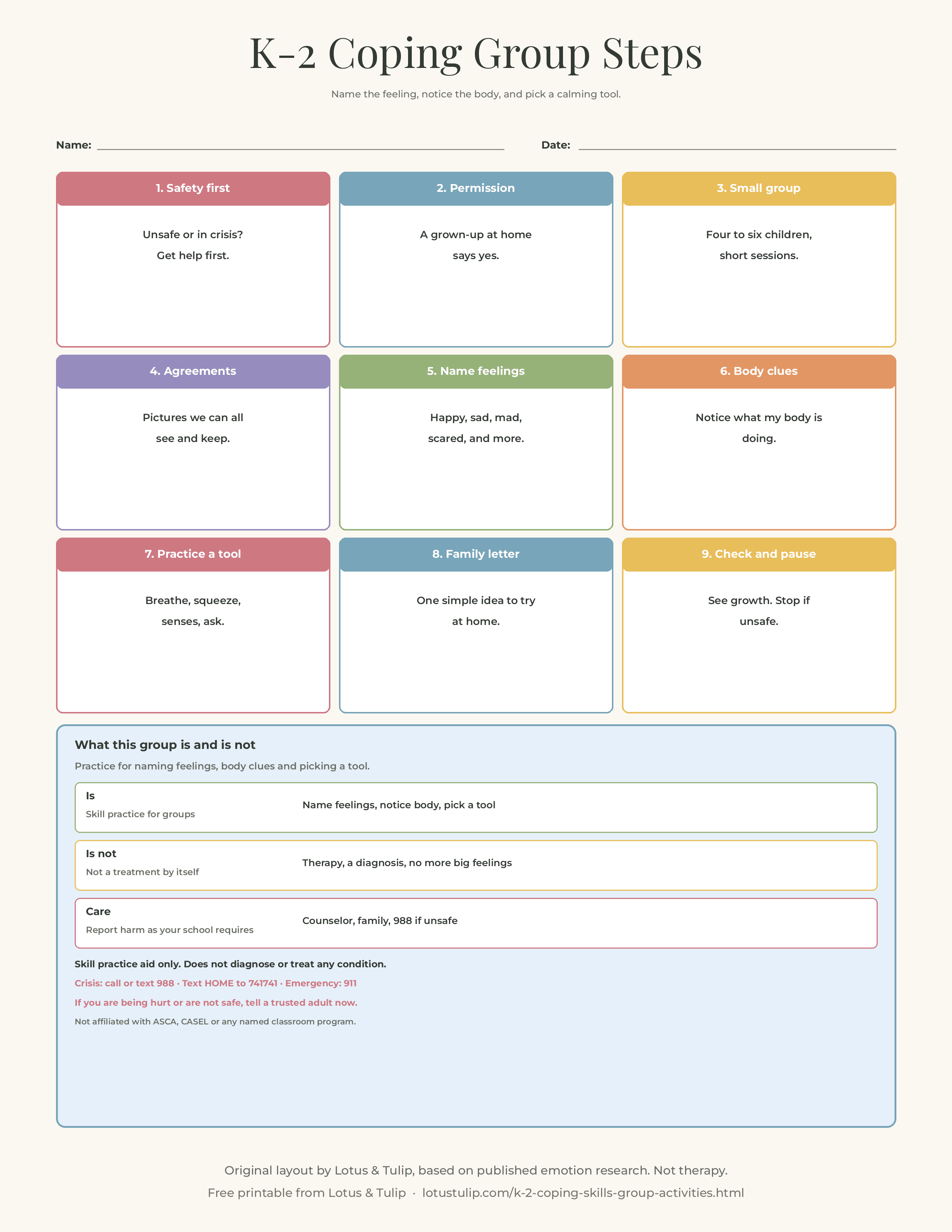
Download the free printable and use it in a small group, a one to one session or a short classroom lesson on naming feelings and picking a tool.
- Page 1: K-2 Coping Group Steps. Nine steps that match the HowTo, what this group is and is not, and crisis resources including 988, the Crisis Text Line and 911.
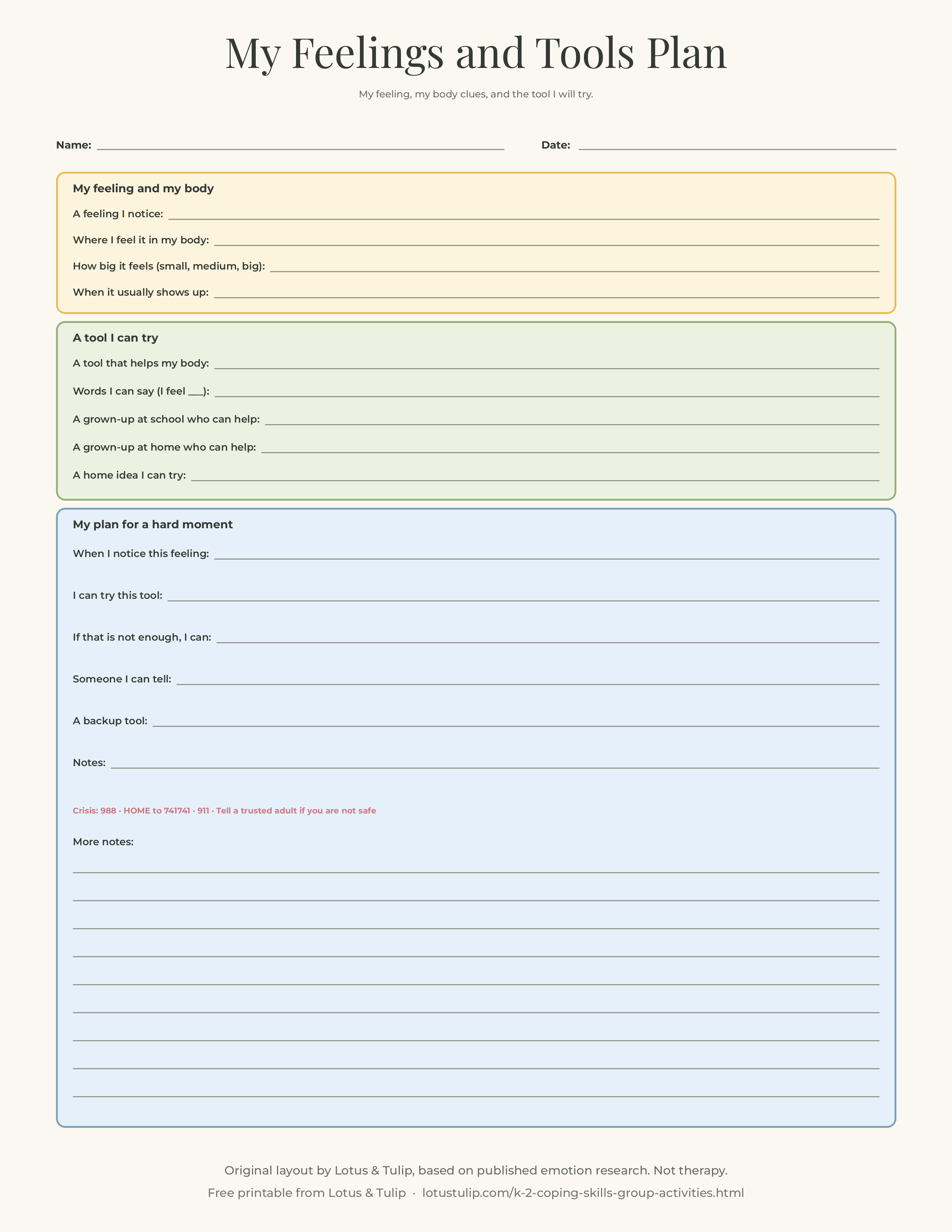
- Page 2: My Feelings and Tools Plan. Space for a feeling, body clues, feeling size, a tool, helper names and a short plan for a hard moment.
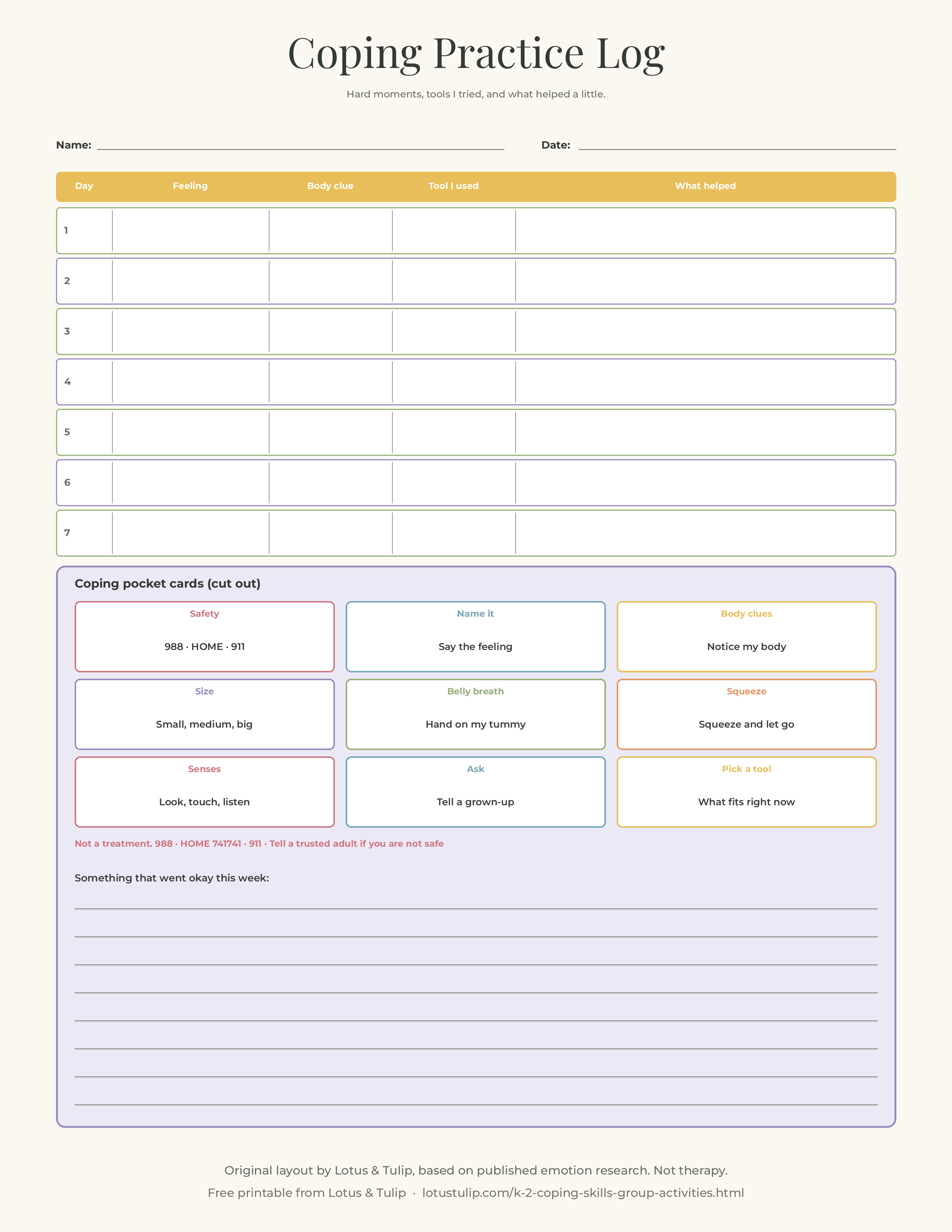
- Page 3: Practice Log. Seven rows for the day's feeling, body clue, tool used and what helped, plus nine pocket cards.
Download free PDF · Page 1 PNG · Page 2 PNG · Page 3 PNG
Research notes (verified, with caveats)
- Denham SA, Blair KA, DeMulder E, et al. Preschool emotional competence: pathway to social competence? Child Development. 2003;74(1):238-256. In 143 preschoolers, emotional competence measured at 3 to 4 years of age (expressiveness, regulation and emotion knowledge) contributed to social competence, shown by sociometric likability and teacher ratings, both at the time and later in kindergarten.
- Denham SA, Bassett HH, Way E, Mincic M, Zinsser K, Graling K. Preschoolers' emotion knowledge: self-regulatory foundations, and predictions of early school success. Cognition and Emotion. 2012;26(4):667-679. In 322 preschoolers (100 followed into kindergarten), emotion knowledge was more advanced in older children, in children not at economic risk and in children with higher self-regulation. It contributed to early school adjustment and academic success even with gender, age and risk taken into account, with stronger patterns for boys, older preschoolers and children at economic risk.
- Izard C, Fine S, Schultz D, Mostow A, Ackerman B, Youngstrom E. Emotion knowledge as a predictor of social behavior and academic competence in children at risk. Psychological Science. 2001;12(1):18-23. In 72 children from economically disadvantaged families, emotion knowledge (recognizing and labeling expressions) at age 5 predicted social behavior and academic competence at age 9, after controlling for verbal ability and temperament. The sample is small and specific; treat it as one careful longitudinal finding, not a universal rule.
- Trentacosta CJ, Fine SE. Emotion knowledge, social competence, and behavior problems in childhood and adolescence: a meta-analytic review. Social Development. 2010;19(1):1-29. Discrete emotion knowledge showed small to medium-sized relations with social competence, internalizing problems and externalizing problems.
- Thompson RA. Emotion regulation and emotional development. Educational Psychology Review. 1991;3(4):269-307. Thompson describes emotion regulation as processes that monitor, evaluate and modify emotional reactions. Early in life, caregivers help manage distress; regulation becomes more self-directed as language, thinking and self-understanding grow. Later writing by Thompson has emphasized that young children still need adult support because self-control systems develop early and slowly. That is the basis for putting co-regulation before independent coping in a K-2 group.
- Eisenberg N, Spinrad TL, Eggum ND. Emotion-related self-regulation and its relation to children's maladjustment. Annual Review of Clinical Psychology. 2010;6:495-525. The review distinguishes effortful self-regulation from less voluntary processes, and regulation from outside the child (for example, a parent) from self-regulation. Emotion-related self-regulation develops rapidly in the early years and more slowly later. Individual differences are inversely related to at least some types of externalizing problems. Findings for internalizing problems are less consistent, though an inverse relation appears after the early years. Some interventions that foster self-regulation have been at least partly effective.
- Compas BE, Jaser SS, Bettis AH, Watson KH, Gruhn MA, Dunbar JP, Williams E, Thigpen JC. Coping, emotion regulation, and psychopathology in childhood and adolescence: a meta-analysis and narrative review. Psychological Bulletin. 2017;143(9):939-991. Across 212 studies and 80,850 participants, adaptive coping, primary control coping (acting on a problem or on your own response) and secondary control coping (adapting when you cannot change the situation) were related to lower symptoms after publication bias was considered. Maladaptive coping, disengagement, suppression, avoidance and denial were related to higher symptoms. Many samples are older than kindergarten, so use this as a reason to teach engaged skills (name, try a tool, ask for help) rather than as proof that a K-2 school group reduces symptoms by a known amount.
- Durlak JA, Weissberg RP, Dymnicki AB, Taylor RD, Schellinger KB. The impact of enhancing students' social and emotional learning: a meta-analysis of school-based universal interventions. Child Development. 2011;82(1):405-432. Across 213 universal school-based SEL programs and 270,034 kindergarten through high school students, participants showed improved social and emotional skills, attitudes, behavior and academic performance, including an 11 percentile point gain in achievement compared with controls. That describes classroom-wide programs, not a 20 to 30 minute counselor group of four to six students.
- Taylor RD, Oberle E, Durlak JA, Weissberg RP. Promoting positive youth development through school-based social and emotional learning interventions: a meta-analysis of follow-up effects. Child Development. 2017;88(4):1156-1171. Across 82 universal school-based SEL interventions and 97,406 kindergarten to high school students, follow-up from 6 months to 18 years showed better social-emotional skills, attitudes and well-being than controls. Benefits were similar regardless of race, socioeconomic background or school location. This is evidence about universal programs over time, not about this pull-out group.
- American School Counselor Association. ASCA Student Standards: Mindsets and Behaviors for Student Success (2021). Wording verified from the official schoolcounselor.org PDF includes M 1, Belief in development of whole self, including a healthy balance of mental, social/emotional and physical well-being; B-SMS 2, Self-discipline and self-control; and B-SMS 7, Effective coping skills. No ASCA affiliation.
- CASEL. CASEL's SEL Framework (2020). Self-awareness is described as the abilities to understand one's own emotions, thoughts and values and how they influence behavior across contexts, including identifying one's emotions. Self-management is described as the abilities to manage one's emotions, thoughts and behaviors effectively in different situations and to achieve goals and aspirations, including managing one's emotions and identifying and using stress-management strategies. No CASEL affiliation.
Classroom programs such as Second Step, PATHS (Promoting Alternative Thinking Strategies) and The Incredible Years teach related emotion and social skills, often at a universal (Tier 1) level. This page is not affiliated with those programs and does not reproduce their lessons. A counselor group of four to six students is a different job than a classroom curriculum.
The activities on this page are original skill practice ideas drawn from themes these sources share: feeling names matter, body clues are teachable, young children often need an adult to co-regulate first, short practiced tools beat lectures, and asking for help counts as coping. They have not been tested as a package in a randomized trial, they are not a manualized protocol, and they are not a treatment claim.
K-2 coping skills group activities: FAQ
What are K-2 coping skills group activities?
They are structured activities a school counselor runs with about four to six students in kindergarten through grade 2. They cover feeling names, body clues, feeling size, short calming tools such as belly breathing, squeeze and release and a simplified five senses check, words to ask for help, and a personal toolkit. Children can point or draw. They do not have to share private family details.
How is a K-2 coping group different from an anxiety group or an anger group?
A K-2 coping group focuses on naming everyday feelings and picking a calming tool, with plenty of pictures and movement. An anxiety group focuses more on how worry works and on brave practice, and often fits grades 2 to 5 better. An anger group focuses on warning signs, cooling down and repair after a blow-up. Some children need a different group, or individual support, instead of or after this one.
What grade levels is this group for?
This page is written for kindergarten through grade 2, about ages 5 to 8. Younger preschoolers usually need even more caregiver involvement and shorter activities. Older elementary students may prefer a worry group, an anger group or individual pages rather than a picture-heavy K-2 plan.
How many sessions should a K-2 coping skills group have?
Many school counselors run six to eight weekly sessions of 20 to 30 minutes. The starter plan on this page uses eight sessions so there is room for feeling names, body clues, size, two or three body tools, asking for help and a toolkit. A shorter group should keep fewer goals and repeat the same tools.
Do school coping skills groups actually work for young children?
There is good evidence that emotion knowledge and adult-supported regulation are linked with better social adjustment in early childhood, and that universal school SEL programs can help students in general. There is not a single gold standard trial that proves a short K-2 "coping group" of this type. Treat the group as skill practice and support, not as a cure and not as a treatment claim. Young children often still need an adult nearby when they use a skill.
What should I do if a child shares something unsafe in group?
Calmly pause the activity, thank the child and talk with them privately right away. Follow your school's crisis or mandated reporting procedure. If a child talks about suicide or self-harm, call or text 988, text HOME to 741741 and call 911 if there is immediate danger. If a child describes abuse or feeling unsafe at home, report as required. Use a written safety plan when it fits. Do not ask the child to repeat the story to the group.
Can I run this as a virtual group?
Usually no, not as a four to six student video group. Kindergarten and first grade students need an adult in the room, materials they can touch and help staying with the activity. If distance services are required, prefer a short individual session with a caregiver present and a clear plan for reaching an on-site adult if safety comes up.
Is the free printable a copy of the paid curriculum?
No. The free three page set is an original companion with group steps, a personal feelings and tools plan and a practice log. The paid K-2 coping curriculum is an eight session pack with lesson plans, student pages and forms. The printable is not a preview of that PDF.