
Kids and teens · Updated 2026-11-08
Middle School Stress Group Activities (with Free Printable)
Ready-made printable: Middle School Stress Small Group Curriculum for Counselors Holiday 20% off: about $11.04, was $14 (EUR 12) · instant digital download
Buy on EtsyTry it free first: download session 1 free (group at a glance, lesson plan and student page, PDF, 73 KB). Run it with your group, then get all 8 sessions. No email needed.

Middle school stress group activities give students in grades 6 to 8 a predictable place to notice what stress does in the body, sort workload and recovery, look at sleep and screens without a lecture, and practice ways to reset. A good group respects young adolescents. It does not talk down to them, does not treat every tight deadline as a disorder, and does not promise that life will become calm. This guide is written for US school counselors (and the school social workers, school psychologists and adolescent therapists who run similar groups) who want a practical Tier 2 plan for about four to six students, in sessions of about 30 to 40 minutes.
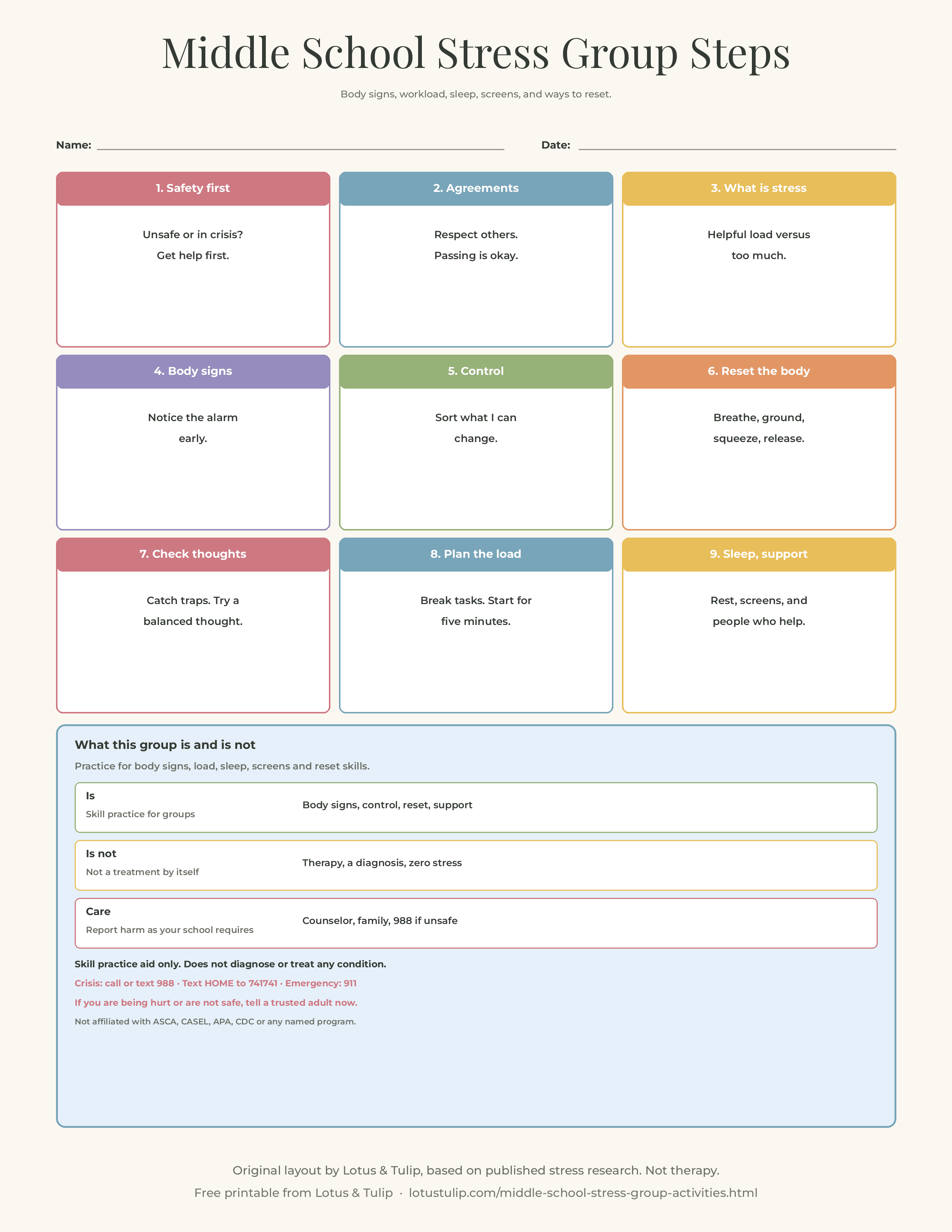
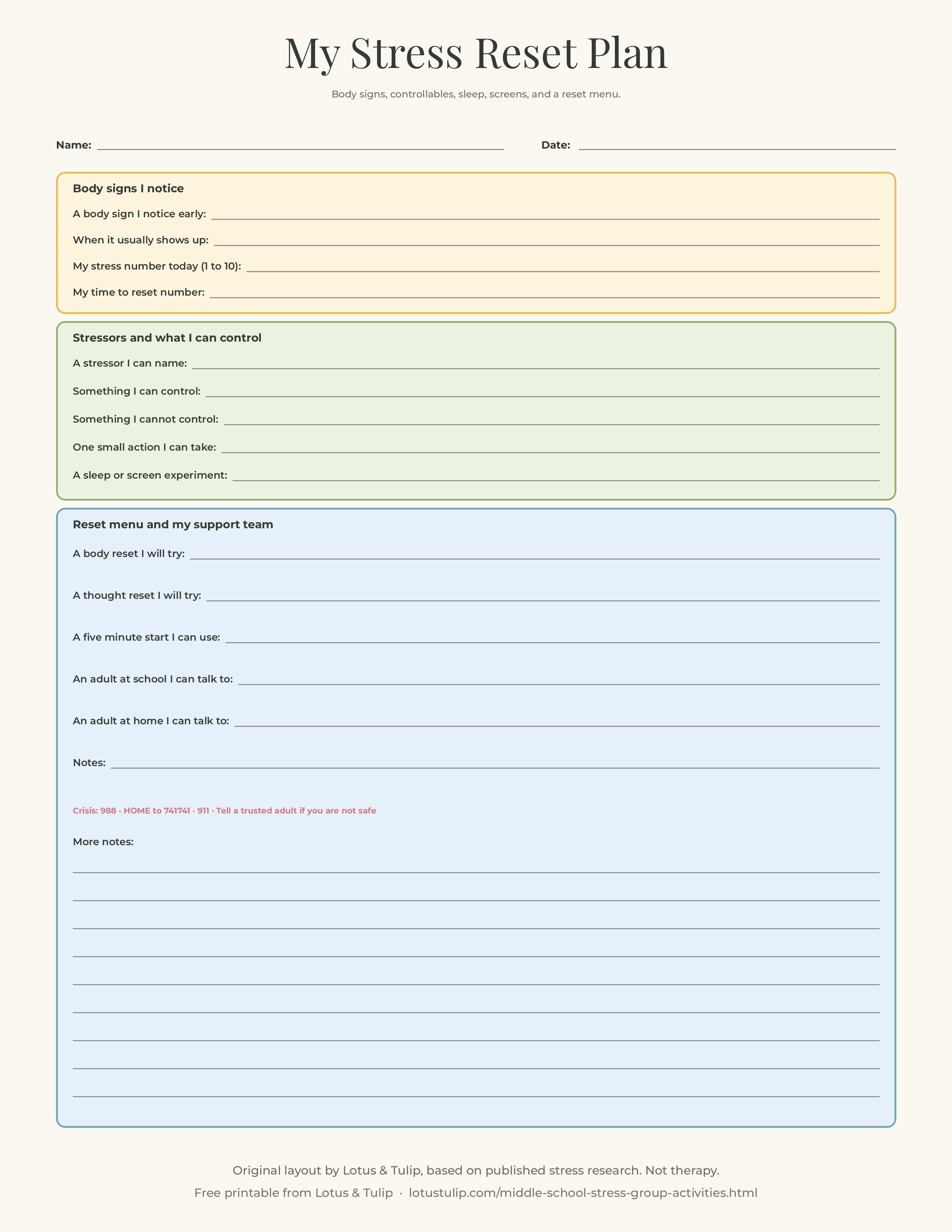
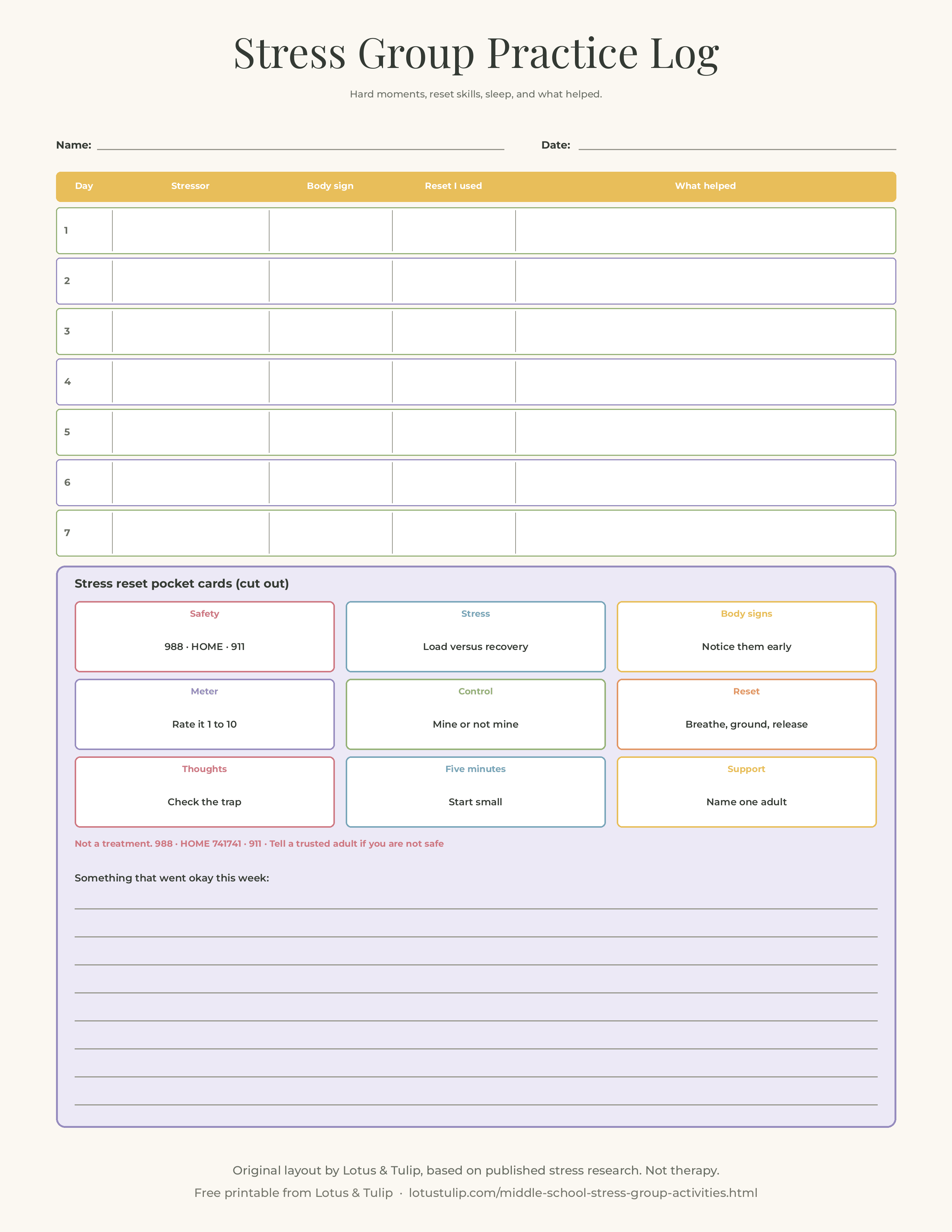
You will get a plain language model of what a middle school stress group can and cannot do, twelve activities you can actually run (with time, group size, materials, steps and a debrief), an eight session starter plan that matches the themes of a ready curriculum, a nine step HowTo, adaptations, tips for counselors, teachers and parents, mistakes, myths, three fictional examples, when-not guidance, verified research notes, eight FAQs and a free three page US Letter printable: Middle School Stress Group Steps, My Stress Reset Plan and a Practice Log with nine pocket cards.
This page is the counselor small-group how-to for grades 6 to 8. It sits beside, and is not a substitute for, our stress management worksheets for teens (individual pages for about ages 12 to 18, not a counselor group plan), small group counseling curriculum for anxiety (an elementary worry group), anxiety activities for teens, anxiety worksheets for adults, anxiety worksheets for kids, self care activities for teens, time management activities for teens, mindfulness activities for teens and middle school transition activities (the move from elementary school, not an ongoing stress group). Skill pages you can borrow from include the circle of control worksheet, breathing exercises for kids, the coping skills list for kids, the 5 4 3 2 1 grounding worksheet, the sleep hygiene worksheet, coping skills worksheets for teens, the test anxiety worksheet and study skills activities for teens.
We draw on published research and public guidance without claiming any affiliation or endorsement, including the American Psychological Association's 2014 teen Stress in America survey, CDC Youth Risk Behavior Survey findings on sleep and mental health among high school students, the Compas, Jaser, Bettis and colleagues (2017) meta-analysis of coping and emotion regulation in youth, Mary Carskadon's account of later sleep timing in adolescence, American Academy of Sleep Medicine sleep duration recommendations, American Academy of Pediatrics guidance on screens and sleep, the CASEL description of self-management, and the ASCA Student Standards: Mindsets and Behaviors for Student Success (2021). Full citations are below. The printable is an original Lotus and Tulip layout, not a preview dump of any paid curriculum.
This guide is educational. A middle school stress group does not diagnose a student, does not treat anxiety, depression, trauma, an eating disorder or any other condition, and does not replace counseling, medical care or a sleep evaluation. The activities are skill practice aids for counselors, not a standalone trial and not a manualized protocol. They are not affiliated with ASCA, CASEL, APA, CDC or any named program. If a student is thinking about suicide or self-harm, call or text 988 (Suicide and Crisis Lifeline) or text HOME to 741741 (Crisis Text Line). For immediate danger, call 911. Pause the group activity and use a written safety plan. If a student describes abuse, neglect or feeling unsafe at home, follow your mandated reporting procedure. A group is not the right tool for a student who is in crisis.
What a middle school stress group is (and is not)
Most middle school counselors already know the students who would fit. There is the seventh grader whose stomach hurts every Sunday night, the sixth grader who melts down when three teachers assign work on the same day, the eighth grader who is up past midnight on a phone and then cannot think in first period, the honors student who looks composed and then falls apart over one quiz, the athlete who is exhausted by Thursday, and the student who is carrying a heavy load at home as well as at school. A stress group is a short, structured series of sessions where four to six of these students practice a few useful skills together.
In plain words, a middle school stress group helps students:
- Name stress accurately. Helpful stress can sharpen focus before a game or a presentation. Too much stress, for too long, with too little recovery, leaves a student overloaded.
- Notice the body alarm early. A tight chest, a clenched jaw, a racing mind or a sudden urge to snap are information, not proof that something is wrong with them.
- Sort load and recovery. Schoolwork, activities, screens and home jobs all count as load. Sleep, food, movement, downtime and people who help count as recovery.
- Separate what they can control from what they cannot. They cannot control a pop quiz or another person's mood. They can control a five minute start, a bedtime plan and who they ask for help.
- Practice reset skills. A short body skill, a more balanced thought and a smaller next step are more useful than "just calm down."
- Protect sleep and be honest about screens. Later bedtimes are common in this age band. Phones in the bedroom make that later still.
A middle school stress group is not:
- An anxiety disorder group. Some students in the room will also be anxious, and the skills overlap. If the main problem is persistent worry, avoidance or panic, use an anxiety plan such as our elementary anxiety small group guide or anxiety activities for teens, and consider a referral. Stress and anxiety are neighbors, not the same thing.
- A trauma processing group. Students may mention hard things at home. You listen, you protect privacy, and you move safety concerns to individual support. You do not ask the group to retell traumatic events.
- An eating disorder group or a medical sleep clinic. If food restriction, bingeing, purging or a suspected sleep disorder is the main issue, stop treating it as ordinary school stress and refer.
- A lecture about grit. Young adolescents tune out pep talks. They stay with a group that takes their workload seriously and gives them something they can try that afternoon.
- A promise to remove all stress. Tests, tryouts, friendships and family life will keep producing pressure. The goal is a better ratio of load to recovery, and skills for the next hard week.
Core ideas that keep a middle school stress group honest
1. Stress and anxiety overlap, and they are not identical
Stress is the body and mind responding to a demand: a test tomorrow, three assignments due, a fight in a group chat, a late bus, a parent who is working two jobs. Anxiety is a more persistent alarm that often keeps firing after the demand has passed, or before it arrives. A student can have both. In group language, stay concrete: "What is the demand?" and "What is your body doing?" rather than "You have anxiety." If the student's life is not especially loaded and the alarm is still high most days, or if they are avoiding school, friends or sleep because of fear, they may need an anxiety focused plan rather than (or as well as) this group.
2. The body alarm is information
Fight, flight and freeze are ordinary survival responses. In middle school they can look like irritability, stomachaches, going blank on a quiz, snapping at a friend or shutting down in class. Teach students to notice the first sign, rate the intensity on a 1 to 10 meter, and choose a reset before the number climbs. The point is not to pathologize a racing heart before a presentation. The point is to catch an overload early enough to do something useful.
3. Load versus recovery matters more than a single bad day
One hard test week is normal. A pattern of high load and thin recovery is what wears students down: late nights, skipped meals, no downtime, constant notifications, plus sports or a job or younger siblings to watch. The group should map both sides. Adding another activity (even a "calming" one) without protecting recovery often makes the week worse.
4. Sleep and screens are part of the stress picture, not a side lecture
During puberty, biological night tends to shift later. Mary Carskadon has described this as part of a "perfect storm": a delayed body clock, a still high need for sleep, early school start times, homework, activities and evening screens. Middle school spans the American Academy of Sleep Medicine ranges of 9 to 12 hours for ages 6 to 12 and 8 to 10 hours for ages 13 to 18. In the 2023 Youth Risk Behavior Survey, only 23 percent of US high school students (a slightly older group) got at least 8 hours of sleep on an average school night. The American Academy of Pediatrics advises avoiding screens for an hour before bed and keeping phones out of the bedroom at night. Present this as information students can test, not as a scolding. Full citations are in the research notes.
5. Controllables beat rumination
Bruce Compas, Sarah Jaser, Alexandra Bettis and colleagues reviewed 212 studies (80,850 children and adolescents) on coping and emotion regulation. After they accounted for publication bias, adaptive coping, primary control coping (acting on a problem or on your own response) and secondary control coping (adapting when you cannot change the situation) were related to lower symptoms. Disengagement coping, and strategies such as suppression, avoidance and denial, were related to higher symptoms. That is a research reason to teach both "what can I change?" and "how do I handle what I cannot change?" rather than only venting or only "think positive."
6. Reset skills should be short enough to use at school
Box breathing, 5 4 3 2 1 grounding and a brief squeeze and release of muscle groups fit a passing period or the two minutes before a quiz. Longer practices belong at home or in a counseling office. Have students rate their stress number before and after so they can see whether a skill helped them, instead of taking your word for it.
7. The goal is not zero stress
Some pressure helps people prepare. The group aims for a workable level: enough activation to start the project, not so much that the student cannot sleep or cannot think. Tell students this in their own language: "We are not trying to make your life boring. We are trying to give you options when the load gets too heavy."
Counselors who write goals against professional frameworks can map this work (without any affiliation) to ASCA Student Standards such as M 1 (belief in development of the whole self, including a healthy balance of mental, social/emotional and physical well-being), B-LS 3 (time-management, organizational and study skills), B-SMS 2 (self-discipline and self-control), B-SMS 7 (effective coping skills), B-SMS 8 (balance of school, home and community activities) and B-SMS 10 (ability to manage transitions and adapt to change). CASEL describes self-management as the abilities to manage one's emotions, thoughts and behaviors effectively in different situations and to achieve goals and aspirations, including managing stress. Use those wordings if they help you write a lesson plan. Do not tell families the group is an ASCA or CASEL program.
Twelve middle school stress group activities
Each activity lists time, group size, materials, steps and a debrief question. Times assume a 30 to 40 minute middle school block with four to six students in grades 6 to 8. Activities 1 to 8 map onto the eight session plan below. Activities 9 to 12 are swaps and extensions.
1. Group agreements that respect older students
Time: 15 minutes. Group size: 4 to 6. Materials: chart paper, markers, printable page 1, a simple pass signal (a card turned over or a hand on the table).
Steps: Tell students this is a skills group for people who feel overloaded, not a class for "kids who cannot handle middle school." Ask what would make it safe enough to talk. Write four to six agreements in their words: we take turns, passing is fine, we do not use someone's story later in the hallway, and nobody has to share family details or grades. Add the adult promise in plain words: "If someone is being hurt or might hurt themselves, I have to get help, because safety comes first." Practice one pass round so passing looks normal, not like failure.
Debrief: "Which agreement will be hardest to keep outside this room?" Teaching point: respect and privacy make skill practice possible, and safety still comes first.
2. What is stress: helpful load versus too much
Time: 20 minutes. Group size: 4 to 6. Materials: two columns on chart paper or a whiteboard, sticky notes, a stressor inventory page (students list current demands; they do not have to share every item).
Steps: Give two fictional examples you invent on the spot (a student who feels extra alert before a basketball game, and a student who has not slept, has three tests and has been scrolling until 1 a.m.). Ask which kind of stress might help and which kind piles up. Students write private stressors on sticky notes and sort a few anonymous ones into "helpful, at least sometimes" and "too much, too long." Categories often include grades and tests, friendships and group chats, sports or activities, home jobs, and screens. Do not force anyone to read a note aloud.
Debrief: "What is one demand that is yours this week, and is it more helpful or more too much?" Teaching point: stress is a response to a demand, and the same demand can be useful in a small dose and overwhelming in a large one.
3. Warning signs and a daily stress meter
Time: 20 minutes. Group size: 4 to 6. Materials: a simple body outline, colored pencils, a 1 to 10 meter drawn on paper or the board.
Steps: Name common body, mind and behavior signs without turning them into a diagnosis: tight stomach, headache, clenched jaw, racing thoughts, going blank, snapping, avoiding the locker, gaming for hours to disappear. Students mark where their own early signs show up. Then they rate a recent school moment from 1 (steady) to 10 (overloaded) and identify the number where a reset is still possible, before they hit a 9. Teach that fight, flight and freeze can all show up in class. Our feelings thermometer can sit beside the meter if students like a visual scale.
Debrief: "What is your earliest warning sign, and what number is your 'time to reset' point?" Teaching point: noticing the alarm early gives you a choice.
4. Circles of control and one small action
Time: 20 minutes. Group size: 4 to 6. Materials: two circles (inside: I can influence; outside: I cannot control), slips of paper. Our circle of control worksheet works if you want a printed page.
Steps: Students sort slips such as: whether a teacher gives a pop quiz, how I start homework, a friend's mood, whether I bring my charger, the Wi-Fi at home, my breathing, a parent's work schedule, how late I keep my phone, who I ask for help. Then each student writes one current stressor and decides where it belongs. If it is outside the circle, they choose one inside action that makes the next day slightly more workable (email a teacher, set a phone to charge in the kitchen, start for five minutes, ask a sibling to wait).
Debrief: "What is one inside-the-circle action you can take before tomorrow?" Teaching point: energy spent on the outer circle rarely changes the week; one inner action often does.
5. Calm the body: three short resets with before and after ratings
Time: 20 to 25 minutes. Group size: 4 to 6. Materials: a timer, a before and after rating strip (stress number 1 to 10), optional cards from our breathing exercises and 5 4 3 2 1 grounding pages.
Steps: Teach three tools students can use at a desk: box breathing (in, hold, out, hold, each to a slow count of four), 5 4 3 2 1 grounding (five things you see, four you can touch, three you hear, two you smell or like the smell of, one you can taste or one slow breath), and squeeze and release (tighten fists, shoulders or legs for five seconds, then let go). Students rate their number, try one tool for about two minutes, then rate again. Compare notes: a skill that drops someone from a 7 to a 5 is a keeper, even if it does not create calm. Remind them that these are practice tools, not a treatment for panic or trauma.
Debrief: "Which tool changed your number at least a little, and where could you use it at school?" Teaching point: you find out what works by measuring, not by guessing.
6. Thought trap detective
Time: 20 to 25 minutes. Group size: 4 to 6. Materials: a simple chart with columns for the situation, the automatic thought, the trap name and a more balanced thought.
Steps: Define four traps in student language: catastrophizing ("If I fail this quiz my year is ruined"), all or nothing ("If it is not an A, it is a failure"), mind reading ("They all think I am awkward") and fortune telling ("I already know I will freeze"). Use fictional examples only. Students pick one thought from their own week if they want to, or work from a fictional card. They write a balanced alternative that is honest, not cheerful ("I might do worse than I want, and I can ask about a retake or study the next section"). This is thought checking, not thought stopping. Cross-link to test anxiety pages if tests are the hook.
Debrief: "Which trap shows up most for you, and what is one sentence that is more balanced?" Teaching point: a thought can feel true and still be exaggerated, and you can test it.
7. Taming the to do list: break it down and start for five minutes
Time: 20 to 25 minutes. Group size: 4 to 6. Materials: scrap paper, a simple weekly planner, a timer. Study skills activities for teens and time management activities for teens go deeper if planning is the main need.
Steps: Ask what makes a task feel impossible (it is vague, it is huge, they do not know the first step, they are already tired). Each student picks one real assignment and breaks it into three to five visible steps, then circles the first step that would take about five minutes. Practice a five minute start in the room if you can: open the document, write the heading, read the first paragraph, or list three study questions. Add a weekly view: which nights are already full (practice, a late bus, a sibling to watch) and which night has a realistic work window. The planner is a recovery tool as much as a productivity tool. Do not turn this into a productivity contest.
Debrief: "What is the five minute start for your next hard task?" Teaching point: starting small beats waiting to feel ready.
8. Sleep, screens and a support map
Time: 20 to 25 minutes. Group size: 4 to 6. Materials: a habit check (usual bedtime, wake time, where the phone sleeps, caffeine after dinner) and a support map with room for adults and peers. Our sleep hygiene worksheet can extend the home piece.
Steps: Share the sleep ranges without shaming: about 9 to 12 hours for ages 6 to 12 and 8 to 10 hours for ages 13 to 18, according to the American Academy of Sleep Medicine. Many middle schoolers sit on the border of those bands. Ask what gets in the way (homework sprawl, group chats, videos that autoplay, a noisy house, early sports). Students privately note one sleep habit and one screen habit they could test for a week, such as charging the phone outside the bedroom or stopping fast-paced games an hour before lights out, which matches American Academy of Pediatrics sleep and media advice. Then they map support: an adult at school, an adult at home or in the family, a friend who helps rather than hypes the drama, and how they would ask. A habit check is not a medical sleep study. If a student snores loudly, gasps at night, or is exhausted despite a long time in bed, suggest a conversation with a parent or guardian about medical evaluation.
Debrief: "What is one sleep or screen experiment you are willing to try, and who is on your support map?" Teaching point: recovery is part of handling stress, and people count as recovery too.
9. Stressor sort across school, friends, screens and home
Time: 15 to 20 minutes. Group size: 4 to 6. Materials: four labeled areas or envelopes, sticky notes.
Steps: Students sort anonymous (or private) stressors into school, friendships and group chats, screens, and home. Look for piles. A student whose notes are almost all "home" may need individual time, because the group cannot fix an unsafe or overloaded household. A student whose notes are almost all "screens" can set one experiment. This activity pairs well with session 1 or 2 if you want more detail than a single inventory.
Debrief: "Which pile is heaviest this month, and which pile can you influence a little?" Teaching point: naming the category makes the next skill easier to choose.
10. Match a reset to the warning sign
Time: 15 minutes. Group size: 4 to 6. Materials: the body's warning signs from activity 3 and a short menu (breathe, ground, squeeze and release, walk to get water, five minute start, ask a person). Our coping skills worksheets for teens and coping skills list for kids offer extra menu ideas if you want a longer list.
Steps: Students draw lines from a body sign to a matching tool: tight chest to box breathing, racing thoughts to grounding, restless legs to a wall push or a short walk, "I cannot start" to a five minute start, "I feel alone" to a support person. They pick a primary tool and a backup. Rate before and after if you have two extra minutes.
Debrief: "Which match will you actually remember on a Wednesday?" Teaching point: a menu beats a single favorite skill used for every problem.
11. A week map of load and recovery
Time: 20 minutes. Group size: 4 to 6. Materials: a seven day grid with two rows, Load and Recovery. Self care activities for teens can help students brainstorm recovery that does not sound childish.
Steps: Students block the coming week: classes with tests, practices, a late activity bus, family jobs, and screen time that tends to sprawl. Then they mark recovery: sleep window, meals, a short outdoor break, a hobby that is not another performance, time with a person who helps. Look together for days that have almost no recovery. The fix is often removing or shrinking one load item, not adding a new "wellness" task. High achieving students and athletes often need this map more than a breathing lesson.
Debrief: "Which day is most overloaded, and what is one recovery you can protect?" Teaching point: stress rises when load stays high and recovery disappears.
12. Build a stress toolkit and close the group
Time: 25 minutes. Group size: 4 to 6. Materials: an envelope or index cards per student, printable page 3 pocket cards, a certificate if you use one.
Steps: Students choose four to six tools that actually helped during the group: an early warning sign, their reset number, one body skill, one balanced thought, a five minute start, a sleep or screen experiment, and the name of a helper. They write a short note to themselves for a future hard week: "When my number hits ___, I will ___ and I can talk to ___." Repeat the pre and post skills check if you used one in session 1. Celebrate without empty praise: name specific skills you saw, not "you are all so strong." Plan a check-in about four to six weeks later.
Debrief: "Which tool will you keep where you can find it (locker, notes app, or planner)?" Teaching point: the group ends, the toolkit stays.
An eight session starter plan (skills practice, not a certified protocol)
Each session runs about 30 to 40 minutes for four to six students and follows the same shape: a number check-in (1 to 10), a short review of last week's experiment, one teaching point, one activity, a closing round and a small take-home. The session themes below match a typical middle school stress curriculum: what stress is, the body alarm, controllables, calming skills, thought traps, planning, sleep and screens with support, and a personal toolkit. They are a skills practice outline, not a tested manual and not a claim that this sequence has its own trial.
| Session | Focus | Activity | Take-home |
|---|---|---|---|
| 1 | Welcome, what is stress? | Agreements; helpful stress versus too much; stressor inventory | Notice one demand and whether it felt helpful or too much |
| 2 | Stress in my body and brain | Warning signs chart and a 1 to 10 daily stress meter | Log an early warning sign and a number once a day |
| 3 | What I can control | Circles of control and one small action step | Do one inside-the-circle action |
| 4 | Calm the body | Box breathing, 5 4 3 2 1 grounding, squeeze and release, before and after ratings | Try one body reset and write the before and after numbers |
| 5 | Thought traps | Catastrophizing, all or nothing, mind reading, fortune telling, and a balanced thought | Catch one trap and write a more balanced sentence |
| 6 | Taming the to do list | Break a real task into steps, make a weekly plan, practice a five minute start | Use a five minute start on one assignment |
| 7 | Sleep, screens and support | Habit check and a personal support map | Test one sleep or screen experiment and name a helper |
| 8 | My stress toolkit and celebration | Personal toolkit, note for a hard week, pre and post check, certificate | Keep the toolkit where you can find it |
Use a brief pre and post skills check in sessions 1 and 8 if you want a simple growth picture (for example, "I can notice stress in my body," "I can name something I can control," "I have a reset skill," "I have an adult I can talk to"), each rated from 1 to 4. Keep expectations realistic. A good outcome is a student who can name a warning sign, rate their number, pick a reset, start a task for five minutes and ask one person for help, even if middle school is still loud.
How to run a middle school stress group, step by step
- Screen for safety and fit first. Read teacher referrals and talk briefly with each student. A student who is in crisis, describes abuse, talks about suicide or self-harm, shows signs of an eating disorder, or seems to be processing trauma needs individual support and your reporting path first, not a skills group. Use 988, HOME to 741741, 911 and your school's procedures when safety is in question. See the safety plan worksheet.
- Collect referrals and consent. Use a teacher referral that asks about observable signs (irritability, missing work, frequent nurse visits, exhaustion) rather than a diagnosis. Send a parent or guardian letter that describes the group as a skills group on stress, workload, sleep, screens and reset tools, and include a consent slip if your district requires one.
- Form a balanced group. Four to six students in grades 6 to 8 works well. Avoid mixing a student in acute crisis with a skills group. Think twice before placing close friends who will perform for each other, or one student who is much younger than the rest.
- Set agreements and explain confidentiality in adolescent language. Build agreements in session 1, practice passing, and say clearly that hallway gossip is off limits. Explain the safety exception without drama.
- Teach what stress is, and what it is not. Use the helpful versus too much sort and a private stressor inventory. Keep the tone respectful. Students this age notice immediately if you treat them like elementary children.
- Map the body alarm and a 1 to 10 meter. Help each student name an early warning sign and a number that means "time to reset." Repeat the meter every week so it becomes a habit.
- Practice controllables and short body resets. Run the circles of control and the three desk-friendly skills (box breathing, 5 4 3 2 1, squeeze and release) with before and after ratings so students can see what helps them.
- Work on thoughts, workload, sleep, screens and support. Sequence thought traps, task breakdown with a five minute start, and a habit check plus support map. Link to test anxiety or study skills pages when schoolwork is the main hook.
- Build a personal toolkit and close well. Have students keep the tools that worked, repeat a pre and post check if you used one, celebrate specific skills and plan a follow-up about four to six weeks later. Offer individual counseling or a community referral for students who are still struggling.
Adaptations
- Grade 6. Keep language concrete and use more drawing or sorting. Sixth graders may still like a visual meter and shorter writing. They are also new to multiple teachers, which overlaps with middle school transition activities if the main issue is the move itself rather than ongoing overload.
- Grade 8. Expect more talk about reputation, high school applications or placements, dating drama, jobs and phones. Give more choice about what they share. Eighth graders often prefer a planner and a thought chart to a cute metaphor.
- Students with ADHD. Keep the same session shape every week, show a visual agenda, build in movement, and make the five minute start the star of session 6. Externalize the plan on paper. These are supports, not ADHD treatment, and they do not replace evaluation or a 504 or IEP conversation.
- Autistic students. Preview the plan, allow written instead of spoken sharing, watch for sensory overload in a small room, and be literal about agreements. Do not force eye contact or "relax your body" language that may not fit. Again, these are supports, not autism treatment.
- Anxious students. A stress group can still help if the student's life really is loaded. If avoidance, panic or constant "what if" thinking is the center of the problem, add or switch to anxiety activities for teens and consider the elementary anxiety small group guide only for younger students. Do not tell an anxious student to simply think less.
- High achievers. Skip pep talks about trying harder. Use the week map, thought traps (especially all or nothing and catastrophizing) and a recovery plan they will not see as slacking. Permission to do a "good enough" draft is often the skill they lack.
- Athletes. Treat practice, games and travel as real load. Protect sleep around late games. Watch for students whose only recovery is more performance. Muscle squeeze and release often lands better than a long breathing monologue.
- Students with a heavy home load. Caring for siblings, translating for adults, a parent who works nights, or an unstable house will not be fixed by a planner. Keep controllables honest, strengthen the support map, and offer individual time. If home is unsafe, pause group work and follow your reporting path.
- English learners. Use visuals for the meter and the circles, offer sentence frames ("My warning sign is ___," "I can control ___," "I will start by ___"), and send family letters in the home language when you can.
- A classroom lesson. Activities 2, 3, 4, 5 and 7 work as single advisory lessons. Skip personal disclosure. Use fictional examples only in a whole class setting.
- Telehealth or virtual groups. Check that the student has a reasonably private space. Use a shared slide for the circles and the meter. Do not ask students to share their screen of a private inventory. Have a crisis plan for a remote session, including how you will reach a parent or an on-site adult if safety comes up.
Tips for counselors, teachers and parents
For school counselors
- Do not pull students from their only elective or from a class they already fear, or the group becomes another stressor.
- Repeat the 1 to 10 check-in every week. The ritual teaches the skill faster than a single lecture.
- Send teachers one paragraph: the student is practicing an early reset and a five minute start, which helps more than "get organized."
- Check in four to six weeks later, especially before exam week.
For teachers
- Refer based on what you see (missing work after a full evening of activities, frequent nurse visits, irritability, shutdown) rather than a guess about diagnosis.
- A student who looks lazy may be overloaded or underslept. A short "what is the first step?" prompt often works better than a lecture.
- If several teachers assign large tasks on the same day, say so in the team meeting. The group cannot fix a stacked calendar by itself.
For parents and guardians
- Ask "What was your number today?" and "What helped a little?" rather than "Why are you so stressed?"
- Protect sleep like an appointment. Charging phones outside the bedroom is one of the few home changes that often shows up the next morning.
- Do not remove every demand. Help your child drop or shrink one thing when the week map is packed, and keep one recovery block they actually like.
- If your child talks about wanting to die, not wanting to be here, or hurting themselves, take it seriously the same day. Call or text 988, text HOME to 741741, call 911 if there is immediate danger, and tell the school counselor.
Common mistakes
- Talking to eighth graders as if they are in third grade. Cute posters and forced sharing will shut the room down.
- Treating every stressed student as anxious, or every anxious student as "just stressed." Assess which problem is in front of you.
- Making the group a vent session with no skill. A little sharing builds trust. An entire period of dumping often leaves students more amped up.
- Promising that breathing will fix a stacked schedule. Body skills help the next ten minutes. Planning and recovery help the next ten days.
- Shaming screens or sleep. Students will hide the truth. Ask what they are willing to test for one week.
- Using the group to process trauma or family conflict. Listen, protect privacy, and move those topics to individual support.
- Skipping follow-up. Skills fade during a hard quarter if nobody checks whether they are still in use.
Myths about middle school stress groups
- Myth: middle schoolers should be able to handle this by now. Their schedules often look like adult schedules, while their sleep clocks are shifting later. Support is not the same as lowering standards.
- Myth: if we talk about stress we will make them more stressed. Naming a demand and picking a skill is different from rumination. The group is short and structured on purpose.
- Myth: the goal is to eliminate stress. Some stress helps people prepare. The goal is a workable load and a way to reset.
- Myth: a worksheet will fix it. Pages help students remember a plan. The practice happens in the week between sessions.
- Myth: teens who look fine are fine. High achievers and students who fear looking weak often hide overload until something breaks.
- Myth: this group treats anxiety, ADHD, trauma or insomnia. It does not. It is skill practice for ordinary and high school stress, with a clear door out when something else is going on.
Three fictional examples
These examples are invented to show how the activities fit together. They are not real students.
Avery, grade 7: the honors calendar that never ended
Avery was referred for irritability and missing smaller homework after late nights of studying. In session 2 Avery's earliest warning sign was a clenched jaw at a 6, usually by Thursday. The circle of control in session 3 put "whether advanced classes are hard" outside the circle and "when I start the review sheet" inside it. Session 6 turned a science project into five steps and a five minute start (open the doc and write the question). Session 7 showed a pattern: phone in bed until after midnight, then a 6:15 a.m. alarm. Avery agreed to charge the phone in the kitchen for one week as an experiment, not a personality makeover. By session 8 the pre and post check moved on "I can break a task down" and "I have a reset skill." Avery was still busy. The week was more workable.
Noah, grade 6: stomachaches before first period
Noah's teacher noticed frequent nurse visits and shutdowns when several assignments landed at once. Noah did not want to talk in front of the group at first, so passing was modeled on day one. The warning signs chart helped Noah see the stomachache as an early alarm, not proof that something terrible was about to happen. Before and after ratings showed that box breathing dropped Noah from a 7 to a 5, while grounding did less. The week map showed almost no recovery on Tuesdays (band plus a late pickup). Noah asked a parent, using a practiced sentence, for a quieter homework spot after band instead of starting at 8:30 p.m. The stomachaches did not vanish. The nurse visits dropped, and Noah had a plan for stacked Tuesdays.
Sam, grade 8: a pause for safety
In session 5, while the group worked on thought traps, Sam wrote that a balanced thought did not matter because "I do not want to be here anyway" and mentioned cutting when stressed. The counselor calmly paused that part of the activity, thanked Sam for putting it on paper, and met with Sam privately as soon as the others began a short written task. The counselor followed the school's crisis procedure, contacted a parent or guardian, used a written safety plan, and shared 988, text HOME to 741741 and 911 for immediate danger. Sam did not return to the skills group that week. Individual support came first. The group was never the tool for that problem.
How this page compares to nearby Lotus and Tulip guides
| Page | Best for | Format |
|---|---|---|
| This page | School counselors running a stress skills group for grades 6 to 8 | Small group activities, eight session plan, counselor how-to |
| Small group counseling permission slip and parent letter | Getting parent permission and student assent before session 1 | Consent how-to (ASCA, FERPA, opt in vs opt out, state examples) with a free letter, filled example and permission log |
| Stress management worksheets for teens | Individual work with teens about ages 12 to 18 | Worksheets, not a grades 6 to 8 group plan |
| Small group counseling curriculum for anxiety | Elementary worry and anxiety groups | Younger students, worry focused |
| Anxiety activities for teens | Teens whose main issue is anxiety | Teen anxiety activities |
| Anxiety worksheets for adults | Adult clients and therapists | Adult clinical worksheets |
| Anxiety worksheets for kids | Younger children with worry | Kids worksheets |
| Self care activities for teens | Recovery habits and care routines | Teen self care, not a stress group |
| Time management activities for teens | Planning and priorities | Teen planning activities |
| Mindfulness activities for teens | Noticing the present moment | Teen mindfulness practice |
| Middle school transition activities | The move into middle school | Schedules, maps, lockers, new teachers |
| Circle of control worksheet | A single controllables page | Individual worksheet |
| Breathing exercises for kids | Teaching calm breathing | Breathing how-to and cards |
| Coping skills list for kids | A menu of tools | List and ideas |
| 5 4 3 2 1 grounding worksheet | A sensory grounding practice | Single skill page |
| Sleep hygiene worksheet | Sleep routines | Individual sleep page |
When not to use these activities
- A student is in crisis. Thoughts of suicide or self-harm call for 988, HOME to 741741, 911 if there is immediate danger, your school's crisis procedure and a written safety plan, not a group session on thought traps.
- Abuse, neglect or a student who is not safe at home. Report as required and plan individual support first.
- Trauma processing. This group does not walk students through traumatic memories. Stabilization and a trauma-informed referral come first.
- A suspected eating disorder. Do not turn food, body comments or restriction into a casual "stress habit" chat. Refer to someone qualified to assess that risk.
- A suspected medical sleep problem. Loud snoring, gasping, falling asleep in class despite a long time in bed, or sudden sleep attacks need medical evaluation. A habit check is not a substitute.
- Severe or worsening symptoms. Ongoing panic, depression, school refusal, self-harm or a sharp behavior change needs assessment and a referral to a mental health professional.
- The student does not want to join. Invite and explain, but do not force. Offer a short individual check-in instead.
Free 3 page middle school stress group printable (US Letter)
Download the free printable and use it in a small group, a one to one session or an advisory lesson on overload and recovery.
- Page 1: Middle School Stress Group Steps. Nine steps that match the HowTo, what this group is and is not, and crisis resources including 988, the Crisis Text Line and 911.
- Page 2: My Stress Reset Plan. Space for body signs, current stressors, a circle of control, a sleep and screens experiment, and a short reset menu.
- Page 3: Practice Log. Seven rows for the day's stressor, body sign, reset used and what helped, plus nine pocket cards.
Download free PDF · Page 1 PNG · Page 2 PNG · Page 3 PNG
Research notes (verified, with caveats)
- American Psychological Association. Stress in America: Are Teens Adopting Adults' Stress Habits? Press release, 11 February 2014. Harris Interactive surveyed 1,018 US teens ages 13 to 17 and 1,950 adults in August 2013. Teens reported school year stress at 5.8 on a 10 point scale, above the 3.9 they called healthy and above adults' 5.1. Many teens reported feeling overwhelmed (31 percent) or depressed or sad (30 percent) as a result of stress, 36 percent reported fatigue or feeling tired, and 23 percent reported skipping a meal due to stress. Teens reported 7.4 hours of sleep on school nights and 8.1 hours on non-school nights. This survey is older and covers ages 13 to 17, so treat it as context rather than a current census of grades 6 to 8. Later Stress in America reports (2023 and 2024) surveyed adults ages 18 and over, not teens.
- Centers for Disease Control and Prevention. Youth Risk Behavior Survey Data Summary and Trends Report for Dietary, Physical Activity, and Sleep Behaviors: 2013 to 2023. In 2023, 23 percent of US high school students got at least 8 hours of sleep on an average school night (32 percent in 2013). YRBS covers grades 9 to 12, a slightly older group than middle school.
- Verlenden JV, Fodeman A, Wilkins N, et al. Mental health and suicide risk among high school students and protective factors. MMWR Supplements. 2024;73(4):79-86. In the 2023 YRBS (20,103 high school students), 39.7 percent experienced persistent feelings of sadness or hopelessness and 28.5 percent experienced poor mental health always or most of the time in the past 30 days. The survey question tells students that poor mental health includes stress, anxiety and depression. Getting 8 or more hours of sleep was associated with lower prevalence of all mental health and suicide risk indicators in that analysis (adjusted prevalence ratios between 0.53 and 0.67). These figures describe high school students, not a middle school stress group, and they are not an effect size for school stress groups.
- Compas BE, Jaser SS, Bettis AH, Watson KH, Gruhn MA, Dunbar JP, Williams E, Thigpen JC. Coping, emotion regulation, and psychopathology in childhood and adolescence: a meta-analysis and narrative review. Psychological Bulletin. 2017;143(9):939-991. A review of 212 studies with 80,850 participants. After accounting for publication bias, the broad domain of emotion regulation and adaptive coping, and the factors of primary control coping and secondary control coping, were related to lower symptoms of psychopathology. Maladaptive coping, disengagement coping, and strategies such as emotional suppression, avoidance and denial were related to higher symptoms. This supports teaching both problem-focused steps and ways to adapt when a demand cannot be changed. It is not an effect size for school stress groups.
- Carskadon MA. Sleep in adolescents: the perfect storm. Pediatric Clinics of North America. 2011;58(3):637-647. Describes later circadian timing in adolescence, a still substantial need for sleep, and social schedules (including early school start times and evening demands) that cut sleep short.
- Paruthi S, Brooks LJ, D'Ambrosio C, et al. Recommended amount of sleep for pediatric populations: a consensus statement of the American Academy of Sleep Medicine. Journal of Clinical Sleep Medicine. 2016;12(6):785-786. Children aged 6 to 12 should sleep 9 to 12 hours per 24 hours on a regular basis; teenagers aged 13 to 18 should sleep 8 to 10 hours. Regularly sleeping fewer than the recommended hours is associated with attention, behavior and learning problems and with higher risk of accidents, injuries, hypertension, obesity, diabetes and depression. In teenagers, insufficient sleep is also associated with increased risk of self-harm, suicidal thoughts and suicide attempts.
- American Academy of Pediatrics, Center of Excellence on Social Media and Youth Mental Health. Screen Time Affecting Sleep (Q and A, 18 October 2023). Advises avoiding screens for an hour before bed, keeping phones and screens out of the child's bedroom at night, and choosing calmer evening media. The same page cites sleep ranges of 9 to 11 hours for ages 6 to 13 and 8 to 10 hours for ages 14 to 17, which is a slightly different banding than the AASM ranges above; report both honestly rather than blending them into one invented number. The AAP no longer treats a single daily screen-time minute cap as the main rule for older children and teens; the practical point here is not letting screens displace sleep.
- American School Counselor Association. ASCA Student Standards: Mindsets and Behaviors for Student Success (2021). Wording verified from the official schoolcounselor.org PDF includes M 1, Belief in development of whole self, including a healthy balance of mental, social/emotional and physical well-being; B-LS 3, Time-management, organizational and study skills; B-SMS 2, Self-discipline and self-control; B-SMS 7, Effective coping skills; B-SMS 8, Balance of school, home and community activities; and B-SMS 10, Ability to manage transitions and adapt to change. No ASCA affiliation.
- CASEL. CASEL's SEL Framework (2020). Self-management is described as the abilities to manage one's emotions, thoughts and behaviors effectively in different situations and to achieve goals and aspirations. That includes delaying gratification, managing stress and having the agency to accomplish personal and collective goals. No CASEL affiliation.
The activities on this page are original skill practice ideas drawn from themes these sources share: accurate information about stress, noticing the body, matching coping to what can and cannot be changed, protecting sleep and asking for help. They have not been tested as a package in a randomized trial, they are not a manualized protocol, and they are not a treatment claim.
Middle school stress group activities: FAQ
What are middle school stress group activities?
They are structured activities a school counselor runs with about four to six students in grades 6 to 8 who feel overloaded. They cover what stress is, body warning signs, what students can and cannot control, short reset skills, thought traps, planning schoolwork, sleep and screens, and a personal toolkit. Students do not have to share private family details.
How is a stress group different from an anxiety group?
A stress group focuses on demands such as workload, sleep, screens and recovery, plus skills for a heavy week. An anxiety group focuses more on persistent worry, avoidance and brave practice. Some students need both. For elementary worry groups see our anxiety small group guide. For teen anxiety, see anxiety activities for teens.
What grade levels is this group for?
This page is written for grades 6 to 8, about ages 11 to 14. Younger students usually need a more concrete elementary group. Older high school students may prefer individual teen stress worksheets or a teen anxiety plan rather than a middle school group script.
How many sessions should a middle school stress group have?
Many school counselors run six to eight weekly sessions of 30 to 40 minutes. The starter plan on this page uses eight sessions so there is room for body skills, thought skills, planning, and sleep and support. A shorter group should keep fewer goals and plan a follow-up before a heavy exam week.
Do school stress groups actually work?
There is good evidence that adaptive coping and emotion regulation skills are linked with better adjustment in children and adolescents, and that sleep is linked with attention, mood and health. There is not a single gold standard trial that proves a short school "stress group" of this type. Treat the group as skill practice and support, not as a cure and not as a treatment claim.
What should I do if a student shares something unsafe in group?
Calmly pause the activity, thank the student and talk with them privately right away. Follow your school's crisis or mandated reporting procedure. If a student is thinking about suicide or self-harm, call or text 988, text HOME to 741741 and call 911 if there is immediate danger. Use a written safety plan when it fits.
How do I talk about phones without starting a fight?
Present sleep ranges and the idea of a one week experiment, such as charging the phone outside the bedroom or stopping fast videos an hour before bed. Ask what the student is willing to test, and measure morning tiredness. Avoid shame and all or nothing rules you cannot enforce from school.
Is the free printable a copy of the paid curriculum?
No. The free three page set is an original companion with group steps, a personal reset plan and a practice log. The paid middle school stress curriculum is an eight session pack with lesson plans, student pages and forms. The printable is not a preview of that PDF.