
Kids and teens · Updated 2026-11-08
Self Esteem Small Group Activities for Elementary Students (with Free Printable)
Ready-made printable: Self Esteem Small Group Curriculum for Elementary School Counselors Holiday 20% off: about $11.04, was $14 (EUR 12) · instant digital download
Buy on Etsy
Self esteem small group activities help elementary students notice what they can already do, talk to themselves with more fairness, try something slightly hard, and repair after a mistake. They are not chants of "you are amazing," and they are not a contest to see who is best. This guide is written for US school counselors (and the school psychologists, social workers and child therapists who run similar groups) who want a practical way to run a confidence group for about grades 2 to 5.
You will get a plain language model of what a self esteem group can and cannot do, twelve activities you can actually run (with time, group size, materials, steps and a debrief), a six session starter plan, a nine step HowTo, adaptations, tips, mistakes, myths, three fictional examples, when-not guidance, verified research notes, eight FAQs and a free three page US Letter printable: Self Esteem Group Steps, My Strengths and Inner Coach Plan and a Practice Log with nine pocket cards.
This page is the counselor small-group how-to. It sits beside, and is not a substitute for, our self esteem worksheets for kids (individual and classroom pages), self esteem activities for teens (ages about 12 to 18), the positive self talk worksheet, the growth mindset worksheet and growth mindset activities for teens, the gratitude worksheet for kids, self advocacy activities for students, social skills activities for teens and friendship worksheets for kids. The product page for the older-student group is middle school self esteem group curriculum. Individual practice pages live on self esteem worksheets for kids and teens.
We draw on published research and public guidance without claiming any affiliation or endorsement, including Baumeister, Campbell, Krueger and Vohs (2003) in Psychological Science in the Public Interest, Mueller and Dweck (1998) on process praise versus person praise, Susan Harter's developmental account of self-concept in the elementary years, Carol Dweck's 2015 warning about a "false growth mindset," the CASEL description of self-awareness, and the ASCA Student Standards: Mindsets and Behaviors for Student Success (2021). Full citations are below. The printable is an original Lotus and Tulip layout, not a preview dump of any paid curriculum.
This guide is educational. A self esteem small group does not diagnose a student, does not treat clinical depression, anxiety, trauma or any other condition, and does not replace counseling, a parenting conversation or medical care. The activities are skill practice aids for counselors, not a standalone trial and not a manualized protocol. They are not affiliated with ASCA, CASEL or any named program. If a student is thinking about suicide or self-harm, call or text 988 (Suicide and Crisis Lifeline) or text HOME to 741741 (Crisis Text Line). For immediate danger, call 911. Pause the group activity and use a written safety plan. If the issue is active bullying or a power imbalance, switch to bullying worksheets for kids or bullying activities for teens and follow your school's reporting procedures. Do not treat empty praise as an intervention.
What a self esteem small group is (and is not)
School counselors get asked for a "self esteem group" for a familiar mix of students: the child who says "I am stupid" after one hard worksheet, the child who will not try unless they are sure they will look good, the child who puts other people down to feel bigger, and the child who seems fine until a friendship slight lands like a verdict. Those students do not all need the same thing, and they do not need a weekly dose of compliments.
A useful elementary group gives students language for strengths that have evidence behind them, a kinder inner voice that is still honest, a chance to try something slightly hard, and a way to come back after a mistake. It also gives the counselor a structured place to watch for problems a group cannot hold: bullying, a home that is unsafe, or signs that a student's distress is clinical rather than situational.
A self esteem small group is:
- A short, counselor-led sequence (often 4 to 6 students, about 30 to 40 minutes) for grades 2 to 5 who need practice with confidence, self talk and trying.
- A place to name strengths with proof, notice a harsh inner voice, practice a fairer sentence, try a small challenge and repair after a miss.
- A skills group that can sit beside (not instead of) academic support, friendship work or a classroom lesson on kindness.
- A chance for students to feel they belong in a small, predictable room with clear agreements and a pass option.
It is not:
- A diagnosis. A group cannot tell you whether a student has depression, anxiety, ADHD, a learning disability or trauma.
- A treatment for clinical depression or self-harm. If mood, sleep, appetite, isolation or hopelessness look significant, refer. The group is not therapy for those concerns.
- Empty praise theater. "You are amazing" said to everyone, about everything, teaches very little and can feel false to the students who most need help.
- A superiority clinic. The goal is not "I am better than other kids." The goal is "I can name what I can do, I can try, and I can be kind to myself and other people."
- The same as a growth mindset lesson. Growth mindset is a neighbor (beliefs about whether abilities can grow). Self esteem is how a student evaluates and feels about themselves. Mixing the two into one slogan helps neither skill.
- A pile of standalone worksheets. Worksheets can support a group. They do not run it. Screening, agreements, sequencing and debrief are the counselor's job.
Core ideas that keep a self esteem group honest
Good groups rest on a few ideas that show up again and again in research and in public school-counseling guidance. You do not need the full theory. You do need these ideas when you choose an activity or decide what not to say.
- Boosting self esteem on purpose often fails to deliver the outcomes people promise. Baumeister, Campbell, Krueger and Vohs (2003), writing in Psychological Science in the Public Interest, reviewed a large body of work and concluded that high self esteem does not reliably cause better school performance, better relationships or healthier lifestyles. Modest links with schoolwork do not mean that raising self esteem raises grades. High self esteem is, in part, a result of doing well. Efforts to boost the self esteem of pupils have not been shown to improve academic performance and may sometimes be counterproductive. The clearer benefits they identified were enhanced initiative and more pleasant feelings. They also warned that high self esteem is a mixed category: it includes people who frankly accept their good qualities and people who are narcissistic, defensive or conceited. Indiscriminate praise, they noted, might just as easily promote narcissism. Their practical recommendation was to use praise as a response to socially desirable behavior and self-improvement, not as a free-floating pep talk. That is the stance of this page.
- Self esteem is not the same as narcissism, and it is not the same as happiness about being better than others. A student who needs to win every game, correct every peer and never look unsure is not showing healthy confidence. A student who can name a real strength, admit a miss and try again is closer to what a group should grow.
- Elementary self-concept becomes more realistic and more comparative. Susan Harter, in The Construction of the Self (1999, with a later edition in 2012), describes how children's self-representations change with development. Very young children often describe themselves in concrete, all-or-nothing ways. In early to middle childhood (about ages 5 to 7), children can begin to notice both positive and negative qualities, though they often lean toward one side. In middle to late childhood (about ages 8 to 10), they can group skills into more stable ideas such as "smart" or "good at sports," and they compare themselves more with classmates. Harter's work also treats worth as tied to several domains, commonly including schoolwork, conduct, athletic skill, peer acceptance and appearance, rather than one global "I am great" score. That is why a group that only says "you are wonderful" misses the students who feel fine at soccer and terrible at reading, or fine at reading and invisible at lunch.
- How you praise matters. Mueller and Dweck (1998), in the Journal of Personality and Social Psychology, reported six studies with 412 fifth graders. Children praised for intelligence (person praise: "you must be smart") later cared more about looking able than about learning, persisted less after failure, enjoyed the task less, blamed lack of ability more and did worse on later problems than children praised for effort (process praise: "you must have worked hard"). Children praised for intelligence also described ability as more fixed. The lesson for a counselor is not "never compliment a child." It is: be specific about what the child did (the strategy, the try, the kindness, the revision), not about a fixed trait.
- Growth mindset is a neighbor, not a synonym. A growth mindset is the belief that abilities can be developed. In a 2015 Education Week essay, Carol Dweck warned about a "false growth mindset": claiming the identity without changing practice, or treating growth mindset as nothing more than praising effort. She wrote that students also need strategies and help when they are stuck, not just a cheer to try harder. Use growth mindset pages when the topic is "can this skill grow?" Use this group when the topic is "how do I see myself, and how do I talk to myself, while I try?"
- Self-awareness includes strengths and limits. CASEL describes self-awareness as the abilities to understand one's own emotions, thoughts and values and how they influence behavior across contexts, including the capacity to recognize strengths and limitations with a well grounded sense of confidence and purpose. Identifying emotions, linking feelings, values and thoughts, experiencing self-efficacy and having a growth mindset sit inside that description. A group that only lists strengths and never names what is still hard is not teaching self-awareness. We are not affiliated with CASEL and this page is not a CASEL curriculum.
- School counseling standards already name confidence, belonging and coping, without turning them into a self-esteem slogan. The ASCA Student Standards: Mindsets and Behaviors for Student Success (2021) include M 1, "Belief in development of whole self, including a healthy balance of mental, social/emotional and physical well-being"; M 2, "Sense of acceptance, respect, support and inclusion for self and others in the school environment"; and M 4, "Self-confidence in ability to succeed." Nearby behavior standards include B-SMS 7, "Effective coping skills"; B-SS 2, "Positive, respectful and supportive relationships with students who are similar to and different from them"; and B-SS 8, "Advocacy skills for self and others and ability to assert self, when necessary." Cite those words if they help you write a lesson objective. Do not claim this group is an official ASCA program. We are not affiliated with ASCA.
- Belonging and competence beat superiority. Students feel sturdier when they can do something that matters, belong with people who treat them decently, hear specific feedback and act in line with values (kind, brave, honest, a good friend). They do not feel sturdier because the group voted them "most amazing."
Twelve self esteem small group activities
Plan for about 4 to 6 students and a 30 to 40 minute block unless noted. Pick one main activity per session, plus a short opening check-in and a closing share. Use the free printable for the plan and log, and the full Etsy curriculum when you want eight ready lesson plans and matching student pages.
1. Group agreements and the try-it room
Time: 15 to 20 minutes. Group size: 4 to 6. Materials: chart paper, markers, the printable page 1, a "pass" signal the group agrees on (a hand on the table, a card turned over).
Steps: Tell students this is a practice room, not a talent show. Ask what would help everyone feel safe enough to try. Write four to six agreements in their words: we take turns, we do not laugh at people, we can pass, what we share stays in the group except if someone is not safe, we notice effort as well as answers. Practice one round of pass so students see that passing is allowed. Add one adult promise: if someone is being hurt or is thinking of hurting themselves, you will get help, because safety comes first.
Debrief: "Which agreement will be hardest for you to keep?" That question surfaces the student who talks over others and the student who never speaks. Teaching point: belonging starts with predictable rules, not with compliments.
2. Strengths with evidence
Time: 20 minutes. Group size: 4 to 6, then pairs. Materials: paper with three columns (I can, Proof I have, Who has seen it), pencils, optional picture prompts for younger students.
Steps: Model one of your own strengths with proof: "I can explain a game clearly, because last week I taught a new student the lunch line without rushing." Students write or draw at least three strengths. Proof can be a finished project, a time they helped, a skill they practiced or something a trusted adult noticed. In pairs, each student shares one strength and the proof (not a secret, not a grade they feel ashamed of). If a student cannot name anything, do not fill the page with "you are awesome." Walk them toward something concrete: careful coloring, remembering a friend's birthday, trying a new food, lining up soccer shots, asking a question in math.
Debrief: "What is the difference between a strength and a compliment?" Teaching point: a strength has evidence. Pair a stuck student with self esteem worksheets for kids later if they need more individual time.
3. Inner coach and inner critic
Time: 20 minutes. Group size: 4 to 6. Materials: two simple drawings or puppets (a critic and a coach), sentence strips, page 2 of the printable.
Steps: Read two voices after a missed soccer goal or a messy paragraph: "You always mess up. You should not even try" versus "That shot went wide. You can set your feet and try one more." Ask which voice helps a person keep going. Students jot a line their inner critic uses (keep it general if they do not want to share the real one) and write a coach line that is kind and true. Kind and true means it does not pretend the miss did not happen. "I am perfect" is not a coach line. "I can try again with a plan" is.
Debrief: Have two volunteers act the voices with a made-up scene, then swap. Teaching point: the coach is not a cheerleader who lies. The coach is a fair friend inside your head. For more individual practice, see the positive self talk worksheet.
4. Permission slips
Time: 15 minutes. Group size: 4 to 6. Materials: small slips of paper or sticky notes, a jar or envelope labeled "permissions."
Steps: Explain that some students act as if they need a permission slip to make a mistake, ask for help, take a turn, or do a "just okay" first draft. Offer starter stems: "I give myself permission to..." Examples: ask a question, try even if my drawing looks messy, tell a friend I want to play, take a break when my body is loud, not know the answer yet. Each student writes two slips, reads one if they want, and keeps one in a pocket or folder.
Debrief: "Which permission would help you this week at school?" Teaching point: permission is not a license to be unkind. It is permission to be a learner.
5. Process praise practice
Time: 20 minutes. Group size: 4 to 6. Materials: cards with person-praise lines and process-praise lines, a simple building or drawing task (10 interlocking blocks, a tangram, or "draw a map of the playground in two minutes").
Steps: Sort cards such as "You are so smart," "You are a natural," "You always get it" versus "You lined those up carefully," "You tried a new way after the first one wobbled," "You asked for one more hint and then kept going." Then give a two-minute challenge that is slightly tricky. Afterward, students write one process-praise sentence they could say to themselves and one they could say to a partner about something specific they saw. The counselor models: no "good job" without a detail.
Debrief: "How did it feel to hear a specific sentence instead of 'you are smart'?" Teaching point: Mueller and Dweck's findings are a caution about trait praise, not a ban on warmth. Specific feedback after real effort is the skill.
6. Self-check: feelings, body and thoughts
Time: 15 minutes. Group size: 4 to 6. Materials: a simple three-box sheet (feeling word, body clue, thought), optional feelings chart.
Steps: Teach a one-minute check: What feeling word fits right now? Where do I notice it in my body? What sentence is my mind saying? Students practice on a mild, made-up moment first ("the teacher calls on you and you are not sure"), then on a real low-stakes moment from the week if they choose. The counselor watches for language that is more than a group can hold (hopelessness, self-harm, a bully by name). Those get a private follow-up, not a group problem-solve.
Debrief: "Which box was easiest to fill?" Teaching point: self-awareness is noticing, not judging. A student who can say "my stomach is tight and my thought is I will look silly" has something to work with. This is next door to emotional regulation worksheets for kids, not a replacement for them.
7. A competence try
Time: 20 to 25 minutes. Group size: 4 to 6. Materials: a short challenge with more than one strategy (a paper-and-pencil puzzle, a "teach us a two-step skill you already know," or building the tallest stable tower from 12 cups and 8 index cards).
Steps: Choose a task where success is possible but not automatic. Before they start, each student names one strategy they will try. During the try, you narrate process ("you paused and looked again") rather than outcome. Afterward, students complete three lines: What I tried. What worked a little. What I would try next. Celebrate the try and the revision, not only the tallest tower. If a student shuts down, scale the task down or pair them, then return to the coach voice from activity 3.
Debrief: "Where did you almost stop, and what helped you continue?" Teaching point: competence (I did a hard-enough thing and noticed how) grows self esteem more honestly than a round of applause for sitting in the group.
8. Kind sentence rewrite
Time: 15 minutes. Group size: 4 to 6, then pairs. Materials: harsh-sentence cards you wrote in advance, plus blank strips for optional personal lines.
Steps: Start with made-up lines: "I am the worst at math." "Nobody wants to sit with me." "If I mess up, I should quit." In pairs, students rewrite each line so it is kinder and still true: "This problem is hard. I can ask for the first step." "I do not have a lunch seat yet. I can ask one person." "I messed up. I can try a different way." Then, if they want, they rewrite one real line from their week. Do not force disclosure. Collect only the made-up cards if privacy feels thin.
Debrief: Read two strong rewrites aloud (with permission). Teaching point: a kind sentence is not magical thinking. "Everyone loves me" is not required. Fairness is.
9. Strengths I notice in you
Time: 15 minutes. Group size: 4 to 6. Materials: sticky notes or small cards, a rule posted: "specific and true."
Steps: After a few sessions, when students have seen each other try, each student writes one specific strength they have noticed in the person on their left: "You waited when it was not your turn," "You showed me how to start the tower," "You used a kind coach voice for yourself." The counselor screens the notes quickly before they are handed over, and blocks anything sarcastic or appearance-based ("you are pretty," "you have nice shoes"). Appearance comments and ranking ("you are the best") go in the recycle pile.
Debrief: "How is this different from a compliment circle where everyone says 'you are nice'?" Teaching point: belonging grows when students are seen for what they do, not ranked. This is neighbor work to friendship worksheets for kids, not a social-skills curriculum by itself.
10. Mistake repair and bounce-back
Time: 20 minutes. Group size: 4 to 6. Materials: a simple four-line repair frame (What happened, How it landed, What I wish I had done, What I will try next), two short role-play scenes.
Steps: Distinguish a learning mistake (the puzzle fell) from a relationship rupture (I laughed when you missed). For a learning miss, practice bounce-back: name it, pick a next try, use the coach voice. For a rupture, practice a short repair: "I laughed when your tower fell. That was unkind. Next time I will help instead of joke." Role-play both. The student who was hurt does not have to accept the repair on the spot.
Debrief: "Why does repair help self esteem too?" Teaching point: a student who can come back after a miss does not have to pretend they never fail. Repair is confidence with other people, not a speech about being a bad kid.
11. Who I want to be this week
Time: 15 minutes. Group size: 4 to 6. Materials: a short values list in kid words (kind, brave, honest, a good friend, a careful worker, a helper, a tryer), page 2 of the printable.
Steps: Explain that values are not trophies. "Be the smartest" is a comparison. "Be a tryer" or "be a good friend" is a direction you can practice even on a hard day. Each student circles two words and writes one behavior that would show each word this week: hold the door, ask someone sitting alone one question, start the homework before saying I cannot, tell the truth about a missing assignment. Keep it small and observable.
Debrief: "Can you practice this value even if you do not win or get an A?" Teaching point: values protect students from the trap of needing to be better than someone else in order to feel okay.
12. Skills I can show and a home plan
Time: 20 minutes. Group size: 4 to 6. Materials: the practice log, optional blank certificates you write by hand for skills practiced (not for "being amazing"), a note for families that explains the group in plain words.
Steps: Review the weeks. Each student names two skills they can show (a strength with proof, a coach sentence, a try, a repair, a value in action) and one skill they will keep practicing at home or in class. Fill the closing lines of the printable. If you use a certificate, write the skill, not a crown: "Practiced a kind inner coach and tried a hard puzzle." Send home the plan, not a secret the student did not agree to share.
Debrief: "What is one sentence you want to remember in May?" Teaching point: ending a group by listing skills practiced is more honest than a party that implies the work is finished.
A six session starter plan (skills practice, not a certified protocol)
This outline is a practical sequence for a Tier 2 style elementary group. It is not a certified protocol, not an ASCA or CASEL program, not a manualized treatment and not a claim that six sessions have been tested as a package. Students who need clinical care, safety planning or a bullying intervention need those first.
| Session | Focus | Activities | Between sessions |
|---|---|---|---|
| 1 | Safety, fit and how this group works | Group agreements and the try-it room; a first self-check | Students notice one feeling and one thought at a hard moment; counselor completes any leftover screening |
| 2 | Strengths with evidence | Strengths with evidence; start the personal plan | Name one strength with proof to a trusted adult or on the log |
| 3 | A kinder, honest inner voice | Inner coach and inner critic; kind sentence rewrite | Catch one critic line and write one coach line |
| 4 | Trying and specific praise | Competence try; process praise practice | Try one slightly hard thing and write what strategy you used |
| 5 | Belonging and repair | Strengths I notice in you; mistake repair and bounce-back | Offer one specific, true notice to a classmate or make one short repair |
| 6 | Values, review and home plan | Who I want to be this week; skills I can show and a home plan | Keep one value behavior and one coach sentence; counselor shares a brief progress note with the agreed adults |
A student who can name a strength with proof, use one kinder sentence after a miss and repair with a peer has made real progress, even if they still dislike math or still feel shy at lunch.
How to run a self esteem small group, step by step
- Screen for safety and fit first. Check teacher notes, attendance, discipline referrals and any history of bullying, self-harm or depression. If a student is in crisis, being targeted, or showing signs of clinical depression, do not use the group as the plan. Use a written safety plan, 988, HOME to 741741, 911 and your school's referral path.
- Get consent and set a clear purpose. Tell families and teachers this is a skills group on strengths, kind self talk, trying and repair, not a diagnosis and not empty praise. Invite questions. Decide how you will share progress without breaking the student's trust on private details.
- Set agreements and a pass option. Build the try-it room in session 1. Practice passing. Say out loud that safety overrides confidentiality if someone is being hurt or might hurt themselves.
- Teach what self esteem is and is not. Use kid words: noticing what you can do, talking to yourself fairly, trying, and being a decent friend. Contrast that with "I am better than everyone" and with "I am terrible at everything."
- Build strengths from evidence, not chants. Have each student name strengths with proof and notice strengths in others that are specific and true. Skip appearance rankings and "most amazing" awards.
- Practice a kind inner coach. Help students hear the critic, write a kinder true sentence and use it after a small miss. Keep the sentence honest.
- Use a real try and process praise. Give a slightly hard task, narrate strategies and practice specific praise for effort, revision and kindness. Avoid "you are so smart" as the main feedback.
- Practice belonging and repair. Make room for noticing others and for coming back after a mistake or an unkind moment. Belonging is part of confidence, not extra credit.
- Review, send home one practice, and get more help when needed. Close with skills the student can show, one home or classroom experiment and a plan for students who still need individual counseling, academic support or a different group. Print the free three page set or share the PDF.
Page two of the printable photographs well, so a student can keep their coach sentence in a folder or a counselor can review it in a later check-in.
Adaptations
- Grade 2. Use drawing, puppets and short sentences more than long writing. Keep strengths concrete ("I can zip my coat," "I can share crayons"). Read cards aloud. A full inner-critic discussion may be too abstract; two voices in a story work better.
- Grades 4 and 5. Students can handle more comparison talk because, as Harter describes, they are already comparing themselves with classmates. Name that fact: "Your brain is getting good at ranking. Our job is to notice when ranking turns mean, including toward yourself." Add a short writing option on the kind-sentence rewrite.
- Students who cannot name a strength. Do not pile on compliments. Collect evidence during the week with a teacher ("I saw you help a classmate find a pencil") and bring that observation in, with care. Start with non-school strengths if school is the sore spot.
- Students who boast or put others down. Treat this as a cue, not as proof that they "already have self esteem." Boasting can hide fear of looking small. Hold the no-ranking agreement and teach process praise. If the pattern is bullying, the group is the wrong tool.
- ADHD or autistic students (supports, not a treatment). Offer extra structure: a visual agenda, a pass card, shorter writing, movement between activities and praise for starting. The group does not treat ADHD or autism. See ADHD worksheets and executive functioning worksheets for kids when planning or starting is the main need.
- Anxious students. Passing is allowed. Do not force sharing a personal critic line in front of peers. Start with made-up cards. If social fear is the main problem for an older student, see social anxiety activities for teens or anxiety worksheets for kids.
- Students with a learning struggle. A reading or math difficulty can look like "low self esteem" when the more useful support is instruction plus specific feedback on strategies. Coordinate with the teacher. Confidence work should not replace academic help.
- English learners. Offer sentence stems, picture prompts and the option to write in the language they use at home, then say one sentence in English if they want. Do not confuse limited English with limited confidence.
- Classroom lesson instead of a group. You can run activity 5 (process praise) or activity 8 (kind sentence rewrite) as a single 25 minute classroom lesson. You cannot run screening, private repair or a full inner-critic share with 25 students in the same way. Keep classroom versions general.
- Telehealth or virtual groups. Use private chat for anything personal, keep cameras optional if that is your school's policy, and watch who is in the room at home. Screen share page two and send the PDF afterward.
Tips for school counselors
- Screen before you invite. A student referred for "low self esteem" may be bullied, depressed, struggling to read or copying a harsh voice they hear at home. Those are different plans.
- Keep the group small. Four to six students is enough for everyone to speak. Larger groups slide toward classroom management and away from practice.
- Model your own coach voice. "I lost my place just then. I am going to look at my notes and start that sentence again" teaches more than a lecture about confidence.
- Praise specifically, out loud. "You asked for a hint and then kept going" beats "good job" and beats "you are so smart."
- Do the hard try in the room. Talking about trying is weaker than trying something slightly hard together and debriefing it.
- Protect privacy. Students should not have to share family business, grades they feel ashamed of, or a diagnosis. Made-up examples come first.
- Tell teachers what to reinforce. A two-line note ("we are practicing specific praise for strategies, not 'you are smart'") helps the skill show up in class.
- Watch comparison talk. Elementary students are already ranking themselves. Name it, then steer back to evidence, values and repair.
Common mistakes
- Using the group as a compliment circle. Students notice when praise is generic. The ones who feel worst often believe it least.
- Praising the person instead of the process. "You are brilliant" can make the next mistake feel like proof that they are not.
- Treating boasting as success. A student who needs to be the best is not finished. They need the same skills: evidence, a fair inner voice and repair.
- Skipping screening. Putting a child who is being bullied into a "feel better about yourself" group leaves the power imbalance untouched.
- Forcing share-outs. Pass exists for a reason. Forced vulnerability is not confidence building.
- Confusing this group with treatment. Pages and activities support practice. They do not treat depression, trauma or a learning disability.
- Sending home a certificate that says "superstar." Write the skill the student practiced. Families can tell the difference.
Myths about self esteem groups
- "If I boost their self esteem, their grades will go up." Baumeister and colleagues (2003) found that the modest link between self esteem and school performance does not show that raising self esteem raises achievement. Doing well contributes to self esteem more than the reverse. Teach the academic skill and give specific feedback. Do not expect a confidence chant to carry the grade.
- "High self esteem is always good." The same review noted that high self esteem is mixed. It can go with initiative and happier feelings, and it can also go with narcissism or defensiveness. The aim is a fair, sturdy view of self, not a bigger ego.
- "Praise them more and they will try more." Mueller and Dweck (1998) found that intelligence praise made fifth graders more fragile after failure than effort praise. Specific process praise after a real try is the safer habit.
- "Growth mindset is just another word for self esteem." It is not. Growth mindset is about whether a skill can grow. Dweck's 2015 Education Week essay also warned against a false growth mindset that is only "try harder" with no strategies. Use both ideas carefully, and do not mash them into one poster.
- "A worksheet will fix low confidence." Paper does not change a pattern by itself. Practice, adult feedback and (when needed) help with bullying, learning or mood do.
- "If they feel good they will be kind." Kindness is taught and practiced. A group that never mentions repair or noticing others can grow self-focus instead of belonging.
Three fictional examples
Jordan, grade 3, who "cannot think of anything good." Jordan shrugged through the first strengths page and wrote "nothing." The counselor did not fill the blanks with compliments. During the competence try (a short drawing challenge), Jordan added speech bubbles that made the other students laugh in a kind way. The counselor named the evidence: "You thought of words that fit the picture, and you kept adding details after your first sketch." By session 4 Jordan had three strengths with proof: careful comics, remembering the class pet's food day and trying again on the drawing. The critic line ("I am bad at everything") became "Some things are hard. I can pick one thing to try." This example is fictional.
Priya, grade 5, who needed to look like the smartest. Priya finished early, corrected peers and said "this is easy" even when her shoulders were tight. Person praise from adults ("you are so gifted") had become a trap: a hard problem felt like a threat. The group practiced process praise and a competence try that was designed so nobody finished perfectly. Priya's coach sentence became "I can ask one question and try a second way." She did not become less able. She became less brittle when she did not know yet. This example is fictional.
A counselor pauses the group for safety. During the self-check, Mateo (grade 4) wrote that his thought was "I should disappear" and, when the counselor met him after group, said kids in his class had been shoving him at recess and telling him to "go die." The counselor stopped using the session for a kind-sentence rewrite. A self esteem activity is the wrong tool when a student is being targeted or when language hints at self-harm. The counselor followed school reporting procedures for bullying, contacted the appropriate adults, used a written safety plan and shared 988, text HOME to 741741 and 911. For bullying skill work later, bullying worksheets for kids (or bullying activities for teens if the students are older) fit better than a confidence chant. The other group members got a simple close: "We are going to pause today's share so I can help someone." This example is fictional.
How this page compares to nearby Lotus and Tulip guides
| Guide | Best for | How it differs |
|---|---|---|
| Small group counseling permission slip and parent letter | Getting parent permission and student assent before session 1 | Consent how-to (ASCA, FERPA, opt in vs opt out, state examples) with a free letter, filled example and permission log |
| Self esteem worksheets for kids | Individual or classroom pages on strengths and self talk | Standalone worksheets, not a counselor how-to for screening, agreements and session sequence |
| Self esteem activities for teens | Ages about 12 to 18 | Teen comparison, identity and social media themes; this page is elementary (about grades 2 to 5) |
| Positive self talk worksheet | Rewriting a harsh thought into a fairer line | One skill in depth; this page puts that skill inside a small-group sequence |
| Growth mindset worksheet and growth mindset activities for teens | Beliefs about whether abilities can grow | A neighbor, not a synonym; this group is about how students evaluate and speak to themselves while they try |
| Gratitude worksheet for kids | Noticing good things outside the self | Gratitude can support mood; it is not a self esteem curriculum |
| Middle school self esteem group curriculum | Older students (about grades 6 to 8) | Identity, comparison and social media for middle school; this page is the elementary group how-to |
| Self esteem worksheets for kids and teens | A printable pack for individual practice | Product pages and worksheets; this article teaches how to run the elementary group |
| Self advocacy activities for students | Knowing needs and asking for support | Voice with adults and plans (often middle and high school); this page is confidence and self talk in an elementary group |
| Social skills activities for teens and friendship worksheets for kids | Peer skills, joining in and repair with friends | How to be with other people; this page includes belonging but stays focused on how students see themselves |
When not to use these activities
- Acute crisis or thoughts of suicide or self-harm. Stop the activity. Use a written safety plan, call or text 988, text HOME to 741741 and call 911 for immediate danger. Follow your school's crisis protocol and inform the appropriate adults.
- Active bullying or a clear power imbalance. A targeted student does not need to "feel better about themselves" as the main plan. Address the behavior, protect the student and use bullying worksheets for kids or bullying activities for teens as skill supports, not as a substitute for adult action.
- Suspected clinical depression or a sharp drop in functioning. Ongoing sadness, loss of interest, sleep or appetite changes, isolation or hopelessness deserve assessment. The group is not treatment.
- A student who needs academic intervention more than a confidence group. If the "low self esteem" is mostly "I cannot read this yet," pair them with instruction and specific feedback. You can still use process praise. Do not let a group replace the skill they are missing.
- Outside your scope. Teachers can use a process-praise lesson. Moderate or severe distress, trauma disclosures and safety concerns should be guided by a counselor or other licensed clinician and your mandated reporting duties.
Free 3 page self esteem group printable (US Letter)
Download the free printable and use it in a small group, a classroom lesson or a one-to-one check-in.
- Page 1: Self Esteem Group Steps. Nine steps that match the HowTo, what this group is and is not, and crisis resources including 988, the Crisis Text Line and 911.
- Page 2: My Strengths and Inner Coach Plan. Space to name strengths with proof, write a critic line and a coach line, choose a permission, plan a slightly hard try and pick a value for the week.
- Page 3: Practice Log. Seven rows for what the student tried and what helped, plus nine pocket cards.
Download free PDF · Page 1 PNG · Page 2 PNG · Page 3 PNG
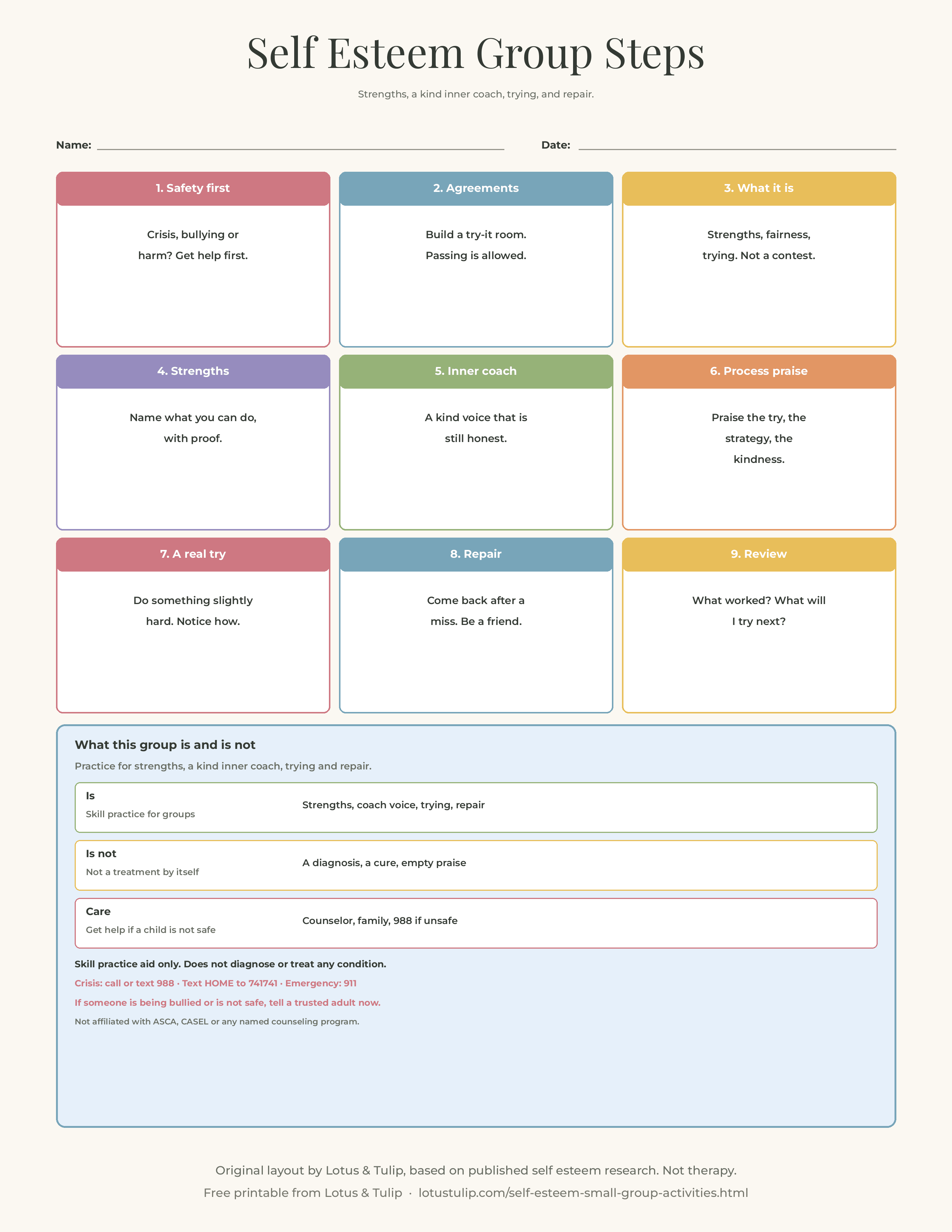
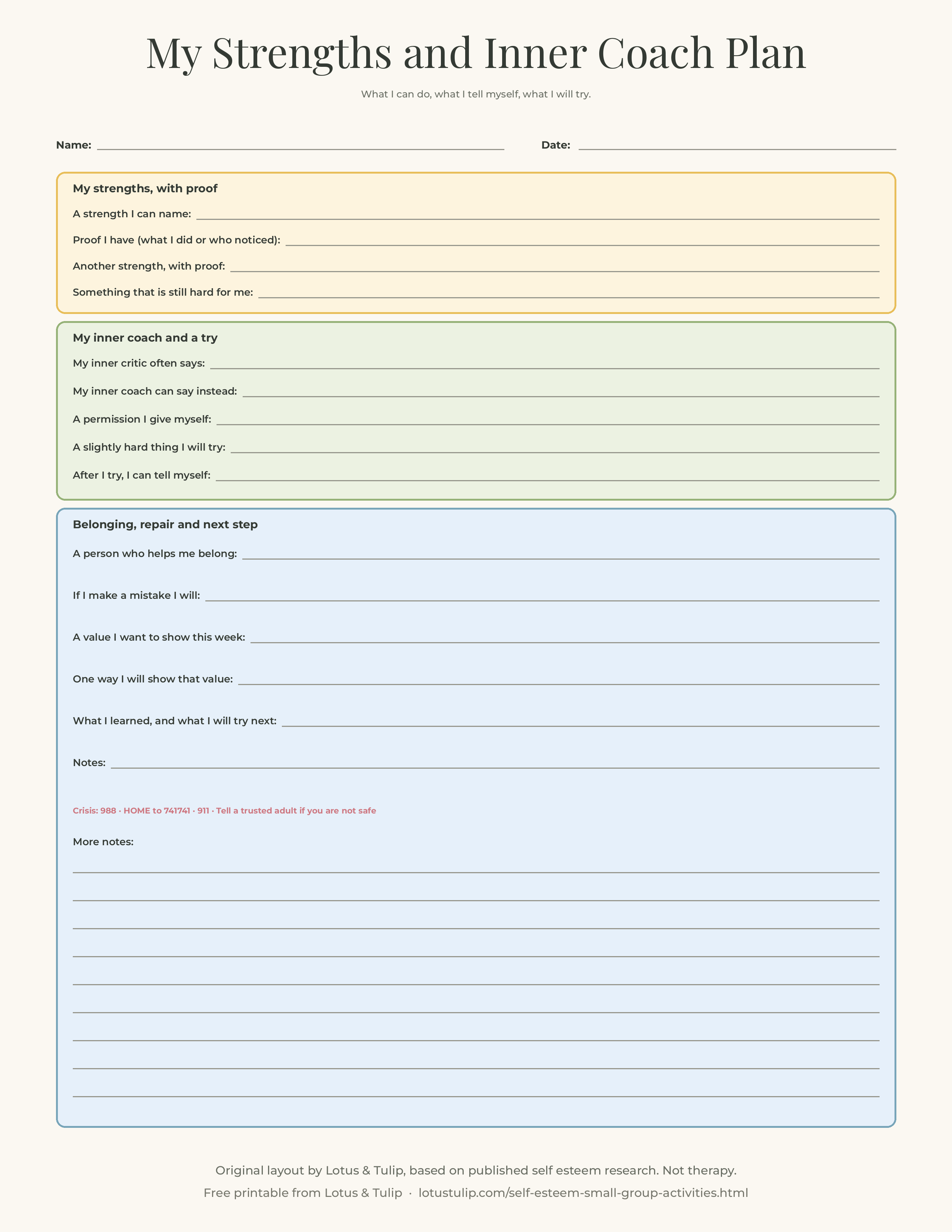
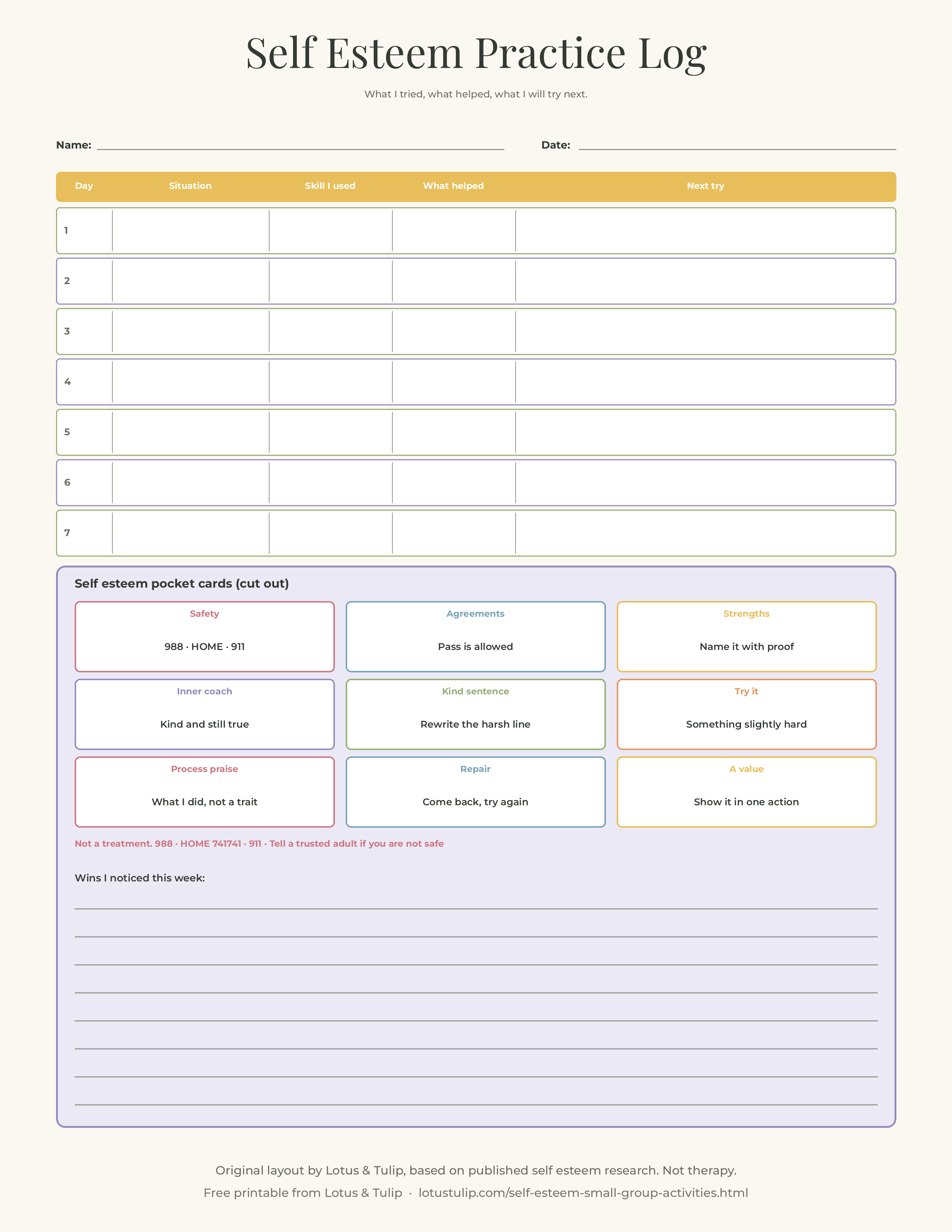
Free self esteem starter pack: Want to try real pages first? The free self esteem worksheets starter pack has six worksheets from our paid self esteem set for kids and teens, including a strengths finder, inner critic and inner coach and a brave steps ladder that fit well into group sessions.
Research notes (verified, with caveats)
- Baumeister RF, Campbell JD, Krueger JI, Vohs KD. Does high self-esteem cause better performance, interpersonal success, happiness, or healthier lifestyles? Psychol Sci Public Interest. 2003;4(1):1-44. The authors concluded that high self esteem does not reliably cause better school or job performance, interpersonal success or healthier lifestyles. Modest correlations with school performance do not mean that high self esteem leads to good performance; high self esteem is partly the result of doing well. Efforts to boost the self esteem of pupils have not been shown to improve academic performance and may sometimes be counterproductive. Laboratory work generally failed to show that self esteem causes good task performance, with an important exception: high self esteem can help people persist after failure. The authors described high self esteem as a mixed category that includes people who frankly accept their good qualities and people who are narcissistic, defensive or conceited. Overall they grouped the clearer benefits as enhanced initiative and pleasant feelings, and they wrote that they had not found evidence that boosting self esteem through interventions or school programs causes the wide benefits people hope for. They cautioned that indiscriminate praise might promote narcissism, and they recommended using praise as a response to socially desirable behavior and self-improvement.
- Mueller CM, Dweck CS. Praise for intelligence can undermine children's motivation and performance. J Pers Soc Psychol. 1998;75(1):33-52. Across six studies with 412 fifth graders, children praised for intelligence cared more about performance goals than learning goals, and after failure they showed less persistence, less enjoyment, more low-ability explanations and worse later performance than children praised for effort. Children praised for intelligence also described intelligence as more fixed. We use this as support for specific process praise, not as a ban on warmth or as a claim that any one phrase is magic.
- Harter S. The Construction of the Self: A Developmental Perspective. New York, NY: Guilford; 1999 (second edition, 2012: The Construction of the Self: Developmental and Sociocultural Foundations). Harter describes how self-representations become more differentiated across childhood. Younger children often use concrete, all-or-nothing descriptions. In early to middle childhood (about ages 5 to 7), children can begin to notice both positive and negative qualities, often leaning toward one side. In middle to late childhood (about ages 8 to 10), they can group skills into more stable ideas (for example, "smart") and compare themselves more with peers. Her work also treats self-evaluations as domain specific, commonly including scholastic competence, behavioral conduct, athletic competence, social acceptance and physical appearance. We describe that developmental pattern and do not invent percentages or decline figures beyond what we verified.
- Dweck C. Carol Dweck revisits the 'growth mindset.' Education Week. 2015 Sep 22. Dweck warned about a "false growth mindset" (a phrase she credits in that essay to Susan Mackie): endorsing the idea without changing practice, or treating growth mindset as nothing but effort praise. She wrote that students also need strategies and input from others when they are stuck. We treat growth mindset as a neighbor to self esteem work, not as the same skill, and we are not affiliated with Dweck or any mindset program.
- Collaborative for Academic, Social, and Emotional Learning. CASEL's SEL Framework (2020). CASEL describes self-awareness as the abilities to understand one's own emotions, thoughts and values and how they influence behavior across contexts, including recognizing strengths and limitations with a well grounded sense of confidence and purpose. Example capacities include identifying emotions, linking feelings, values and thoughts, experiencing self-efficacy and having a growth mindset. We are not affiliated with CASEL and this group is not a CASEL program.
- American School Counselor Association. ASCA Student Standards: Mindsets and Behaviors for Student Success. Alexandria, VA: Author; 2021. Wording verified from the official ASCA standards document: M 1, "Belief in development of whole self, including a healthy balance of mental, social/emotional and physical well-being"; M 2, "Sense of acceptance, respect, support and inclusion for self and others in the school environment"; M 4, "Self-confidence in ability to succeed"; B-SMS 7, "Effective coping skills"; B-SS 2, "Positive, respectful and supportive relationships with students who are similar to and different from them"; B-SS 8, "Advocacy skills for self and others and ability to assert self, when necessary." We are not affiliated with ASCA. Citing a standard is not the same as claiming this page is an ASCA curriculum.
We do not invent effect sizes beyond what we could verify. The sources above describe reviews, experiments, developmental theory and public frameworks, not a three page printable or a six session outline. The free pages are a skill practice aid. They have not been tested in a randomized trial and they are not a manualized protocol.
Self esteem small group activities: FAQ
What are self esteem small group activities?
They are structured practices a school counselor can run with a small group of elementary students (often grades 2 to 5) to help them name strengths with proof, use a kinder and still honest inner voice, try something slightly hard and repair after a mistake. They are not compliment circles and not a diagnosis.
What grade levels is a self esteem small group for?
This page is written for about grades 2 to 5. Younger students need more drawing and shorter language. Older elementary students can handle more talk about comparison. For about grades 6 to 8, use the middle school self esteem group curriculum instead of stretching these activities upward.
Do self esteem groups raise grades?
You should not count on that. Baumeister, Campbell, Krueger and Vohs (2003) found that boosting self esteem has not been shown to improve academic performance and that doing well in school is part of what builds self esteem. Teach the academic skill, give specific feedback and use the group for how students talk to themselves while they try.
How is this different from a growth mindset lesson?
Growth mindset is about whether a skill can grow. Self esteem is how a student evaluates and feels about themselves. They can support each other. They are not the same thing. Dweck (2015) also warned against a false growth mindset that is only praise for effort with no strategies.
What is process praise?
It is specific feedback about what a student did: the strategy, the revision, the kindness or the persist-after-a-miss. Mueller and Dweck (1998) found that praising fifth graders for intelligence made them more fragile after failure than praising them for effort. "You lined those blocks carefully" beats "you are so smart."
How many students should be in the group?
Four to six is a workable size for a 30 to 40 minute elementary block. Everyone can speak, and you can still watch for safety. A full class can do a short process-praise or kind-sentence lesson, but not a private inner-critic share.
Can I use these activities if I am worried about bullying or depression?
If bullying is active, protect the student and address the behavior first. If a student talks about self-harm, hopelessness or wanting to disappear, pause the group activity, use a safety plan, call or text 988, text HOME to 741741 and call 911 if there is immediate danger. The group does not treat clinical depression and does not replace a bullying response.
Is the free printable a copy of the paid curriculum?
No. The free three page set is an original companion with group steps, a strengths and inner coach plan and a practice log. The paid elementary curriculum is an eight session pack with lesson plans and student pages such as inner coach, permission, strengths, a self check and a certificate. The printable is not a preview dump of that PDF.