
Kids and teens · Updated 2026-11-08
Anger Management Small Group Activities for Elementary Students (with Free Printable)
Ready-made printable: Anger Management Small Group Curriculum for School Counselors Holiday 20% off: about $11.04, was $14 (EUR 12) · instant digital download
Buy on Etsy
Anger management small group activities give elementary students who blow up, shut down or lash out a predictable place to notice their body clues early, name the feeling under the anger, cool their body before solving the problem, and choose a next step they will not regret. A good anger group does not shame children for being angry, does not lecture them about being nice, and does not promise that angry feelings will disappear. Anger is information. The group teaches students what to do with it.
This guide is written for US elementary school counselors, and for the school social workers, school psychologists and behavior support staff who run similar Tier 2 groups, who want a practical way to run an eight session anger management group for about grades 2 to 5, with four to six students and sessions of about 30 to 40 minutes. You will get a plain language model of what an anger group can and cannot do, the core ideas that keep it honest, twelve activities you can actually run (with time, group size, materials, steps and a debrief), an eight session starter plan, a nine step HowTo, adaptations for younger and older students, tips, common mistakes, myths, three fictional examples, guidance on when not to use a group, verified research notes, eight FAQs and a free three page US Letter printable: Anger Group Steps, My Anger Reset Plan and an Anger Group Practice Log with nine pocket cards.
This page is the counselor small group how-to. It sits beside, and is not a substitute for, our anger management activities for kids (thirty classroom and individual calm down ideas), anger management activities for teens, the anger iceberg worksheet, the size of the problem worksheet, emotional regulation worksheets for kids, the coping skills list for kids, calm down corner ideas, breathing exercises for kids and the feelings thermometer printable. If you work with kindergarten to grade 2, see K-2 coping skills group activities first. A comparison table further down shows which page fits which job.
We draw on published research and public guidance without claiming any affiliation or endorsement, including the Sukhodolsky, Kassinove and Gorman (2004) meta-analysis of cognitive behavioral therapy for anger in children and adolescents, Bushman (2002) on venting and rumination, published descriptions of the Coping Power program by John Lochman and colleagues (a neighbor program, named only for context), the CASEL SEL Framework and the ASCA Student Standards. Full citations are below. The printable is an original Lotus and Tulip layout, not a copy of any published program or paid curriculum.
This guide is educational. An anger group does not diagnose a student, does not treat oppositional defiant disorder, conduct disorder, intermittent explosive disorder, ADHD, trauma or any other condition, and does not replace evaluation, therapy or an individual behavior plan. The activities are skill practice aids for counselors, not a standalone trial and not a manualized protocol. They are not affiliated with ASCA, CASEL, Coping Power or any named program. If a student is thinking about suicide or self-harm, call or text 988 (Suicide and Crisis Lifeline) or text HOME to 741741 (Crisis Text Line). For immediate danger, call 911. If a student describes abuse or neglect, or threatens to seriously hurt someone, stop the activity, follow your school's threat assessment and mandated reporting procedures, and use a written safety plan where it fits.
What an anger management small group is (and is not)
Every elementary counselor knows the referral. The third grader who flips a chair when he loses at four square. The fifth grader who goes silent, red faced and rigid, then shoves a classmate in the hallway twenty minutes later. The second grader who screams "I hate you" at her teacher and then sobs because she does not know why she said it. The student who is fine all week and explodes every Monday. Teachers are tired, families are worried, and the student is often the most upset person in the room once the storm passes.
An anger management small group is a short, structured series of sessions where four to six of these students practice a few skills together, with a caring adult, before they need them. In plain words, a good anger group helps students:
- Notice anger early. Most children can tell you they were angry after the fact. Fewer can spot the hot face, tight fists, fast heart or loud voice that showed up a minute before. Early noticing creates a gap where choices are possible.
- Name what is under the anger. Anger often rides on top of embarrassment, hurt, worry, unfairness, hunger or tiredness. Naming the second feeling makes the problem easier to solve.
- Size the problem. A broken pencil and a broken arm are not the same size. Students practice matching their reaction to the problem.
- Cool the body before solving. A brain flooded with anger is poor at problem solving. Students practice a few cool down tools until they are automatic.
- Choose a next step. Words, space or help. Students rehearse what to say, where to go and who to ask.
- Repair after a rupture. Everyone loses it sometimes. Students learn how to make things right without drowning in shame.
- Focus on what they can control. Other kids, rules and adults are often outside their control. Their next move is inside it.
What a group like this is not matters just as much, because anger groups are easy to get wrong:
- Not a diagnosis. Being referred to an anger group does not mean a child has a disorder. Many children in these groups are reacting to something real.
- Not treatment for a conduct disorder or explosive disorder. Students with severe, frequent aggression, cruelty, or outbursts that are far out of proportion and happen across settings need evaluation and more intensive support. A school group can sit alongside that work but cannot replace it.
- Not trauma processing. Some angry children have lived through frightening things. The group does not ask students to tell trauma stories. If trauma is suspected, refer to a qualified clinician.
- Not a punishment group. If students hear "this is where bad kids go," the group will fail. Present it as a skills group, like a reading group for feelings.
- Not a lecture about being nice. Children who struggle with anger have already heard "use your words" and "be kind" hundreds of times. They need practice, not more speeches.
- Not a promise to end all angry feelings. Anger is a normal human emotion. The goal is safer, more useful responses, not a child who never gets mad.
- Not a substitute for evaluation, therapy or behavior support. When a student needs a functional behavior assessment, an individual plan, special education evaluation or outside therapy, the group is a supplement at most.
- Not the same as a pile of calm down worksheets or a classroom lesson of thirty ideas. Worksheets and idea lists are useful. A group adds peers, rehearsal, feedback and repetition over eight weeks, which is where most of the change happens.
Core ideas that keep an anger group honest
Before you plan activities, settle on a few core ideas. They will guide what you say when a student storms in, when a parent asks what the group is for, and when a teacher wants a quick fix.
1. Anger is information, not a character flaw
Anger usually means something feels unfair, blocked, threatening or hurtful. That information is useful. A child who gets angry when a classmate keeps taking his eraser has noticed a real problem. The group's job is to help him do something about it that works better than throwing the eraser across the room. Say this out loud in session one and repeat it often: "Angry feelings are allowed. Hurting people and things is not. We are here to practice what to do in between."
2. Co-regulation and safety come first
Elementary students borrow calm from adults before they can make their own. Your voice, pace and body are the most powerful tools in the room. Speak slowly, lower your volume, stay at eye level, and give space. Keep the room physically safe: few loose objects, a clear exit, a known calm spot. When a student escalates in group, stop teaching, regulate first, and talk later. A lesson about cooling down that is delivered while the counselor is visibly frustrated teaches the opposite.
3. Notice body clues early
The most practical skill in the group is early warning. Children often describe anger as going from zero to one hundred instantly. When you slow it down with them, most can find a step or two in between: a hot face, a clenched jaw, a buzzing feeling in the arms, a louder voice, a thought like "that is not fair." Each student builds their own list. The earlier the clue, the more choices they have.
4. Name the feeling under the anger
Ask "what else might be there?" rather than "why are you angry?" A student who was laughed at may be embarrassed. A student whose parent forgot pick-up may be hurt and scared. Our anger iceberg worksheet is a good companion for this idea; link to it or use it, but do not rush students into deep disclosures in a group setting.
5. Size of the problem
Many explosive reactions come from treating small problems as huge ones. Matching the size of the reaction to the size of the problem is a teachable skill. The size of the problem worksheet has the full scale and scenario cards; the group uses it as practice, not as a way to tell children their feelings are wrong. A problem can be small and the feeling still big. Both are true.
6. Cool the body before solving the problem
Teach in this order: cool down first, think second, act third. A student who is still at a five on the thermometer will not brainstorm good solutions. Slow breathing, pushing against a wall, a drink of water, counting backward, a short walk with permission or squeezing a stress ball can bring the body down. Students try several and keep the ones that work for them. Our breathing exercises for kids page has scripts.
7. Choose a next step: words, space or help
Once the body is cooler, a student has three broad options. Words: "Please stop taking my eraser" or "I am mad that I lost, I need a minute." Space: moving to a calm spot, taking a break card, walking to get water. Help: telling a teacher, asking a friend, going to the counselor. Practicing these out loud in role plays makes them available when it counts.
8. Repair after a rupture
Children who struggle with anger often carry a lot of shame. They know they hurt someone; they just do not know how to fix it, so they avoid it or double down. Repair is a skill: notice what happened, own your part, make it right, and plan what to try next time. Repair is not a forced apology. It is an invitation to reconnect.
9. What the student can control
A child cannot control whether a classmate cheats at tag or whether recess is canceled. They can control their breathing, their words, where they go and who they ask for help. Keeping this distinction clear reduces helplessness, which often fuels anger.
A note on venting
Many adults still tell children to "get it out" by punching a pillow or yelling into a cushion. The research does not support venting as a reliable way to reduce later aggression. In a well known experiment, Bushman (2002) found that college students who hit a punching bag while thinking about the person who had insulted them were angrier and more aggressive afterward than students who did nothing at all. That study was with adults in a laboratory, so be careful about stretching it, but it is one reason this guide teaches cooling the body and choosing a next step rather than venting aggression. Movement can still help a child calm down; the difference is whether the activity is calming (wall push-ups, a walk, slow breathing) or rehearses hitting while the child replays the grievance.
Twelve anger management small group activities
Each activity lists time, group size, materials, steps and a debrief question. Times assume a 30 to 40 minute elementary block with four to six students in about grades 2 to 5. Activities 1 to 8 map onto the eight session plan below; 9 to 12 are swaps, warm ups and extensions. Keep every session predictable: a check-in, a short teaching point, one activity, a closing round and a small take-home challenge.
1. Group agreements and "anger is information"
Time: 15 minutes. Group size: 4 to 6. Materials: chart paper, markers, printable page 1, a pass signal (a card students can turn over).
Steps: Welcome students by saying what the group is: "This is a group for kids who have big angry feelings sometimes. Everybody gets angry. We are going to practice what to do with it." Ask what would help everyone feel safe. Write four to six agreements in their words, for example: we keep hands and feet to ourselves, we take turns talking, we can pass, what others share stays here, and we can take a break if we need one. Add the adult promise in plain words: "If someone is being hurt, might hurt themselves or might hurt someone else, I have to get help, because safety comes first." Then write on the board: "Anger is information." Ask what information anger might give us. Collect answers such as "something is unfair," "someone is being mean," "I did not get what I wanted," "I am scared."
Debrief: "If anger is information, what do you think we should do with it?" Teaching point: angry feelings are allowed; the group is about choosing what to do next.
2. Body clue map
Time: 20 minutes. Group size: 4 to 6. Materials: a simple body outline per student, red, orange and yellow crayons, sticky notes.
Steps: Model first. Describe a small, safe moment when you felt annoyed (the copier jammed right before class) and point to where you felt it: "My shoulders went up, my jaw got tight, my face got warm." Students color where anger shows up in their body. Yellow is the first clue, orange is getting bigger, red is the biggest. Prompt with options for students who are stuck: hot face, fast heart, tight fists, stomach ache, loud voice, crying, wanting to run, wanting to hit, going quiet. Each student picks their earliest clue and writes it on a sticky note.
Debrief: "Which clue comes first for you? What could you do when you notice it?" Teaching point: the earliest clue is your warning light. The sooner you notice it, the more choices you have.
3. The anger thermometer check
Time: 15 minutes. Group size: 4 to 6. Materials: a large drawn thermometer with five levels, clothespins with student names, the feelings thermometer printable if you want a ready version.
Steps: Label the levels in student language: 1 calm, 2 a little bugged, 3 frustrated, 4 really mad, 5 about to explode. Read short situations aloud ("someone cuts in line," "you lose a game," "your little brother breaks your Lego") and students clip their name where they would be. Notice that different students land in different places for the same event. Then ask what each level looks like and sounds like in their body. Finish by marking which level is still a good time to use a cool down tool (usually 2 or 3) and which is a stop and get help level (5).
Debrief: "At what number can you still make a good choice? What number is too late to think?" Teaching point: use your tools early, at a 2 or 3, not only when you are at a 5.
4. Feeling detective: what is under the anger?
Time: 20 minutes. Group size: 4 to 6. Materials: feeling word cards (embarrassed, hurt, left out, worried, jealous, tired, hungry, disappointed, scared, unfair), a paper bag, magnifying glass prop.
Steps: Read a short story about a fictional student: "Jordan threw his paper on the floor and yelled when the class laughed at his answer." Ask, "Jordan looked angry. What else might Jordan have been feeling?" Students pull feeling cards and decide whether each could be part of the story. Do two or three stories. Then invite, but do not require, each student to think of one time they were angry and what other feeling might have been there. They can write it privately on the back of a card. Connect to the anger iceberg worksheet if you use it individually.
Debrief: "Why might it help to know the feeling under the anger?" Teaching point: if you know you are embarrassed or hurt, you can ask for what you really need.
5. Size of the problem sort
Time: 20 minutes. Group size: 4 to 6. Materials: three baskets or taped squares labeled small, medium and big, scenario cards you write yourself, the size of the problem worksheet as a reference.
Steps: Define sizes simply. Small problems you can fix yourself quickly. Medium problems need some help or time. Big problems involve safety or need an adult right away. Students sort scenario cards (lost a pencil, friend will not play, someone pushes you on purpose, someone gets hurt on the playground, a fire alarm). Then add the second question: "What size reaction fits this problem?" Act out a small reaction to a small problem and a too big reaction to a small problem. Keep it playful; exaggerated acting gets laughs and makes the point.
Debrief: "Can a problem be small but the feeling still be big?" Teaching point: yes. Your feeling is real; matching the reaction is the skill.
6. Cool down tryouts lab
Time: 25 minutes. Group size: 4 to 6. Materials: a timer, water cups, stress balls, a wall space, a tracking sheet with five tools and a rating column.
Steps: Students try five tools for about one minute each and rate how calm they feel before and after on a 1 to 5 scale: slow breathing (in for four, out for six), wall push-ups, counting backward from twenty, squeezing and releasing a stress ball, and a slow sip of cold water. Optional extras: tracing a finger around a hand while breathing, or naming five things you can see. Each student circles their top two tools. Practice those two again at the end. Remind students that tools work best when practiced at a calm moment first, the same way fire drills happen when there is no fire.
Debrief: "Which tool lowered your number the most? Where could you use it at school without anyone noticing?" Teaching point: you need a tool you can use in class, on the bus and at home.
7. Hot thought, cool thought swap
Time: 20 minutes. Group size: 4 to 6. Materials: red and blue cards, a few short scenarios.
Steps: Explain that thoughts can pour fuel on anger or cool it down. Read a scenario: "Someone bumps you in line." A hot thought might be "He did that on purpose. He always does that." A cool thought might be "Maybe it was an accident. The line is crowded." Students write hot thoughts on red cards and cool thoughts on blue cards for three or four scenarios. Practice saying cool thoughts out loud with a calm voice. Be honest that sometimes the other person did do it on purpose; the cool thought then is "I can handle this. I will tell the teacher."
Debrief: "What is one cool thought you could use this week?" Teaching point: thoughts are not facts. Checking them gives you time.
8. Words, space or help role plays
Time: 25 minutes. Group size: 4 to 6. Materials: three large signs (Words, Space, Help), simple scenario cards, a talking object.
Steps: Teach three next steps. Words: an I feel sentence ("I feel mad when you take my eraser. Please give it back."). Space: moving away, taking a break, going to the calm spot. Help: telling a trusted adult. Pairs pick a scenario card and act it out twice, first with a cool down tool then with a next step. The group decides which sign fits. Coach students on tone and body language, not only words. Try the same scenario with all three options and discuss which works best in which setting.
Debrief: "Which next step is hardest for you? When would asking for help be the best choice?" Teaching point: asking for help is a strong move, not a weak one. See the I statements worksheet for more practice.
9. Pause button game (warm up)
Time: 10 minutes. Group size: 4 to 6. Materials: music or a drum, space to move.
Steps: Students move or dance while music plays. When the music stops, they freeze and take one slow breath. Make it harder: freeze on a clap but not on a stomp, or move slowly when the music is fast. Link it explicitly to anger: "Your brain has a pause button. We are practicing pressing it." This is a good opener for students who struggle to sit still.
Debrief: "What did your body have to do to freeze? Where could you use a pause button this week?" Teaching point: stopping is a skill you can practice like a sport.
10. The repair recipe
Time: 20 minutes. Group size: 4 to 6. Materials: a recipe card template with four steps, a fictional story.
Steps: Read a story where a character yells at a friend and breaks the friend's drawing. Ask what the friend might feel and what the character might feel afterward. Introduce a four step repair recipe: 1) Notice what happened. 2) Own my part ("I broke your drawing"). 3) Make it right (help redraw it, say sorry in my own words, give space if needed). 4) Plan next time ("Next time I will walk away and breathe"). Students practice repair lines in pairs. Make clear that repair is not about saying sorry because an adult insists; it is about fixing what you can and showing you care. If the other person is not ready, that is okay too.
Debrief: "Why is repair hard? What would make it easier?" Teaching point: everyone makes mistakes when angry. Repair is how you show who you want to be.
11. Circle of control for anger triggers
Time: 20 minutes. Group size: 4 to 6. Materials: a large circle drawn on paper, sticky notes, the circle of control worksheet as a reference.
Steps: Students list common anger triggers (losing a game, being teased, a sibling, homework, being told no). For each, they sort what is inside their control (my breathing, my words, where I go, who I ask) and outside it (what others do, the rules, the weather, the score). Place notes inside or outside the circle. Then pick one trigger and plan one thing inside the circle.
Debrief: "How does it feel to focus on what you can control?" Teaching point: you cannot control everything, but your next move is yours.
12. My reset plan and teach back celebration
Time: 30 minutes. Group size: 4 to 6. Materials: printable page 2 (My Anger Reset Plan), certificates, a small celebration snack if your school allows it.
Steps: Students complete their reset plan: earliest body clue, a feeling that often hides under their anger, two cool down tools, a cool thought, a next step for words, space and help, a repair line and their support team. Each student teaches one skill to the group as if the others were younger students. Celebrate progress with specific feedback ("You noticed your fists before you yelled at recess on Tuesday"). Hand out certificates and pocket cards from page 3.
Debrief: "What skill from group will you keep using? Who will you show your plan to?" Teaching point: the group ends but the skills go with you. Plan a check-in four to six weeks later.
An eight session starter plan (skills practice, not a certified protocol)
This table is an original skills practice starter built around the same public themes as our paid curriculum: self regulation skills drawn from cognitive behavioral ideas, a teacher referral to start and a certificate to finish. It is not the paid kit, not its session titles and not a certified or manualized protocol. Each session runs about 30 to 40 minutes for four to six students and follows the same shape: check-in on the thermometer, review the last take-home, one teaching point, one activity, a closing round and a small take-home challenge.
| Session | Focus | Activity | Take-home |
|---|---|---|---|
| 1 | Welcome, anger is information | Agreements; pre check; what anger tells us | Notice one time you felt annoyed and what it was about |
| 2 | My early warning lights | Body clue map | Catch your first body clue once this week |
| 3 | How hot is it? | Anger thermometer check, pause button warm up | Rate your number twice a day |
| 4 | The feeling underneath | Feeling detective | Name one feeling under your anger |
| 5 | Cool the body first | Cool down tryouts lab | Practice your top two tools when calm |
| 6 | Size it up, think it through | Size of the problem sort; hot thought, cool thought swap | Use one cool thought |
| 7 | Next steps and repair | Words, space or help role plays; repair recipe | Try one next step or one repair |
| 8 | My reset plan and celebration | Reset plan, teach back, post check, certificate | Show your plan to one adult at home or school |
Use a simple pre and post check in session 1 and session 8. Keep it short and student friendly, for example four statements rated with faces: "I can tell when I am starting to get angry," "I have a tool that helps me cool down," "I know what to do instead of hitting or yelling," and "I know how to fix things after I lose my temper." Add teacher ratings from the referral form at the start and again two to four weeks after the group ends. Report changes honestly; small shifts are normal and worth celebrating.
If you have a short window, a six session version can merge sessions 3 and 4 and sessions 6 and 7. Do not drop the cool down practice or the next step role plays; they carry most of the skill building. If you have more time, add a booster session a month later to review the reset plan.
How to run an anger management small group, step by step
- Screen for safety and fit. Read teacher referrals and talk briefly with each student and, where possible, their family. A student who is in crisis, has seriously hurt someone, threatens serious harm, describes abuse or is showing severe symptoms needs individual support, a safety plan and your school's threat assessment or reporting path first, not a group. Check whether anger is covering grief, bullying or home stress, and look at existing behavior plans or IEP goals so the group supports them.
- Get permission and set expectations. Follow your district policy on parent or guardian consent for small group counseling. Send a short, warm letter that describes the group as a skills group, not a punishment, lists the number of sessions and times, and explains confidentiality and its limits. Talk with teachers about which class times students will miss and how to share progress.
- Choose group size and mix with care. Four to six students is the usual sweet spot. Avoid putting several students with the most severe aggression in the same small group. Research with adolescents (Dishion, McCord and Poulin, 1999) found that grouping high risk youth together can sometimes increase problem behavior, so mix in students with milder difficulties or steady role model skills. Balance ages within about two grade levels and think about who has history with whom on the playground.
- Set group agreements. Build agreements in students' words in the first session, including safety rules, turn taking, the right to pass, confidentiality and its limits, and how to take a break. Post them every session and revisit them when needed.
- Teach body clues and early warning. Use the body clue map and the thermometer to help each student find their earliest sign of anger. Model with your own small examples, and keep returning to "what is your first clue?" every session during check-in.
- Practice cool down and next step skills. Run the cool down tryouts lab, the hot thought and cool thought swap, size of the problem practice and words, space or help role plays. Practice when students are calm so the skills are ready when they are not. Build in repair practice so students know how to reconnect after a blow up.
- Send a family letter and keep teachers in the loop. After the cool down session, send families a one page letter that names the student's top tools and the words, space, help plan, with one way to practice at home. Share the same plan with teachers so they can prompt it in the moment ("Want to use your breathing or take a break?").
- Measure with a simple pre and post check. Use the same short student check and teacher ratings at the start and end, plus a few behavior notes from referrals or office data where appropriate. Look for patterns, not perfection, and share results with families and staff.
- Know when to pause and how to close. Pause a student's participation and move to individual support if safety concerns, disclosures of abuse, threats to hurt someone, or escalating behavior make the group unsafe or unhelpful. In the final session, celebrate growth, give certificates, send home the reset plan and schedule a check-in four to six weeks later. Refer out to outside therapy or evaluation when needs go beyond what a group can offer.
Adaptations
Grade 2 versus grades 4 and 5
Second graders need shorter teaching points (two to three minutes), more movement, more pictures and fewer words. Use a three level thermometer (green, yellow, red) instead of five, puppets for role plays, and one cool down tool per session. Keep sessions closer to 30 minutes. Kindergarten and first grade students usually do better in a broader coping group such as our K-2 coping skills group than in an anger specific group. Fourth and fifth graders can handle the full five level thermometer, hot and cool thoughts, written reset plans and more realistic role plays about friends, games and fairness. Older students also care a lot about not looking babyish, so use their language, let them help design scenarios and give them leadership roles in teach backs. For students moving into middle school, the anger management activities for teens and middle school stress group activities pages fit better.
Students who escalate quickly
Some students go from calm to explosive in seconds. For them, the group should spend extra time on very early clues and very quick tools. Agree on a private signal (a card, a hand sign) that means "I need a break" and practice using it. Seat them near the exit and near you. Keep a predictable break spot just outside the circle. When they escalate, use few words, lower your voice, give space and wait. Talk about what happened later, when everyone is calm. Coordinate with any existing behavior intervention plan so expectations match.
ADHD or autistic students
Many students in anger groups have ADHD or are autistic. The group is not treatment for either, but you can make it work better for them. Use visual schedules for the session, short activities with movement breaks, clear rules written and pictured, concrete language ("hands in your lap" rather than "settle down") and extra practice. Autistic students may need advance notice of changes, a quiet corner, sensory tools and literal scenarios. Some may express anger differently or have trouble naming feelings at all; allow pointing, drawing or choosing from cards. Work with the special education team so the group supports IEP goals rather than competing with them.
Anxious students
Some children who look angry are actually very anxious. They lash out when they feel trapped, embarrassed or overwhelmed. Look for clues such as outbursts before tests, refusal followed by explosions, or anger in new situations. These students may need a worry group more than an anger group, or both skills. Our small group counseling curriculum for anxiety article covers worry groups in detail. In an anger group, pair cool down tools with brave steps and normalize worry as one of the feelings under anger.
English learners
Use pictures, gestures, color coding and simple sentence frames ("I feel ... when ... I need ..."). Allow students to use their home language with each other when helpful. Learn a few feeling words in their languages if you can. Keep role plays short and model them first. Be aware that some cultures express anger very differently and that what looks like defiance may be confusion or frustration about language. Families may appreciate letters translated into their home language through your district's services.
Classroom lesson versus pull out group
A classroom lesson about anger works well as Tier 1 prevention: everyone learns body clues, cool down tools and words, space, help. The thirty ideas on our anger management activities for kids page suit that setting. A pull out group is Tier 2: fewer students, more practice, more feedback and more personal plans. If you only have time for one, start with a brief classroom lesson and then run a small group for students who need more support. Avoid naming or pointing out any student during whole class lessons.
Telehealth or video groups
Video is usually a poor fit for elementary anger groups. It is hard to manage safety, read body language and keep students engaged online. Escalated students can simply log off or behave in ways you cannot see. If you must meet virtually, keep the group very small, add a trusted adult on the student's end, avoid role plays that could trigger strong emotions, and plan how you will respond if a student becomes unsafe at home.
When anger is covering grief, bullying or home stress
Many angry children are hurting. A student whose grandparent just died, who is being bullied at recess or whose family is going through divorce may show anger first. Watch for sudden changes, anger tied to specific places or people, or comments about home. In these cases, pair group work with individual support and the right resources: grief activities for kids, bullying worksheets for kids and divorce small group activities. If you suspect abuse, neglect or domestic violence, follow your mandated reporting procedure. Refer out to a community clinician when a student's needs go beyond what a school group can address.
Tips for school counselors
- Practice when calm. The skills only show up in hard moments if students practice them in easy moments first. Make every session feel like practice, not crisis management.
- Model your own small frustrations. Briefly share safe examples ("I felt my face get hot when my computer froze, so I took three breaths"). Students learn more from watching than from listening.
- Use specific praise. "You noticed your fists and asked for a break" teaches more than "good job."
- Keep sessions predictable. Same opening, same closing, same agreements. Predictability lowers arousal and helps students who struggle with transitions.
- Give students jobs. Timekeeper, materials helper, agreements reader. Students who feel useful are less likely to act out.
- Connect with teachers weekly. A two line email ("This week we practiced wall push-ups and the words, space, help plan") helps teachers prompt the skills in class.
- Plan for the worst day. Know who you will call if a student becomes unsafe in group, where other students will go, and how you will document it.
- Celebrate small wins. One fewer office referral, one time a student walked away instead of hitting, one repair. These matter.
- Use the student's words. If a student calls anger "the volcano" or "going red," use that language in their plan.
- Remember the long game. An eight week group plants seeds. Real change usually takes months of reinforcement at home and school.
Common mistakes
- Grouping only the most aggressive students. Without steadier peers, the group can turn into a place to compare fights and outbursts.
- Teaching only when students are already angry. A child at a five on the thermometer cannot learn a new skill. Teach in calm moments.
- Lecturing instead of practicing. Long talks about why anger is bad lose students fast. Short teaching, lots of practice.
- Forcing apologies. Forced sorry teaches students to say words without meaning them. Teach repair as a choice and a skill.
- Using the group as a consequence. If students are sent to group instead of recess as punishment, they will resent it and the skills will not stick.
- Ignoring what is underneath. Treating every outburst as a skills problem can miss grief, bullying, abuse, learning struggles or sleep problems.
- Skipping families and teachers. Skills practiced only in your office rarely transfer. Families and teachers need the same simple plan.
- Promising too much. Telling teachers the group will stop all outbursts sets everyone up for disappointment. Promise practice and support, not a cure.
- Teaching venting. Encouraging students to hit pillows while thinking about who made them mad may feel satisfying in the moment, but it does not reliably reduce aggression and can rehearse it.
- Not planning for disclosures. Anger groups sometimes surface abuse, violence at home or threats. Know your reporting and safety procedures before session one.
Myths about anger and anger groups
Myth: Just tell them to calm down. Telling an angry child to calm down rarely works, because their body is not ready to listen. Calm is taught and practiced, not ordered. Adults help most by staying calm themselves, lowering their voice, giving space and offering a tool.
Myth: Punching a pillow fixes it. Venting aggression is a popular idea, but research such as Bushman (2002) found that hitting a punching bag while thinking about the person who caused the anger increased anger and aggression in adults. Calming movement is fine; rehearsing hitting while replaying the grievance is not a reliable fix.
Myth: Angry kids are bad kids. Children who struggle with anger are often sensitive, hurting, overwhelmed or missing skills. Many have good hearts and feel terrible afterward. Labeling them as bad makes things worse.
Myth: A worksheet alone fixes aggression. Worksheets can help students reflect and remember, but aggression changes through relationships, practice, consistent adults and, sometimes, more intensive support. A worksheet is a tool, not a treatment.
Myth: More punishment teaches control. Consequences have a place, but harsh or frequent punishment without skill teaching often increases shame, avoidance and anger. Students learn control by practicing skills with support and seeing them work.
Myth: If they can control it at school, they can control it everywhere. Many children hold it together in one setting and fall apart in another. That is common and does not mean they are faking. Plans need to fit each setting.
Three fictional examples
These examples are fictional composites written to show how the ideas fit together. They are not real students.
Example 1: Malik, grade 4, recess blow ups
Malik's teacher referred him after three fights during four square in two weeks. In session two, Malik discovered that his first clue was "my ears get hot" and his first thought was "they are cheating." In the cool down lab, wall push-ups dropped his number from four to two. In the hot thought, cool thought swap, he practiced "maybe they did not see the line, I can ask the recess aide." His reset plan named ears hot as his warning light, wall push-ups and three slow breaths as his tools, and "I am going to take a break and come back" as his words step. The recess aide got a copy of the plan. Malik still got mad at four square, but he walked to the wall twice in the following weeks instead of pushing someone. At the four week check-in, his teacher reported one incident, down from three.
Example 2: Sofia, grade 2, tears and tantrums
Sofia's anger looked like screaming and crying when work felt hard. In group, she used a three level thermometer and drew her clues: tight tummy and wet eyes. Feeling detective helped her name "embarrassed" and "worried I will get it wrong" under the anger. The counselor shared this with her teacher and family. Sofia's plan focused on space and help: a break card and a sentence frame, "This is hard. Can you help me start?" Her outbursts did not vanish, but they became shorter, and she began to ask for help before she reached the screaming stage. The counselor also suggested a worry focused check-in after the group, because anxiety seemed to drive much of her anger.
Example 3: Devon, grade 5, a pause for safety
Devon joined the group after several angry outbursts. In session four, during feeling detective, he said quietly, "I get mad because my mom's boyfriend hits us when he is drunk. One day I am going to get a knife and make him stop." The counselor calmly paused the activity, thanked Devon for telling her, and moved the group to a short, quiet drawing task with a colleague's help. She spoke with Devon privately right away, without pressing for details, and told him she needed to get help to keep him safe. She followed her school's mandated reporting procedure for suspected abuse and its threat assessment procedure for the statement about a knife, involved an administrator, and created a written safety plan with Devon about where to go and who to tell if he felt unsafe or had thoughts of hurting someone. Devon moved to individual support and was referred to a community therapist, and he returned to group only after the team agreed it was helpful and safe. This example is general information, not legal advice. Mandated reporting rules and threat assessment procedures vary by state and district; follow your local policies. If a student is in immediate danger, call 911. If a student is thinking about suicide or self-harm, call or text 988 or text HOME to 741741.
How this page compares to nearby Lotus and Tulip guides
| Page | Best for | Format |
|---|---|---|
| This page | School counselors running an eight session Tier 2 anger group, about grades 2 to 5 | Small group activities, session plan, HowTo, safety notes |
| Small group counseling permission slip and parent letter | Getting parent permission and student assent before session 1 | Consent how-to (ASCA, FERPA, opt in vs opt out, state examples) with a free letter, filled example and permission log |
| Anger management activities for kids | Classroom lessons, individual sessions, home | Thirty calm down ideas, not an eight session group |
| Anger management activities for teens | Ages about 12 to 18 | Teen activities and plans |
| Anger iceberg worksheet | Exploring feelings under anger | Single worksheet with how-to |
| Size of the problem worksheet | Matching reactions to problems | Scale, scenario cards, reflection sheet |
| Emotional regulation worksheets for kids | All big feelings, not only anger | Worksheets for individual work |
| Coping skills list for kids | Choosing calming tools | A list, not a group plan |
| Calm down corner ideas | Classroom setup | Corner setup and steps printable |
| Breathing exercises for kids | Teaching breathing tools | Scripts and printables |
| Feelings thermometer printable | Rating feeling intensity | Printable thermometer and guide |
| K-2 coping skills group activities | Kindergarten to grade 2, all feelings | Younger coping group, not an anger group |
| Self esteem small group activities | Students with low confidence | Elementary group how-to |
| Middle school stress group activities | Grades 6 to 8 | Stress group how-to |
| Anger Management Small Group Curriculum (paid) | Counselors who want ready lesson plans and forms | Eight session PDF kit with referral form and certificate |
When not to use these activities
- Crisis. If a student is in active crisis, highly escalated or at risk of harming themselves or others, focus on immediate safety and crisis procedures. Use 988, HOME to 741741 and 911 as needed.
- Suspected abuse or neglect. If anger seems linked to abuse, neglect or domestic violence, follow mandated reporting procedures first. A group is not the right setting for disclosure or processing.
- Threats to seriously hurt someone. Follow your school's threat assessment and safety procedures. Do not handle serious threats only within the group.
- Trauma processing. Students who need to work through traumatic experiences should see a trained trauma clinician. The group can teach coping skills but should not ask students to retell trauma.
- Severe symptoms needing referral. Frequent, intense outbursts, cruelty to people or animals, destruction of property or symptoms across all settings call for evaluation and more intensive services. The group may be a supplement at most.
- A student who does not want to join. Forcing a student into an anger group can increase resistance and shame. Offer individual support or a later group, and keep the door open.
Free 3 page anger management small group printable (US Letter)
Download the free printable and use it in a small group, a one to one session or alongside a classroom lesson on anger.
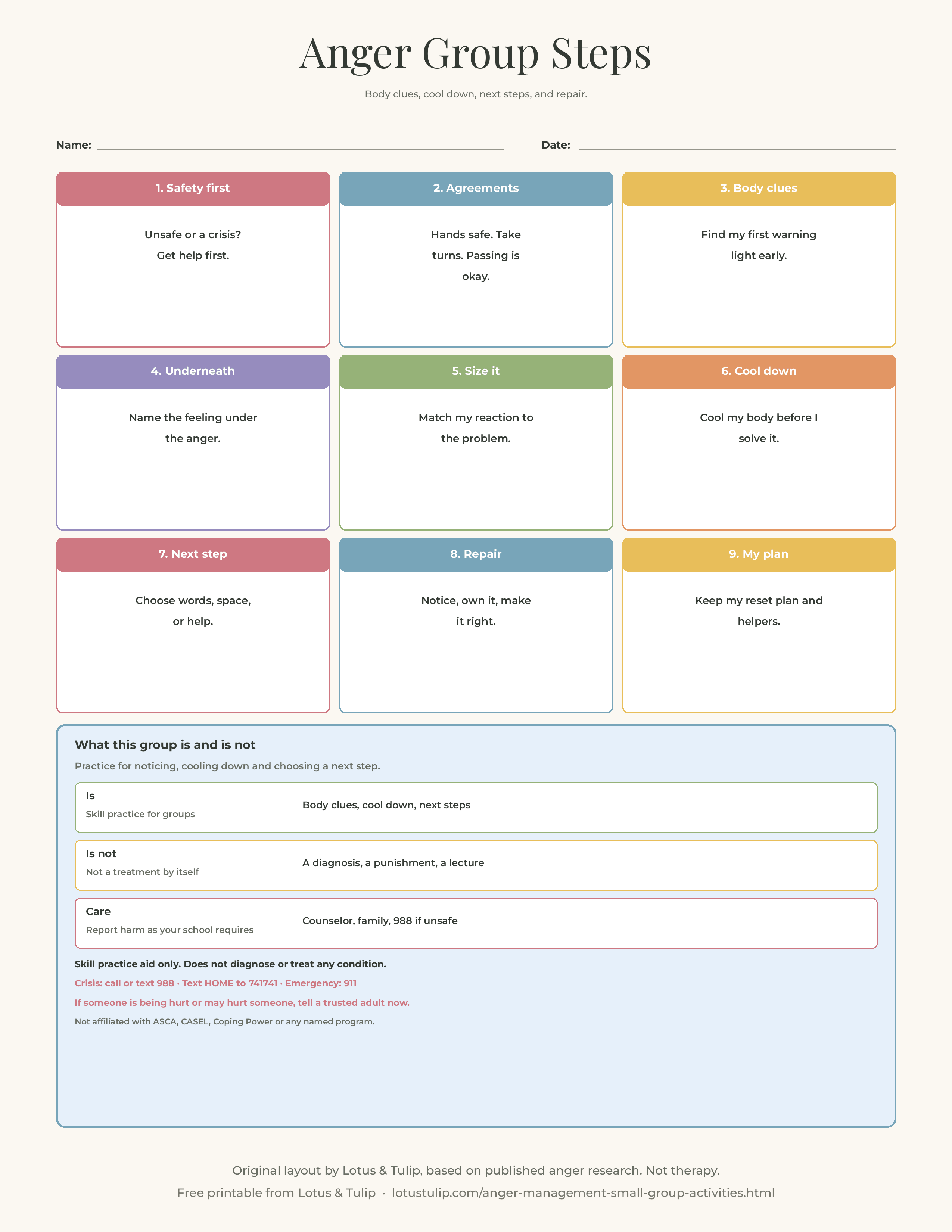
- Page 1: Anger Group Steps. Nine steps that match the HowTo above, what this group is and is not, and crisis resources including 988, the Crisis Text Line and 911.
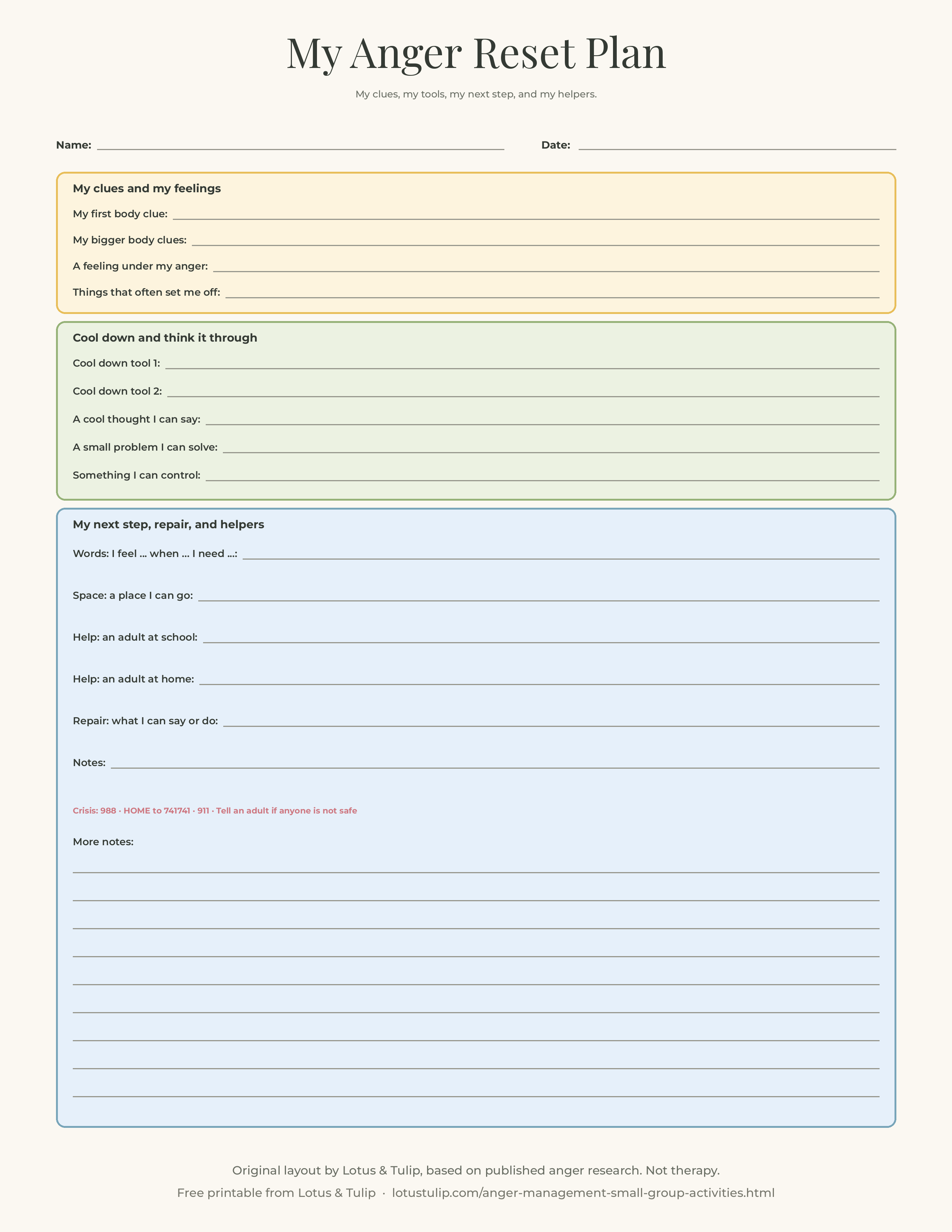
- Page 2: My Anger Reset Plan. Space for a student's earliest body clue, the feeling under the anger, two cool down tools, a cool thought, a words, space and help plan, a repair line and a support team.
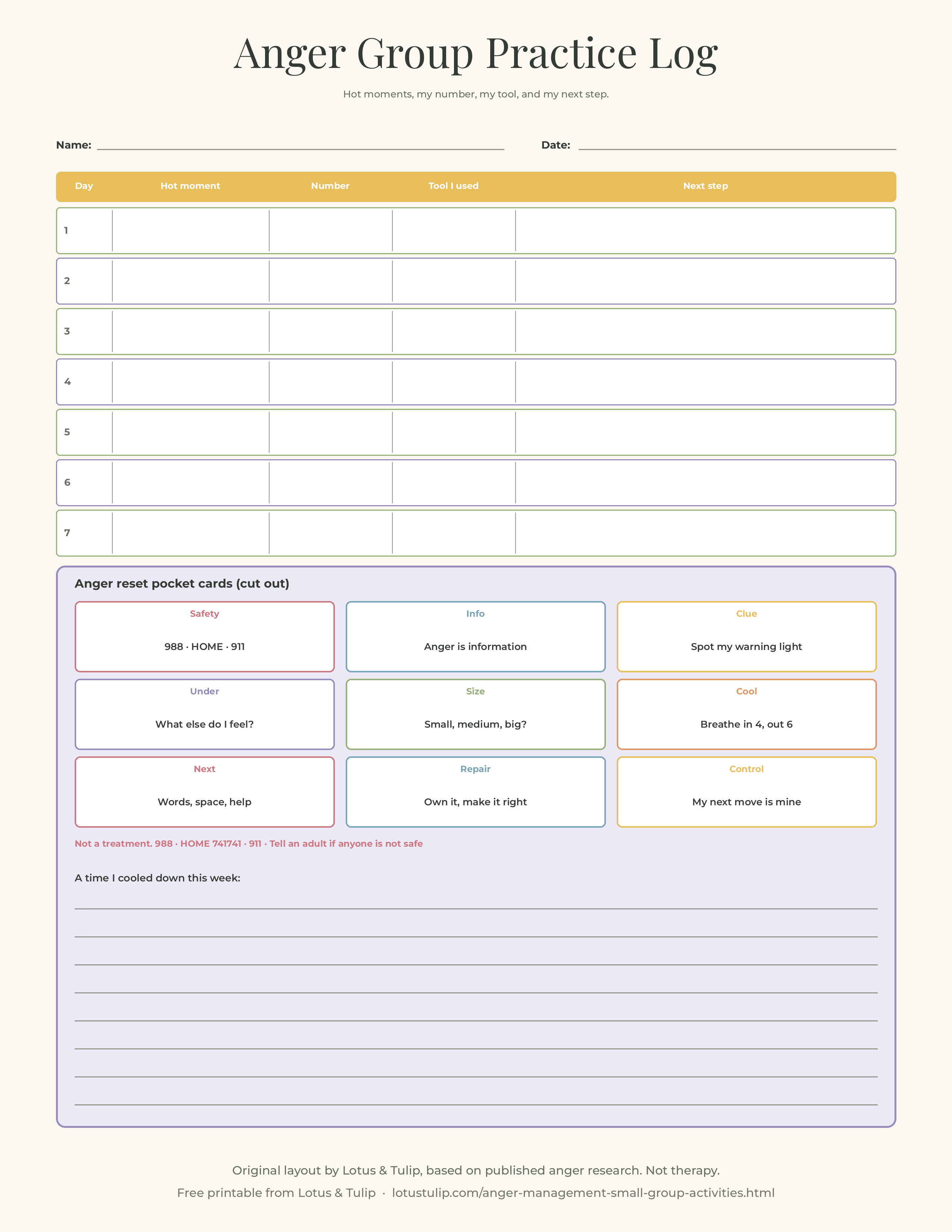
- Page 3: Anger Group Practice Log. Seven rows for hot moments, the thermometer number, the tool used and the next step, plus nine pocket cards to cut out.
Download free PDF · Page 1 PNG · Page 2 PNG · Page 3 PNG
Research notes (verified, with caveats)
- Sukhodolsky DG, Kassinove H, Gorman BS. Cognitive-behavioral therapy for anger in children and adolescents: a meta-analysis. Aggression and Violent Behavior. 2004;9(3):247-269. The authors pooled 40 studies (21 published and 19 unpublished) with 1,953 participants and found a mean effect size of d = 0.67, in the medium range and similar to child psychotherapy in general. Skills training and multimodal approaches were most effective for reducing aggressive behavior and improving social skills; modeling, feedback and homework were linked to larger effects. Caveat: an independent review noted limited detail on individual studies, so treat the size of the effect with some caution. This supports the general approach of practice, feedback and take-home challenges; it does not evaluate this page or any Lotus and Tulip product.
- Bushman BJ. Does venting anger feed or extinguish the flame? Catharsis, rumination, distraction, anger, and aggressive responding. Personality and Social Psychology Bulletin. 2002;28(6):724-731. In an experiment with 600 undergraduates, those who hit a punching bag while thinking about the person who had insulted them were angrier and more aggressive than a group that did nothing. Caveat: adult laboratory study, not a study of children or schools.
- Dishion TJ, McCord J, Poulin F. When interventions harm: peer groups and problem behavior. American Psychologist. 1999;54(9):755-764. Describes how grouping high risk adolescents together can sometimes increase problem behavior. Caveat: focused on adolescents; used here only to support careful group composition.
- Coping Power (Lochman and colleagues) is a published, school based cognitive behavioral program for aggressive preadolescent children with child and parent components. The What Works Clearinghouse describes a child component of 34 group sessions plus periodic individual sessions and a parent component of 16 group sessions. Lochman JE, Wells KC. The Coping Power program for preadolescent aggressive boys and their parents: outcome effects at the 1-year follow-up. Journal of Consulting and Clinical Psychology. 2004;72(4):571-578. We name Coping Power only as a neighbor program for context. This page is not affiliated with it and does not reproduce it.
- CASEL SEL Framework (2020) defines self-management as "the abilities to manage one's emotions, thoughts, and behaviors effectively in different situations and to achieve goals and aspirations." An anger group supports this competency. No affiliation with CASEL.
- American School Counselor Association. ASCA Student Standards: Mindsets and Behaviors for Student Success (2021). Relevant standards include M 1 "Belief in development of whole self, including a healthy balance of mental, social/emotional and physical well-being," B-SMS 2 "Self-discipline and self-control," B-SMS 7 "Effective coping skills" and B-SMS 9 "Personal safety skills." No affiliation with ASCA.
Our paid curriculum is a skill practice aid built around these general ideas. It has not been tested in its own randomized trial and is not a manualized protocol.
Anger management small group activities: FAQ
What are anger management small group activities?
They are structured activities a school counselor runs with about four to six students who struggle with anger. They teach students to notice body clues early, name the feeling under the anger, size the problem, cool their body, choose a next step with words, space or help, and repair after a blow up.
What grade levels is this anger group for?
This guide is written for about grades 2 to 5. Second graders need shorter sessions, a simpler thermometer and more movement. Kindergarten and first grade students usually fit better in a general K-2 coping skills group, and students in grade 6 and up are better served by teen anger activities.
How many sessions should an anger management group have?
Many school counselors run six to eight weekly sessions of about 30 to 40 minutes. Eight sessions give time to teach body clues, cool down tools, thinking skills, next steps and repair, with a check-in four to six weeks after the group ends. Published research programs such as Coping Power are much longer.
Do anger management groups for kids work?
A 2004 meta-analysis by Sukhodolsky, Kassinove and Gorman found that cognitive behavioral approaches for anger in children and adolescents had a medium average effect, with skills training, modeling, feedback and homework linked to better results. A short school group is best seen as skill practice and support, not a cure, and results vary by student.
Should students punch a pillow to get their anger out?
Venting aggression is not a reliable way to reduce later aggression. In Bushman's 2002 experiment with adults, hitting a punching bag while thinking about the person who caused the anger increased anger and aggression. Calming movement such as wall push-ups or a short walk is a better choice than rehearsing hitting.
Who should not be in an anger management group?
Students in crisis, students who have threatened serious harm, students with suspected abuse that needs reporting, students who need trauma treatment and students with severe symptoms that need evaluation should get individual support and referrals first. A student who does not want to join should not be forced.
What should I do if a student shares something unsafe in group?
Calmly pause the activity, thank the student and talk with them privately right away. Follow your mandated reporting procedure for suspected abuse or neglect and your threat assessment procedure for threats to hurt someone. If a student is thinking about suicide or self-harm, call or text 988 or text HOME to 741741, and call 911 if there is immediate danger.
Is the free printable a copy of the paid curriculum?
No. The free three page set is an original companion with group steps, an anger reset plan and a practice log. The paid Anger Management Small Group Curriculum is an eight session pack with lesson plans, student pages and forms. The printable is not a preview of that PDF and is not material from any named program.