
Therapist practice · Updated 2026-11-09
Group Therapy Progress Notes: Template, Examples and Checklist (Free Printable)
Ready-made printable: Therapy Progress Notes and Intake Templates Fillable PDF: includes SOAP, DAP and BIRP progress note pages, plus intake, notes and safety plan pages (20 pages)
Holiday 20% off: about $7.36, was $9 (EUR 8) · instant digital download
Try it free first: download a fillable sample (SOAP note and DAP note, PDF, 226 KB). Type into it on screen, then get the full pack. No email needed.

A group therapy progress note has to do two jobs at once. It records what happened in the group as a whole, and it records what happened for one client inside that group. Most weak group notes fail at the second job: the same paragraph pasted into eight charts, with only the name changed. Most risky group notes fail at a third job nobody mentions until an audit or a records request: they name, or describe, other members in a client's record.
This guide is for counselors, therapists, social workers, psychologists, addiction counselors and trainees in the US who lead or co lead therapy groups. It covers what a group note must contain, the two part format that Medicare contractor guidance describes, how to keep other members out of a client's record, how billing for group psychotherapy commonly differs from individual sessions (with a clear "check your payer" caveat), and how to write a group note step by step. Then come three complete fictional examples, including two members from the same session written side by side so you can see what individualization looks like, plus common mistakes, an FAQ and a free three page printable: a blank group note with a group section and an individual section, a filled example and a before you sign checklist.
Jump to the free group therapy note template
This is educational information for licensed clinicians and trainees, not legal, billing or clinical advice. Documentation and billing rules differ by state, license, setting and payer. Check your state board, your agency policy, your payer contracts and your supervisor's guidance if you are pre-licensed. Every client, clinician and group on this page is fictional.
What a group therapy progress note is
A group therapy progress note is the clinical record of one client's attendance at one group session. It sits in that client's chart, just like an individual session note, and it should let a covering clinician, a supervisor or a reviewer answer four questions: what was this group session about, what did the leader do, what did this particular client do and how did they respond, and what happens next for this client.
Because the group content is shared but the record is individual, most group notes end up with two parts:
| Part | What it holds | Same for every member? |
|---|---|---|
| Group section | Group name and type, date, start and stop times, number of members present, facilitators, the session topic and goal, and the interventions the leader used with the whole group. | Yes, it can be written once and used for each member's note, as long as it names no members. |
| Individual section | This client's attendance, presentation, participation, response to the interventions, progress on their own treatment plan objective, risk, and plan. | No. This is the part that must be written for each client. |
That structure is not an invention of software vendors. A Medicare billing and coding article for psychiatry and psychology services (A56937) says group therapy session notes "can be organized according to the general session note guidelines for individual therapy or the clinician may elect to use the following group note format":
- "One portion of the note that is common to all patients, documenting date, length of time for the session, along with key issues presented. Names of the patients in the group should not appear in this group note."
- "A second portion of the note, for each patient's record, commenting on that particular patient's participation in the group process and any significant changes in patient status."
The same article says group notes "must be prepared within a reasonable time period after the rendering of professional services consistent with accepted practice." So you have two legitimate choices: write each member's note in the same format you use for individual sessions (SOAP, DAP, BIRP or GIRP), or use the two part group format. Either way, the individual content has to be individual.
What a group note must contain
Agency forms differ, but a complete group note usually covers the items below. The first block is the group section; the second block is the individual section.
Group section (shared)
- Group name and type. For example "Anxiety skills group (CBT), closed, 8 weeks" or "Relapse prevention group, intensive outpatient." Say whether it is a psychotherapy group, a psychoeducational group or a multiple-family group, because that can change how the service is billed and whether it is covered.
- Session number. "Session 4 of 8" tells a reader where the group is in its curriculum.
- Date, start and stop times, and total minutes. Record the actual times, not the scheduled ones.
- Format. In person, telehealth video or a mix.
- Group size. The number of members enrolled and the number present today, as numbers only.
- Facilitators. The leader and any co leader, with credentials.
- Session topic and goal. One or two lines on what the session aimed to do.
- Interventions used with the group. Psychoeducation, skills practice, role play, exposure exercise, process discussion, mindfulness, homework review. Say what the techniques were applied to.
- Key themes, described without names. "Members discussed avoidance at work and what it costs them," not who said what.
Individual section (one per client)
- Client name or ID, and attendance. Present for the full session, arrived late, left early (with times), or absent. If the client was absent, a short note recording the absence and any follow up belongs in the chart too, but it is not a billable group session.
- Treatment plan link. The goal or objective number from this client's plan that the group addressed, in the plan's wording.
- Presentation. Brief observations: mood and affect, appearance where relevant, alertness, any change from last session.
- Participation. What this client did in the group: shared, practiced a skill, answered a prompt, gave or received feedback, stayed quiet. Describe behavior, not character.
- Response. How the client responded to the interventions: ratings before and after an exercise, a new insight in their own words, a skill they could demonstrate, or a barrier.
- Progress on the objective. Met, progressing, no change or worse, with the evidence.
- Risk. Whether risk was screened and the result, or why not, and what you did about any concern.
- Plan. Homework, next group date, any individual follow up, referrals, coordination of care, and changes to this client's plan.
- Signature. The clinician's signature, credentials and the date and time signed.
The same Medicare article lists items that "must be included in all psychiatric medical record documentation and made available upon request," including the name of the beneficiary and date of service, the "type of service (individual, group, family, interactive, etc.)," the time element where duration determines the code, the "modalities and frequency of treatment furnished," a clinical note for each encounter that in the aggregate summarizes diagnosis, symptoms, functional status, focused mental status examination, treatment plan, prognosis and progress to date, and the identity and professional credentials of the person performing the service. The group and individual sections above map onto that list.
Confidentiality: keep other members out of a client's record
In individual therapy, the chart is about one person. In group therapy, every note is written about one person who spent the session with several others. Those others are also clients, and their information belongs in their own records, not in anyone else's.
Why it matters
- Clients can see their records. Under the HIPAA Privacy Rule (45 CFR 164.524), individuals generally have a right to inspect and get a copy of their information in the designated record set, with an exception for psychotherapy notes. A group progress note is part of that record. If it says "J.R. disclosed her divorce," the client who requests their chart now holds information about J.R.
- Records travel. Notes are sent to payers for review, to other providers with a release, and sometimes to courts. Every copy of a note that names another member is another disclosure of that member's information.
- Medicare guidance says it plainly. In the two part format quoted above, "Names of the patients in the group should not appear in this group note."
- The ethics codes expect it. The ACA Code of Ethics (2014), standard B.4.a, says: "In group work, counselors clearly explain the importance and parameters of confidentiality for the specific group." The APA Ethics Code, standard 10.03, says psychologists who provide services in a group setting "describe at the outset the roles and responsibilities of all parties and the limits of confidentiality." Careful notes are part of keeping that promise.
How to write around other members
The goal is that nobody reading this client's note could identify another member. Initials are not enough: in a small group, in a small town or in a school, initials plus a detail can point straight to a person. Use descriptions that carry the clinical meaning without the identity.
| Instead of | Write |
|---|---|
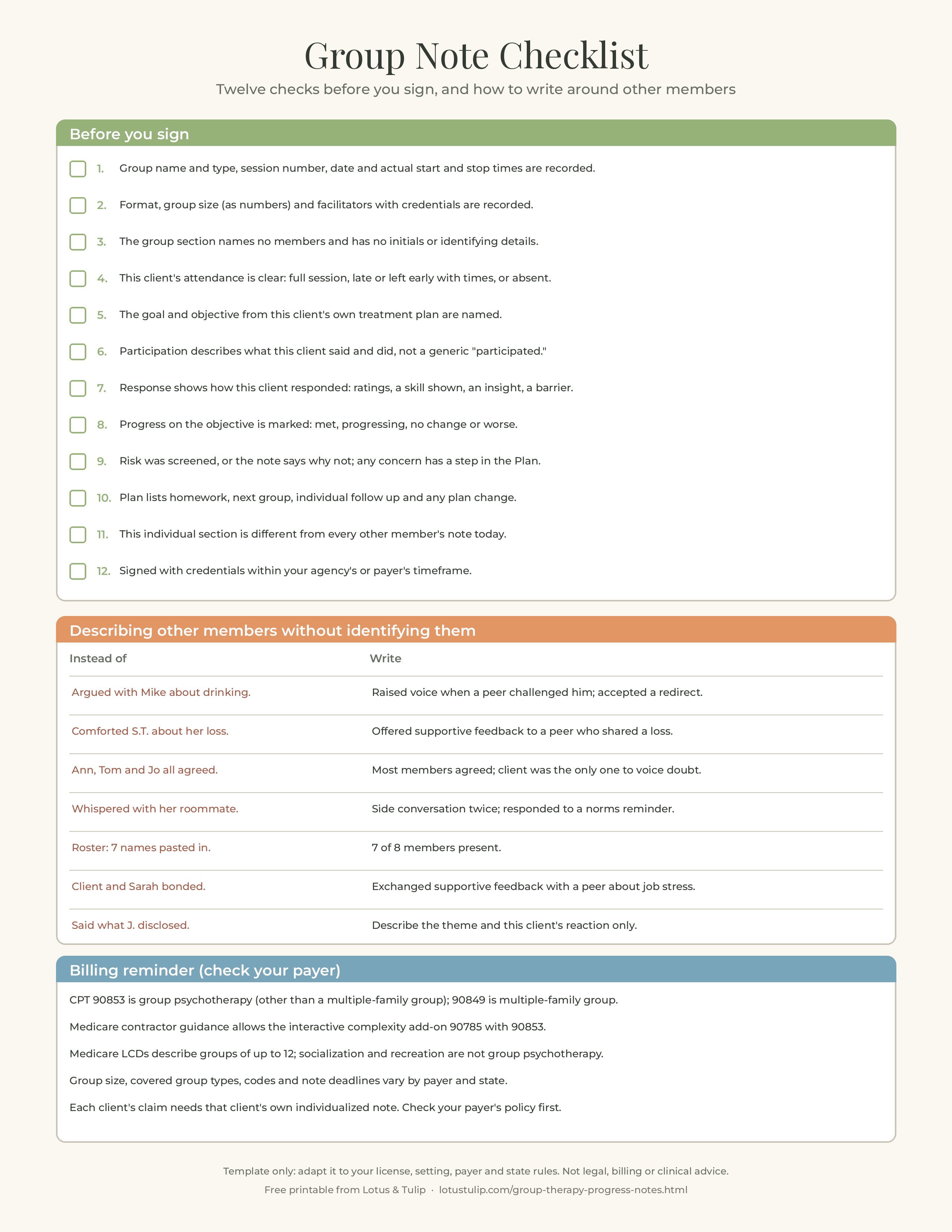
| "Argued with Mike about his drinking." | "Became raised in voice when another member challenged his account of last weekend; accepted a redirect from the facilitator within a minute." |
| "Comforted S.T. after she talked about her miscarriage." | "Offered supportive feedback to a peer who shared a recent loss; said it reminded him of his own grief." |
| "Sat next to her roommate from the unit and whispered." | "Engaged in side conversation twice; responded to group norms reminder." |
| "The other members, Ann, Tom, Lisa and Jo, all agreed." | "Most members agreed; client was the only one to voice doubt." |
| "Disclosed she is dating the new member." | "Disclosed a relationship with another group member outside of group; addressed in individual follow up per group agreement." |
A few more habits help:
- Use "a peer," "another member" or "the group" for everyone except the client whose note it is.
- Leave out details that identify other people, such as their job, diagnosis, age, or what they shared. If another member's disclosure matters clinically for this client, describe the theme, not the content.
- If something about another member needs documenting (for example, a safety concern), document it in that member's own record.
- Record group size as a number. "8 members present" is useful; a roster is not.
- Keep a sign in sheet or attendance roster as a separate administrative record, handled under your agency's policy, not copied into each client's note.
- Check your template. Some electronic records pull a full attendance list into every member's note. Turn that off or edit it out.
What about psychotherapy notes?
HIPAA gives extra protection to one narrow category called "psychotherapy notes." The definition in 45 CFR 164.501 explicitly includes group sessions: notes "recorded (in any medium) by a health care provider who is a mental health professional documenting or analyzing the contents of conversation during a private counseling session or a group, joint, or family counseling session and that are separated from the rest of the individual's medical record." The same definition excludes "medication prescription and monitoring, counseling session start and stop times, the modalities and frequencies of treatment furnished, results of clinical tests, and any summary of the following items: Diagnosis, functional status, the treatment plan, symptoms, prognosis, and progress to date."
A group progress note is mostly made of those excluded items, so it is part of the clinical record, not a psychotherapy note. If you keep separate process notes about group dynamics, they only get psychotherapy note protection if they are kept separate from the rest of the record. Write every group progress note as if this client, and every other member, might one day read it.
HIPAA applies to covered entities, which include health care providers who transmit health information electronically in connection with standard transactions such as claims. If you lead a self pay group and never bill electronically, you may not be a covered entity, but state law, licensing board rules and your ethics code still govern your records. Substance use disorder programs that are federally assisted are also covered by 42 CFR Part 2, which has its own consent and disclosure rules, and school counselors work under FERPA and district policy. The GIRP notes guide covers Part 2 and FERPA in more detail.
Billing: how group psychotherapy codes commonly differ
Billing rules vary by payer, state Medicaid program, setting and contract, and CPT codes are updated every year. The points below are general and come from public Medicare contractor documents. Check your payer's policy, your contracts and your billing staff before you bill.
In the US, group therapy is usually billed with different codes, and under different rules, from individual psychotherapy.
- CPT 90853 is group psychotherapy. Its descriptor is "group psychotherapy (other than of a multiple-family group)." Each client who attended is billed on their own claim, which is one more reason each client needs their own note.
- It is not one of the time tier codes. Individual psychotherapy codes 90832, 90834 and 90837 are chosen by time; Medicare article A57520 gives 16 to 37 minutes for 90832, 38 to 52 minutes for 90834 and 53 or more for 90837. 90853 is not chosen by session length in the same way. Record start and stop times anyway: payers and auditors still look for them, and some payers set their own minimums. Medicare LCD L33632 describes a group session that "typically lasts 45 to 60 minutes."
- Multiple-family groups use a different code. CPT 90849 is multiple-family group psychotherapy. One Medicare LCD (L34616) says multiple-family group psychotherapy "would generally be non-covered by Medicare." Coverage by other payers varies.
- Interactive complexity can be added. Medicare article A56937 says the interactive complexity add-on 90785 may be used with group psychotherapy (90853), as well as with diagnostic evaluations and individual psychotherapy codes. If you use it, the note for that client needs to show the communication factor that made the session more complex.
- Group size. Medicare LCDs describe group psychotherapy as involving "no more than 12 participants" (L33632) or "of a size that can be successfully led (e.g., maximum of 12 people)" (L34616). State Medicaid programs can be more specific. Minnesota's Medicaid provider manual, for example, describes group psychotherapy as provided by one mental health professional for 3 to 8 members or two professionals for 9 to 12 members, and says group size cannot exceed 12. Your state may differ.
- What does not count as group psychotherapy. L34616 says group therapy "does not include socialization, music therapy, recreational activities, art classes, excursions, sensory stimulation or eating together, cognitive stimulation, or motion therapy," and that "self-help groups or support groups without a qualified professional present are not covered." The same LCD says group therapy "must be led by a person who is authorized by state statute to perform this service."
- Medical necessity still applies to each client. Medicare article A57065 says the record "should document the target symptoms, goals of therapy and methods of monitoring outcome," and how treatment "is expected to improve the health status or function of the patient." In a group note, that comes from the individual section and the client's treatment plan, not from the group topic.
- Programs may use other codes. Partial hospitalization, intensive outpatient and some Medicaid or managed care programs bill group services with program specific codes. Follow your program's billing guide.
The practical takeaway for documentation: a group note that supports a 90853 claim shows the type of service, the actual times, the group size, who led it and their credentials, and, above all, an individualized account of this client's participation and progress toward their own plan.
How to write a group therapy progress note, step by step
- Write the group section once, without names. Group name and type, session number, date, actual start and stop times, total minutes, format, number enrolled and number present, and facilitators with credentials. Then the session topic and goal, the interventions used and the key themes, described without naming or identifying any member.
- Start each client's individual section with attendance. Present for the full session, late or left early with times, or absent. If a client left early, say when and why if known, and whether you followed up.
- Link to the client's treatment plan. Name the goal or objective number this group addressed for this client, in the plan's wording. A group topic can serve different objectives for different members.
- Record presentation briefly. Mood and affect, alertness, and anything that changed since the last group. Use the client's words in quotes when they capture their state.
- Describe this client's participation as behavior. What did they say, practice, or offer? Did they share voluntarily or when prompted? Did they give or receive feedback? Refer to other members only as "a peer" or "another member."
- Record their response to the interventions. Ratings before and after an exercise, a skill they demonstrated, an insight in their own words, or a barrier. This is where cloned notes fall apart, so write what was true for this client.
- Mark progress on the objective. Met, progressing, no change or worse, with the evidence.
- Record the risk check. Whether risk was screened and the result, or why it was not screened today. If there is any concern, document what you did and the follow up plan in this client's record only.
- Write the plan, then read and sign. Homework, next group date, individual follow up, referrals and any plan change. Read the note as the client would: does it name or identify anyone else? Then sign with your credentials within your agency's or payer's timeframe, and use a dated addendum for anything you add later.
Group note examples (all fictional)
All three examples are fictional and simplified. They show the group section once, then individual sections. In a real record, each client's note would contain the group section plus only their own individual section.
Example 1: Adult anxiety skills group (CBT), outpatient
Group section
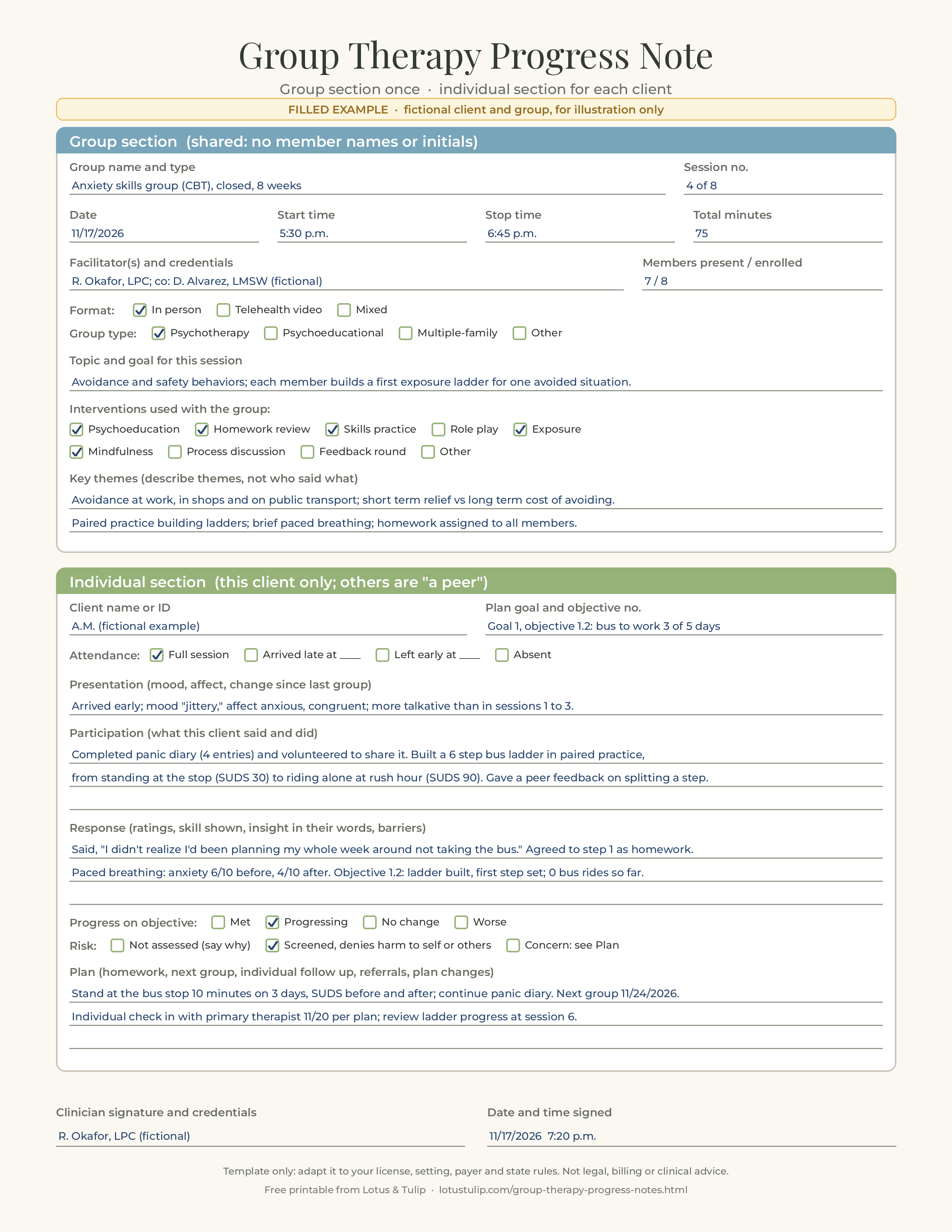
Group: Anxiety skills group (CBT), closed group, session 4 of 8. Date: 11/17/2026. Time: 5:30 to 6:45 p.m. (75 minutes). Format: in person. Members enrolled: 8; present: 7. Facilitator: R. Okafor, LPC (fictional). Co facilitator: D. Alvarez, LMSW (fictional).
Topic and goal: avoidance and safety behaviors; members to identify one avoided situation and build a first step exposure ladder. Interventions: psychoeducation on the avoidance cycle (10 minutes), homework review, worked example of an exposure ladder on the whiteboard, paired practice building each member's ladder, brief paced breathing practice, homework assignment. Key themes: members described avoidance at work, in shops and on public transport, and the short term relief and long term cost of avoiding.
Individual section: client "A.M."
Attendance: present for full session. Plan link: Goal 1, reduce panic related avoidance. Objective 1.2: ride the bus to work 3 of 5 days for 2 weeks (currently driven by spouse daily).
Presentation: arrived early, casually dressed, mood "jittery," affect anxious, congruent; more talkative than in sessions 1 to 3.
Participation: completed last week's homework (panic diary, 4 entries). Volunteered to share the diary in the review. In paired practice, built a 6 step ladder from standing at the bus stop (SUDS 30) to riding the full route alone at rush hour (SUDS 90). Gave feedback to a peer about breaking a large step into two.
Response: stated, "I didn't realize I'd been planning my whole week around not taking the bus." Rated the first ladder step at SUDS 30 and agreed to it as homework. Practiced paced breathing; reported anxiety 6 out of 10 before and 4 out of 10 after. Progress on objective 1.2: progressing (ladder built and first step scheduled; 0 bus rides so far).
Risk: screened at check in; denies thoughts of harm to self or others.
Plan: stand at the bus stop for 10 minutes on 3 days, rating SUDS before and after; continue panic diary. Next group 11/24. Individual check in with primary therapist on 11/20 per plan.
Signed: R. Okafor, LPC (fictional), 11/17/2026, 7:20 p.m.
Example 2: A second member from the same session
Same group, same group section as Example 1. This is what makes group notes individual: the same 75 minutes, written for a different client with a different plan.
Individual section: client "L.K."
Attendance: arrived 15 minutes late (5:45 p.m.), stayed to the end; said traffic.
Plan link: Goal 2, reduce social anxiety at work. Objective 2.1: speak at least once in 3 of 4 weekly team meetings (baseline 0 of 4).
Presentation: quiet, made limited eye contact in the first half, mood "fine," affect constricted.
Participation: did not share homework in the review (stated she had not completed it). Spoke once without prompting, during paired practice. Built a 4 step ladder about meetings with a peer's help, from asking a coworker one question in person (SUDS 40) to giving an opinion in the full meeting (SUDS 85). Declined to share the ladder with the whole group; facilitator accepted this.
Response: said, "It's easier to talk to one person than to everyone," which matches her treatment plan formulation. Did not complete the breathing ratings. Progress on objective 2.1: no change (0 of 4 meetings this month); engagement in group improved from session 3 (spoke once versus not at all).
Risk: screened at check in; denies thoughts of harm to self or others.
Plan: first ladder step (one question to a coworker) as homework. Facilitator will check in at the start of next group about homework barriers. Flag to primary therapist: missed homework 2 weeks running; consider reviewing objective 2.1 at the 12/1 plan review. Next group 11/24.
Signed: R. Okafor, LPC (fictional), 11/17/2026, 7:30 p.m.
Compare the two notes. Same group, same topic, same interventions, but different attendance, different objectives, different participation, different progress and different plans. A reviewer reading both charts should see two people, not one template.
Example 3: Relapse prevention group, intensive outpatient, telehealth, with a risk concern
Group section
Group: Relapse prevention group, intensive outpatient program, open enrollment. Date: 11/18/2026. Time: 6:00 to 7:30 p.m. (90 minutes). Format: telehealth video. Members present: 6. Facilitator: M. Haddad, LCSW, LCADC (fictional).
Topic and goal: cravings and high risk times around the holidays; members to name one high risk event and a coping plan. Interventions: check in with craving ratings, urge surfing exercise (5 minutes), psychoeducation on the urge curve, small group discussion in breakout rooms, coping plan worksheet, closing round. Key themes: family gatherings, loneliness on holidays, and saying no to offers of alcohol.
Individual section: client "R.D."
Attendance: present from 6:00 p.m.; left video at 7:05 p.m. without explanation. Facilitator called after group at 7:40 p.m.
Plan link: Goal 1, maintain abstinence from alcohol. Objective 1.3: complete a written coping plan for 3 identified high risk situations.
Presentation: camera on, in a dim room; mood "low"; affect flat; speech slow. Reported craving 7 out of 10 at check in (4 out of 10 last week).
Participation: shared, when prompted, that this will be the first Thanksgiving since a family loss. Took part in urge surfing; did not complete the coping plan worksheet before leaving.
Response: craving 7 before urge surfing, 6 after. Said, "I don't really see the point this year." Progress on objective 1.3: no change (1 of 3 situations planned).
Risk: the statement above prompted a follow up. On the 7:40 p.m. call, client said he left because he "didn't want to bring the group down." Facilitator completed a risk screen by phone using the program's screening tool: client denied current suicidal intent or plan, denied access to firearms, and agreed he had not used alcohol today. Reviewed his existing safety plan together, including the 988 Suicide and Crisis Lifeline (call or text 988) and his sponsor's number. Client agreed to keep his safety plan visible and to call his sponsor tonight.
Plan: individual session with primary counselor moved up to tomorrow, 11/19, at 10:00 a.m. (scheduled during the call). Primary counselor and supervisor notified per program policy at 8:05 p.m. Finish the coping plan for Thanksgiving in that session. Next group 11/20.
Signed: M. Haddad, LCSW, LCADC (fictional), 11/18/2026, 8:20 p.m.
Two things to notice. First, the risk follow up lives only in R.D.'s record; other members' reactions to him leaving are not described. Second, the note shows what the facilitator did and when, which is what a reviewer or a covering clinician needs. If your program is a federally assisted substance use disorder program, its records are also protected by 42 CFR Part 2. Your own risk assessment and escalation procedures come first; this example is not a protocol.
Group note vs individual note formats
You do not have to choose between "a group note" and SOAP, DAP, BIRP or GIRP. Many clinicians write the individual section in the format they already use. The Medicare article quoted above allows notes organized "according to the general session note guidelines for individual therapy." For example:
| Format | How the individual section reads |
|---|---|
| BIRP | B: this client's presentation and participation. I: the group interventions, and anything aimed at this client. R: this client's response and progress. P: this client's plan. See the BIRP notes guide, which includes a group example. |
| GIRP | G: this client's plan objective and status. I, R and P as above. Useful when a group serves members with different objectives. See the GIRP notes guide. |
| DAP | D: the group section plus this client's participation and observations. A: your assessment of this client's progress. P: this client's plan. |
| SOAP | S: what this client reported. O: what you observed, including participation and any measures. A: assessment and progress. P: plan. See SOAP vs DAP notes. |
Pick one format for the program and stick with it, so every member's chart reads the same way.
Words to watch in group notes
| Vague or risky | Better |
|---|---|
| "Client participated." | "Shared homework voluntarily; built a 6 step exposure ladder in paired practice." |
| "Client was resistant." | "Declined to share in the full group twice; spoke once in paired practice." |
| "Group went well." | "Members completed exposure ladders; 6 of 7 agreed to a first step." (in the group section, as numbers) |
| "Client was disruptive." | "Interrupted peers 4 times; responded to a norms reminder after the second." |
| "Client and Sarah bonded." | "Exchanged supportive feedback with a peer about job stress." |
| "Discussed feelings." | "Named shame and relief as the feelings after leaving a family event early." |
| "No change." | "No change on objective 2.1 (0 of 4 meetings); homework not completed 2 weeks running; flagged for plan review." |
| "Client seemed suicidal." | "Said, 'I don't really see the point this year.' Risk screen completed by phone at 7:40 p.m.: denies intent or plan; safety plan reviewed." |
Common group note mistakes
- Cloned individual sections. The same "Client actively participated and benefited from group" line in every chart. It shows nothing individual happened and can undermine each claim.
- Names or initials of other members. Including a pasted attendance roster. Use numbers and "a peer."
- Another member's story in this client's chart. Describe the theme and this client's reaction, not what the peer disclosed.
- Scheduled times instead of actual times. Write when the group really started and ended, and when a client arrived late or left early.
- No link to the client's plan. The group topic is not the client's goal. Name the objective this session served for this client.
- Only the group topic, no response. A list of what the leader did, with nothing about what this client did or how they responded.
- Missing group size or facilitator credentials. Both are often checked against payer rules on group size and who can lead groups.
- Quiet clients written off. "Did not participate" tells a reader little. Note what you observed, whether you invited participation, and what the plan is.
- Risk concerns raised in group and not followed up in the note. If something was said, the note should show what you did.
- Psychoeducational or social activities billed as group psychotherapy. Check what your payer covers and what kind of group you actually ran.
- Late notes. Medicare guidance expects group notes within "a reasonable time period"; your agency or payer may set a specific deadline. Writing eight notes a week later is how cloning happens.
A faster way to write individualized group notes
Individualized group notes take longer than cloned ones, but not by as much as people expect if you set up the session for it.
- Write the group section before the session. Fill in the topic, goal and planned interventions in advance, then correct times and anything that changed afterward.
- Jot one line per member during breaks or right after. A sticky note per member with one quote, one behavior and one rating is enough to write a real note later.
- Put each member's objective number on your roster. Then the plan link takes seconds.
- Use the co facilitator. If you co lead, split observation: each of you watches half the room.
- Build ratings into the session. A craving, anxiety or distress rating at check in and check out gives every member a measurable response line.
- Block note time. Schedule 15 to 30 minutes after group for notes, depending on group size.
Free printable: group therapy note template, filled example and checklist
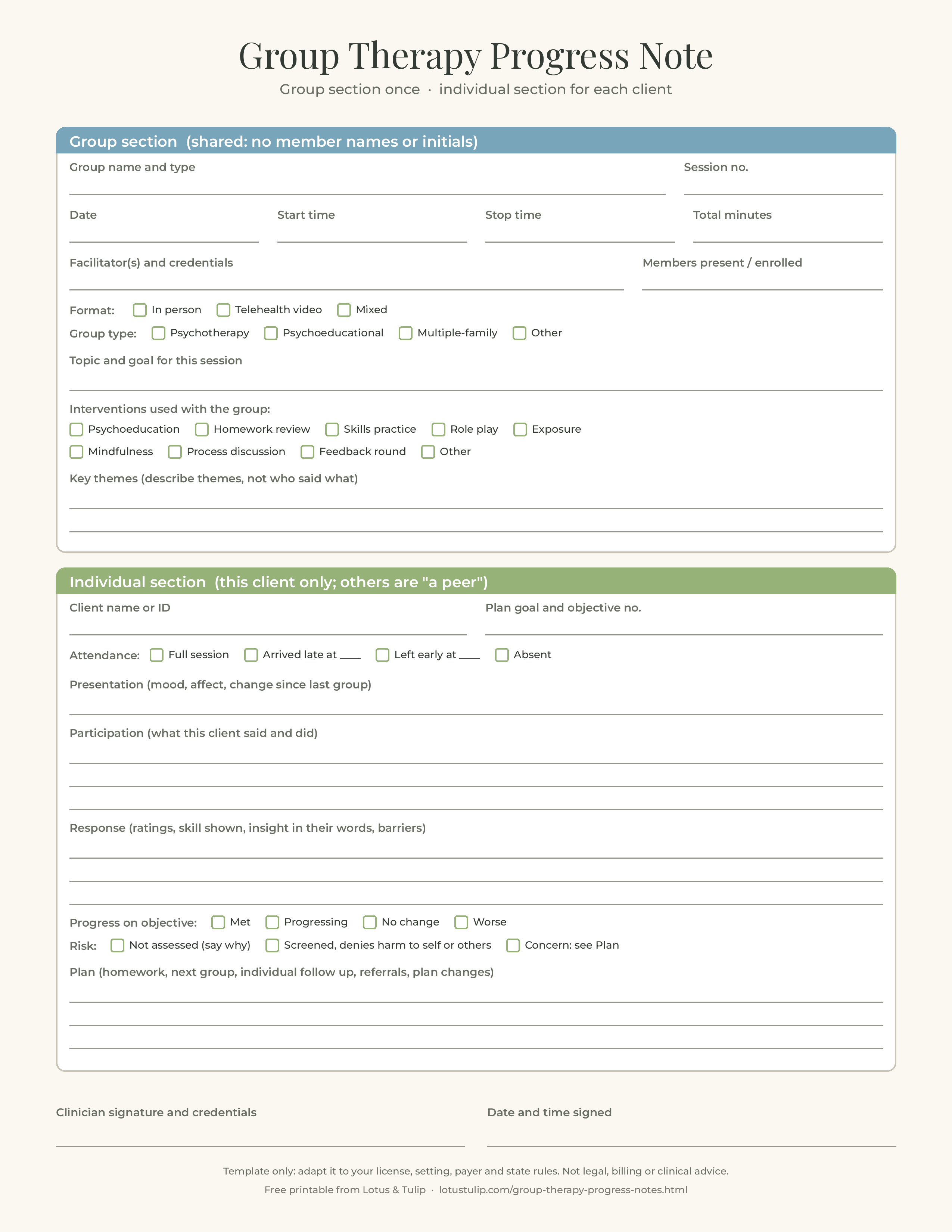
The free printable has three US Letter pages: a blank group therapy progress note with a group section (group name and type, session number, date, times, format, group size, facilitators, topic, interventions and themes, with a reminder to name no members) and an individual section (client ID, attendance, plan objective, presentation, participation, response, progress, risk, plan and signature); a filled example for a fictional client from the anxiety skills group in Example 1; and a one page checklist with twelve checks before you sign, a table of ways to describe other members without identifying them, and a short billing reminder.
Download the free group therapy note template (PDF, 3 pages)
Rather type than handwrite? The free PDF above is for printing. Therapy Progress Notes and Intake Templates comes as a fillable PDF you type straight into (604 fields in Adobe Acrobat Reader), plus the printable version: SOAP, DAP and BIRP notes, intake, treatment plan and safety plan, 20 pages. Holiday 20% off: about $7.36, was $9 (EUR 8) · instant digital download
Buy on EtsyPrefer single images? Page 1: blank group therapy note template (PNG) · Page 2: filled group therapy note example (PNG) · Page 3: before you sign checklist and confidentiality table (PNG)
Free to print and use in your own practice or program. Please link to this page rather than re-uploading the file. The template is a starting point: adapt it to your license, setting, payer and state rules. Using it does not guarantee that any payer, auditor or board will accept your documentation.
Related resources
- Small group counseling referral form: teacher, parent and self referral, screening and a free referral log
- Small group counseling pre and post assessment: how to write, give, score and report it, with a free survey and results sheet
- Small group counseling permission slip and parent letter, with a free letter, filled example and permission log
- Closing a therapy private practice: checklist, timeline, client letters, records plan and free printable
- HIPAA risk assessment for therapists: security risk analysis, filled example and free worksheet
- Business associate agreement for therapists: which vendors need a BAA, breach duties, filled vendor log and free printable
- Professional will for therapists: clinical executor, records custodian, client notification scripts, filled example and free printable
- Couples therapy informed consent form: no secrets policy, individual sessions, records access, safety screening, filled example and free printable
- Treatment summary template for therapists: how to write a treatment summary letter, transfer records under HIPAA, filled example and free printable
- Notice of privacy practices for therapists: HIPAA 164.520 elements, 2026 Part 2 update, filled example and free printable
- Parental consent form for therapy of a minor: who can consent, custody orders, state minor consent laws, HIPAA, filled example and free printable
- Credit card authorization form for therapists: card on file consent, PCI DSS rules, filled example and free printable
- Sliding scale fee policy for therapists: 2026 poverty guideline tiers, copay waiver rules, filled example and free printable
- Therapy cancellation policy template: late cancellation and no show fees, Medicare and Medicaid rules, filled example and free printable
- Release of information form for therapists: HIPAA authorization elements, psychotherapy notes, Part 2, filled example and free printable
- Superbill template for therapists: every field insurers need, CPT and POS codes, filled example and free printable
- Good Faith Estimate template for therapists: No Surprises Act rules, filled example and free printable
- Psychotherapy notes vs progress notes: what HIPAA says, what goes where and free printable
- Therapy termination letter template: how to end therapy ethically, sample letters and free printable
- Informed consent for therapy template: what to include, sample consent and free printable
- Biopsychosocial assessment template: example, 4 Ps formulation and free printable
- BIRP notes for therapists: template, 5 examples and free printable
- GIRP notes for therapists: template, 5 examples and free printable
- Therapy discharge summary template: example and free printable
- Telehealth progress note template: examples, checklist and free printable
- Mental status exam template: examples, word bank and free printable
- SOAP vs DAP notes for therapists, with examples
- Therapy treatment plan template with SMART objectives (free printable)
- What to include in a therapy intake form (checklist)
- Icebreaker activities for counseling groups
- Safety plan worksheet (free printable)
- Therapy progress notes and intake templates
Sources: CMS Medicare Coverage Database billing and coding articles A56937 (Psychiatry and Psychology Services), A57065 (Outpatient Psychiatry and Psychology Services) and A57520, and LCDs L33632 and L34616; Minnesota DHS MHCP provider manual (mental health services); eCFR 45 CFR 164.501 and 164.524; ACA Code of Ethics (2014) B.4.a; APA Ethical Principles of Psychologists and Code of Conduct, standard 10.03. CPT is a registered trademark of the American Medical Association. Rules change; check the current versions.
FAQ
What should a group therapy progress note include?
A group section (group name and type, session number, date, actual start and stop times, format, number of members present, facilitators with credentials, topic, interventions and key themes without names) and an individual section for each client (attendance, the treatment plan objective addressed, presentation, participation, response, progress on the objective, risk check, plan and signature).
Can I use the same note for every member of the group?
You can reuse the group section if it names no members. The individual section has to be written for each client. Medicare contractor guidance describes a second portion "for each patient's record" covering that patient's participation and any significant changes in status, and identical individual notes suggest nothing individual happened.
Can I mention other group members in a client's note?
Avoid it. Do not use names or initials, and leave out details that could identify another member. Write "a peer" or "another member" and describe the theme and this client's reaction. Clients can generally request copies of their records, so anything about another member in the note is a disclosure of that member's information.
What is the CPT code for group therapy?
CPT 90853 is group psychotherapy other than a multiple-family group, and 90849 is multiple-family group psychotherapy. Medicare contractor guidance allows the interactive complexity add-on 90785 with 90853. Coverage, group size limits and documentation rules vary by payer and state, and some programs use their own codes, so check your payer's policy before billing.
Does a group therapy note need start and stop times?
Yes, record them. 90853 is not chosen by time tiers the way 90832, 90834 and 90837 are, but Medicare guidance expects the date and length of the session in the group portion of the note, and payers and auditors look for actual times. Also note when a client arrived late or left early.
How do I document a client who did not talk in group?
Describe what you observed (attentive, looked down, left the room once), whether you invited participation and how they responded, any rating they gave, and the plan, such as a check in at the next session or a flag to their individual therapist. "Did not participate" on its own tells a reader very little.
Are group therapy notes psychotherapy notes under HIPAA?
No. The HIPAA definition of psychotherapy notes in 45 CFR 164.501 can cover process notes about a group session, but only if they are kept separate from the medical record, and it excludes session times, modalities and summaries of diagnosis, symptoms, functional status, treatment plan and progress. A group progress note contains those items, so it is part of the clinical record.
Is this group therapy note template free?
Yes. The three page printable (blank group note, filled example and checklist) is free to print and use in your own practice or program. Please link to this page rather than re-uploading the file, and adapt it to your setting and payer requirements.