
Therapist practice · Updated 2026-11-09
Treatment Summary Template for Therapists: How to Write a Treatment Summary Letter, Transfer Records Under HIPAA, and a Filled Example (Free Printable)
Ready-made printable: Therapy Progress Notes and Intake Templates Fillable PDF: includes a discharge summary page, plus intake, notes and safety plan pages (20 pages)
Holiday 20% off: about $7.36, was $9 (EUR 8) · instant digital download
Try it free first: download a fillable sample (SOAP note and DAP note, PDF, 226 KB). Type into it on screen, then get the full pack. No email needed.

The request usually arrives on an ordinary afternoon. A client is moving across the country and their new therapist would like "a treatment summary." A psychiatrist asks for "something brief on how therapy is going" before a medication change. An intensive outpatient program needs "records" by Friday. A former client emails asking for "a copy of everything," then adds that a short letter would also be fine. Each of these sounds like the same task, and each one is different: a different reader, a different legal basis, a different amount of information, and in some cases a federal deadline.
This guide is for counselors, therapists, clinical social workers, marriage and family therapists and psychologists in the US. It explains what a treatment summary is and how it differs from a discharge summary, a copy of the record and psychotherapy notes; when you may send one without a signed authorization under HIPAA and when you should get one anyway; what the client's right of access requires (including the 30 day clock and the rule on giving a summary instead of copies); what to put in the letter and what to leave out; how to send it and log it; and what happens to the record afterward. It includes a full fictional treatment summary letter, a records transfer cover letter, short examples for common recipients and a free three page printable: a blank treatment summary and transfer form, the same form filled for a fictional client, and a checklist with a records request and transfer log.
Jump to the free treatment summary template
This is educational information for licensed clinicians and trainees in the US. It is not legal advice and does not create any professional relationship. The federal rules quoted here were checked against the current eCFR text of 45 CFR part 164 and 42 CFR part 2 (up to date as of November 5, 2026) and against HHS Office for Civil Rights guidance; the ethics standards were checked against the published APA and ACA codes. State laws on mental health records, consent, fees and retention add their own requirements and are often stricter. Have an attorney, your professional association or your compliance adviser review your process. Every practice, clinician, client and detail in the examples on this page is fictional.
The short answer
A treatment summary is a short, dated letter or report, written by the treating clinician, that tells a specific reader what they need to know about a client's care: why the client came, the diagnosis or clinical focus, what treatment was given, how the client responded, where things stand now, and what you recommend. It is part of the regular clinical record, not a psychotherapy note.
- Know your reader and your legal basis first. Another treating provider, the client, someone the client designates in writing, an insurer, a court and a school are six different situations under HIPAA.
- Treatment disclosures to another provider are permitted by HIPAA without a signed authorization (45 CFR 164.506(c)(2)), but state mental health laws, ethics codes and your own consent form often call for written permission. Most therapists get it.
- Anything else usually needs a valid authorization that meets 45 CFR 164.508(c), and psychotherapy notes always need their own authorization, even for treatment (164.508(a)(2)).
- When the client asks for their own records, you must act within 30 days, with one 30 day extension (164.524(b)(2)). You may give a summary instead of copies only if the client agrees to that, and to any fee, in advance (164.524(c)(2)(iii)).
- Write only what the reader needs. HIPAA's minimum necessary rule does not apply to disclosures to a provider for treatment, to the client, or under an authorization, but the APA and ACA codes still ask you to include only information germane to the purpose.
- Keep it factual and current. Dates, numbers, plain behavioral language, current risk status and specific recommendations.
- Log every request and every disclosure, and keep the authorization or written request with the record.
What a treatment summary is, and what it is not
"Treatment summary" is a working term, not a legal one. Clinicians use it for a closing summary sent to a new provider, an interim update to a psychiatrist, a letter for a client to carry to their next therapist and a summary given to a client instead of a full copy of the record. What these have in common is that you write a new document from the record for a particular reader. That is what separates it from the documents it is most often confused with.
| Document | What it is | Who it is for | How it relates to a treatment summary |
|---|---|---|---|
| Treatment summary | A new, dated summary written from the record for a specific purpose | A named reader: a provider, the client, a program | The subject of this guide |
| Discharge summary | The closing note for your own record when an episode of care ends | Your file, and later anyone the record goes to | Often the source for a treatment summary; it may be sent as is if it suits the reader |
| Copy of the record | Copies of the documents themselves: intake, assessments, plans, progress notes, discharge summary | The client, or a recipient they or the law designate | A summary can replace it only by agreement or when the reader asked for a summary |
| Psychotherapy notes | Separate notes analyzing the content of sessions, kept apart from the record | The clinician who wrote them | Never summarize them into a treatment summary; they have their own HIPAA rules |
| Treatment plan and review | The plan and its periodic review | You and the client | A main source for the goals and progress sections |
| Referral letter | A request for a service, with enough background for the recipient to accept the referral | A provider or program you are referring to | Overlaps; a referral asks a question, a summary reports |
| Letter of support or forensic report | An opinion for a third party, such as an employer, court or housing provider | Non treating readers | Different role and risks; not covered here |
The psychotherapy notes line matters most. Under 45 CFR 164.501, psychotherapy notes are notes recorded by a mental health professional documenting or analyzing the contents of conversation during a counseling session, kept separate from the rest of the record. The same definition excludes "any summary of the following items: diagnosis, functional status, the treatment plan, symptoms, prognosis, and progress to date." In other words, the content of a treatment summary is regular record content by definition. That is why a treatment summary can go to another provider under the ordinary rules, and why it must not quote or paraphrase what you wrote in separate process notes.
When therapists are asked for a treatment summary
Before you write a word, name the situation. The table covers the common ones, with the HIPAA basis that usually applies and what that means in practice. "HIPAA basis" assumes you are a covered entity; state law can add requirements in every row.
| Situation | Usual HIPAA basis | Signed authorization under HIPAA? | Practical note |
|---|---|---|---|
| Client is moving or changing therapists; the new therapist asks for a summary | Disclosure for treatment activities of a health care provider, 164.506(c)(2) | Not required by HIPAA | Get written permission anyway in most cases (state law, ethics, client trust); confirm the requester is who they say they are |
| Psychiatrist, primary care provider or other current treating provider | Treatment, 164.506(c)(2) | Not required by HIPAA | Many therapists' consent forms promise to ask first; keep that promise |
| Step up to a higher level of care (IOP, PHP, residential, inpatient) | Treatment, 164.506(c)(2) | Not required by HIPAA | Speed matters; current risk and safety plan are the priority content |
| Client asks for a summary or their records for themselves | Right of access, 164.524 | No; a written request may be required if your policy says so | 30 day deadline; summary only if the client agrees in advance |
| Client asks you to send their records to someone they choose | Right of access, third party directive, 164.524(c)(3)(ii), limited by the Ciox court order (see below); or an authorization under 164.508 | A signed, written request or a valid authorization | Use your release form for anything other than an electronic copy of an electronic record |
| Attorney, employer, disability insurer, school, court evaluator | Authorization, 164.508 | Yes, a valid authorization | Check purpose, scope and expiration; discuss the content with the client first |
| Subpoena or court order | Judicial and administrative proceedings, 164.512(e) | Not if the rule's conditions are met | A court order allows only what it expressly authorizes; a subpoena alone needs specific assurances; state privilege law often adds more; get advice |
| Health plan, for payment or utilization review | Payment, 164.506(c)(1) and (c)(3) | Not required by HIPAA | Minimum necessary applies; send what the plan's criteria require, not the whole story |
Who can receive a treatment summary, and on what basis
Another treating provider: permitted, but get permission anyway
Under 45 CFR 164.506(c)(2), a covered entity "may disclose protected health information for treatment activities of a health care provider." That includes a provider who is not a covered entity and a provider who will start treating the client next month. HIPAA also exempts these disclosures from the minimum necessary standard: the rule does not apply to "disclosures to or requests by a health care provider for treatment" (164.502(b)(2)(i)).
So why do most therapists still ask for a signed release? Three reasons. First, many state mental health records laws are stricter than HIPAA and require the client's consent for some disclosures HIPAA allows; HIPAA yields to a more protective state law. Second, the ethics codes expect it: the ACA Code of Ethics (2014) says that, unless exceptions to confidentiality exist, "counselors obtain written permission from clients to disclose or transfer records to legitimate third parties" (B.6.g), and APA standard 4.05 allows disclosure with the client's appropriate consent (4.05(a)) and, without consent, only as mandated or permitted by law for a valid purpose, such as providing needed professional services (4.05(b)). Third, your own informed consent and notice of privacy practices may promise that you will ask before talking to other providers. If they do, that promise binds you.
A practical rule: unless it is an emergency, send a treatment summary to another provider with the client's written permission on file, and say in the letter what that permission covers. The release of information form guide explains the elements in detail.
Everyone else: a valid authorization
For recipients who are not treating the client, and are not covered by another HIPAA permission, you need a written authorization. A valid authorization under 164.508(c)(1) contains at least: a specific and meaningful description of the information; who may disclose it; who may receive it; the purpose (or "at the request of the individual"); an expiration date or event; and the signature and date, with a description of the representative's authority if a personal representative signs. It must also put the client on notice of the right to revoke in writing, whether treatment can be conditioned on signing, and the potential for redisclosure by the recipient (164.508(c)(2)), and be written in plain language with a copy given to the client (164.508(c)(3) and (c)(4)).
Read the authorization against the request. An authorization for "progress summary" does not cover a full copy of the record; one for "my new therapist, Dr. Ellison" does not cover her group's billing office; one that expired last month covers nothing.
Psychotherapy notes: their own authorization, always
Under 164.508(a)(2), you must obtain an authorization for any use or disclosure of psychotherapy notes, with narrow exceptions (your own use for treatment, your supervised training programs, defending yourself in a legal action brought by the client, and a short list of disclosures required or permitted by law, including to prevent a serious and imminent threat). Sending them to a new therapist is not one of the exceptions. An authorization for psychotherapy notes may not be combined with an authorization for other information, except another authorization for psychotherapy notes (164.508(b)(3)(ii)). In practice, a treatment summary should never contain or depend on them, and a request for "all records" does not include them unless the client signed a separate authorization naming them.
Substance use disorder records from a Part 2 program
If your file includes records you received from a federally assisted substance use disorder treatment program, 42 CFR part 2 may follow those records. When Part 2 records are disclosed with the patient's written consent, 42 CFR 2.32 requires the disclosure to be accompanied by one of two written notices, the shorter of which reads: "42 CFR part 2 prohibits unauthorized use or disclosure of these records." It also requires a copy of the consent or a clear explanation of its scope (2.32(b)). Whether and how this applies when you, as a HIPAA covered entity, pass on Part 2 information you received is a question for your adviser; the safest default is to leave Part 2 records out of a treatment summary unless the client's consent specifically covers them, and to attach the notice when they are included.
Verify who is asking
Before any disclosure, HIPAA requires you to verify the identity and authority of a requester you do not know (164.514(h)(1)). For a new therapist, that can be as simple as calling the practice number listed on their website rather than the number in the email, or checking their license on the state board's lookup. For a parent, guardian or executor, it means seeing the documents that give them authority.
When the client asks: the HIPAA right of access
A client asking for their own records, or for a summary of them, is exercising a legal right, not asking a favor. Under 45 CFR 164.524(a)(1), an individual has a right to inspect and obtain a copy of protected health information about them in a designated record set, for as long as you keep it. For a provider, the designated record set includes the medical records and billing records you keep about clients, and any other records you use to make decisions about them (164.501). Two things are excluded from the right: psychotherapy notes, and information compiled in reasonable anticipation of, or for use in, a civil, criminal or administrative proceeding (164.524(a)(1)).
The deadline
You must act on a request no later than 30 days after you receive it (164.524(b)(2)(i)). If you cannot, you may extend once, by no more than 30 days, provided that within the first 30 days you give the client a written statement of the reasons for the delay and the date by which you will act (164.524(b)(2)(ii)). HHS calls the 30 calendar days "an outer limit" and encourages covered entities to respond as soon as possible. You may require requests in writing if you tell clients about that requirement, for example in your notice of privacy practices (164.524(b)(1)).
Form and format
You must provide access in the form and format the client asks for, if it is readily producible; if not, in a readable hard copy or another form you both agree on (164.524(c)(2)(i)). If you keep the record electronically and the client asks for an electronic copy, you must provide it in the electronic form and format requested if readily producible, or in another readable electronic form you agree on (164.524(c)(2)(ii)). You must also arrange a convenient time and place for inspection or mail the copy if asked (164.524(c)(3)(i)).
A summary instead of copies: only if the client agrees in advance
This is the rule that matters most for treatment summaries. Under 164.524(c)(2)(iii), you may give the client a summary of the information requested instead of access to it, or an explanation of the information you provide, only if the client agrees in advance to the summary or explanation, and agrees in advance to the fee, if any. HHS's access guidance adds that the client must choose to receive the summary, including in the electronic or paper form you offer.
In practice: you cannot answer "please send me my records" with a two page letter because you think it would be kinder or easier. You can offer the choice. Many clients, once they understand what a full copy of their therapy record contains, prefer a summary, or a copy plus a meeting to go through it; ACA standard B.6.f asks counselors to "provide assistance and consultation in interpreting counseling records" when clients request access. Record the client's choice in writing.
Fees
If the client asks for a copy, or agrees to a summary or explanation, you may charge a reasonable, cost based fee that includes only: labor for copying, whether paper or electronic; supplies for a paper copy or for portable electronic media if the client asks for that; postage if the client asks you to mail it; and preparing an explanation or summary, if the client agreed to it (164.524(c)(4)). HHS's guidance says the fee may not include the cost of reviewing the request or searching for and retrieving the information, and offers a simple option for electronic copies of records kept electronically: a flat fee not exceeding $6.50, inclusive of labor, supplies and postage. HHS also clarified that $6.50 is an option, not a cap, for entities that calculate actual or average allowable costs. State law can prohibit fees or allow only lower ones, and where it does, the state rule applies. Many therapists charge nothing for a client's own copy or summary; whatever you decide, put it in writing before you start.
The APA code adds one firm limit: psychologists "may not withhold records under their control that are requested and needed for a client's/patient's emergency treatment solely because payment has not been received" (standard 6.03).
Sending the client's records to someone they choose
Section 164.524(c)(3)(ii) says that if the client's request directs you to send the copy directly to another person, you must do so, and the request must be in writing, signed by the client, and clearly identify the designated person and where to send the copy. A federal court narrowed this in 2020. In Ciox Health, LLC v. Azar, No. 18-cv-0040 (D.D.C. January 23, 2020), the court vacated the third party directive insofar as it went beyond requests for a copy of an electronic health record in an electronic format, and HHS states that the fee limitation in 164.524(c)(4) applies only to an individual's request for access to their own records, not to a request to transmit records to a third party. The client's own right of access and its fee limits remain in effect.
What that means for a small practice: a client's signed request to send an electronic copy of their electronic record to a named recipient is a right of access request, with the 30 day clock. Anything else, such as paper records to a new therapist, is handled under your normal treatment permission or a HIPAA authorization. Most therapists simply use one release form for both and treat every client directed request promptly.
When you may deny access
Some denials are not reviewable, such as a request for psychotherapy notes or for information compiled for a legal proceeding (164.524(a)(2)). Others are allowed only with a right to review by another licensed health care professional who did not take part in the original decision: when a licensed health care professional has determined, in the exercise of professional judgment, that the access requested is reasonably likely to endanger the life or physical safety of the client or another person; when the record refers to another person (not a health care provider) and access is reasonably likely to cause that person substantial harm; or when a personal representative requests access and access is reasonably likely to cause substantial harm to the client or another person (164.524(a)(3) and (a)(4)). A denial must be timely, written, in plain language, state the basis, explain review rights and how to complain to you and to HHS, and give the name or title and phone number of your contact person (164.524(d)(2)). You must still give access to the rest of the information (164.524(d)(1)).
These grounds are narrower than many clinicians assume. "The client might be upset by my notes" is not one of them. The ACA code sets a similar bar: counselors limit client access "only when there is compelling evidence that such access would cause harm to the client," and document the request and the rationale (B.6.e).
For minors, parents usually exercise these rights as the minor's personal representative, with important exceptions under 164.502(g) and state law; see the parental consent form guide. For a client who has died, HIPAA treats as personal representative the person who has authority under applicable law to act for the deceased or the estate, such as an executor or administrator, and HIPAA protects a deceased person's information for 50 years after death (164.502(f) and (g)(4)).
Treatment summary, copy of records, or both?
Once you know the reader and the basis, decide what to send. The choice is not about saving time. It is about what the reader can use and what the client has agreed to.
| Reader | Usually best | Why |
|---|---|---|
| New outpatient therapist | Treatment summary, plus copies of the intake assessment and most recent treatment plan if they ask | A two page summary gets read; forty pages of progress notes often do not |
| Psychiatrist or prescriber | Short interim summary focused on symptoms, measures, sleep, functioning and risk | They need trends and current status before a medication decision |
| Higher level of care | Summary with current risk and safety plan first, sent the same day; records follow if requested | Speed and safety information matter more than completeness |
| The client, asking for "everything" | A copy of the designated record set, unless the client chooses a summary in advance | It is their right; a summary is their choice, not yours |
| Attorney or insurer under an authorization | Exactly what the authorization describes, nothing more | Scope is set by the signed form, and the recipient is not bound by HIPAA |
What to include in a treatment summary
A good treatment summary answers the questions the next reader will ask in the first five minutes. The table lists the sections in the order most clinicians use, with what each should contain. For a short interim update, keep the identifiers, current status, risk and recommendations and trim the rest.
| Section | What to write | Source in your record |
|---|---|---|
| 1. Header | Practice name, address, phone and secure contact; date of the letter; "Confidential" | Practice details |
| 2. Recipient, purpose and permission | Name, role and organization of the reader; why you are writing ("at the client's request to support continuity of care"); the permission on file and its date | Request, authorization or release |
| 3. Client identifiers | Name and date of birth; no Social Security number, no insurance ID unless the reader needs it | Intake |
| 4. Dates and services | First and last session dates, number of sessions attended, format (in person, video), frequency, and approach (for example cognitive behavioral therapy) | Session log, progress notes |
| 5. Reason for referral and presenting concerns | Two or three sentences: who referred, what brought the client in, in functional terms | Intake, assessment |
| 6. Diagnosis or clinical focus | Diagnosis with code if you made one, and when; or the clinical focus if you did not diagnose | Assessment, treatment plan |
| 7. Measures | Standardized measures with dates and scores at start and most recent (for example PHQ-9, GAD-7) | Assessment, progress notes |
| 8. Goals and interventions | The treatment goals and the main interventions used for each | Treatment plan and reviews |
| 9. Progress and response | What changed, with evidence; what did not; attendance and engagement in neutral terms | Plan reviews, progress notes, measures |
| 10. Current status and risk | Status at last contact, date of the last risk assessment, current safety plan if any; past history only as relevant | Most recent note, risk assessment, safety plan |
| 11. Medications and other care | As reported by the client, with prescriber name if known; other treating providers | Intake updates, notes |
| 12. Recommendations | Level of care, modality, frequency, what has worked, what to watch for, open items | Your clinical judgment |
| 13. Contact and signature | An offer to talk (with the client's permission), your name, credentials, license number and state, signature and date | Practice details |
| 14. Confidentiality statement | A short note that the letter contains confidential health information for the named purpose only; any required state or Part 2 notice | Your template |
Current status and risk: be specific and dated
The section a receiving clinician reads most closely is current status and risk. Write what you assessed, when, and what you found: "At our last session on 10/27/2026, Morgan denied suicidal ideation, intent or plan; no history of attempts; no access to firearms reported. A safety plan was written on 02/09/2026 and reviewed on 09/15/2026; a copy is enclosed at Morgan's request." Avoid an undated "no risk." If there was a period of elevated risk, say so with dates and what was done, because the next clinician needs that history.
What to leave out
HIPAA's minimum necessary standard does not apply to disclosures to a provider for treatment, to the client, or under an authorization (164.502(b)(2)(i) to (iii)). The ethics codes fill the gap. APA standard 4.04(a) says psychologists "include in written and oral reports and consultations, only information germane to the purpose for which the communication is made," and the ACA code, for case consultation, asks that written and oral reports "present only data germane to the purposes of the consultation" (B.7.a). Leave out:
- Psychotherapy notes and their content. Not quoted, not paraphrased, not summarized.
- Detailed narrative of session content. Themes, yes; the client's words about their partner's affair, no, unless clinically essential.
- Information about other people. Family members' diagnoses, a partner's behavior, names of people the client talked about. In couples or family work, include only what relates to the individual whose summary it is; ACA B.6.e makes the same point for records access.
- Raw test data. APA standard 9.04 treats raw and scaled scores, responses and testing notes as test data, released pursuant to a client release, and allows psychologists to refrain from releasing them to protect against substantial harm or misuse; send a summary of results instead, and release test data only deliberately.
- Sensitive categories the reader does not need, such as substance use history from a Part 2 program, HIV status, reproductive health or legal history, unless the purpose requires it and the permission covers it.
- Opinions outside your role. No custody recommendations, fitness for duty opinions or disability determinations in a treatment summary. Those are different services with different standards.
- Billing details, balances and collection notes.
Words to watch in a treatment summary
A treatment summary will be read by a stranger, and quite possibly by the client. Write so that both can understand it and neither would be surprised by it.
| Instead of | Write |
|---|---|
| "Client was noncompliant with homework." | "Morgan completed thought records in about half of the weeks; completion improved after we shortened the form." |
| "Resistant," "manipulative," "attention seeking" | A description of the behavior and its context |
| "No risk." | "Denied suicidal ideation, intent and plan at last contact on [date]." |
| "Borderline traits" without a diagnosis | The diagnosis you made, or the specific pattern you observed |
| "Client made excellent progress." | "GAD-7 fell from 15 at intake to 7 on [date]; returned to full time work in May." |
How to write a treatment summary, step by step
- Log the request the day it arrives. Note who asked, what they asked for, the date received and, if it is a client's own access request, the 30 day due date.
- Identify the reader and the legal basis: treatment by another provider, the client's own access request, a client directed request, an authorization, or a court order or subpoena.
- Check the permission. Read the authorization or release against the request: recipient, information described, purpose, expiration, signature, and a separate authorization if psychotherapy notes are involved. Verify the requester's identity and authority.
- Talk with the client when you can. Explain what you plan to include, offer the choice between a summary and copies if they are asking for their own records, and agree on any fee in advance.
- Gather your sources: intake, assessment, treatment plan and reviews, measures, the most recent progress notes, risk assessment and safety plan, and any discharge summary.
- Draft the summary in the standard order: identifiers, dates and services, reason for referral, diagnosis or focus, measures, goals and interventions, progress, current status and risk, recommendations.
- Cut to what the reader needs. Remove psychotherapy note content, other people's information, raw test data and sensitive details outside the purpose; check every sentence for plain, behavioral language.
- Sign, date and add the confidentiality statement, plus any state required wording or a Part 2 notice if Part 2 records are included.
- Send it securely and document it: use a secure portal, encrypted email, verified fax or tracked mail; keep a copy in the record with the request and permission; and complete your log with the date sent, the method and what was sent.
Treatment summary example for therapy (fictional, full)
The fictional clinician D. Moreau, LCSW, runs Stillwater Bend Counseling, a small private practice. Morgan L., 34, has been seen for anxiety since January and is moving to another state for a new job. Morgan has chosen a new therapist, Dr. K. Ellison, PsyD, at Northfield Psychology Group, and signed the practice's release of information for a treatment summary and the most recent treatment plan. D. Moreau verified Dr. Ellison's practice phone number and license before sending. Psychotherapy notes are not kept. Here is the letter.
Stillwater Bend Counseling (fictional) · 100 Example Street, Suite 2 · (555) 010-0148 · secure portal on request
CONFIDENTIAL · November 9, 2026
To: K. Ellison, PsyD, Northfield Psychology Group (fictional), sent by secure portal
Re: Treatment summary for Morgan L., date of birth 04/18/1992
Purpose and permission: At Morgan's request, to support continuity of care. Release of information signed 11/03/2026, covering this summary and the current treatment plan, valid until 02/28/2027.
Dates and services. First session 01/12/2026; last session 10/27/2026. 26 sessions attended (weekly through May, then every other week), 50 minute individual sessions, about half by video. Approach: cognitive behavioral therapy for anxiety, including psychoeducation, cognitive restructuring, worry postponement, graded exposure to avoided situations and relaxation training.
Reason for referral. Referred by primary care after two urgent care visits for chest tightness with negative cardiac workups. Morgan described daily worry about work performance and health, poor sleep, irritability, and avoidance of highway driving and team meetings, and had taken two weeks of unpaid leave in December 2025.
Diagnosis. F41.1 Generalized anxiety disorder, made at intake assessment on 01/19/2026. No other diagnosis made.
Measures. GAD-7: 15 on 01/12/2026; 11 on 04/06/2026; 7 on 10/13/2026. PHQ-9: 11 on 01/12/2026; 5 on 10/13/2026.
Goals and progress. (1) Reduce worry and physical anxiety enough to work full time: met; returned to full time work on 05/04/2026 after a period of reduced hours, with no missed days for anxiety since. (2) Resume avoided activities: largely met; drives on the highway alone for up to 40 minutes, speaks in team meetings; still avoids presenting to senior leadership. (3) Improve sleep: partly met; falls asleep within about 30 minutes on most nights, up from over an hour, but reports early waking during stressful weeks. Homework completion was about half of weeks early on and improved after we shortened the thought record.
Current status and risk. At the last session on 10/27/2026, Morgan described anxiety as "manageable most days" and was looking forward to the move with expected nervousness. Morgan denied suicidal ideation, intent or plan at intake and at each quarterly check, most recently on 10/27/2026, and reports no history of suicide attempts or self harm. No safety concerns were identified during treatment, so no safety plan was written.
Medications and other care. Morgan reports no psychiatric medications. Primary care is with a physician at the current clinic; Morgan plans to establish primary care after the move.
Recommendations. Continued outpatient therapy, every other week for at least the first two to three months after the move, as relocation and a new role are likely stressors. What helped most: worry postponement, graded exposure with clear hierarchies, and brief written coping plans. Suggested focus: completing the exposure hierarchy for presentations to senior leadership, and sleep (consider CBT for insomnia strategies if early waking persists). Signs to watch: avoidance creeping back during high pressure weeks and physical symptoms read as illness.
I am glad to speak with you about Morgan's care with Morgan's permission; please call the number above. The current treatment plan is enclosed.
D. Moreau, LCSW, License No. 000000 (fictional), [State] · signed 11/09/2026
This letter contains confidential health information, disclosed with the client's written permission for the purpose stated above. Please do not redisclose it except as permitted by law. [Add any wording your state requires.]
Why it works: the reader learns in the first lines who, why and on what permission; every claim of progress has a date, a number or a function behind it; risk is assessed, dated and honest; recommendations are specific enough to act on; nothing about the content of individual sessions or other people appears.
Records transfer cover letter example
When you send copies of records rather than (or as well as) a summary, a short cover letter makes the disclosure clear to the recipient and to anyone who later audits your file. It lists exactly what was sent.
Stillwater Bend Counseling (fictional) · CONFIDENTIAL · November 9, 2026
To: Northfield Psychology Group (fictional), Attn: K. Ellison, PsyD
Re: Records for Morgan L., date of birth 04/18/1992
Enclosed, as authorized by Morgan L. in a release signed 11/03/2026: (1) treatment summary dated 11/09/2026, 2 pages; (2) treatment plan dated 01/26/2026 with review dated 07/20/2026, 3 pages. Total 5 pages. Not included: progress notes and billing records (not requested). The practice does not keep psychotherapy notes.
These records contain confidential health information. If you received them in error, please notify us at (555) 010-0148 and destroy them.
D. Moreau, LCSW
Responding when the client asks for their own records
A short written reply keeps the 30 day clock visible and records the client's choice. Here is an example for a client who asked by email for "my records or a summary, whichever is easier."
Dear Jamie,
Thank you for your request, which I received on November 2, 2026. You have a right to a copy of your records. You can choose: (a) a copy of your records (intake, assessments, treatment plans, progress notes and discharge summary), as a PDF through the portal; (b) a written summary of your treatment instead of the copy; or (c) both, with a meeting to go through them if you would like. There is no fee for any of these. Please reply with your choice. I will send what you choose no later than December 2, 2026, and sooner if I can.
Warmly, D. Moreau, LCSW
The letter offers the summary as the client's choice, not yours; states the fee in advance (here, none); and states a date within the 30 days. If you need the one time extension, the written notice of the reasons and the new date must reach the client within the first 30 days.
Four short treatment summary examples
1. Interim update to a psychiatrist (treatment, with permission). "Riley has attended 9 of 10 weekly sessions since 08/04/2026 for depression (F33.1). PHQ-9: 18 on 08/04, 14 on 09/29, 15 on 10/27. Sleep 4 to 5 hours, appetite reduced, still working part time. Behavioral activation started; activity logs show 2 to 3 planned activities a week. Denied suicidal ideation, intent and plan on 10/27/2026; safety plan in place since 08/11/2026. Riley reports morning nausea since the dose increase on 09/15 and would like to discuss it with you. I recommend continuing weekly therapy."
2. Step up to an intensive outpatient program (treatment, same day). "Sam (DOB 06/02/2003) was seen today, 11/09/2026, and agreed to referral to your IOP. Reports passive suicidal ideation for two weeks, increasing today, with no plan or intent stated; no prior attempts; reports no firearms at home and agreed that a parent will hold medications. Safety plan updated today and enclosed with Sam's written permission. Diagnosis: F43.10 Posttraumatic stress disorder; 14 sessions since 06/2026. I will call your intake line this afternoon to confirm receipt."
3. Summary given to the client instead of copies (right of access, client chose a summary). "You came to therapy in March 2026 after your divorce, wanting to sleep better and feel less stuck. We met 18 times. We worked on grief, routines and self compassion. Your sleep improved and you rejoined your running group; you told me loneliness on weekends is still hard. Our work ended by mutual agreement on 10/20/2026. If you start therapy again, you could share this summary with your new therapist."
4. To a client's attorney (authorization). "As authorized by Taylor M. on 10/30/2026 for 'dates of service and diagnosis only,' Taylor attended 12 sessions between 02/03/2026 and 06/16/2026. Diagnosis: F43.23 Adjustment disorder with mixed anxiety and depressed mood." Nothing else. If the attorney asks for opinions, that is a different service and a different conversation with the client.
Sending the summary securely, and logging it
HIPAA requires appropriate administrative, technical and physical safeguards for protected health information (164.530(c)), but does not prescribe one transmission method. What matters is that the method is reasonable and that you can show where the information went.
- Secure portal or encrypted email to an address you have verified. A portal invitation sent to a known contact is better than an attachment sent to an address copied from an email signature.
- Fax to a number confirmed by phone, with a cover sheet that states what is enclosed, the number of pages and what to do if received in error.
- Mail with tracking, marked confidential, addressed to a named person.
- Never through social media messaging or to a personal email you have not verified.
Then log it. HIPAA's accounting of disclosures excludes disclosures to carry out treatment, payment and health care operations, disclosures to the client, and disclosures under an authorization (164.528(a)(1)(i), (ii) and (iv)), so most treatment summaries never appear in a formal accounting. Disclosures under 164.512, such as in response to a court order, are not excluded: they belong in an accounting, which covers the six years before the client's request. A simple request and transfer log, like page 3 of the free printable, covers both: date received, requester, basis, due date, what was sent, how, when and by whom.
Keep the signed authorization or written request with the record. Under 164.508(b)(6) and 164.530(j), a covered entity must document and retain signed authorizations, and documentation required by the Privacy Rule must be kept for six years from the date of its creation or the date when it last was in effect, whichever is later.
After the transfer: retention and the record you keep
Sending a summary or copies does not move your record; you keep the original. How long you keep it is mostly a state law question. HHS states that the HIPAA Privacy Rule does not include medical record retention requirements and that state laws generally govern how long medical records are kept, while HIPAA requires appropriate safeguards for as long as you keep them, including through disposal (45 CFR 164.530(c)). The six year rule in 164.530(j) applies to HIPAA documentation, such as signed authorizations, policies and your notice of privacy practices, not to the clinical record itself.
Where state law is silent, professional guidance fills in. The APA's Record Keeping Guidelines (2007) suggest that, in the absence of a superseding requirement, psychologists may consider retaining full records until 7 years after the last date of service for adults, or until 3 years after a minor reaches the age of majority, whichever is later. Payer contracts, licensing board rules and your malpractice carrier may require longer. Write your retention period in your consent form and your discharge summary so that you and the client know it.
Plan for your own absence too. APA standard 6.02(c) asks psychologists to "make plans in advance to facilitate the appropriate transfer and to protect the confidentiality of records and data in the event of psychologists' withdrawal from positions or practice," and ACA standard B.6.i asks counselors to take reasonable precautions to protect confidentiality in the event of the counselor's termination of practice, incapacity or death, and to appoint a records custodian when appropriate. A one page professional will that names a custodian, where records are and how clients can get them is the practical version.
Transfers when therapy ends, and when it does not
A treatment summary is often written at a transition, and the ethics codes treat transitions as clinical work, not paperwork. The ACA code says that when counselors transfer or refer clients to other practitioners, "they ensure that appropriate clinical and administrative processes are completed and open communication is maintained with both clients and practitioners" (A.11.d). APA standard 10.10(c) asks psychologists, except where precluded by the client's or a payer's actions, to provide pretermination counseling and suggest alternative service providers as appropriate, and standard 3.12 asks for reasonable efforts to plan for interrupted services, for example because of the psychologist's relocation or the client's.
In practice, a good transfer has four parts: a conversation with the client about the ending or the move; a termination letter if therapy is ending; a discharge summary for your own file; and, with permission, a treatment summary to the next provider, ideally sent before the client's first appointment there. If the client is moving to another state, remember that your license generally does not travel with them; the transfer may need to happen sooner than the client expects.
Common treatment summary mistakes
- Sending before checking the permission, or relying on a release that expired, named a different recipient or covered different information.
- Answering a client's request for records with a summary the client did not agree to in advance.
- Missing the 30 day deadline, or extending it without telling the client in writing why and when.
- Including psychotherapy note content, or treating a request for "all records" as including psychotherapy notes without a separate authorization.
- Too much story, too little status: two pages of history and one line on current risk and recommendations.
- Undated risk statements such as "no risk."
- Other people's information, especially in couples and family work.
- Raw test data sent without thought, where a summary of results would serve the reader.
- Charging what the rule does not allow, such as search and retrieval fees for a client's own copy, or withholding records needed for emergency treatment because of an unpaid balance.
- No record of what went where. No copy of the letter, no log entry, no note of the method.
Free printable: treatment summary template, filled example and transfer log
The free printable has three US Letter pages. Page 1 is a blank treatment summary and records transfer form: practice and clinician, recipient and secure delivery, the legal basis for the disclosure with check boxes (treatment by another provider, the client's own access request, a signed client directed request, an authorization on file, a court order), client and service details, six clinical sections (reason for referral, diagnosis and measures, goals and interventions, progress, current status and risk, recommendations), a "what is enclosed" check list (summary only, records copy, psychotherapy notes not included, Part 2 notice attached, test data not included, other people's details removed), a confidentiality statement, the clinician's signature and an office use strip for the request date, the 30 day due date and how and when it was sent. Page 2 is the same page filled for the fictional Stillwater Bend Counseling example. Page 3 is a ten point before you send checklist and an eight row records request and transfer log.
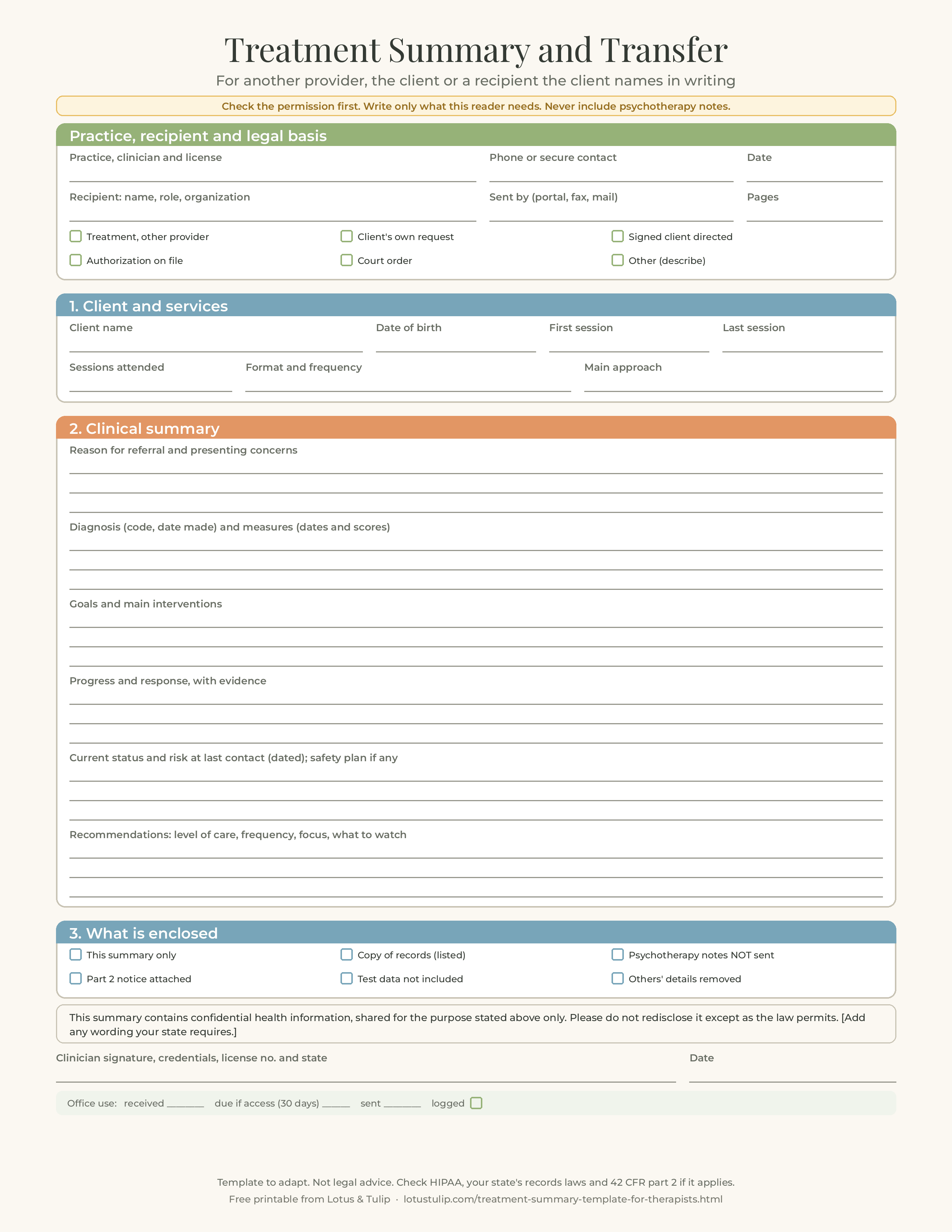
Download the free treatment summary template (PDF, 3 pages)
Rather type than handwrite? The free PDF above is for printing. Therapy Progress Notes and Intake Templates comes as a fillable PDF you type straight into (604 fields in Adobe Acrobat Reader), plus the printable version: SOAP, DAP and BIRP notes, intake, treatment plan and safety plan, 20 pages. Holiday 20% off: about $7.36, was $9 (EUR 8) · instant digital download
Buy on EtsyPrefer single images? Page 1: blank treatment summary and transfer form (PNG) · Page 2: filled fictional example (PNG) · Page 3: before you send checklist and transfer log (PNG)
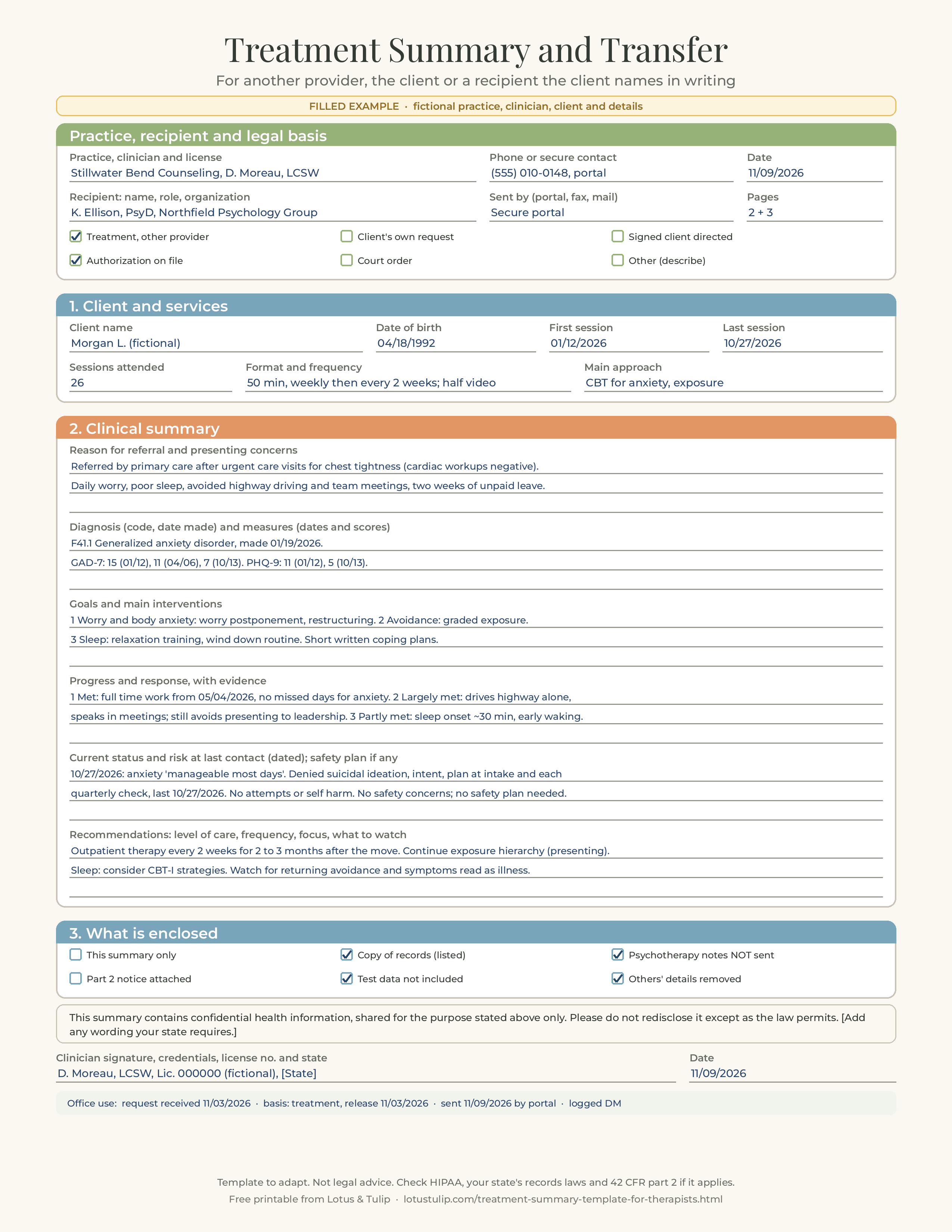
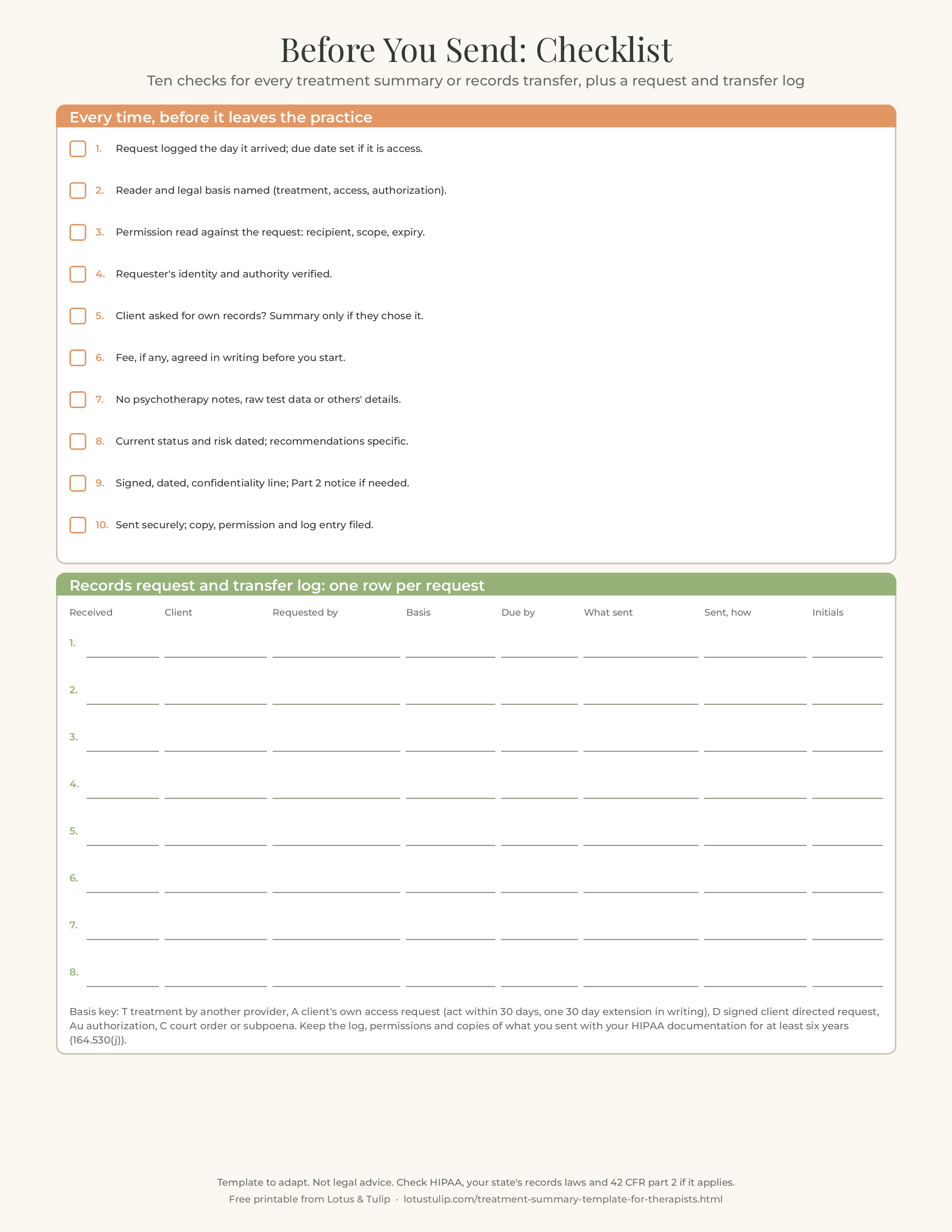
Free to print and use in your own practice. Please link to this page rather than re-uploading the file. The form helps you plan, write and document a treatment summary; it is not legal advice. Check your state's mental health records, consent, fee and retention laws, your licensing board's rules and, if they apply, 42 CFR part 2.
Related resources
- Closing a therapy private practice: checklist, timeline, client letters, records plan and free printable
- HIPAA risk assessment for therapists: security risk analysis, filled example and free worksheet
- Business associate agreement for therapists: which vendors need a BAA, breach duties, filled vendor log and free printable
- Professional will for therapists: clinical executor, records custodian, client notification scripts, filled example and free printable
- Couples therapy informed consent form: no secrets policy, individual sessions, records access, safety screening, filled example and free printable
- Therapy discharge summary template: how to write one, with an example and free printable
- Release of information form for therapists: HIPAA authorization elements, psychotherapy notes, Part 2, filled example and free printable
- Notice of privacy practices for therapists: HIPAA 164.520 elements, 2026 Part 2 update, filled example and free printable
- Psychotherapy notes vs progress notes: what HIPAA says, what goes where and free printable
- Therapy termination letter template: how to end therapy ethically, sample letters and free printable
- Therapy treatment plan template
- Parental consent form for therapy of a minor: who can consent, custody orders, state minor consent laws, HIPAA, filled example and free printable
- Therapy progress notes and intake templates
Sources: 45 CFR 164.501 (definitions of designated record set and psychotherapy notes), 164.502(b), (f) and (g), 164.506(c), 164.508(a)(2), (b)(3), (b)(6) and (c), 164.512(e), 164.514(h), 164.524, 164.528(a) and 164.530(c) and (j), eCFR text up to date as of November 5, 2026; 42 CFR 2.32, eCFR current text; HHS OCR, Individuals' Right under HIPAA to Access their Health Information (45 CFR 164.524), including the fee guidance and the $6.50 flat fee clarification; HHS OCR, Important Notice Regarding Individuals' Right of Access to Health Records (Ciox Health, LLC v. Azar, No. 18-cv-0040, D.D.C. January 23, 2020); HHS OCR FAQ, Does the HIPAA Privacy Rule require covered entities to keep patients' medical records for any period of time?; APA Ethical Principles of Psychologists and Code of Conduct (2002, amended 2010 and 2016), standards 3.12, 4.04, 4.05, 6.02, 6.03, 9.04 and 10.10; APA Record Keeping Guidelines (2007), Guideline 7; ACA Code of Ethics (2014), standards A.11.d, B.6.e to B.6.i and B.7.a. Rules change; check the current versions.
FAQ
What is a treatment summary in therapy?
A treatment summary is a dated letter or report written by the treating clinician for a specific reader, usually another provider or the client, that summarizes the reason for treatment, diagnosis or clinical focus, services provided, progress, current status and risk, and recommendations. It is part of the regular clinical record, not a psychotherapy note.
Do I need a signed release to send a treatment summary to a client's new therapist?
HIPAA permits a covered entity to disclose information for the treatment activities of another health care provider without a signed authorization (45 CFR 164.506(c)(2)). Many state mental health laws, the ACA code (B.6.g) and most therapists' own consent forms call for written permission, so in practice most therapists get a signed release first, except in an emergency.
How long do I have to respond to a client's request for their records?
Under 45 CFR 164.524(b)(2), you must act no later than 30 days after receiving the request. You may extend once by up to 30 more days if, within the first 30 days, you tell the client in writing why and by when you will act. State law may set a shorter deadline.
Can I give a client a treatment summary instead of a copy of their records?
Only if the client agrees in advance to receive a summary instead of the copy, and agrees in advance to any fee for preparing it (45 CFR 164.524(c)(2)(iii)). You can offer the choice, but you cannot impose it.
Is this treatment summary template free?
Yes. The three page printable (a blank treatment summary and records transfer form, a filled fictional example, and a before you send checklist with a records request and transfer log) is free to print and use in your own practice. Please link to this page rather than re-uploading it.