
Therapist practice · Updated 2026-11-10
HIPAA Breach Notification for Therapists: What Counts as a Breach, the Four Factor Risk Assessment, 60 Day Deadlines and an Incident Response Plan (Free Template)
Ready-made printable: Therapy Progress Notes and Intake Templates Fillable PDF, 20 pages: SOAP, DAP and BIRP notes, intake, treatment plan and safety plan
Holiday 20% off: about $7.36, was $9 (EUR 8) · instant digital download
Try it free first: download a fillable sample (SOAP note and DAP note, PDF, 226 KB). Type into it on screen, then get the full pack. No email needed.

Most HIPAA breaches in a small therapy practice do not look like the ones in the news. Nobody holds the practice to ransom. Instead, a superbill with a diagnosis code goes to the wrong client because the email program finished the address. A phone with the practice's text messages is left in a rideshare. A former contractor still has a login to the EHR three months after leaving. A telehealth link is pasted into the wrong calendar invite and a stranger appears in the waiting room. Each of these is a few minutes of panic followed by a real question with a legal deadline attached: is this a breach, who has to be told, and by when?
This guide is written for therapists, counselors, social workers, marriage and family therapists and psychologists in private practice in the United States, and for the people who run their offices. It explains what HIPAA's Breach Notification Rule (45 CFR 164.400 to 164.414) actually requires, in plain language and with the rule's own words where they matter: the difference between a security incident and a breach; the three exceptions; when lost or stolen data is not "unsecured" because it was encrypted the way HHS describes; the four factor risk assessment that decides whether a presumed breach can be treated as low risk; when the 60 day clock starts; what a notice to clients must say and how it must be sent; when to tell HHS, and how the 500 person threshold changes everything; the media notice; breaches at vendors; law enforcement delays; how state laws can add to all of this, with two verified examples; what to document and for how long; and how to talk with a client whose information was exposed. It ends with a ten step process for writing your own incident response plan, a filled example for a fictional practice, six short scenarios, the mistakes that cause the most trouble, and a free three page printable: a blank incident and breach assessment form, the same form filled in, and a first 24 hours checklist with a breach and incident log.
Jump to the free breach assessment form, checklist and log
This is educational information for clinicians and practice staff in the US. It is not legal or cybersecurity advice and does not create any professional relationship. If you think you have a breach, the deadlines are real: talk to an attorney who knows health privacy law, your malpractice or cyber insurer, and a qualified IT or security professional as early as you can. The federal rules quoted here were checked on November 10, 2026 against the eCFR text of 45 CFR 164.400 to 164.414 (subpart D), 164.304, 164.308 and 164.530; the HHS Breach Notification Rule page; the HHS Guidance to Render Unsecured Protected Health Information Unusable, Unreadable, or Indecipherable to Unauthorized Individuals; the HHS page Submitting Notice of a Breach to the Secretary (content last reviewed February 13, 2026) and the OCR breach portal; the HHS OCR Fact Sheet: Ransomware and HIPAA (July 11, 2016); NIST SP 800-61 Revision 3 (April 2025); California Civil Code section 1798.82 (as amended effective January 1, 2026); and Texas Business and Commerce Code section 521.053. State laws differ and change. Every practice, person, number and date in the examples on this page is fictional.
The short answer
- Not every incident is a breach, but every incident needs a response and a record. HIPAA's Security Rule requires you to "identify and respond to suspected or known security incidents," mitigate harm "to the extent practicable" and "document security incidents and their outcomes" (164.308(a)(6)(ii)). Whether you must notify anyone is a separate question.
- An impermissible use or disclosure of protected health information is presumed to be a breach. You can only skip notification if one of three narrow exceptions applies, if the information was not "unsecured" (for example, it was encrypted to HHS's standard and the key was not compromised), or if a documented risk assessment of at least four factors shows "a low probability that the protected health information has been compromised" (164.402).
- Clients must be told without unreasonable delay and no later than 60 calendar days after discovery (164.404(b)). Sixty days is the outer limit, not a target. Discovery is the first day the breach was known, or would have been known with reasonable diligence, to anyone in your workforce other than the person who caused it.
- HHS must be told too. For a breach affecting fewer than 500 people, you log it and report it on the HHS portal no later than 60 days after the end of the calendar year it was discovered in (for breaches discovered in 2026, by March 1, 2027); you may report sooner. For 500 or more, you report at the same time as you notify clients, within the 60 days (164.408).
- The media are told only for more than 500 residents of one state or jurisdiction (164.406), which almost never applies to a small practice.
- Vendors must tell you. A business associate must notify you of a breach of unsecured PHI it discovers, within the same 60 day outer limit (164.410), and your business associate agreement can require faster reporting.
- The burden of proof is yours. If you decide something was not a breach, you must be able to show why, in writing, for six years (164.414(b) and 164.530(j)).
- State law can add to all of this, with shorter deadlines, notices to the state attorney general, or different definitions. California's general law, for example, now sets 30 calendar days for its notice. Check your own state before you send anything.
Does the Breach Notification Rule apply to your practice?
The rule applies to HIPAA covered entities and their business associates. A therapist or practice is a covered entity if it is a health care provider that transmits health information electronically in connection with a standard transaction, most commonly billing insurance or checking eligibility electronically, directly or through a billing service or clearinghouse. Most therapists who take insurance are covered entities. A strictly private pay practice that never sends standard electronic transactions may not be, although many such practices choose to follow HIPAA anyway, and their state laws, licensing board rules and ethics codes still require them to protect client information. Our guide to business associate agreements for therapists explains the covered entity test in more detail.
Three points are easy to miss:
- Non-covered practices are not off the hook for breaches. State breach laws usually apply to any business that holds certain personal information in computerized form, and several states include health or medical information in that definition. The two examples later on this page, California and Texas, both do.
- Substance use disorder records can carry a second set of rules. If your practice is a federally assisted substance use disorder program covered by 42 CFR Part 2, HHS now requires breach reports for unsecured Part 2 records too, under 42 CFR 2.16(b), through the same portal. If you are not sure whether Part 2 applies to you, ask before an incident, not after.
- Your workforce includes more people than you think. Under HIPAA, workforce means employees, volunteers, trainees and others whose conduct is under your direct control, whether or not you pay them. An associate, an intern, a part time biller working in your office and a virtual assistant you direct can all be workforce members. What they know about a breach can start your clock.
Security incident, breach, breach of unsecured PHI: three different things
Much of the confusion about breach notification comes from using three terms as if they meant the same thing. They do not, and the difference decides what you must do.
| Term | What it means | What you must do |
|---|---|---|
| Security incident (164.304) | "The attempted or successful unauthorized access, use, disclosure, modification, or destruction of information or interference with system operations in an information system." A phishing email that someone clicked, malware on a laptop, a stolen phone, repeated failed logins. | Identify, respond, mitigate harmful effects where practicable, and document the incident and its outcome (164.308(a)(6)(ii)). No notification unless it is also a breach of unsecured PHI. |
| Impermissible use or disclosure | Any use or disclosure of PHI the Privacy Rule does not permit, electronic or not: a paper chart left on a train, a voicemail with clinical details left for the wrong person, a superbill sent to the wrong client. | Mitigate (164.530(f)), apply sanctions if a policy was broken (164.530(e)), and decide whether it is a breach. |
| Breach (164.402) | "The acquisition, access, use, or disclosure of protected health information in a manner not permitted under subpart E of this part which compromises the security or privacy of the protected health information." Presumed unless an exception applies or a risk assessment shows a low probability of compromise. | Notify, if the PHI was unsecured. |
| Breach of unsecured PHI | A breach of PHI "that is not rendered unusable, unreadable, or indecipherable to unauthorized persons" by encryption or destruction as HHS's guidance specifies. | Notify affected clients, HHS and, if more than 500 residents of a state, the media, within the deadlines below. |
A security incident can happen without any PHI being touched (a blocked phishing attempt), and a breach can happen without any computer being involved (a lost appointment book). Your incident response plan has to handle both.
What the rule says, section by section
The Breach Notification Rule is short. It is worth reading in full on eCFR at least once; here is what each section does.
| Section | What it covers |
|---|---|
| 164.400 | Applies to breaches occurring on or after September 23, 2009. |
| 164.402 | Definitions: "breach," its three exceptions, the presumption of a breach and the four factor risk assessment, and "unsecured protected health information." |
| 164.404 | Notice to individuals: when a breach is treated as discovered, the 60 calendar day outer limit, the five required content elements, plain language, first class mail or agreed email, next of kin for deceased clients, substitute notice and urgent telephone notice. |
| 164.406 | Notice to prominent media outlets for breaches involving more than 500 residents of a state or jurisdiction. |
| 164.408 | Notice to the Secretary of HHS: with the individual notices for 500 or more, or in an annual report for fewer than 500, plus a log or other documentation. |
| 164.410 | Notice by a business associate to the covered entity, within the same 60 day outer limit, identifying each affected individual where possible. |
| 164.412 | Delaying notice when a law enforcement official says it would impede a criminal investigation or damage national security. |
| 164.414 | Administrative requirements (policies, training, complaints, sanctions, no retaliation, no waivers, documentation) and the burden of proof. |
Is it a breach? Five questions, in order
When something goes wrong, work through these questions in this order and write down each answer with the date and who decided. The order matters, because an earlier answer can end the analysis.
- Was protected health information involved? PHI is individually identifiable health information held or transmitted by a covered entity or business associate, in any form. For a therapy practice that includes far more than notes: a client's name with an appointment time is PHI, because it reveals that the person is in therapy. So is an insurance member ID on a superbill, a voicemail that says "this is your counselor's office," and a photo of a waiting room sign in sheet. If no PHI was involved (a phishing email blocked before anyone opened it, a stolen laptop that never held client data), you have a security incident to document, not a breach.
- Was the use or disclosure one the Privacy Rule does not permit? Many disclosures that feel wrong are permitted: a disclosure to another provider for treatment, a report required by law, a disclosure under a valid authorization. Incidental disclosures that happen despite reasonable safeguards, such as a client in the waiting room overhearing a name called, are also generally permitted if you had reasonable safeguards and applied the minimum necessary standard. If the use or disclosure was permitted, it is not a breach.
- Does one of the three exceptions apply? See the next section. If one does, it is not a breach, but document which exception and why.
- Was the PHI unsecured? If the PHI was encrypted consistent with HHS's guidance and the key or password was not also compromised, or the media was destroyed as HHS describes, notification is not required. HHS's ransomware fact sheet says that in that case "the entity is not required to conduct a risk assessment to determine if there is a low probability of compromise, and breach notification is not required." Document the encryption and why it held.
- Does a four factor risk assessment show a low probability of compromise? If you can demonstrate that, in writing, notification is not required. If you cannot, or you choose not to try, you notify. HHS says covered entities "have discretion to provide the required breach notifications following an impermissible use or disclosure without performing a risk assessment."
Two things run in parallel with these questions from the first hour: containing the incident so it stops getting worse, and preserving evidence so you can answer the questions honestly. Both are covered in the playbooks further down.
The three exceptions, with therapy practice examples
Section 164.402 lists three situations that are not breaches at all. They are narrow, and each has conditions that must all be met.
1. Unintentional access by a workforce member, in good faith
The rule excludes "any unintentional acquisition, access, or use of protected health information by a workforce member or person acting under the authority of a covered entity or a business associate, if such acquisition, access, or use was made in good faith and within the scope of authority and does not result in further use or disclosure" not permitted by the Privacy Rule.
Example: your office manager, who handles billing, opens the wrong client's chart because two clients share a last name, realizes within seconds, closes it and tells you. It was unintentional, in good faith, within the scope of her job (she is allowed into charts for billing), and nothing further happened. Not an example: a staff member looks up an ex partner's new girlfriend, who is a client. That is not unintentional, not in good faith and not within the scope of authority. It is a breach to assess, and a sanctions matter.
2. Inadvertent disclosure between people authorized at the same organization
The rule excludes "any inadvertent disclosure by a person who is authorized to access protected health information at a covered entity or business associate to another person authorized to access protected health information at the same covered entity or business associate, or organized health care arrangement in which the covered entity participates," as long as the information is not further used or disclosed improperly.
Example: in a group practice, a clinician sends a treatment plan meant for her own supervisor to another licensed clinician in the same practice who also has record access. Not an example: the same email sent to a colleague's personal Gmail account, or to a clinician at a different practice down the hall.
3. The recipient could not reasonably have retained the information
The rule excludes "a disclosure of protected health information where a covered entity or business associate has a good faith belief that an unauthorized person to whom the disclosure was made would not reasonably have been able to retain such information."
Example: you hand a client the wrong appointment reminder card, notice immediately, and take it back before she has read it. Not an example: an email or text sent to the wrong person. Electronic messages can be read, forwarded, screenshotted and stored, so a good faith belief that the recipient could not retain them is hard to support; treat them under the risk assessment instead.
If you rely on an exception, write a short note that names it, states each condition and the facts that meet it, and keep it with your incident log. The burden of proof rule in 164.414(b) applies here too.
Unsecured PHI and the encryption safe harbor
Breach notification is only required for unsecured PHI, which the rule defines as PHI "that is not rendered unusable, unreadable, or indecipherable to unauthorized persons through the use of a technology or methodology specified by the Secretary" in guidance. HHS's guidance specifies exactly two ways: encryption and destruction.
Encryption
Electronic PHI is secured if it has been encrypted, in the Security Rule's words, by "the use of an algorithmic process to transform data into a form in which there is a low probability of assigning meaning without use of a confidential process or key," and "such confidential process or key that might enable decryption has not been breached." HHS adds that the decryption tools "should be stored on a device or at a location separate from the data they are used to encrypt or decrypt." The guidance names the NIST standards that meet the test:
- Data at rest (laptops, phones, external drives, files on a server): encryption consistent with NIST Special Publication 800-111, Guide to Storage Encryption Technologies for End User Devices.
- Data in motion (email in transit, telehealth streams, file transfers): encryption that complies, as appropriate, with NIST SP 800-52 (TLS), SP 800-77 (IPsec VPNs) or SP 800-113 (SSL VPNs), "or others which are Federal Information Processing Standards (FIPS) 140-2 validated."
Destruction
PHI on paper is secured once the paper has been "shredded or destroyed such that the PHI cannot be read or otherwise cannot be reconstructed," and HHS is explicit that "redaction is specifically excluded as a means of data destruction." Electronic media are secured once "cleared, purged, or destroyed consistent with NIST Special Publication 800-88, Guidelines for Media Sanitization such that the PHI cannot be retrieved." This matters when you retire old laptops, phones, copiers and external drives: a device wiped properly before it left your office is not a breach if it later goes missing; one that was simply deleted and donated may be.
Three ways encryption fails to protect you
- The device was on and unlocked. HHS's ransomware fact sheet explains that full disk encryption protects a laptop that is "properly shut down and powered off" and then lost or stolen. But once the computer is powered on and the user is logged in, "many full disk encryption solutions will transparently decrypt and encrypt files accessed by the user." If malware reaches files while you are logged in, those files were unsecured at that moment and a breach is presumed. The same logic applies to a phone stolen out of your hand while unlocked.
- The key went with the data. A laptop with its password on a sticky note in the laptop bag, or an encrypted USB drive carried on the same key ring as a card with its passcode, has lost the protection of encryption because the "confidential process or key" was breached too.
- It was not the encryption you thought it was. HHS notes that consistency with NIST SP 800-111 "requires not only the consideration of an encryption algorithm, but also consideration of additional areas of an encryption solution including encryption methodologies (e.g., full disk, virtual disk/volume, folder/file), cryptographic key management, and pre-boot authentication, where applicable." "My email is encrypted" often means only that it was encrypted in transit between servers, not that the message sitting in the wrong recipient's inbox is unreadable to them.
The practical takeaway is the one in our HIPAA risk assessment guide: turn on full disk encryption on every laptop and phone that touches client information, require a strong passcode and automatic locking, keep passwords out of the bag, and record in your risk analysis that you did it and how. It is the single cheapest way to turn a lost device from a breach into a documented incident.
The four factor risk assessment, factor by factor
If the PHI was unsecured and no exception applies, the rule presumes a breach "unless the covered entity or business associate, as applicable, demonstrates that there is a low probability that the protected health information has been compromised based on a risk assessment of at least the following factors." This breach risk assessment is a different document from the Security Rule's risk analysis (the enterprise wide review covered in our risk assessment guide); it is about one incident. HHS's ransomware guidance describes the standard: the assessment "must be thorough, completed in good faith and reach conclusions that are reasonable given the circumstances." The four factors, with what they tend to mean in a therapy practice:
Factor 1: the nature and extent of the PHI, including identifiers and the likelihood of re-identification
Ask what was exposed, about how many people, and how easily it points to a real person. A name plus a diagnosis code, a session date, an insurance member ID, a Social Security number or a date of birth is high on this factor. So, for therapy, is almost any clinical content: the fact of treatment, the reason for it, notes about trauma, substance use, sexuality, immigration status, family conflict or suicidality. Mental health information is among the most sensitive kinds of health information, and a reasonable assessment should say so rather than treat a progress note like a dental appointment reminder. A list of first names and appointment times without anything else is lower, but in a small town or a small community, re-identification can be easy.
Factor 2: the unauthorized person who used the PHI or received it
Who got it matters. Another HIPAA covered entity (a different clinic, a hospital, an insurer) is itself obliged to protect PHI, which generally lowers the risk. A client of yours who received another client's information, a family member or ex partner of the client, an employer, an unknown thief or an attacker on the internet is very different. Note whether you know who the person is, whether they have any relationship to the affected client, and what they have said or done.
Factor 3: whether the PHI was actually acquired or viewed
This factor asks for evidence, not hope. A misdirected letter returned unopened by the post office, or a stolen laptop recovered by the police with a forensic report showing no files were opened after the theft, can support a finding that the PHI was not viewed. An email that the wrong recipient replied to ("I think this is not for me") was at least opened. For computer incidents, the answer usually comes from logs: the EHR's access log, the email account's sign in history, the telehealth platform's attendance record, a forensic examination. If you do not have the evidence, you cannot claim this factor in your favor.
Factor 4: the extent to which the risk has been mitigated
What did you do, and what assurances did you get? Typical mitigation in a practice: getting the recipient to confirm in writing (an email reply is fine) that they deleted the message and its attachments, did not forward, print or save them and will not use them; remotely wiping a lost phone; resetting passwords and ending all active sessions; revoking a former staff member's access; retrieving paper records. Assurances from a known, cooperative recipient count for more than assurances from someone you cannot identify. HHS's ransomware guidance adds that where data integrity or availability is at risk, robust backups and tested restores can show mitigation, but that whether PHI was exfiltrated "should also be considered."
Writing the conclusion
Rate each factor, explain the facts behind each rating, and then state the overall conclusion in one sentence: either "Based on these factors, we have demonstrated a low probability that the PHI has been compromised, and notification is not required," or "We cannot demonstrate a low probability of compromise; this is a reportable breach." The factors are "at least" the four listed; HHS encourages considering others, such as a high risk that data is unavailable or corrupted. If one factor clearly points to compromise (for example, a hostile ex partner who opened the file), good ratings on the others rarely rescue the conclusion. When the answer is genuinely unclear, many practices choose to notify, and the rule allows that. What you should not do is reach a convenient conclusion and fail to write down why.
When the clock starts: discovery
All the deadlines run from discovery, and discovery is earlier than many people think. Under 164.404(a)(2), a breach is "treated as discovered by a covered entity as of the first day on which such breach is known to the covered entity, or, by exercising reasonable diligence would have been known to the covered entity." And the practice is "deemed to have knowledge of a breach if such breach is known, or by exercising reasonable diligence would have been known, to any person, other than the person committing the breach, who is a workforce member or agent of the covered entity."
In practice:
- Your staff's knowledge is your knowledge. If your biller noticed on Monday that she sent a statement to the wrong client but did not tell you until Friday, the clock started Monday.
- "Would have been known" counts. A practice that never reviews EHR access logs, never reads its vendor's security notices and never opens returned mail may be treated as having discovered a breach when it should have, not when it finally did.
- The clock does not wait for your investigation. You may need weeks to learn the scope, but the 60 days are already running. Notice may be sent "in one or more mailings as information is available."
- Sixty days is a ceiling. The standard is "without unreasonable delay and in no case later than 60 calendar days after discovery." Holding a finished notice until day 59 is not what the rule describes.
Count calendar days, not business days. For a breach discovered on Tuesday, March 9, 2027, the latest date for client notices is Saturday, May 8, 2027. Put both dates at the top of your assessment form the day you learn of the incident.
Notifying clients: content, method and timing
What the notice must say
Section 164.404(c) requires that the notice include, "to the extent possible":
- "A brief description of what happened, including the date of the breach and the date of the discovery of the breach, if known";
- "A description of the types of unsecured protected health information that were involved in the breach (such as whether full name, social security number, date of birth, home address, account number, diagnosis, disability code, or other types of information were involved)";
- "Any steps individuals should take to protect themselves from potential harm resulting from the breach";
- "A brief description of what the covered entity involved is doing to investigate the breach, to mitigate harm to individuals, and to protect against any further breaches"; and
- "Contact procedures for individuals to ask questions or learn additional information, which shall include a toll-free telephone number, an e-mail address, Web site, or postal address."
It must be "written in plain language." Avoid legal jargon and avoid minimizing. Clients can tell the difference between an honest apology and a letter written to protect the practice.
How it must be sent
- First class mail to the client's last known address, or email "if the individual agrees to electronic notice and such agreement has not been withdrawn." A general consent to receive appointment reminders by email is not obviously an agreement to receive breach notices electronically; if you want the email option, ask clients to agree to it specifically, and record the answer.
- Deceased clients: if you know the client has died and you have the address of the next of kin or personal representative, send written notice to either of them by first class mail.
- Substitute notice when contact information is insufficient or out of date: for fewer than 10 people, "an alternative form of written notice, telephone, or other means"; for 10 or more, either a conspicuous posting for 90 days on your website's home page or conspicuous notice in major print or broadcast media where the people likely live, plus a toll free number active for at least 90 days.
- Urgent cases: where you believe there is "possible imminent misuse," you may also call clients, in addition to (not instead of) the written notice.
Therapy specific cautions
- Safety. A letter that arrives at a shared address and says "your counseling records" can itself expose a client, for example one in an abusive relationship. Check the chart for any request for confidential communications (clients may ask you to contact them by alternative means or at alternative locations, and providers must accommodate reasonable requests), and plan how to honor it. If the rule's "last known address" requirement and a client's safety seem to conflict, get advice quickly rather than guessing.
- Minors and personal representatives. For a minor client, the parent or guardian is often the personal representative who receives the notice, but state minor consent laws can change that for some mental health services. Our parental consent guide covers the basics; for a breach, ask your attorney who should receive the letter.
- Former clients are affected individuals too. Use the most recent address in the record, and plan substitute notice if mail comes back.
- The envelope. The return address and the outside of the envelope should not reveal more than your usual mail does.
A sample client notice (fictional)
This is a short example for a small, single client incident. It is not a form to copy without review; your attorney and your state's law may require more.
Notice of a privacy incident involving your information
Dear [Client name],
I am writing to tell you about a mistake my office made with some of your information, what we have done about it, and what you can do. What happened: On March 8, 2027, a member of my office staff sent an email with a billing statement (superbill) for your sessions to another client of the practice by mistake. We learned of it on March 9, 2027, when the other person replied to tell us. What information was involved: your name, date of birth, insurance member ID, the dates of three sessions, the session fee and a diagnosis code. Your session notes and your Social Security number were not included. What we are doing: the person who received the email confirmed in writing that they deleted it and its attachment and did not forward or save it. We have turned off automatic address completion on the office email, now send statements only through the client portal, and have retrained staff. What you can do: we do not believe you need to take any action, but you may wish to review explanation of benefits statements from your insurer and tell them if you see services you did not receive. For more information: call me at [phone], email [address] or write to [postal address]. I am sorry this happened, and I am glad to talk about it in our next session or by phone, whichever you prefer.
[Clinician name, credentials], [Practice name], [Date of this letter]
Notifying HHS: the portal, the 500 person line and the annual report
Every breach of unsecured PHI must be reported to the Secretary of HHS, including the one client superbill above. What changes with size is the timing.
| Breach size | When to report to HHS | Also required |
|---|---|---|
| Fewer than 500 individuals | Keep "a log or other documentation of such breaches" and report each one "not later than 60 days after the end of each calendar year" for breaches discovered that year (164.408(c)). HHS adds that "you do not have to wait until the end of the year (you may report the breach as soon as it is discovered)." | Individual notice within 60 days of discovery, as for any breach. |
| 500 or more individuals | "Contemporaneously with the notice required by 164.404(a)," meaning at the same time as the client notices: without unreasonable delay and no later than 60 calendar days after discovery (164.408(b)). | Media notice if more than 500 residents of one state or jurisdiction. HHS publishes a list of breaches affecting 500 or more individuals. |
How the annual deadline works out: breaches discovered during 2026 must be reported by March 1, 2027, and breaches discovered during 2027 by February 29, 2028, because 2028 is a leap year. Do not count on remembering a breach from last spring in February; enter it in your log the day you decide it is reportable, and many small practices simply report each one as soon as the individual notices go out so that nothing is left hanging.
Where to report. Reports go through the HHS Office for Civil Rights breach portal at ocrportal.hhs.gov/ocr/breach, linked from the HHS page "Submitting Notice of a Breach to the Secretary." The portal has separate paths for breaches affecting 500 or more individuals and fewer than 500. According to HHS, "you must submit a separate notice for each breach incident," you may report several breaches on the same date, and if you are uncertain how many people were affected "you should provide an estimate." If you learn more later, you can file an addendum using the transaction number from your first report. Save a PDF or screenshot of each submission and its transaction number with your incident file.
What happens next. OCR reviews breach reports and may open an investigation, which usually means a letter asking for your policies, your risk analysis, your breach assessment and proof of notification. This is one reason a current security risk analysis matters so much: investigations that start with a small breach report often turn into questions about whether the practice ever did one.
Media notice: rare for a small practice, but know the rule
Under 164.406, for a breach of unsecured PHI "involving more than 500 residents of a State or jurisdiction," you must also notify "prominent media outlets serving the State or jurisdiction," within the same 60 day outer limit and with the same content as the individual notice. HHS says this will "likely" take the form of a press release. Note the two different thresholds: HHS's immediate reporting starts at 500 or more individuals in total, while media notice requires more than 500 residents of a single state. A group practice whose EHR vendor is hit by ransomware could reach either one. Substitute notice by media for 10 or more people with bad contact details, described above, is a separate rule.
When the breach happens at a vendor
Many breaches affecting therapy practices happen at a business associate: an EHR, billing service, telehealth platform, answering service, IT provider or cloud storage company. Section 164.410 requires the business associate, "following the discovery of a breach of unsecured protected health information," to notify you "without unreasonable delay and in no case later than 60 calendar days after discovery," and to identify, "to the extent possible," each affected individual and give you the other information you need for your own notices, "at the time of the notification ... or promptly thereafter as information becomes available."
Points that catch practices out:
- You remain responsible for the notices. HHS: "while the covered entity is ultimately responsible for ensuring individuals are notified, the covered entity may delegate the responsibility of providing individual notices to the business associate." Your business associate agreement should say who sends notices and who pays.
- Your clock may start before the vendor tells you. If the vendor is acting as your agent under the federal common law of agency, its knowledge can be treated as yours. If it is an independent contractor, your clock generally starts when you are told. Most BAAs do not settle this clearly; ask your attorney when a vendor breach is serious.
- Contract for speed. HHS's sample business associate agreement provisions suggest parties "may wish to add additional specificity regarding the breach notification obligations of the business associate, such as a stricter timeframe." A window measured in days rather than the federal 60 is a reasonable thing to ask for. Our BAA guide includes the clauses to look for.
- Read vendor security emails. A notice titled "security update" from your EHR may be your notice of a breach. Route vendor notices to the person responsible for incidents, not to a shared inbox nobody reads.
Law enforcement delay
If police or federal agents tell you that notice "would impede a criminal investigation or cause damage to national security," 164.412 requires you to delay. If the statement "is in writing and specifies the time for which a delay is required," delay for that period. If it is made orally, "document the statement, including the identity of the official making the statement," and delay "temporarily and no longer than 30 days from the date of the oral statement, unless a written statement ... is submitted during that time." Write the officer's name, agency, badge or contact number, the date and exactly what was said, and calendar the 30th day. The delay applies to notices; it does not pause your investigation, containment or documentation. HHS's ransomware guidance also recommends that a practice hit by ransomware contact its local FBI or Secret Service field office.
State breach laws: what they can add
HIPAA sets a federal floor. State laws can add requirements on top of it, and in many states they apply whether or not you are a HIPAA covered entity. Depending on the state, a state law can add a shorter deadline, a notice to the state attorney general or another agency, specific required headings or content, a duty to offer credit monitoring when certain identifiers are exposed, notice to consumer reporting agencies for large breaches, or a broader definition of covered information. Some states treat a HIPAA compliant notice as satisfying part of their law; others do not. We are not going to summarize fifty states, because those laws change often and a summary you cannot verify is worse than none. Two verified examples show the kind of difference to look for:
California: Civil Code 1798.82
- Applies to a person or business that conducts business in California and owns or licenses computerized data that includes "personal information," which includes a name combined with "medical information" or "health insurance information" when not encrypted.
- As amended effective January 1, 2026, the disclosure "shall be made within 30 calendar days of discovery or notification of the data breach," subject to delays for law enforcement or "as necessary to determine the scope of the breach and restore the reasonable integrity of the data system."
- The notice must be titled "Notice of Data Breach" with the headings "What Happened?", "What Information Was Involved?", "What We Are Doing," "What You Can Do," and "For More Information," in at least 10 point type.
- A HIPAA covered entity "will be deemed to have complied with the notice requirements in subdivision (d)" (the content and format rules) if it has complied completely with the HITECH Act's content requirements, but the statute adds that "nothing in this subdivision shall be construed to exempt a covered entity from any other provision of this section."
- Anyone required to notify more than 500 California residents of a single breach must submit a sample copy of the notice to the Attorney General "within 15 calendar days of notifying affected consumers."
California also has other health privacy laws that can apply to licensed providers. If you practice in California, ask your attorney how 1798.82's 30 day window and HIPAA's 60 day outer limit fit together for your specific incident; do not assume the longer one controls.
Texas: Business and Commerce Code 521.053
- Applies to a person who conducts business in Texas and owns or licenses computerized data that includes "sensitive personal information," which includes information that identifies an individual and relates to "the physical or mental health or condition of the individual," "the provision of health care to the individual," or payment for it.
- Individual notice "without unreasonable delay and in each case not later than the 60th day after the date on which the person determines that the breach occurred."
- Notice to the Texas Attorney General, through the form on its website, "as soon as practicable and not later than the 30th day after the date on which the person determines that the breach occurred if the breach involves at least 250 residents of this state."
- Notice to the nationwide consumer reporting agencies if more than 10,000 people must be notified at one time.
For every other state, look up the current breach notification statute on your state legislature's or attorney general's website, note any attorney general notice threshold and deadline, and write them into your plan now. If clients live in several states (common with telehealth across state lines), the laws of the states where affected clients live may each apply.
Other people you may need to tell
- Your insurers. Professional liability and cyber policies often require prompt notice of a possible claim or incident and may provide breach coaches, forensic help and attorneys. Read the notice clause now, and call before you send letters if the policy requires it.
- Your licensing board, if your state's rules or a board order require it. Check your board's rules rather than assuming either way.
- Contract partners, such as an agency you subcontract for, which may be the covered entity for some of your clients and need to make its own notices.
What an incident response plan for a therapy practice needs
HIPAA does not use the phrase "incident response plan," but it requires the substance. The Security Rule requires "policies and procedures to address security incidents," with the required implementation specification to "identify and respond to suspected or known security incidents; mitigate, to the extent practicable, harmful effects of security incidents that are known to the covered entity or business associate; and document security incidents and their outcomes" (164.308(a)(6)). It requires a contingency plan with a data backup plan, a disaster recovery plan and an emergency mode operation plan (164.308(a)(7)). And the Breach Notification Rule requires written policies and procedures, training and sanctions for breach notification itself, through 164.414(a) and 164.530. HHS summarizes: "covered entities must have in place written policies and procedures regarding breach notification, must train employees on these policies and procedures, and must develop and apply appropriate sanctions against workforce members who do not comply."
For a solo or small group practice, all of that can fit in four to six pages. The free printable on this page gives you the working forms; the plan itself should cover:
- Who is responsible. Name your privacy official (164.530(a)) and security official (164.308(a)(2)). In a solo practice, both are you; write it down anyway. Name a backup for when you are away.
- Definitions. What counts as a security incident, an impermissible use or disclosure and a breach, in the rule's terms, with examples from your own practice.
- How anyone reports a problem. Every workforce member, including associates and contractors you direct, must report any suspected incident to the privacy or security official immediately, the same day at the latest, and without fear of retaliation. Say how (a phone number, not only email, since email may be the thing that is compromised).
- A contact list, kept on paper and outside your main systems: your attorney, your malpractice and cyber insurers with policy numbers and claim lines, your IT support, each critical vendor's security contact (EHR, email, telehealth, billing, phone system), your bank, and local FBI field office information.
- Triage and containment steps for the incidents you are most likely to have (the playbooks below).
- Evidence preservation. What not to do (do not wipe the infected computer, do not delete the misdirected email from your sent folder, do not pay a ransom on your own), and what to save (screenshots, logs, the wrong recipient's reply).
- The breach assessment. The five questions, the four factor risk assessment and who signs the conclusion.
- Notification procedures: deadlines, templates for client letters, the HHS portal, media and state requirements, and who approves each notice.
- Documentation and retention: the incident log, where files are kept and for how long.
- Mitigation, sanctions and lessons learned: how you fix the cause, what happens when a policy was not followed, and how findings feed back into your risk analysis.
- Training and testing. When the plan is reviewed with staff, and a short tabletop exercise at least once a year.
NIST's incident response guidance is a useful outside reference. NIST SP 800-61 Revision 3, published in April 2025, superseded Revision 2 (the version HHS cites in its 2016 ransomware fact sheet) and frames incident response around the NIST Cybersecurity Framework 2.0. You do not need to adopt it wholesale, but its cycle of preparing, detecting, responding and recovering, then improving, is a sensible shape for a small practice's plan too.
Playbooks for the incidents therapy practices actually have
Each playbook below is a starting point. Adjust it to your systems, write it into your plan, and use the blank form on page 1 of the printable to record what happened.
Email or text sent to the wrong person
- Do not panic delete. Keep the sent message as evidence; note the time, the recipient address and exactly what was attached.
- If your email system supports recall or expiry for encrypted messages, use it, and note whether it worked.
- Contact the recipient, briefly and politely, by reply or phone. Ask them not to open any attachment if they have not, to delete the message and attachments from their inbox and deleted items, not to forward, print or save them, and to confirm in writing.
- Identify every affected client and every type of information exposed.
- Run the four factor assessment. Who the recipient is, whether they opened it, and whether they confirmed deletion are the facts that will decide it.
- Fix the cause: turn off address autocomplete for client messages, use a secure portal for documents, add a second check before sending attachments.
Lost or stolen phone, laptop or tablet
- Record when and where it was last seen, and whether it was powered off, locked or in use.
- Use the device management or "find my" service to locate, lock and, if appropriate, remotely erase it. Note the result and time.
- Change passwords for every account used on the device (EHR, email, telehealth, cloud storage, messaging) and sign out of all sessions.
- Establish whether full disk encryption was on, whether the passcode was strong, and whether the key or password was stored with the device. That decides whether the PHI was unsecured.
- File a police report for a theft and keep the report number.
- List what PHI was on the device or reachable from it without a further login: downloaded files, photos of documents, cached email, text messages.
Compromised email account or phishing
- Reset the password from a clean device, turn on multifactor authentication if it was off, and end all active sessions.
- Check for forwarding rules, filters and new connected apps the attacker may have added. Attackers often add a rule that silently forwards everything to an outside address.
- Pull the sign in history and the account's audit logs before they roll over, or ask your provider to preserve them.
- Work out which messages and attachments containing PHI were in the mailbox during the period of access. With no evidence about what was read, assume the whole mailbox could have been.
- Warn clients and colleagues if the attacker sent messages from your account.
Ransomware or other malware
- Disconnect affected devices from the network and the internet; do not turn them off unless your IT support tells you to, because memory can hold evidence.
- Call your cyber insurer and IT support before doing anything else. HHS recommends contacting your local FBI or Secret Service field office.
- Activate your contingency plan: how you will see clients, find contact details and keep safety plans available while systems are down.
- Remember HHS's position: when ransomware encrypts ePHI, "a breach has occurred because the ePHI encrypted by the ransomware was acquired," and a breach is presumed unless you can demonstrate a low probability of compromise. That needs forensic facts, not optimism.
- Restore from clean, tested backups, and fix the way the attacker got in.
Telehealth session problems
- If the wrong person joins a session or a waiting room, end or pause the session and remove them. Note who they were, if known, and what they could see or hear.
- If a link was sent to the wrong person, generate a new link for the client and lock or delete the old meeting.
- If a session was recorded without your intent, find where the recording is stored, who can reach it, and delete it according to your policy, after recording the facts.
- Assess under the four factors. A stranger who saw an empty waiting room for ten seconds is very different from one who heard twenty minutes of a session. Our telehealth across state lines guide and telehealth note guide cover the rest of a telehealth setup.
Access by a former staff member or snooping by a current one
- Disable the account immediately and change any shared passwords.
- Pull the EHR access log for the person's activity over the whole relevant period.
- Identify every chart opened outside the person's job duties. Each affected client is a potential breach.
- Apply your sanctions policy and document it (164.530(e)). Fix the offboarding checklist so accounts end on the last day.
Paper records and mail
- For lost paper, list exactly which documents were involved; for a stolen bag or car break in, file a police report.
- For mail sent to the wrong address, contact the recipient where you can, and ask for the item back or confirmation of shredding.
- For records found in a recycling bin or left in a shared space, retrieve them, find out how long they were there and who had access.
- Remember that only shredding or destruction secures paper; a document "blacked out" with marker is not destroyed.
Online reviews, social media and other public replies
Responding to a client's online review with anything that confirms they are a client, or discusses their treatment, can be an impermissible disclosure even if the client posted first. If it has already happened, remove the reply, record what it said and how long it was visible, and assess it like any other disclosure. Our guide to what therapists can post on social media covers safer ways to respond.
Documentation: what to keep, and for how long
Section 164.414(b) puts the burden on you: "the covered entity or business associate, as applicable, shall have the burden of demonstrating that all notifications were made as required by this subpart or that the use or disclosure did not constitute a breach." Section 164.530(j) requires you to "maintain documentation sufficient to meet its burden of proof" and to retain required documentation "for six years from the date of its creation or the date when it last was in effect, whichever is later." HHS's ransomware guidance lists what that documentation should include: the risk assessment "demonstrating the conclusions reached," any exception you relied on, and documentation "demonstrating that all notifications were made" where the incident was reportable.
For each incident, keep one file (paper or electronic, outside the client's clinical record) with:
- The completed incident and breach assessment form, signed and dated by the person who made the decision.
- The evidence: screenshots, the misdirected message, logs, the recipient's confirmation, police report numbers, vendor notices, forensic reports.
- Copies of every notice sent, with the date, the method and the list of recipients, and any returned mail.
- The HHS portal submission confirmation and transaction number, and any addendum.
- Any state attorney general submission, insurer notice and law enforcement delay statement.
- Mitigation steps, sanctions applied and changes made to policies or systems.
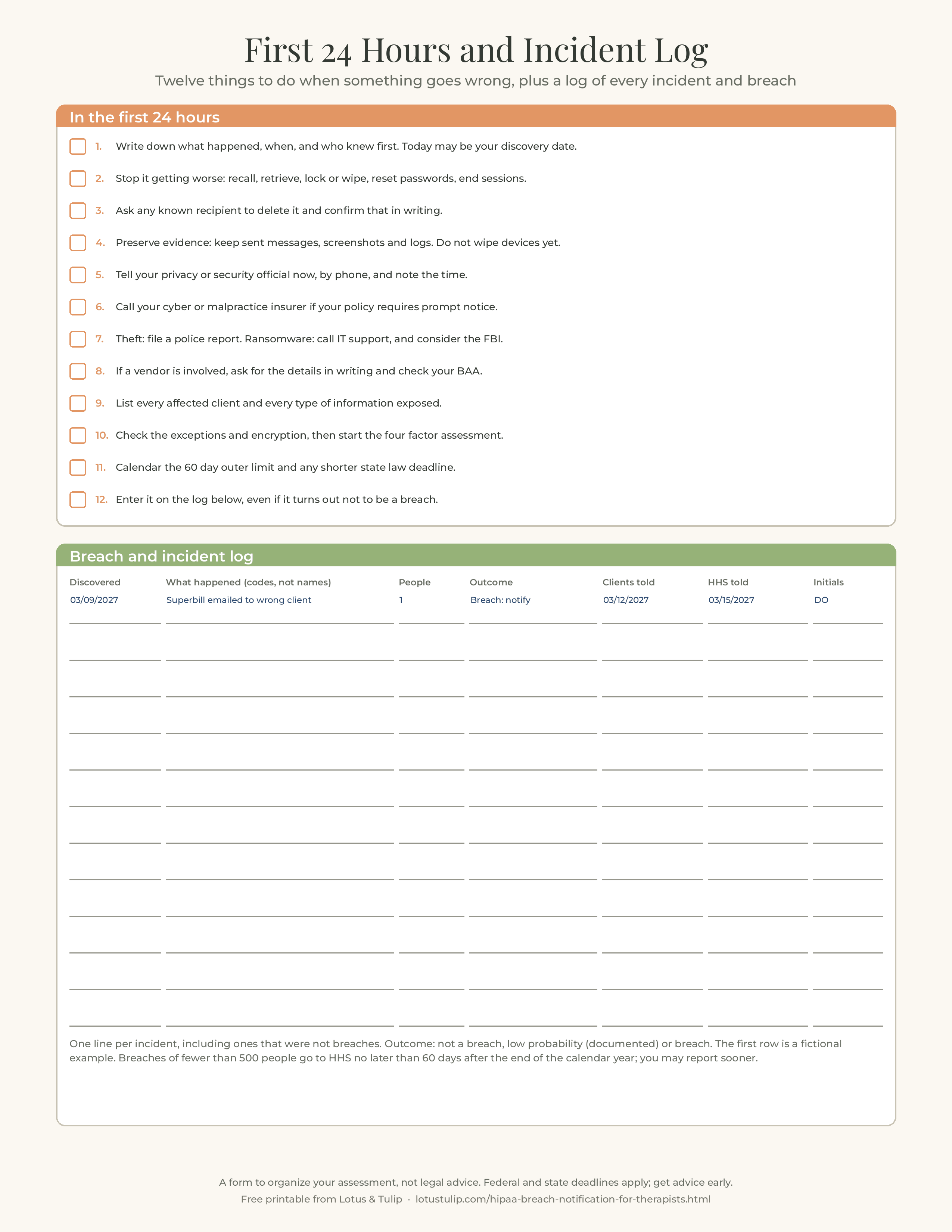
Keep the running breach and incident log (page 3 of the printable) as well. The log is what lets you file the annual HHS report for small breaches accurately, and it is the first thing an investigator will ask for. Should you note the incident in the client's chart? Many clinicians record a brief, factual note that the client was informed of a privacy incident and how they responded, especially if it was discussed in session, while keeping the incident file itself separate. Decide your approach in the plan so that it is consistent.
Mitigation, sanctions, training and no retaliation
- Mitigation. "A covered entity must mitigate, to the extent practicable, any harmful effect that is known to the covered entity of a use or disclosure of protected health information in violation of its policies and procedures" or the Privacy Rule, including by its business associate (164.530(f)). This applies even when no notice is required.
- Sanctions. You must "have and apply appropriate sanctions" against workforce members who fail to follow your privacy policies or the breach rules, and "document the sanctions that are applied, if any" (164.530(e)). Sanctions should be proportionate: retraining for an honest autocomplete mistake, something much more serious for deliberate snooping.
- Training. You must train your workforce on your breach notification policies and procedures and document the training (164.530(b)). Train new staff within a reasonable time, and retrain after a material change.
- Complaints. You must have a process for individuals to complain about your privacy policies and practices, and document complaints and their disposition (164.530(d)). A client upset by a breach notice may use it.
- No retaliation. You may not intimidate or retaliate against anyone for exercising their rights, including filing a complaint (164.530(g)). That includes a staff member who reports a breach they caused or noticed. A culture where people report mistakes quickly is the best protection you have, because hidden incidents are the ones that become late notices.
Talking with a client whose information was exposed
For most businesses, a breach notice is a letter. For a therapist, it is also a clinical event. The client trusted you with things they may not have told anyone else, and the news that some of it went somewhere it should not have can bring up shame, fear, anger or a sense of betrayal, especially for clients with trauma histories or those whose safety depends on privacy.
- Tell them yourself if you can. The written notice is required, but for an active client a phone call or a conversation at the start of the next session, followed by the letter, is usually kinder than a letter arriving cold. Do not let the conversation delay the written notice.
- Be specific and honest. Say what happened, what information was involved, who received it if you know, what you did and what you have changed. Do not minimize, and do not speculate beyond the facts.
- Apologize without hedging. "I am sorry this happened, and I take responsibility for it" is better than a legal sounding formula. If you are worried about how an apology affects a possible claim, ask your insurer before the conversation, not during it.
- Make room for the reaction. Offer time in session to talk about it, at no charge if that feels right. Some clients will want to discuss it at length; some will want to move on; a few will want to end treatment. Respect each choice, and offer referrals if a client wants a new therapist.
- Answer practical questions. What can the recipient do with it? Do I need to do anything? Could my employer find out? If you do not know, say so, and follow up in writing.
- Consider the people around the client. In couples or family therapy, an incident can expose one person's information to another. Think through who should be told what before you call anyone. Our couples therapy consent guide covers how information is handled between partners.
Prepare before you need it. Your informed consent and notice of privacy practices already tell clients how you protect their information; reviewing them when you write your incident plan will show you where your promises and your practices differ.
How to write a HIPAA incident response plan, step by step
- Name your officials and backups. Write down your privacy official and security official (both may be you), a backup for each, and how to reach them out of hours.
- Build the contact list. Attorney, malpractice and cyber insurers with policy numbers and claim lines, IT support, each vendor's security contact, your bank and your local FBI field office. Print it and keep a copy outside your office systems.
- List your likely incidents. Use your security risk analysis to pick the five or six incidents your practice is most likely to have, and write a short playbook for each.
- Write the reporting rule. Every workforce member reports any suspected incident to the privacy or security official the same day, by phone, with no retaliation for reporting.
- Adopt an assessment form. Use the free form on this page or your own, covering the five questions, the four factors, the conclusion and who decided.
- Write the notification procedure. The 60 day outer limit from discovery, letter templates, the HHS portal steps and annual deadline, media notice, vendor coordination and law enforcement delay.
- Add your state rules. Look up your state's breach statute and any attorney general notice threshold, and those of states where many clients live, and write the deadlines into the plan.
- Check your contracts. Make sure every business associate agreement has a breach reporting window you can live with and says who notifies clients.
- Set up the log and files. Create the breach and incident log and a secure place for incident files, kept for at least six years.
- Train, test and review. Walk staff through the plan, run a 30 minute tabletop exercise using one scenario below, record the training, and review the plan every year and after any incident.
Filled example: a fictional solo practice in Texas
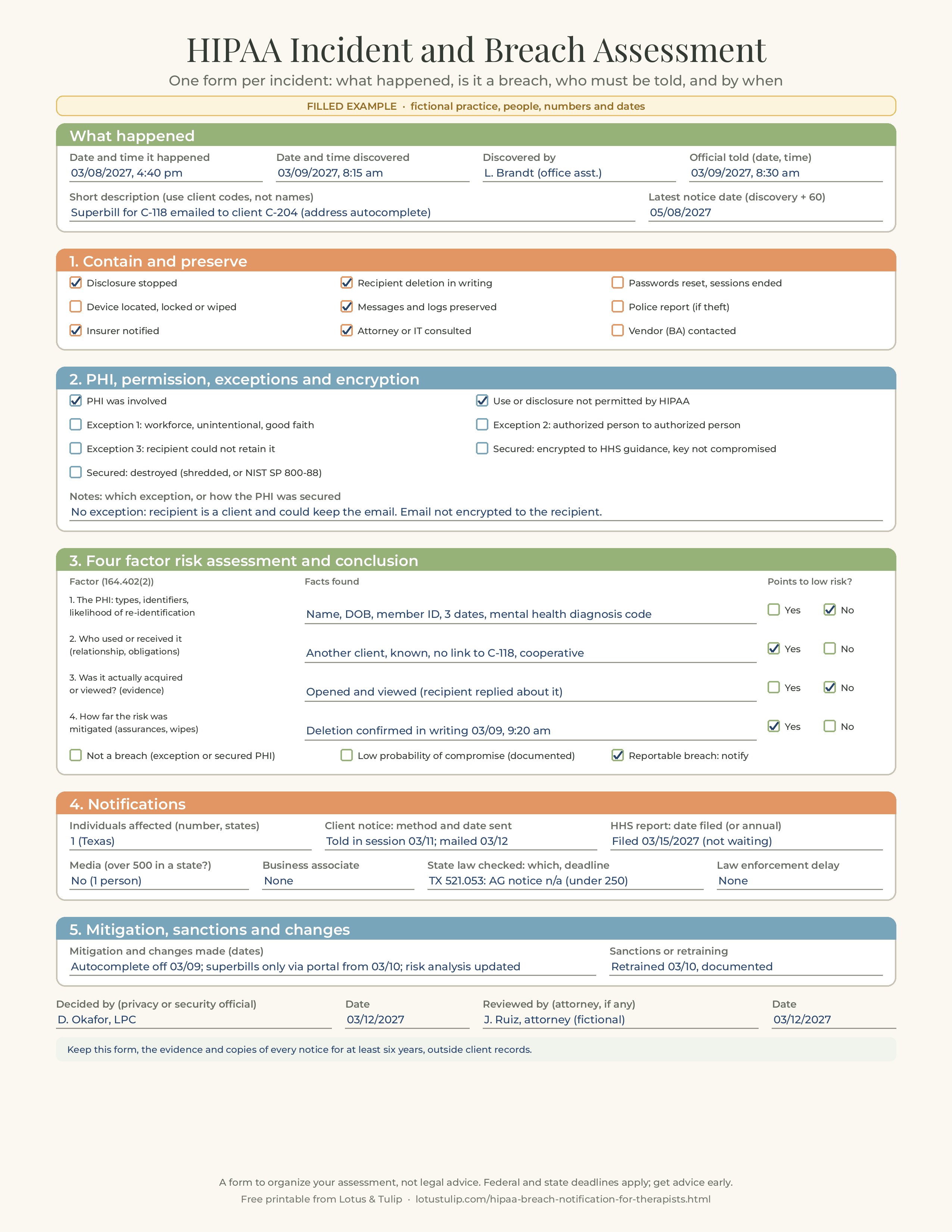
Harbor Light Counseling, PLLC is a fictional solo counseling practice in Austin, Texas. D. Okafor, LPC, is the owner and the privacy and security official. A part time office assistant, L. Brandt, handles scheduling and billing and is a workforce member. The practice bills insurance electronically, so it is a HIPAA covered entity. Everything here is invented for illustration; it is not legal advice and does not cover every Texas requirement.
- What happened: on Monday, March 8, 2027 at 4:40 pm, L. Brandt emailed a superbill for client C-118 to client C-204, because the email program completed the address. The superbill showed C-118's name, date of birth, insurance member ID, three dates of service, fees and diagnosis code.
- Discovery: at 8:15 am on Tuesday, March 9, C-204 replied: "I think this was sent to me by mistake." L. Brandt told D. Okafor at 8:30 am. Discovery date recorded as March 9, 2027 (no one in the practice knew earlier). Latest individual notice date: May 8, 2027.
- Containment: D. Okafor phoned C-204 at 9:00 am, who agreed to delete the email and attachment from the inbox and deleted items and confirmed by email at 9:20 am that they had not forwarded, printed or saved it.
- Five questions: PHI was involved; the disclosure was not permitted; no exception applies (C-204 is not a workforce member and could retain an email); the email was not encrypted end to end, so the PHI was unsecured; risk assessment needed.
- Four factors: (1) name, date of birth, member ID and a mental health diagnosis code: high sensitivity; (2) recipient is another client, known to the practice, no known connection to C-118, cooperative; (3) the email and attachment were opened and viewed; (4) written confirmation of deletion within an hour of discovery. Conclusion: because the attachment was viewed and included a diagnosis, the practice cannot demonstrate a low probability of compromise and treats it as a reportable breach.
- Notices: D. Okafor told C-118 at the start of their session on March 11 and mailed the written notice by first class mail on March 12 (C-118 had not agreed to electronic notice). HHS report filed on the portal on March 15, 2027 for 1 individual, transaction number saved, rather than waiting for the annual deadline of February 29, 2028. No media notice (1 person).
- State law: Texas Business and Commerce Code 521.053 also covers health information in computerized data; the attorney general notice applies only to breaches involving at least 250 Texas residents, so it does not apply here. D. Okafor asked the practice's attorney to confirm that the HIPAA letter also meets the Texas individual notice requirement.
- Mitigation and follow up: address autocomplete turned off on March 9; superbills now sent only through the client portal from March 10; L. Brandt retrained on March 10 (documented, no further sanction for an honest error reported promptly); risk analysis updated with the new control; insurer notified as the policy requires.
Page 2 of the free printable shows this assessment filled in, and page 3 shows the log entry.
Six short scenarios
1. A powered off, encrypted laptop is stolen from a car. A clinician's laptop, with full disk encryption consistent with NIST SP 800-111 and a strong password not stored with it, was shut down and in a locked trunk. Under HHS's guidance and the ransomware fact sheet's laptop example, the PHI was not "unsecured," so breach notification is not required. It is still a security incident: file a police report, remotely wipe if possible, change passwords, and document the encryption, the power state and the reasoning.
2. The same laptop, open and logged in at a coffee shop. It is grabbed from the table while unlocked. Full disk encryption no longer protects files the logged in user could reach. Treat the PHI as unsecured and run the four factor assessment; with an unknown thief and no evidence about access, a low probability of compromise is hard to show.
3. A fax goes to the wrong doctor's office. A records request response meant for a client's psychiatrist is faxed to a pediatric practice. The recipient is another covered entity bound by HIPAA, who calls to say it has shredded the pages. Factors 2 and 4 point toward low risk; factor 1 depends on what was in it. A careful written assessment may support a low probability of compromise. Document the call, the name of the person, and the confirmation.
4. The EHR vendor reports a breach. A vendor tells you on November 2 that an attacker accessed its systems in September, affecting "some customers." Ask in writing whether your clients were affected and request the list and details 164.410 requires. Decide with your attorney who sends notices, when your clock started, and whether the vendor's notice to you is complete. Log your own decisions and dates even if the vendor sends the letters.
5. A clinician looks up a friend's chart. In a group practice, an associate opens the record of a friend she knows is a client, out of concern. It was intentional and outside her job duties, so the first exception does not apply. Assess the breach (factor 2 is the associate herself, who is bound by the practice's policies; factor 3 is clear from the access log), apply and document sanctions, and consider retraining the whole team.
6. A detective asks you to wait. After a burglary in which paper charts were taken, a detective tells you by phone that notifying clients now would compromise an arrest. Document the detective's name, agency, contact number, the date and the words used, and delay no more than 30 days from that call unless you receive a written statement specifying a longer period. Keep investigating and preparing the notices so they can go out as soon as the delay ends.
Common mistakes
- Deciding "no harm done" without a written assessment. The rule presumes a breach. Without documentation, you cannot meet your burden of proof.
- Starting the clock late. Discovery is when anyone in your workforce other than the person responsible knew or should have known, not when you finished investigating.
- Treating 60 days as the deadline. The standard is without unreasonable delay; 60 days is the outer limit.
- Forgetting HHS for small breaches. Every breach of unsecured PHI is reported to HHS, including a single client. Small ones go in the annual report if not sooner.
- Assuming "encrypted" means safe harbor. Encryption only helps if it meets HHS's guidance and the key was not compromised, and full disk encryption does not protect a device that was on and unlocked.
- Using email for the notice without agreement. The rule requires first class mail unless the client agreed to electronic notice.
- Ignoring state law. Some states have shorter deadlines or attorney general notices that apply alongside HIPAA.
- Deleting the evidence. Wiping a computer, deleting the sent email or clearing logs can destroy the facts that would have supported a low risk finding.
- Not reading vendor notices. A vendor's security email may be your notice of a breach, and your BAA may give you obligations of your own.
- Having no plan until the day you need one. Writing the plan, the contact list and the letter templates now turns a crisis into a checklist.
Free printable: incident and breach assessment form, filled example, checklist and log
The free printable has three US Letter pages. Page 1 is a blank incident and breach assessment form: what happened (date it happened, date discovered and by whom, when the privacy or security official was told, the 60 day notice deadline, and a short description); containment and evidence (tick boxes for stopping the disclosure, recipient deletion confirmed in writing, passwords reset and sessions ended, device locked or wiped, logs and messages preserved, police report, insurer called, attorney or IT consulted); the first four of the five questions (PHI involved, permitted or not, which exception if any, and whether the PHI was secured by encryption or destruction to HHS's standard with the key safe); the four factor risk assessment with a rating and the facts for each factor; the conclusion (not a breach, low probability of compromise, or reportable breach); notifications (number of individuals and states, individual notice method and date, HHS report path and date, media, business associate, state law, law enforcement delay); and mitigation, sanctions and sign off. Page 2 is the same form filled in for the fictional Harbor Light Counseling example above. Page 3 is a twelve point first 24 hours checklist and a twelve row breach and incident log with columns for the discovery date, a short description, the number of people, the outcome, the dates individuals and HHS were notified, and initials.
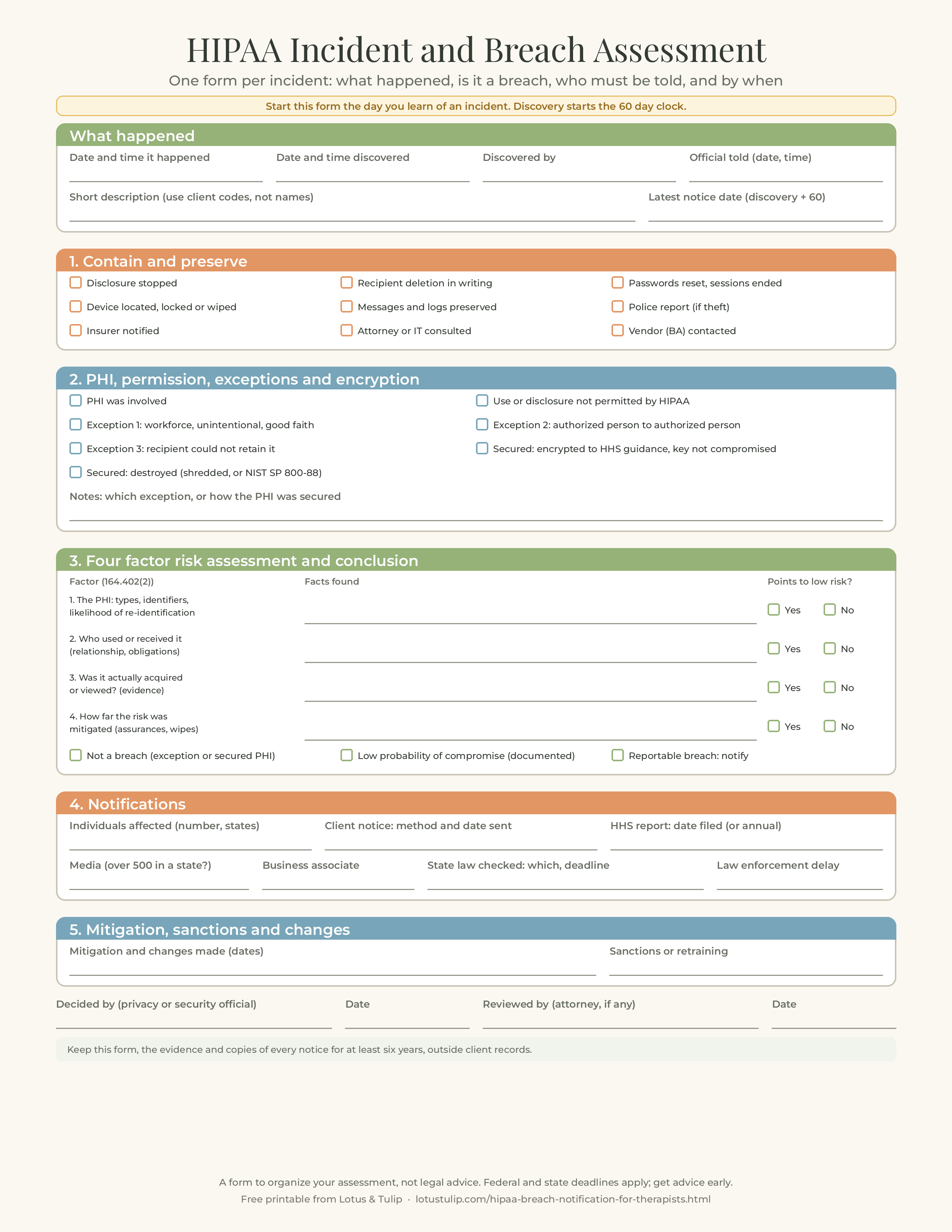
Download the free HIPAA breach assessment form and incident log (PDF, 3 pages)
Rather type than handwrite? The free PDF above is for printing. Therapy Progress Notes and Intake Templates comes as a fillable PDF you type straight into (604 fields in Adobe Acrobat Reader), plus the printable version: SOAP, DAP and BIRP notes, intake, treatment plan and safety plan, 20 pages. Holiday 20% off: about $7.36, was $9 (EUR 8) · instant digital download
Buy on EtsyPrefer single images? Page 1: blank assessment form (PNG) · Page 2: filled fictional example (PNG) · Page 3: first 24 hours checklist and incident log (PNG)
Free to print and use in your own practice. Please link to this page rather than re-uploading the file. This form helps you organize and document an incident and a breach risk assessment. It does not decide whether notification is required, it is not legal or cybersecurity advice, and it does not cover any state's breach law. Keep completed forms and the log outside client records, use client codes rather than names on the log, and keep them for at least six years.
Related resources
- HIPAA risk assessment for therapists: security risk analysis and free worksheet
- Business associate agreements for therapists
- Notice of privacy practices for therapists
- Telehealth across state lines for therapists
- Telehealth progress note template and examples
- Psychotherapy notes vs progress notes
- Informed consent for therapy template
- Release of information form for therapists
- Duty to warn for therapists, by state
- Closing a therapy private practice
Sources: 45 CFR 164.400, 164.402, 164.404, 164.406, 164.408, 164.410, 164.412 and 164.414 (Breach Notification Rule, subpart D); 45 CFR 164.304 (definitions of security incident and encryption); 164.308(a)(2), (a)(6) and (a)(7); 164.530(a), (b), (d), (e), (f), (g) and (j), eCFR text as in effect on November 10, 2026; HHS, Breach Notification Rule page; HHS, Guidance to Render Unsecured Protected Health Information Unusable, Unreadable, or Indecipherable to Unauthorized Individuals; HHS, Submitting Notice of a Breach to the Secretary (content last reviewed February 13, 2026) and the OCR breach portal at ocrportal.hhs.gov/ocr/breach; 42 CFR 2.16(b); HHS Office for Civil Rights, Fact Sheet: Ransomware and HIPAA (July 11, 2016); NIST SP 800-111, 800-52, 800-77, 800-113 and 800-88, as named in the HHS guidance; NIST SP 800-61 Revision 3 (April 2025); California Civil Code section 1798.82 (amended by Stats. 2025, ch. 319, SB 446, effective January 1, 2026); Texas Business and Commerce Code sections 521.002 and 521.053. Rules and guidance change; check the current versions.
FAQ
What counts as a HIPAA breach for a therapist?
Any acquisition, access, use or disclosure of protected health information that the Privacy Rule does not permit is presumed to be a breach, unless one of three exceptions applies, the information was secured by encryption or destruction as HHS's guidance specifies, or a documented risk assessment of at least four factors shows a low probability that the information was compromised. Common examples in therapy practices are emails or superbills sent to the wrong client, lost or stolen unencrypted devices, compromised email accounts, ransomware and staff looking at charts they had no reason to open.
How long do I have to notify clients after a HIPAA breach?
Without unreasonable delay and in no case later than 60 calendar days after discovery (45 CFR 164.404(b)). Discovery is the first day the breach was known, or with reasonable diligence would have been known, to anyone in your workforce other than the person who caused it. Some state laws set shorter deadlines; California's general breach law, for example, sets 30 calendar days.
Do I have to report a breach of one client's information to HHS?
Yes. Every breach of unsecured PHI is reported to HHS. For breaches affecting fewer than 500 people, you keep a log and report each breach on the OCR breach portal no later than 60 days after the end of the calendar year in which it was discovered (March 1, 2027 for breaches discovered in 2026), and you may report sooner. For 500 or more, you report at the same time as the individual notices, within 60 days of discovery.
What are the four factors in a HIPAA breach risk assessment?
Under 45 CFR 164.402(2): the nature and extent of the PHI involved, including the types of identifiers and the likelihood of re-identification; the unauthorized person who used the PHI or to whom it was disclosed; whether the PHI was actually acquired or viewed; and the extent to which the risk has been mitigated. The assessment must be thorough, in good faith and reasonable, and you must keep it for six years.
Is a lost laptop a HIPAA breach if it was encrypted?
Not if the encryption met HHS's guidance (consistent with NIST SP 800-111 for data at rest), the device was powered off or locked so the encryption was in effect, and the password or key was not compromised. In that case the PHI was not "unsecured" and notification is not required, though you still document the incident. If the laptop was on and logged in, or the password was taped to it, treat the PHI as unsecured and assess the breach.
Do I need a written incident response plan as a solo therapist?
If you are a HIPAA covered entity, yes in substance. The Security Rule requires policies and procedures to identify, respond to, mitigate and document security incidents (164.308(a)(6)) and a contingency plan (164.308(a)(7)), and the Breach Notification Rule requires written breach notification policies, training and sanctions (164.414(a) and 164.530). For a solo practice, a short plan with named responsibilities, a contact list, a few playbooks, an assessment form and an incident log is usually enough to start.