
Therapist practice · Updated 2026-11-09
Superbill Template for Therapists: Every Field Insurers Need, CPT and POS Codes, and a Filled Example (Free Printable)
Ready-made printable: Therapy Progress Notes and Intake Templates Fillable PDF, 20 pages: SOAP, DAP and BIRP notes, intake, treatment plan and safety plan
Holiday 20% off: about $7.36, was $9 (EUR 8) · instant digital download
Try it free first: download a fillable sample (SOAP note and DAP note, PDF, 226 KB). Type into it on screen, then get the full pack. No email needed.

Most private pay therapists hear the same question in the first phone call: "Do you take my insurance?" When the honest answer is no, the next best answer is "I can give you a superbill." A superbill is the itemized statement a client sends to their own health plan to ask for out of network reimbursement. Done well, it turns your fee from "too expensive" into "partly covered" for many clients with PPO or POS plans. Done badly, it comes back from the insurer with a denial code, and the client calls you to fix it.
This guide is for counselors, therapists, clinical social workers, marriage and family therapists and psychologists in private practice in the US. It covers what a superbill is and is not, every field insurers look for (with the matching box on the CMS-1500 claim form), the CPT codes therapists use most with plain descriptions, place of service codes 02, 10 and 11, telehealth modifiers 95, GT and 93, ICD-10-CM diagnosis codes, how clients actually get reimbursed for out of network therapy, how a superbill fits with the Good Faith Estimate, the reasons claims get rejected, a step by step process, a full fictional superbill and an FAQ. At the end you can download a free three page printable: a blank superbill, a filled fictional example, and a before you submit checklist with a reimbursement tracking log for clients.
Jump to the free superbill template for therapists
This is educational information for licensed clinicians, trainees and their clients. It is not billing, coding, legal or tax advice, and it does not create any professional relationship. Code descriptions on this page are plain language summaries written for this guide, not the official descriptors; CPT is a registered trademark of the American Medical Association, and the official code sets, payer policies and plan documents decide what is covered and how. Coding rules and insurer policies change. Check your current CPT and ICD-10-CM references, the client's plan and your professional association before you rely on any of this. Every practice, clinician, client, identifier and number on this page is fictional.
The short answer
A superbill is an itemized receipt for services the client has already paid for, laid out with the codes and identifiers a health plan needs to process an out of network claim. For therapy it lists your name, credentials and license number, your NPI and Tax ID, your practice address, the client's name, date of birth, address and insurance member ID, and for each session the date of service, the place of service code (usually 11 for the office, 02 or 10 for telehealth), the CPT code (such as 90791, 90834 or 90837) with any modifier, the ICD-10-CM diagnosis code, your fee, and the amount the client paid. You sign and date it. The client sends it to their plan, usually with the plan's own member claim form, and the plan reimburses the client according to their out of network benefits.
A superbill is not a claim you file, a guarantee of payment or a promise of how much the plan will pay. Whether the client gets money back depends on their plan: whether it has out of network benefits at all, the out of network deductible, the coinsurance and the amount the plan "allows" for the code.
Superbill fields at a glance
There is no single official superbill form. Insurers process out of network claims using the same data elements as a professional claim, so the safest superbill carries every item a payer would otherwise need from the CMS-1500 (the standard paper claim form for professional services, maintained in content by the National Uniform Claim Committee, NUCC). The box numbers below come from the NUCC 1500 Claim Form Reference Instruction Manual for the 02/12 form.
| Field on your superbill | Why the insurer needs it | CMS-1500 box |
|---|---|---|
| Provider name and credentials (for example "R. Nguyen, LPC") | Identifies who rendered the service and whether that license type is covered by the plan | 31 (signature with degrees or credentials); 24J rendering provider |
| Individual NPI (10 digits) | The HIPAA standard identifier for health care providers; claims without it are commonly returned | 24J (rendering), 33a (billing) |
| Group NPI, if the practice bills as a group | Shows the billing entity when it differs from the clinician | 33a |
| Tax ID: EIN, or SSN if you have no EIN | Required federal tax ID of the billing provider | 25 |
| State license number and state | Many plans check that a licensed clinician provided the service | Not a standard box; many member forms ask for it |
| Practice name, address and phone | Billing provider and, if different, where services were rendered | 33 (billing provider), 32 (service facility) |
| Client full name, date of birth and address | Matches the claim to the right member | 2, 3, 5 |
| Insurance member ID (and group number if any) | Matches the claim to the policy; the insured's name if the client is a dependent | 1a, 4, 11 |
| Date of service for each session | One line per date; plans pay per service date | 24A |
| Place of service code | Where the service happened: 11 office, 02 or 10 telehealth | 24B |
| CPT code and modifier | What service was provided, and how (for example modifier 95 for video) | 24D (up to four modifiers) |
| ICD-10-CM diagnosis code(s) | Why the service was medically necessary; up to 12 codes on a claim, A to L | 21, with the pointer in 24E |
| Units | Usually 1 per session code | 24G |
| Fee charged for each line and the total | Your charge for the service, not the plan's allowed amount; for a client on your sliding scale, the reduced fee you actually charged | 24F, 28 |
| Amount paid by the client, and the date | Shows the client already paid you, so the plan sends reimbursement to the client | 29 |
| Provider signature and date | Certifies the services and charges | 31 |
Optional but helpful: a superbill number, the client's account number (box 26 on a claim), your taxonomy code, the session length in minutes, and a line stating that payment was received in full. A diagnosis description in words can help the client, but on an actual CMS-1500 the NUCC instructions say to enter codes only, with no narrative.
What a superbill is, and what it is not
Superbill vs invoice vs receipt
An invoice asks for payment. A receipt confirms payment. A superbill is a receipt with the clinical and provider data a health plan needs. Many practices generate all three from the same record: an invoice before payment, then a superbill showing the payment once it clears. A plain receipt that says "Therapy session, $160, paid" will almost always be returned by an insurer because it has no codes, NPI or Tax ID.
Superbill vs claim
When you are in network, you submit the claim to the plan, the plan pays you, and the client pays a copay or coinsurance. When you are out of network and give a superbill, the client pays you in full, then the client submits the claim, and the plan pays the client. You are not a party to the claim. That is why superbills are popular with private pay clinicians: no credentialing, no contracted rates, no chasing the plan for payment. It also means the client carries the paperwork, so your superbill has to be complete the first time.
Who usually cannot use a superbill
- Clients with no out of network benefits. HMO and EPO plans typically pay only for in network care except emergencies. The client can ask the plan, but a superbill cannot create a benefit that does not exist.
- Medicare beneficiaries. Medicare has a mandatory claim submission rule (Social Security Act section 1848(g)(4)): a clinician who has not opted out generally has to submit claims to Medicare for covered Part B services rather than handing the patient a superbill. Clinicians who have formally opted out of Medicare use private contracts instead, and Medicare pays neither the clinician nor the patient for those services. If you see Medicare clients, read the Medicare Benefit Policy Manual chapter 15 section 40 and get advice before you take private payment.
- Medicaid members. Medicaid programs set their own rules on billing members privately; check your state's program before accepting payment from a member.
- Services the plan does not cover. Many plans pay only for treatment of a diagnosed condition. Couples counseling coded only with a relationship Z code such as Z63.0 (problems in relationship with spouse or partner), coaching, or consultation without a diagnosis is often denied.
Every superbill field, explained
Provider block
Name and credentials. Use the name on your license and your license type: LPC, LCPC, LMHC, LMFT, LCSW, PsyD, PhD and so on. If you are an associate or pre-licensed clinician under supervision, do not list your supervisor as the rendering provider unless that is true and permitted. Many plans do not reimburse services by pre-licensed clinicians at all, and a superbill that misstates who provided the service is a misrepresentation, not a workaround. Tell associate-level clients plainly that their plan may not reimburse.
NPI. The National Provider Identifier is a 10 digit number issued free through the CMS NPPES system. Individual clinicians have a Type 1 NPI. A group practice that bills under its own name has a Type 2 NPI as well. On a superbill, list your individual NPI as the rendering provider, and the group NPI if the practice is the billing entity. Check that the name and address on your NPPES record match your superbill; mismatches are a quiet cause of returned claims.
Tax ID. The CMS-1500 asks for the billing provider's federal tax ID, either an EIN or an SSN. Most solo clinicians get a free Employer Identification Number from the IRS and use it rather than printing their Social Security number on every client document.
License number and state. Not a box on the CMS-1500, but many insurers' member claim forms ask for it, and it lets a claims processor confirm your license type quickly.
Practice address and phone. Your billing address. If you see clients in an office, the service location is usually the same. If you work only by telehealth, use your business address and note telehealth on each line with the right place of service code.
Client block
Name and date of birth exactly as on the insurance card. "Kate" when the plan has "Katherine" can be enough to delay a claim.
Address. The client's mailing address. Some plans mail reimbursement checks to the address on the claim.
Member ID and group number. From the client's card. If the client is covered as a dependent, the plan also needs the policyholder's name and date of birth, which the client normally adds on the plan's claim form. Leaving the member ID off your superbill is fine if the client's form asks for it, but adding it saves a step.
Service lines
One line per session: date of service, place of service code, CPT code, modifier if needed, diagnosis pointer or code, units, fee and a short description. A monthly superbill with four weekly sessions has four lines, not one line with quantity 4. Plans adjudicate each date separately.
Payment and signature
Show the total charged, the total paid by the client, the payment date or dates, and the balance (usually $0). Sign and date. Some clinicians add "Paid in full by client" because it helps the plan send the reimbursement to the client rather than to you.
CPT codes therapists put on superbills
CPT (Current Procedural Terminology) codes describe the service. Psychotherapy codes are chosen by the time you spent face to face with the client and/or family member, not by the scheduled length of the appointment. The time thresholds below follow the CPT time rule as widely published by payers and coding references: a unit of time is reached when the midpoint is passed.
| Code | Plain description | Time |
|---|---|---|
| 90791 | Psychiatric diagnostic evaluation, without medical services. The intake or initial assessment by a non-prescribing clinician. | No set time; usually once at intake, and again later only if a new evaluation is needed |
| 90832 | Individual psychotherapy, 30 minutes | 16 to 37 minutes |
| 90834 | Individual psychotherapy, 45 minutes | 38 to 52 minutes |
| 90837 | Individual psychotherapy, 60 minutes | 53 minutes or more |
| 90846 | Family psychotherapy without the client present, 50 minutes | 26 minutes or more |
| 90847 | Family psychotherapy (conjoint psychotherapy) with the client present, 50 minutes. Also used for couples sessions when one partner is the identified client. | 26 minutes or more |
| 90853 | Group psychotherapy, other than a multiple-family group | Per group session |
| 90785 | Interactive complexity add-on, listed in addition to a primary code when specific communication factors complicate the session | Add-on only |
| 90839 / 90840 | Psychotherapy for crisis: 90839 for the first 60 minutes (used for 30 to 74 minutes), 90840 for each additional 30 minutes | See current CPT |
A few practical notes:
- Bill the time you actually spent. A 50 minute session is 90834, not 90837. Your progress note should show start and stop times or total minutes so the code is supported if the plan asks for records.
- Couples work. 90847 requires an identified client with a diagnosis. The diagnosis code belongs to that client, and the superbill goes in that client's name. If neither partner has a diagnosis, the sessions may not be reimbursable.
- Group sessions. 90853 is per client per session; each group member gets their own superbill.
- Prescribers and E/M. Psychiatrists and nurse practitioners use evaluation and management codes and psychotherapy add-on codes (90833, 90836, 90838) that are outside the scope of this guide.
- Use the code set in effect on the date of service. CPT is updated every year, effective January 1. Check your current reference before you set up your superbill template each year.
Place of service codes: 11, 02 and 10
The place of service (POS) code tells the plan where the service happened. CMS maintains the code set and says POS codes "should be used on professional claims to specify the entity where service(s) were rendered," while each payer sets its own reimbursement policy for them. For therapists, three codes cover almost every session:
| POS | Name | Use it when |
|---|---|---|
| 11 | Office | You saw the client in person at your office |
| 02 | Telehealth Provided Other than in Patient's Home | Telehealth session and the client was not at home: for example at work, in a parked car or at a school |
| 10 | Telehealth Provided in Patient's Home | Telehealth session and the client was at home (a private residence, not a hospital or facility). Effective January 1, 2022. |
The difference between 02 and 10 is where the client is, not where you are. Ask at the start of each telehealth session where the client is located (you need this anyway for licensure and safety) and note it in the progress note, then use the matching code. Other codes exist for other settings, for example 12 for an in-person session in the client's home and 03 for a school; see the full CMS place of service code set. For Medicare, CMS pays telehealth services to patients at home (POS 10) at the non-facility rate since January 1, 2024. Commercial plans set their own rules.
Telehealth modifiers: 95, GT and 93
A modifier is a two character code added to the CPT code. For telehealth sessions, plans differ on which modifier they want, and getting it wrong is one of the most common reasons a telehealth superbill comes back.
| Modifier | Meaning | Who tends to use it |
|---|---|---|
| 95 | Synchronous telemedicine service rendered via a real-time interactive audio and video telecommunications system | Many commercial plans and state Medicaid programs ask for 95 on video sessions |
| GT | Via interactive audio and video telecommunication systems (a HCPCS modifier) | An older telehealth modifier. Medicare eliminated it for professional claims in its 2018 fee schedule, and since October 1, 2018 it is only allowed on certain Critical Access Hospital institutional claims. Some commercial plans still mention it in older policies. |
| 93 | Synchronous telemedicine service rendered via telephone or other real-time interactive audio-only telecommunications system | Audio-only (phone) sessions, where the plan covers them |
How this plays out on a superbill:
- Video session, client at home: POS 10 and, for most commercial plans, modifier 95 on the CPT code: for example "90837-95, POS 10."
- Video session, client at work: POS 02 with modifier 95.
- Phone session: the POS that matches the client's location plus modifier 93, if the plan covers audio-only therapy.
- Plans that want office POS: some commercial plans ask providers to report the POS where the service would have happened in person (often 11) plus modifier 95, instead of 02 or 10. This is plan policy, and it changes.
Since the client submits the superbill, the simplest approach is to code accurately (POS by client location, 95 for video, 93 for audio-only) and tell the client that if their plan's telehealth policy asks for something different, you will issue a corrected superbill. Medicare has its own telehealth rules, including audio-only rules for behavioral health at home, and they do not decide what a commercial plan wants.
ICD-10-CM diagnosis codes on a superbill
Health plans reimburse treatment of a condition, so the superbill needs at least one ICD-10-CM diagnosis code. The ICD-10-CM code set is updated every year, effective October 1; the FY2027 edition took effect October 1, 2026.
- Code to the highest specificity. The official ICD-10-CM guidelines say codes are to be reported "at their highest number of characters available." F41 (other anxiety disorders) is a category, not a billable code; F41.1 (generalized anxiety disorder) is billable. F43.2 (adjustment disorders) is a heading; F43.21, F43.22 or F43.23 are the billable codes.
- The diagnosis must be yours. Code assignment is based on the clinician's diagnostic statement, supported by the record. Never pick a code because "it gets paid."
- Primary diagnosis first. List the main reason for the sessions first. On a claim, codes go in box 21 (A to L) and each service line points to the relevant letter in 24E.
- Talk with the client about it. A superbill shares a diagnosis with the client's insurer, and the client will see it. Many clinicians discuss the diagnosis and what it means for the record before the first superbill, often during informed consent. Some clients decide not to use their insurance for privacy reasons; that is their choice, and it moves them into Good Faith Estimate territory.
Examples of codes therapists commonly see, with their official titles: F41.1 Generalized anxiety disorder; F32.1 Major depressive disorder, single episode, moderate; F43.23 Adjustment disorder with mixed anxiety and depressed mood; F43.10 Post-traumatic stress disorder, unspecified. These are examples only. Use the code that matches your documented diagnosis and the current code book.
How to get reimbursed for out of network therapy (a guide to share with clients)
Clients often ask their therapist how out of network reimbursement works. You do not have to be their benefits counselor, but a clear one page explanation saves a lot of back and forth. This is the version many clinicians give.
1. Check your out of network benefits before the first session
Call the member services number on your insurance card, or log in to the plan's member portal, and ask about outpatient mental health, out of network. Questions to ask:
- Do I have out of network benefits for outpatient mental health or behavioral health? (HMO and EPO plans usually do not.)
- What is my out of network deductible, and how much of it have I met this year?
- After the deductible, what percentage do you pay (coinsurance)?
- How do you calculate the allowed amount for out of network services? What is the allowed amount for CPT 90837 (or 90834) in my area, if you can tell me?
- Is there an out of network out of pocket maximum?
- Do I need pre-authorization, and is there a limit on the number of sessions?
- Are telehealth sessions covered out of network, and do you require a particular modifier or place of service code?
- Which license types do you reimburse (for example LPC, LMFT, LCSW, psychologist)?
- How do I submit, which claim form do I use, and what is the deadline after the date of service?
Write down the date of the call, the representative's name and the reference number.
2. Understand the math
The plan does not reimburse a share of what your therapist charged. It reimburses a share of what it decides to allow for the code, after the deductible. A fictional example, with made up numbers for illustration only: the therapist charges $160 for a 90837 session. The plan's allowed amount for that code is $120. The client has already met the out of network deductible, and the plan pays 60% of the allowed amount. Reimbursement: 60% of $120 = $72. The client's net cost for the session is $160 minus $72 = $88. If the deductible were not yet met, the allowed amounts would count toward the deductible and the plan might pay nothing until it is met. That is why many clients see no reimbursement in January and February even though their claims are processed correctly.
3. Pay your therapist and collect your superbills
Most therapists issue superbills monthly or on request. Check each one when it arrives: name and date of birth exactly as on your card, every session date, the codes, and the provider's NPI, Tax ID and signature.
4. Submit the claim
Plans accept member claims in a few ways, and each plan tells members which it wants:
- Member portal upload: many plans let you upload the superbill as a PDF or photo and fill in a short online form.
- The plan's member claim form: most insurers publish a "medical claim form" or "member reimbursement form" for members. You fill in your details and the policyholder details, sign it, and attach the superbill as the itemized bill. This is the usual route for a superbill.
- CMS-1500: the standard professional claim form, usually completed by providers. Some plans accept a CMS-1500 from a member, and some clients use a completed CMS-1500 from the provider instead of a superbill. The official form is printed in red ink for scanning, so a photocopy or a home printout may not be accepted on paper; check with the plan.
Some clients pay third party services to file claims for them. Whatever route they use, the superbill data is the same.
5. Read the Explanation of Benefits
Weeks later the plan sends an Explanation of Benefits (EOB) for each claim: the amount billed, the allowed amount, what went to the deductible, what the plan paid and why. If it says denied or "additional information needed," the remark code on the EOB tells you what to fix. Send the EOB to the therapist if a code or identifier needs correcting.
6. Appeal if the denial looks wrong
Plans must explain how to appeal on the EOB or denial notice. Common fixable problems are a missing NPI, a typo in the member ID or a missing modifier: ask the therapist for a corrected superbill and resubmit. If the plan says it does not cover the service or the license type, an appeal is possible but harder.
Two extras worth knowing. If a client's plan has no in network therapists who can see them within a reasonable time, the client can ask the plan for a network gap exception, and some plans instead set up a single case agreement with the out of network clinician, so the client pays in network cost sharing for that clinician. Not every plan offers either, and the client has to ask. And superbills or receipts can document spending for a health savings account or flexible spending account; the plan administrator decides what it accepts.
How superbills relate to the Good Faith Estimate
The Good Faith Estimate (GFE) under the No Surprises Act is an estimate given before services to clients who are uninsured or not having a claim submitted to their plan. A superbill is a statement given after services, so the client can submit a claim. They sit at opposite ends of the same client relationship.
- The gray area. A client who pays you and then submits superbills has insurance and is seeking to have a claim submitted, but you are not the one submitting it. The regulation (45 CFR 149.610) does not name this situation, and CMS has not addressed it directly in its GFE FAQs. Many practices give these clients a GFE anyway: it costs little and protects both sides. Ask your professional association or attorney how they read it.
- Keep them consistent. If you issue both, the codes and fees on the GFE should match what ends up on the superbills. A client who was told 90837 at $160 and then receives superbills for 90837 at $175 has a fair complaint, and if the total exceeds the estimate by $400 or more, the dispute process for self pay clients may come into play.
- Different purposes, different documents. Do not put the GFE disclaimers on a superbill or call a superbill an estimate. One is a forecast with required notices; the other is a receipt with codes.
- Surprise billing protections are a separate thing. The No Surprises Act balance billing protections cover emergency services, certain non-emergency services by out of network providers at in network facilities, and air ambulance services. A client who chooses an out of network therapist in private practice is generally outside those protections, which is why their reimbursement depends on their plan's out of network benefits.
Why superbills get rejected (and how to prevent it)
| Problem | What happens | Fix |
|---|---|---|
| Missing NPI or Tax ID | Claim returned as incomplete | Print both on every superbill; check your NPPES record matches |
| Missing or non-specific diagnosis code | Denied or returned; a category like F41 is not billable | Use a valid, fully specified ICD-10-CM code from the current year |
| Name, date of birth or member ID mismatch | Plan cannot find the member | Copy exactly from the insurance card |
| Several sessions on one line | Only one date paid, or the claim is returned | One line per date of service |
| Wrong or missing telehealth modifier or POS | Denied, or paid at a different rate | POS by client location; 95 for video, 93 for audio-only; follow the plan's telehealth policy |
| Code not supported by time | Downcoded on review, or records requested | Bill the actual minutes; record start and stop times in the note |
| Service not covered (Z code only, coaching, couples without an identified client) | Denied as not covered | Tell the client before you start; do not change the diagnosis to fit |
| License type not reimbursed, or pre-licensed clinician | Denied for provider type | Check with the client's plan at intake; never list a different rendering provider |
| Filed after the plan's deadline | Denied for timely filing | Issue superbills monthly; remind clients that deadlines vary by plan |
| No out of network benefits | Denied | Clients check benefits before the first session |
| Deductible not met | Processed, but $0 paid | Not an error: amounts count toward the deductible |
| Missing signature or unreadable copy | Returned | Sign each superbill; send a clean PDF |
| Duplicate submission | Denied as duplicate | Clients track what they sent; issue superbills for new dates only |
How to create a superbill for therapy, step by step
- Set up your provider block once. Practice name, your name and credentials, license number and state, individual NPI (and group NPI if the practice bills), Tax ID (EIN), address and phone. Check it against your NPPES record.
- Collect client billing details at intake. Legal name and date of birth as on the insurance card, address, member ID, group number and the policyholder's details if the client is a dependent. Ask clients to check their out of network benefits before the first session.
- Agree on the diagnosis conversation. Explain in informed consent that a superbill includes a diagnosis code that the client's plan will see, and decide together whether the client will use their insurance.
- Document each session to support the code. Start and stop times or total minutes, the service type, and for telehealth the client's location and whether it was video or audio-only.
- Add one line per session. Date of service, POS code, CPT code with modifier if needed, diagnosis pointer, units, fee and amount paid.
- Add diagnosis codes and totals. Primary ICD-10-CM code first, then any others; total charges, total paid, payment dates and balance.
- Sign, date and deliver securely. Sign and date it, then send it the way the client prefers, through a secure portal or encrypted email if it is electronic, and keep a copy with the client's financial record.
- Correct quickly when a plan asks. If the client's EOB shows a fixable problem, issue a corrected superbill marked "corrected" with the original date, and keep both versions.
Superbill example for therapy (fictional, full)
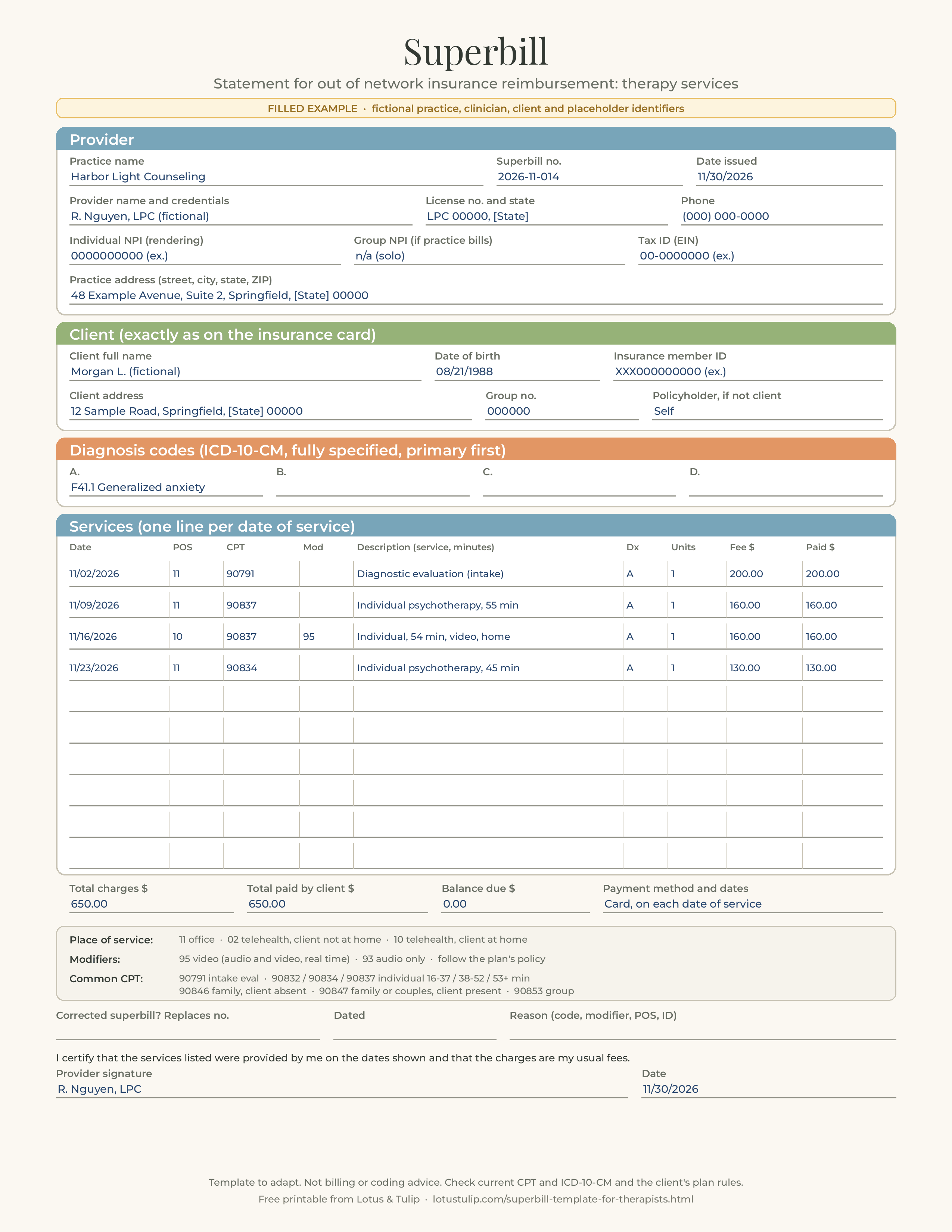
The fictional clinician R. Nguyen, LPC, of Harbor Light Counseling sees a fictional client, Morgan L., who has a PPO plan with out of network benefits. Morgan paid in full at each session. At the end of the month R. Nguyen issues this superbill through the client portal.
Harbor Light Counseling: Superbill / Statement for Insurance Reimbursement
Superbill no.: 2026-11-014. Date issued: November 30, 2026. Statement period: November 1 to 30, 2026.
Provider: R. Nguyen, LPC (fictional). License: LPC no. 00000, [State]. Individual NPI: 0000000000 (example placeholder). Tax ID (EIN): 00-0000000 (example placeholder). Practice address: 48 Example Avenue, Suite 2, Springfield, [State] 00000. Phone: (000) 000-0000.
Client: Morgan L. (fictional). Date of birth: 08/21/1988. Address: 12 Sample Road, Springfield, [State] 00000. Insurance member ID: XXX000000000 (example). Group no.: 000000 (example). Policyholder: self.
Diagnosis: A. F41.1 Generalized anxiety disorder.
| Date of service | POS | CPT / modifier | Description | Dx | Units | Fee | Paid |
|---|---|---|---|---|---|---|---|
| 11/02/2026 | 11 | 90791 | Diagnostic evaluation (intake) | A | 1 | $200.00 | $200.00 |
| 11/09/2026 | 11 | 90837 | Individual psychotherapy, 55 min | A | 1 | $160.00 | $160.00 |
| 11/16/2026 | 10 | 90837-95 | Individual psychotherapy, 54 min, video, client at home | A | 1 | $160.00 | $160.00 |
| 11/23/2026 | 11 | 90834 | Individual psychotherapy, 45 min | A | 1 | $130.00 | $130.00 |
| Totals | $650.00 | $650.00 | |||||
Balance due: $0.00. Paid in full by client by card on each date of service.
I certify that the services listed were provided by me on the dates shown and that the charges are my usual fees.
Signature: R. Nguyen, LPC. Date: 11/30/2026.
Why this example works: the provider block has the name, license type and number, NPI, Tax ID and address; the client block matches the insurance card and includes the member ID; each session has its own line with date, POS, CPT code and modifier, diagnosis pointer, units, fee and amount paid; the code matches the minutes documented (the 45 minute session is 90834, not 90837); the telehealth session shows POS 10 and modifier 95 because Morgan was at home on video; the diagnosis is a valid, fully specified code; and the superbill is signed and dated with a $0 balance. In a real superbill, use your real identifiers and the codes from your documentation.
What happens next in the fictional case: Morgan uploads the superbill with the plan's member claim form. The EOB shows the plan allowed amounts for each code, applied the first part to Morgan's remaining out of network deductible, and paid its coinsurance share on the rest. In January, Morgan's deductible resets, so the first claims of the new year count toward the deductible again. R. Nguyen had explained this at intake, so nobody is surprised.
Five short superbill examples
Telehealth from the office. A client joins a video session from their office at work. The line reads POS 02, 90834-95, with the minutes and "video" in the description.
Phone session. The video link fails and the session continues by phone for 40 minutes. The clinician documents the switch and, if the client's plan covers audio-only therapy, reports 90834-93 with the POS for the client's location. If the plan does not cover audio-only sessions, the clinician tells the client the line may not be reimbursed.
Couples sessions. One partner is the identified client with a diagnosis of F43.23. Joint sessions are billed as 90847 on that partner's superbill, with that partner's diagnosis. The other partner does not receive a superbill for those sessions.
Monthly group. A client attends four weekly group sessions. Their superbill lists four lines of 90853, one per date, with the group fee on each line.
Corrected superbill. An EOB comes back "missing modifier" for a video session. The clinician issues a corrected superbill for that date with 90837-95, marks it "Corrected, replaces superbill dated 11/30/2026," and keeps both in the record.
Common superbill mistakes
- Calling a plain receipt a superbill. Without codes, NPI and Tax ID, plans will return it.
- Bundling sessions into one line. Use one line per date of service.
- Billing the scheduled time instead of the actual time. A 50 minute hour is 90834.
- Using a heading code instead of a billable diagnosis code. F41 and F43.2 are not complete codes.
- Choosing a diagnosis to get paid. The code must match your documented clinical judgment.
- Getting POS 02 and 10 backwards. It depends on where the client is, not you.
- Adding GT by habit. Medicare no longer uses it on professional claims; most commercial plans want 95.
- Listing the supervisor as the provider for an associate's sessions. Only if that is accurate and allowed by the plan; otherwise it is a misrepresentation.
- Printing your Social Security number. Get a free EIN.
- Waiting until December. Plans have filing deadlines; issue superbills monthly.
- Sending superbills by ordinary email without thinking about security. A superbill contains a diagnosis and identifiers; use your portal or encrypted email, as you would for any protected health information.
- Promising reimbursement. Say "your plan may reimburse part of the fee," never "insurance will cover it."
Free printable: superbill template for therapists, filled example and before you submit checklist
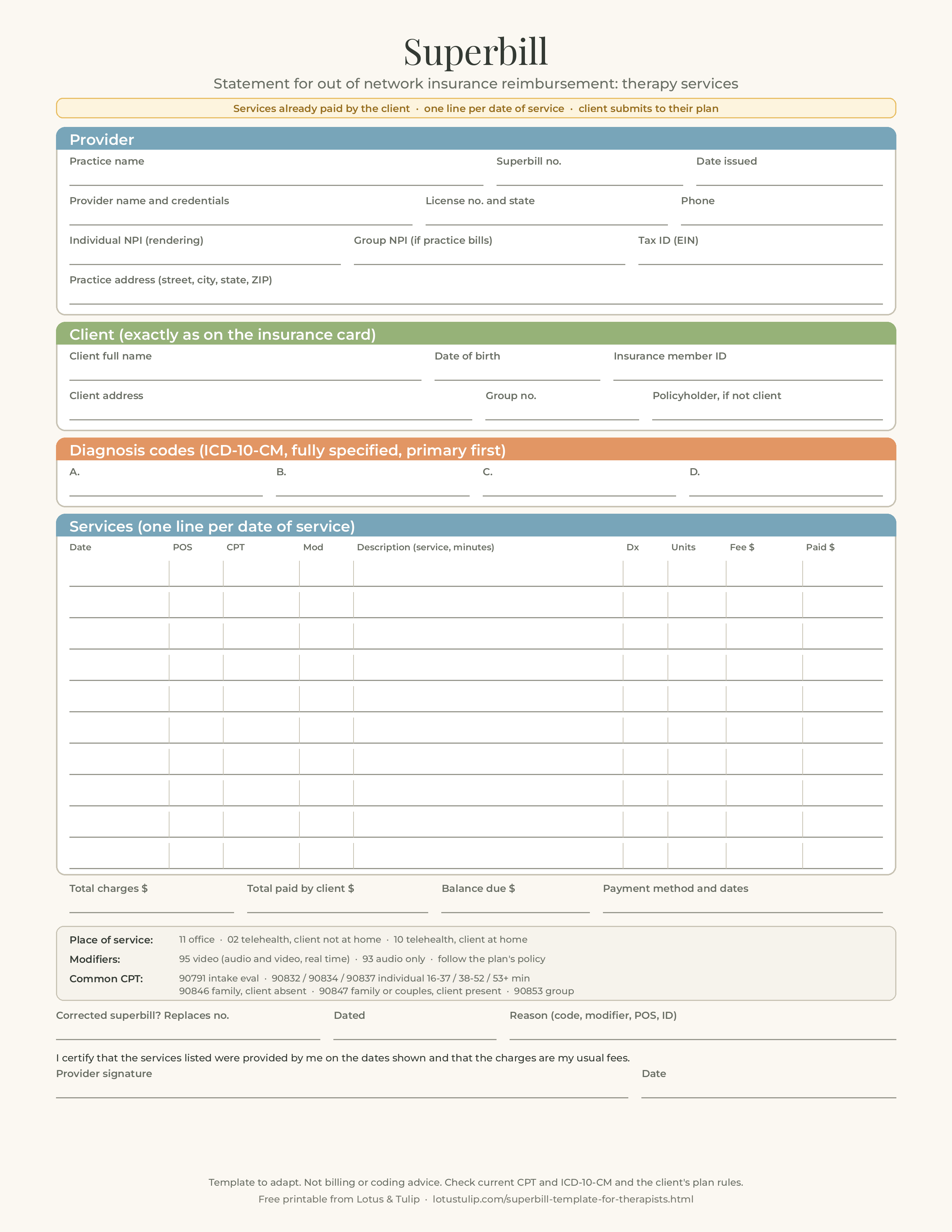
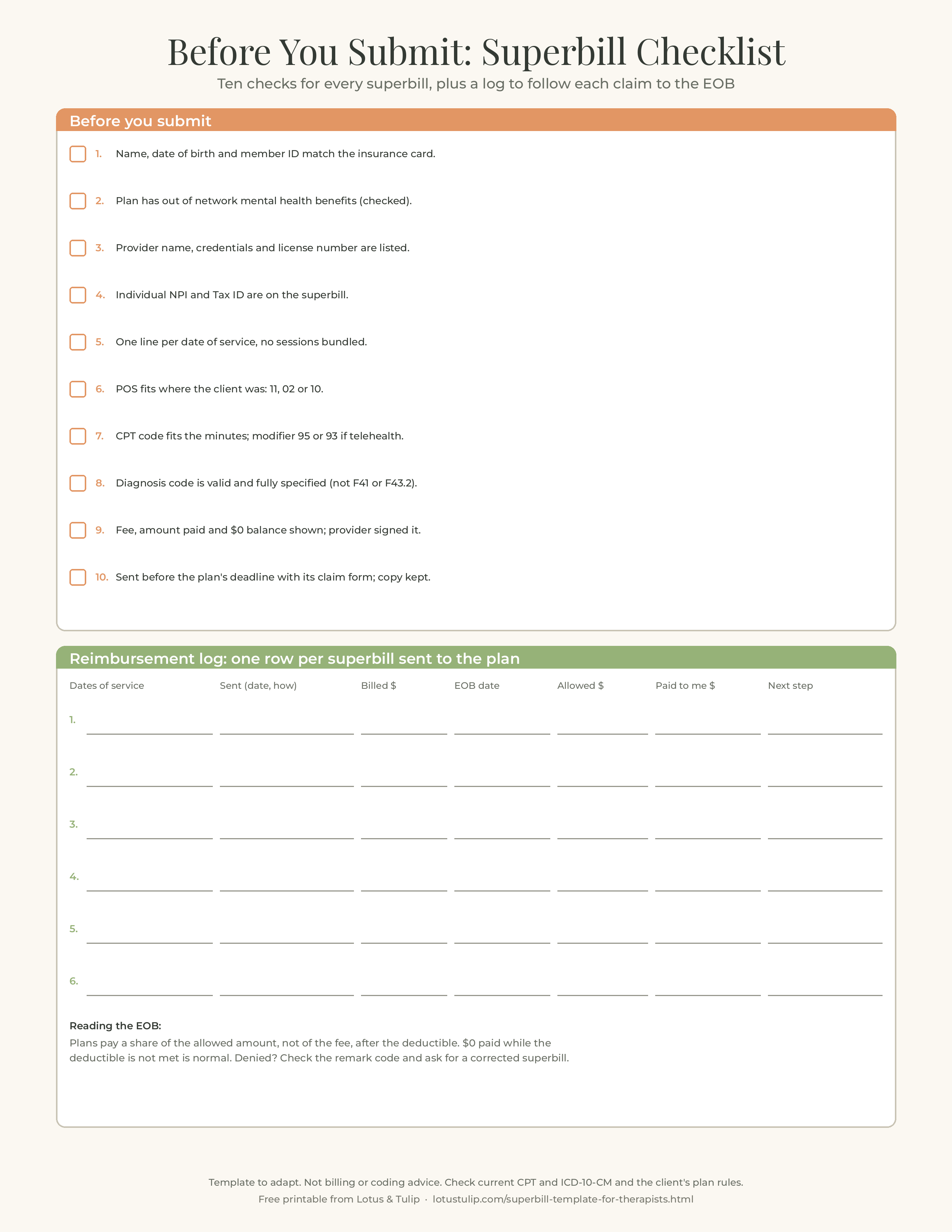
The free printable has three US Letter pages. Page 1 is a blank superbill for therapy: provider block (name and credentials, license number and state, individual and group NPI, Tax ID, address and phone), client block (name, date of birth, address, member ID, group number, policyholder), diagnosis codes A to D, a ten line service table with date of service, POS, CPT code, modifier, description, diagnosis pointer, units, fee and amount paid, totals with payment method and balance, a key to place of service codes, telehealth modifiers and common CPT codes, a corrected superbill line, and a signed certification. Page 2 is the filled fictional example from this page (Harbor Light Counseling, R. Nguyen, LPC, client Morgan L.) with placeholder identifiers. Page 3 is a ten point before you submit checklist plus a reimbursement tracking log that clients can use to follow each claim from superbill to EOB.
Download the free superbill template for therapists (PDF, 3 pages)
Rather type than handwrite? The free PDF above is for printing. Therapy Progress Notes and Intake Templates comes as a fillable PDF you type straight into (604 fields in Adobe Acrobat Reader), plus the printable version: SOAP, DAP and BIRP notes, intake, treatment plan and safety plan, 20 pages. Holiday 20% off: about $7.36, was $9 (EUR 8) · instant digital download
Buy on EtsyPrefer single images? Page 1: blank superbill (PNG) · Page 2: filled fictional example (PNG) · Page 3: before you submit checklist and reimbursement log (PNG)
Free to print and use in your own practice, and to share with your clients. Please link to this page rather than re-uploading the file. The template is a starting point: check your current CPT and ICD-10-CM references and the client's plan requirements. Using it does not guarantee that any claim will be paid.
Related resources
- Closing a therapy private practice: checklist, timeline, client letters, records plan and free printable
- HIPAA risk assessment for therapists: security risk analysis, filled example and free worksheet
- Business associate agreement for therapists: which vendors need a BAA, breach duties, filled vendor log and free printable
- Professional will for therapists: clinical executor, records custodian, client notification scripts, filled example and free printable
- Couples therapy informed consent form: no secrets policy, individual sessions, records access, safety screening, filled example and free printable
- Treatment summary template for therapists: how to write a treatment summary letter, transfer records under HIPAA, filled example and free printable
- Notice of privacy practices for therapists: HIPAA 164.520 elements, 2026 Part 2 update, filled example and free printable
- Parental consent form for therapy of a minor: who can consent, custody orders, state minor consent laws, HIPAA, filled example and free printable
- Credit card authorization form for therapists: card on file consent, PCI DSS rules, filled example and free printable
- Sliding scale fee policy for therapists: 2026 poverty guideline tiers, copay waiver rules, filled example and free printable
- Therapy cancellation policy template: late cancellation and no show fees, Medicare and Medicaid rules, filled example and free printable
- Release of information form for therapists: HIPAA authorization elements, psychotherapy notes, Part 2, filled example and free printable
- Good Faith Estimate template for therapists: No Surprises Act rules, filled example and free printable
- Informed consent for therapy template: what to include, sample consent and free printable
- Psychotherapy notes vs progress notes: what HIPAA says, what goes where and free printable
- Telehealth progress note template: examples, checklist and free printable
- Therapy termination letter template: sample letters and free printable
- What to include in a therapy intake form (checklist)
- Biopsychosocial assessment template: example and free printable
- Therapy treatment plan template with SMART objectives (free printable)
- SOAP vs DAP notes for therapists, with examples
- BIRP notes for therapists: template, 5 examples and free printable
- GIRP notes for therapists: template, 5 examples and free printable
- Group therapy progress notes: template, examples and free printable
- Mental status exam template: examples, word bank and free printable
- Therapy discharge summary template: example and free printable
- Therapy progress notes and intake templates
Sources: CMS, Place of Service Code Set (database updated May 2, 2024), including POS 02, 10, 11 and 12; National Uniform Claim Committee, 1500 Health Insurance Claim Form Reference Instruction Manual for the 02/12 form, version 13.0 (July 2025), items 1a, 2, 3, 5, 12, 13, 21, 24A to 24J, 25, 26, 28, 29, 31, 32 and 33; CMS, Telehealth FAQ (updated October 2026) and MLN901705 Telehealth and Remote Monitoring (POS 02 and 10, non-facility rate for POS 10 from January 1, 2024, modifier 93); Telehealth.HHS.gov, Billing and coding Medicare Fee-for-Service claims; CMS MLN Matters MM10583 (GT modifier limited to CAH Method II institutional claims from October 1, 2018); CDC/NCHS and CMS, ICD-10-CM Official Guidelines for Coding and Reporting FY2027 (effective October 1, 2026), Section I.B level of detail and code assignment; ICD-10-CM tabular titles for F41.1, F32.1, F43.23, F43.10 and Z63.0; published CPT time thresholds for psychotherapy codes 90832, 90834, 90837, 90846 and 90847 (CPT is a registered trademark of the American Medical Association); CMS, Medicare Benefit Policy Manual chapter 15, section 40 (mandatory claim submission and opt out); 45 CFR 149.610 and CMS Good Faith Estimate FAQs; CMS NPPES. Codes, payer policies and plan terms change; check the current versions.
FAQ
What is a superbill for therapy?
A superbill is an itemized statement of therapy sessions the client has already paid for, with the codes and provider details a health plan needs to process an out of network claim: provider name, license, NPI and Tax ID, client name, date of birth and member ID, and for each session the date, place of service code, CPT code, diagnosis code, fee and amount paid. The client submits it to their plan for possible reimbursement.
What needs to be on a therapy superbill?
Provider name and credentials, license number, individual NPI (and group NPI if the practice bills), Tax ID, practice address and phone; client name, date of birth, address and insurance member ID; for each session the date of service, place of service code, CPT code and any modifier, ICD-10-CM diagnosis code, units, fee and amount paid; totals; and the provider's signature and date.
How do I get reimbursed for out of network therapy?
Check that your plan has out of network mental health benefits and ask about the deductible, coinsurance and allowed amounts. Pay your therapist and ask for a superbill. Submit it to your plan through the member portal or with the plan's member claim form. The plan sends an Explanation of Benefits and reimburses you its share of the allowed amount once your out of network deductible is met.
Which place of service code should I use for telehealth therapy?
Use POS 10 when the client is at home during the telehealth session and POS 02 when the client is somewhere other than home. For in-person sessions in your office, use POS 11. Some commercial plans ask for a different combination, such as POS 11 with modifier 95, so follow the client's plan policy when it says otherwise.
Should I use modifier 95 or GT for telehealth?
Most commercial plans and many Medicaid programs ask for modifier 95 on synchronous audio and video sessions. Medicare stopped using GT on professional claims in 2018, and it now applies only to certain Critical Access Hospital institutional claims. Use modifier 93 for audio-only sessions where the plan covers them.
Can a superbill be submitted on a CMS-1500?
The CMS-1500 is the standard professional claim form, usually completed by providers. Some plans accept it from members, but most ask members to use their own member claim form with the superbill attached as the itemized bill. Ask the plan which it wants.
Do I need to give a Good Faith Estimate if I give superbills?
The No Surprises Act rule requires a Good Faith Estimate for clients who are uninsured or not having a claim submitted to their plan. A client who submits their own superbills is a gray area that the regulation does not name and CMS has not directly addressed, so many practices give these clients a GFE anyway and keep the codes and fees consistent with the superbills.
Is this superbill template free?
Yes. The three page printable (a blank superbill, a filled fictional example and a before you submit checklist with a reimbursement tracking log) is free to print and use in your own practice and to share with clients. Please link to this page rather than re-uploading the file, and check your current code references and the client's plan requirements before use.