
Therapist practice · Updated 2026-11-09
Credit Card Authorization Form for Therapists: Card on File Consent, PCI DSS Rules, What to Include and a Filled Example (Free Printable)
Ready-made printable: Therapy Progress Notes and Intake Templates Fillable PDF, 20 pages: SOAP, DAP and BIRP notes, intake, treatment plan and safety plan
Holiday 20% off: about $7.36, was $9 (EUR 8) · instant digital download
Try it free first: download a fillable sample (SOAP note and DAP note, PDF, 226 KB). Type into it on screen, then get the full pack. No email needed.

Most private practice therapists keep a client's card on file at some point: to collect the session fee without a payment conversation at the end of every hour, to charge a copay or a balance after an insurer pays, or to collect a late cancellation fee the client agreed to. The card on file itself is rarely the problem. The problem is the paper form many practices still use to set it up: a sheet that asks for the full card number, the expiration date and the three digit security code, signed once and then kept in a folder for years. That form creates a security risk, breaks a basic card industry rule once the security code is kept, and is usually too vague to settle a dispute.
This guide is for counselors, therapists, clinical social workers, marriage and family therapists and psychologists in the US. It explains what a credit card authorization form is and when therapy practices use one, what it should contain, what the card industry security standard (PCI DSS v4.0.1) says about card numbers and security codes on paper, why a processor stored card with only the last four digits on your form is the safer design, what Visa's stored credential rules expect from a card on file agreement, how HIPAA applies to payment information, the Medicare and Medicaid cautions, the client's right to revoke, receipts, disputes, and scripts. At the end you can download a free three page printable: a blank card on file authorization that deliberately does not collect the full card number or the security code, the same form filled for a fictional practice, and a before you use checklist with a charge log.
Jump to the free credit card authorization form template
This is educational information for licensed clinicians and trainees in the US. It is not legal, billing, payment compliance or tax advice, and it does not create any professional relationship. Card network rules, processor terms, payer contracts, state law and licensing board rules vary and change. Check them, and have an attorney or your professional association review your final form. Every practice, clinician, client, card detail and amount in the examples on this page is fictional.
The short answer
A credit card authorization form (often called a card on file authorization) is a short written agreement in which a client allows your practice to keep a payment card on file and charge it for defined amounts, at defined times, until the client revokes the permission. In a therapy practice it typically covers session fees for self pay clients, copays, coinsurance and deductibles for insured clients, balances left after an insurer pays, and late cancellation or no show fees under your written cancellation policy.
The rules that matter most in the US:
- Never keep the security code. PCI DSS v4.0.1 requirement 3.3.1.2 says the card verification code (the three or four digit number on the card) is not stored once authorization is complete, and sensitive authentication data must not be stored after authorization even if encrypted. A paper form with the code on it in a filing cabinet fails that rule.
- Do not collect the full card number on paper. Paper with full card numbers is cardholder data that must be physically secured and destroyed by cross-cut shredding, incineration or pulping when no longer needed (PCI DSS 9.4.1 and 9.4.6). The safer design is to let the client enter the card in your payment processor or practice software, which stores it as a token, and to record only the card brand, the last four digits and the expiration date on your form.
- Be specific. Visa's stored credential framework expects a card on file agreement to show the last four digits, how the card will be used, how the client will be told about changes, and the end date if there is one; for charges you initiate later, the amount or how it is calculated, the event or frequency that triggers a charge, and your cancellation and refund policy.
- Payment information is health information in your hands. Under HIPAA, payment activities are part of how you use protected health information. Share only the minimum necessary, keep diagnoses off payment records and receipts, and use a neutral name on card statements where your processor allows it.
- The client can revoke. Say how, and say that fees for services already provided remain due. Stop charging the card once the authorization is revoked or expires.
- Payer rules still apply. A signed card authorization does not let you charge a Medicaid client a missed appointment fee, charge Medicare clients differently from everyone else, or collect more from an in-network client than the contract allows.
What a credit card authorization form is, and what it is not
A card authorization answers one narrow question: may the practice charge this card later, without the client handing it over each time, and if so for what? It is a payment consent, separate from your fee or financial policy (which sets fees and collections steps), your cancellation policy (which decides whether a missed session fee applies and how much it is), your informed consent to treatment, and the Good Faith Estimate that uninsured and self pay clients must still receive. The authorization points to those documents; it does not replace any of them.
Two terms you will meet in processor settings: a token is a substitute value the processor gives you in place of the real card number (PCI DSS lists index tokens among the accepted ways to render a stored card number unreadable, requirement 3.5.1), and a merchant initiated charge is one you run later without the client taking part at that moment, such as a no show fee charged the next day. Those later charges rest entirely on the client's earlier consent, which is why the wording of the authorization matters.
When therapy practices use a card on file
Name each charge type you use on the form; a vague "any amounts owed" clause invites disputes.
| Charge type | Typical timing | What to write on the form | Cautions |
|---|---|---|---|
| Session fee (self pay) | Day of each session | "Session fees at my agreed rate of $[amount], charged on the day of each session." | The fee should match the Good Faith Estimate and any sliding scale agreement. |
| Copay at the visit | Day of each session | "My plan's copay, charged on the day of each session." | In-network contracts set what you may collect; do not routinely waive cost sharing. |
| Coinsurance, deductible or balance after the claim | After the insurer's explanation of benefits or remittance arrives | "The amount my plan says I owe, charged after the claim is processed, with a statement first." | Charge only the patient responsibility shown by the payer. Send the statement before the charge. |
| Late cancellation and no show fees | Next business day after the missed session | "Late cancellation fee $[amount] and no show fee $[amount] under the cancellation policy I signed." | Medicare: same policy and amount for everyone. Medicaid: generally not allowed. In-network: check the contract. |
| Letters, reports and records fees | When the item is delivered | "Fees for letters or reports I request, at the rate in the fee policy, after I approve the amount." | State law may limit fees for copies of records; check before charging. |
| Packages or monthly plans | On a set date each month | "$[amount] on the [day] of each month for [what is included], until I cancel." | This is a recurring charge: state the frequency and the cancellation method clearly. State automatic renewal laws may apply. |
Many practices also use the card on file for past due balances. If you do, say so, cap the amount or require a statement first, and remember your code's rule on collections (APA 6.04(e), for example, asks psychologists to tell the client before using a collection agency or legal measures and to give an opportunity to make prompt payment). A card on file is not a substitute for that notice.
What a credit card authorization form should contain
Use this table as a checklist. The free printable at the end follows the same order.
| Element | What to decide | Example wording |
|---|---|---|
| Practice and contact | Practice name, clinician, address or city and state, phone or portal for billing questions | "Questions about a charge: billing@[practice] or the client portal." |
| Cardholder and client | The client's name and, if different, the cardholder's name and relationship (parent, partner) | "Cardholder: Jamie R., parent of the client." |
| Card identification | Card brand, last four digits and expiration month and year only, taken from the processor record | "Visa ending 4821, expires 08/2029." |
| Where the card is stored | That the full number is held only by your payment processor or practice software | "The full card number is stored only in [processor]. The practice does not keep it on paper or in email." |
| Authorized charge types | Tick boxes for each type you use | "Session fees; copays; coinsurance and deductibles after claims; late cancellation and no show fees." |
| Amounts | The amount or how it is calculated, and a maximum per charge | "No single charge will be more than $150 without my separate approval." |
| Timing | When each charge type is run | "Missed session fees are charged the next business day." |
| Notice before charge | Whether you message the client before certain charges, and how far ahead | "I will receive a message at least one business day before any charge other than a session fee." |
| Receipts | How each receipt is sent and what it shows | "An email receipt for every charge, showing the date, amount and the last four digits." |
| Surcharge or card fee | Whether you add one, and only if network rules and state law allow | "No card fee is added." or the exact rule |
| Duration | When the authorization ends | "Until I revoke it, or 90 days after our last session, whichever is first." |
| Revocation and changes | How to revoke or replace the card; that earned fees remain due; how you notify changes | "I may revoke in writing at any time. Fees for services already provided remain due." |
| Disputes | Who to contact first, and how fast you respond and refund errors | "Please contact the practice first. Errors are refunded to the same card." |
| Insurance and public programs | How Medicare, Medicaid and plan contracts limit what you charge | "Missed session fees are not charged to clients with Medicaid coverage." |
| Signatures and copy | Cardholder signature and date, client signature if different, staff signature, copy given | "Copy given via portal on 11/09/2026." |
Why the old paper form is the riskiest part of your billing
Search for a credit card authorization template and most results show boxes for the full card number, the expiration date, the CVV or security code and the billing address. That design comes from mail order businesses and hotels, before processors offered card storage. In a small therapy practice it causes three problems. The security code cannot be kept: PCI DSS treats it as sensitive authentication data that must not be stored after authorization "even if encrypted," and its guidance says a code written on paper should be cut out or covered with an opaque marker once authorization is complete. A full card number on paper is cardholder data you must protect: it must be physically secured and, when no longer needed, cross-cut shredded, incinerated or pulped. It is weak in a dispute: a card number with no defined charge types, amounts, timing or notice proves little about what the client agreed to. A form that names those things is much stronger, and it does not need the card number at all.
The fix is not more security for paper forms. It is to stop writing card numbers on paper.
PCI DSS v4.0.1 basics for a small practice
The Payment Card Industry Data Security Standard is written by the PCI Security Standards Council, which was founded by the major card brands. Version 4.0.1, published in June 2024, is a limited revision of version 4.0 with no new or deleted requirements. Version 4.0 was retired on December 31, 2024, which left 4.0.1 as the active version, and the requirements that version 4.0 had future dated became mandatory on March 31, 2025. The card brands and your acquirer (the bank behind your processor) decide how you validate compliance, often through a yearly self assessment questionnaire.
The parts that matter for a card on file form:
| Data element | What PCI DSS v4.0.1 says | What it means for your form |
|---|---|---|
| Card verification code (CVV, CVC, CID) | Sensitive authentication data. Not stored after authorization, even if encrypted (3.3.1, 3.3.1.2). | Never ask for it on a form you keep. Let the client enter it in the processor's own form. |
| Primary account number (full card number) | Storage kept to a minimum (3.2); rendered unreadable anywhere it is stored electronically, for example by tokenization, truncation or strong cryptography (3.5.1); masked when displayed so that only staff with a business need see more than the bank identification number and last four digits (3.4.1). | Do not write it on the form, in notes, in email or in your EHR's free text fields. |
| Paper with cardholder data | Physically secured (9.4.1); destroyed by cross-cut shredding, incineration or pulping when no longer needed, held in secure containers until then (9.4.6). | If an old form with a card number exists, shred it with a cross-cut shredder once the card is in the processor, and keep a note that you did. |
| Cardholder name and expiration date | Cardholder data; storage kept to a minimum. | Brand, last four and expiry on your form are enough to identify the card without exposing it. |
Card details should never travel by email, text or voicemail; if a client sends one, ask them to enter it in the portal instead and delete the message where you can. Staff taking a card by phone should type it straight into the processor's virtual terminal, never onto paper first. Your processor's self assessment questionnaire will tell you which requirements apply to your setup.
The safer design: a processor stored card plus a signed authorization
Most payment processors and practice management systems used by therapists offer a card on file or "save card" feature. The client enters the card in the processor's secure form (in the client portal, on a card reader in the office, or on a payment link), and the processor stores it and returns a token. Your screen then shows only the card brand, the last four digits and the expiration date. That gives you everything you need for a strong authorization form without ever holding the card number.
- The client enters the card in the processor's form or terminal. Where the form asks for the security code, the processor uses it for verification and does not give it to you.
- The processor confirms the card with a payment or a zero amount verification and saves it. Visa's framework expects a payment or an account verification when a credential is first stored.
- You copy the brand, last four digits and expiry into the authorization (or the processor's own consent screen records them).
- The client reviews and signs the authorization: what may be charged, when, the maximum, the notice and the revocation method.
- You give the client a copy and file the signed authorization with your billing records.
If your system only shows the client "save this card for future payments," add your own authorization that names the charge types and amounts.
| Question | Paper form with full card number | Processor stored card plus authorization |
|---|---|---|
| Who holds the card number? | You, in a folder or a scan | The processor, as a token |
| Security code kept? | Often, which PCI DSS prohibits | No |
| What you must protect | Paper and any scans or emails, plus secure destruction | Your processor login and the signed consent |
| Strength in a dispute | Depends on the wording, often weak | Strong if it names charge types, amounts, timing and notice |
What card network rules expect from a card on file agreement
Card networks have rules for "stored credentials," and merchants agree to follow them through their processor agreement. Visa's Stored Credential Transaction Framework, introduced in 2017, is the most widely documented. Visa's published summary says that merchants that offer to store a cardholder's credentials must disclose how the credentials will be used, obtain the cardholder's consent to store them, notify the cardholder when the terms change, and flag stored credential transactions correctly when they are submitted. The flagging is your processor's job when you use its card on file feature as designed.
Visa's summary lists what the consent agreement should contain before the card is stored:
- a truncated version of the stored credential, such as the last four digits of the card number;
- how the cardholder will be notified of any changes to the agreement;
- the expiration date of the agreement, if there is one; and
- how the stored credential will be used.
When the cardholder is agreeing that the merchant may start charges later without the cardholder taking part (the missed session fee charged the next day, or the coinsurance charged after a claim), the summary adds: the cancellation and refund policies, the merchant's location, the transaction amount or how it will be calculated, any surcharge if permitted, and the frequency (for recurring charges) or the event (for unscheduled charges) that will prompt a charge. It also says the merchant should retain the agreement for the duration of the consent, and should not charge beyond the agreed duration, after the cardholder asks to change the payment method, after the cardholder cancels under the agreed policy, or after a decline response.
Mastercard and other networks publish their own rules, which processors pass on through their merchant terms and which change over time; read your processor's card on file guidance. The practical point is the same across them: the client should be able to read your authorization and know exactly what can be charged, when, how much, and how to stop it.
Card fees and surcharges
Some practices add a fee for card payments. Be careful. Visa's US merchant surcharging rules, for example, allow a surcharge on credit cards only (not debit or prepaid cards, even if the client chooses "credit" on the terminal), limit it to the merchant's discount rate for that card or 3 percent, whichever is lower, require the merchant to notify its acquirer at least 30 days before starting, and require disclosure at the point of entry, at the point of sale and on every receipt. Some states restrict or prohibit surcharges or have their own disclosure rules. Many HSA and FSA cards are debit or prepaid cards, so a blanket "3% card fee" can break the rules on the very cards clients use most for therapy. If you are unsure, do not surcharge; build card costs into your fee instead. If you do surcharge, say so on the authorization and in your fee policy.
Debit cards, bank accounts and the client's dispute rights
A card on file authorization does not take away rights the client has under federal consumer law. Two rules are worth knowing.
Recurring debits from a bank account or debit card. Regulation E covers electronic fund transfers from a consumer's account, including debit card transactions. A "preauthorized electronic fund transfer" is one authorized in advance to recur at substantially regular intervals. Under 12 CFR 1005.10(b), such transfers may be authorized only by a writing signed or similarly authenticated by the consumer, and the person that obtains the authorization must give the consumer a copy. The consumer may stop payment by notifying their bank at least three business days before the scheduled transfer (1005.10(c)), and if a preauthorized transfer will vary in amount from the previous one or from the preauthorized amount, the payee or the bank must send written notice of the amount and date at least 10 days before the transfer, unless the consumer has chosen to receive notice only outside an agreed range (1005.10(d)). If you set up regular debits, such as a monthly package or payment plan, give the client a signed copy and plan your notices around these rules; for per session charges, a copy and advance notice are good practice anyway.
Credit card billing disputes. Under Regulation Z, a credit card holder may send the card issuer a billing error notice within 60 days after the issuer sent the first statement showing the charge (12 CFR 1026.13(b)). Card networks also run their own dispute processes. No wording on your form can waive these rights. What your form can do is make disputes rarer and easier to resolve.
HIPAA and payment information
HIPAA defines "payment" broadly. For a health care provider it includes activities to obtain reimbursement for care, including billing, claims management and collection activities (45 CFR 164.501). When you charge a client's card, the client's name, the fact that they are your client and the amounts are protected health information in your records, and the Privacy Rule's usual protections apply to how you use and share them.
Your card processor is usually not your business associate for the payment itself. HHS's business associate guidance says a business associate agreement is not required when a financial institution processes consumer conducted financial transactions by debit, credit or other payment card, or otherwise directly facilitates the transfer of funds for payment for health care, because the institution is providing its normal banking or financial services to its customers (HIPAA section 1179). That exception covers payment processing only. A practice management or EHR system that stores client records, or a billing service that handles your claims, is different and generally needs a business associate agreement.
The minimum necessary standard applies to most uses and disclosures for payment: you must make reasonable efforts to limit protected health information to the minimum necessary for the purpose (45 CFR 164.502(b)). In practice for a card on file:
- Keep clinical details out of payment records. No diagnosis, CPT code or session content in processor memo fields, invoice descriptions sent to the card, or email receipts. "Professional services, 11/09/2026" is enough.
- Think about the card statement. The name that appears on the client's card statement (the statement descriptor) may be seen by a partner or parent who shares the account. Many processors let you choose it. A neutral business name is kinder than "Anxiety and Trauma Therapy." Mention it on the form so the client recognizes the charge.
- Limit access to the processor dashboard to people who run charges, with individual logins, and keep the authorization with billing records, not progress notes.
- Ask about receipts. If the cardholder is a parent or partner, the receipt goes to them. Agree in writing who gets receipts, and remember that a receipt itself tells the cardholder that the client is in therapy.
Medicare, Medicaid and insurance: what a card authorization cannot do
A signed authorization is consent to a payment method. It does not change what you are allowed to charge.
Medicare
For Medicare clients, the amounts you may collect are the Part B deductible and coinsurance the client owes and, where you have one, a missed appointment fee. The Medicare Claims Processing Manual (Pub. 100-04, Chapter 1, section 30.3.13) allows missed appointment charges to Medicare beneficiaries only if the same policy applies to non-Medicare patients and the amount is the same, and these charges are never billed to Medicare. A card authorization that lists missed appointment fees for Medicare clients should therefore use exactly the same amounts as for everyone else. Collect coinsurance as the rule; the HHS Office of Inspector General has long warned that routinely waiving Medicare copayments and deductibles is unlawful, with a narrow exception for individual, documented financial hardship (see our sliding scale fee policy guide for the details).
Medicaid
If you are enrolled in your state Medicaid program, the Medicaid payment plus any cost sharing the state plan allows is payment in full (42 CFR 447.15). CMS has stated that Medicaid policy does not allow billing beneficiaries for missed appointments, and several state Medicaid agencies say the same, including for managed care members. So for a client with Medicaid coverage, the authorization should cover at most the cost sharing the state allows, and often nothing at all. Write "Missed session fees are not charged to clients with Medicaid coverage" on the form, and check your state rules for clients with dual coverage.
Commercial plans
If you are in network, your contract sets what you may collect: generally the cost sharing shown on the plan's explanation of benefits, and missed appointment fees only if the contract allows. Charge coinsurance from the payer's figure after the claim is processed, and do not charge the difference between your full fee and the allowed amount; network contracts generally prohibit that balance billing. Read your contract and provider manual.
For out of network clients, the superbill shows only services provided and the fee actually charged; missed session fees never go on it (see the superbill template for therapists).
The Good Faith Estimate
Uninsured and self pay clients must be offered a Good Faith Estimate of expected charges under 45 CFR 149.610. The session fee on the estimate, the fee in your agreement and the amount on the card authorization should all match. If the fee changes, issue a new estimate before charging the new amount. See the Good Faith Estimate template for therapists.
Notice before charging, and receipts
The most effective dispute prevention costs nothing: tell the client before you charge anything they might not expect, and send a receipt every time. Session fees and copays charged on the day usually need no advance message if the form says so. Missed session fees deserve a short message before the charge, ideally the same day. Balances after insurance should follow a statement showing the payer's figure, the amount and the charge date, with a few business days to respond. Anything above your stated maximum needs the client's separate approval first.
Receipts should show the practice name, the date of the charge, what it was for in neutral terms, the amount and the card brand with the last four digits. If you hand out printed receipts from a card terminal or a receipt printer, federal law says no person that accepts credit or debit cards may print more than the last five digits of the card number, or the expiration date, on an electronically printed receipt given to the cardholder at the point of sale (15 U.S.C. 1681c(g)). Processor generated receipts normally comply; avoid typing card details into a homemade invoice.
The client's right to revoke
A client can withdraw permission to charge a stored card. Your form should make that easy and say what happens next.
- How to revoke. In writing, by email, portal message or letter, so you have a record. Say you will confirm receipt.
- When it takes effect. For example, "within one business day of receipt," and say that charges already processed before then stand.
- What remains due. Fees for services already provided, and missed session fees already incurred under the policy, remain due, and you will invoice them instead.
- Another payment method. Say what you need instead, for example payment at the start of each session by another method.
- Replacing a card. If the card expires or is replaced, the client updates it in the portal and you update the last four digits on file, or the client signs a new authorization.
- Ending treatment. Set an end date, such as 90 days after the last session, after which you will not charge the card without new consent. After that, invoice any remaining balance.
Once the authorization is revoked, expired or replaced, stop charging the old card. Visa's framework says the same: no charges beyond the agreed duration, after the cardholder asks to change the payment method, or after the cardholder cancels under the agreed policy. If a client revokes after a dispute, keep the conversation clinical and kind, and see our therapy termination letter template if fees lead to ending services.
When a client disputes a charge
Most disputes are misunderstandings: a cancellation the client thought they had made, an unexpected coinsurance charge, or an unrecognized statement name.
- Respond the same or next business day, and do not argue by text. "Thank you for letting me know. Let me check the record and come back to you today."
- Check the facts: the authorization, the policy, the appointment record, cancellation messages and the notice you sent.
- Refund errors to the same card, promptly, and say so in writing.
- If the charge was correct, explain it with the policy wording, and consider whether a one time exception serves the therapy.
- If the client files a dispute with their card issuer, your processor will ask for evidence. Send the signed authorization, the relevant policy, the appointment and cancellation record, and your notice and receipt. Do not send clinical notes; share only what the dispute requires.
What the ethics codes say about fees and payment arrangements
No ethics code mentions card authorizations by name, but each expects fee arrangements to be clear, agreed early and honest.
| Code | Standard | What it asks | What it means for your form |
|---|---|---|---|
| APA Ethics Code (2002, amended 2010 and 2016) | 6.04(a) Fees and Financial Arrangements | Reach an agreement specifying compensation and billing arrangements as early as feasible | Sign the authorization at intake, with the fee policy, not after the first missed session |
| APA Ethics Code | 6.04(e) | Before using collection agencies or legal measures, inform the person and give an opportunity to make prompt payment | A card on file does not replace notice before collection steps |
| APA Ethics Code | 6.06 Accuracy in Reports to Payors | Accurate reporting of services, fees, charges and payments | Missed session fees never appear as services on claims or superbills |
| ACA Code of Ethics (2014) | A.2.b Types of Information Needed | Informed consent covers fees and billing arrangements, among other things | Mention the card on file in your consent and attach the authorization |
| NASW Code of Ethics | 1.03(a) Informed Consent; 1.13(a) Payment for Services | Clear informed consent; fees fair, reasonable and commensurate with services, with consideration of ability to pay | Explain the authorization plainly and offer another payment method where a card is a hardship |
Marriage and family therapists should also check the AAMFT Code of Ethics, and every clinician should check state law and licensing board rules on fee disclosure and collections.
Introducing the card on file at intake
Mention the card on file on the first call as a routine part of how the practice works, then send the authorization with the intake packet, next to your informed consent, fee and cancellation policies and the Good Faith Estimate notice. Our therapy intake form checklist shows where the financial pages fit, and the informed consent for therapy template has a fees clause you can point to the authorization from. Have the client enter the card themselves in the portal or on the office terminal, never by email or text, and review the form together briefly at the first session: what can be charged, when, the maximum, the notice and how to revoke. Give a copy.
Scripts for the payment conversations
When a client asks why you need a card on file: "It means we don't have to deal with payment at the end of a session, which can be a hard moment to switch to money. The card is stored by my payment processor, not by me. I only see the last four digits. The form lists exactly what can be charged and how to stop it at any time."
When a client offers to email or text the card number: "Thank you, but please don't send card details by email or text; they aren't secure there. I'll send you a link to enter it in the payment portal. It takes a minute."
Before a missed session fee: "Hi Riley, I missed you at today's 4 pm session. I hope you're OK. Under our cancellation policy, the $75 no show fee will be charged to your Visa ending 4821 tomorrow. If something urgent happened, let me know today."
When a client revokes the authorization: "Thank you for letting me know. I've removed the card and won't charge it again. For future sessions, payment is due at the start of each session by [method]. The balance of $150 from last week is still due; I'll send an invoice."
Documenting card on file charges
Keep payment records with your billing and administrative records, not in progress notes. Record:
- The signed authorization, the version date, and the date a copy was given.
- The card brand, last four digits and expiry on file, and the date and source of any update.
- Every charge: date, amount, charge type, the authorization it relied on, whether notice was sent and when, and the receipt.
- Every refund, dispute and revocation, with dates and the outcome.
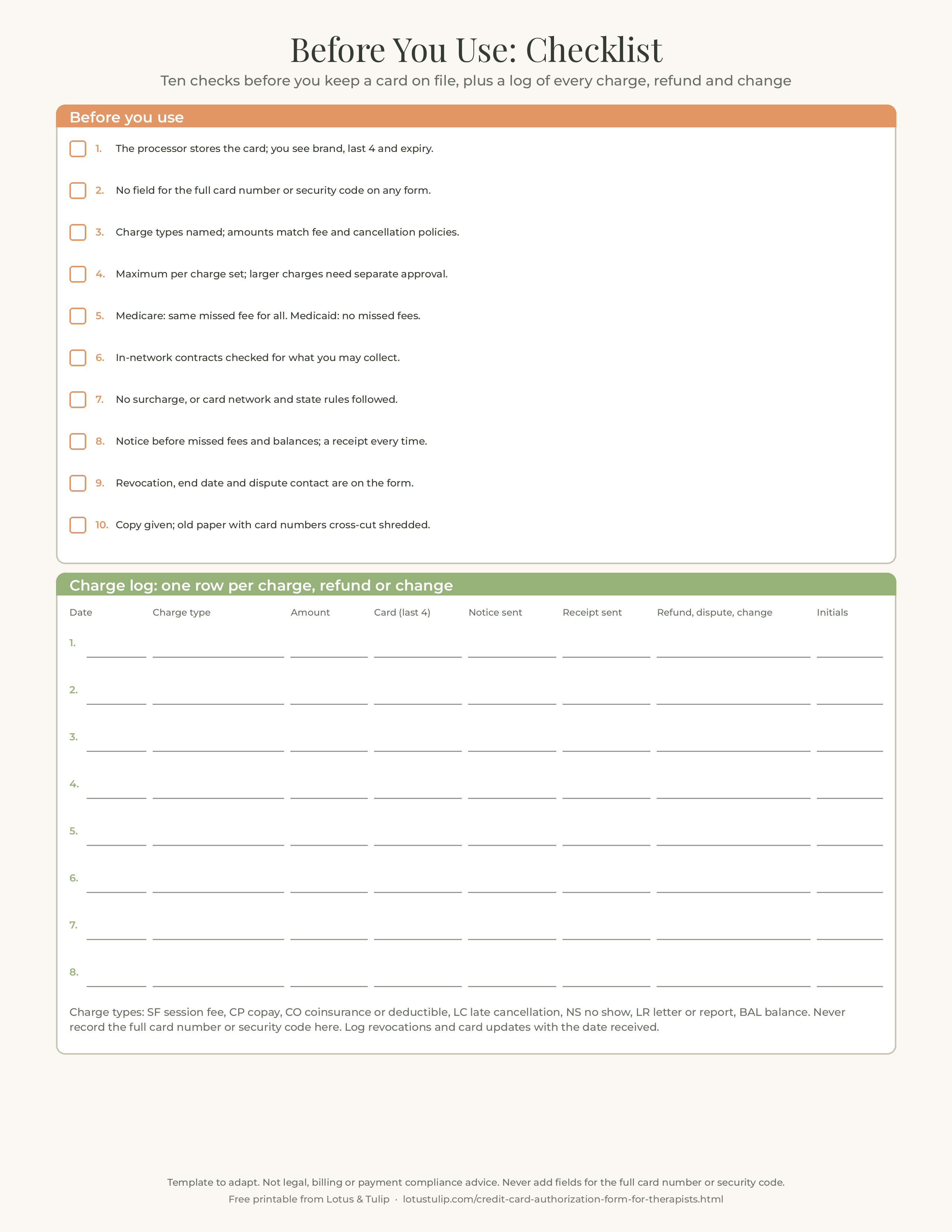
A one page charge log for each client makes this easy and makes any dispute a five minute task. Page 3 of the free printable includes one.
How to create a credit card authorization form, step by step
- Choose your processor's card on file feature. Confirm that clients can enter the card themselves, that you only see the brand, last four digits and expiry, and how the processor records consent. Ask whether it signs a business associate agreement for any non payment features you use.
- List the charge types you will actually use, such as session fees, copays, coinsurance and deductibles after claims, late cancellation and no show fees, and letters or reports, and drop the rest.
- Set amounts, timing and a maximum per charge, matching your fee policy, cancellation policy and Good Faith Estimate.
- Decide your notice and receipt rules: which charges get an advance message and how far ahead, and how every receipt is sent and what it shows.
- Check payer and program limits: same missed appointment policy and amount for Medicare clients, no missed session fees for Medicaid clients, and your in-network contracts.
- Decide on card fees. If you surcharge, follow card network rules and state law and disclose it; if not, say no fee is added.
- Write the duration, revocation, change and dispute wording, including that fees for services already provided remain due.
- Remove every field for the full card number and security code from your form, and shred any old forms that hold card numbers once the cards are in the processor.
- Use it at intake: the client enters the card, signs the authorization, gets a copy, and you file it with billing records and start a charge log.
Credit card authorization form example (fictional, full)
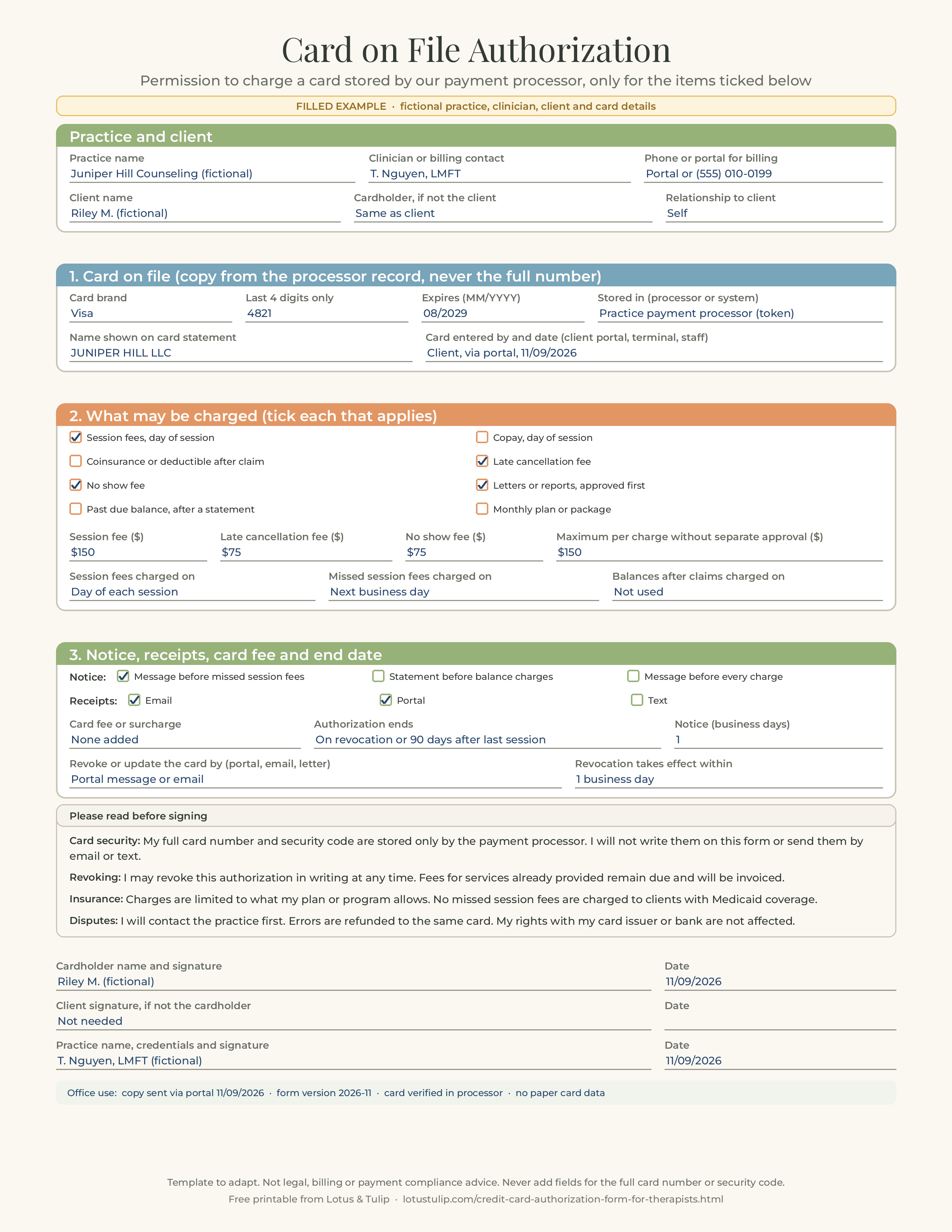
The fictional clinician T. Nguyen, LMFT, runs a small self pay and out of network practice, Juniper Hill Counseling, with in person and video sessions. The fee is $150 for a 53 minute session; the cancellation policy charges $75 for a late cancellation (less than 24 hours' notice) and $75 for a no show. The practice is not enrolled in Medicare or Medicaid. The client, Riley M., pays with a Visa card they entered in the client portal.
Juniper Hill Counseling: Card on File Authorization
About this form. This form lets Juniper Hill Counseling keep a card on file and charge it for the items ticked below. Your full card number and security code are stored only by our payment processor. We never write them down, and we cannot see them.
Card on file. Visa ending 4821, expires 08/2029. Cardholder: Riley M. (the client). Card entered by the client in the client portal on 11/09/2026.
What may be charged. Session fees at my agreed rate of $150, on the day of each session. Late cancellation fee of $75 and no show fee of $75 under the cancellation policy I signed, on the next business day. Fees for letters or reports I request, at the rate in the fee policy, only after I approve the amount.
Maximum. No single charge will be more than $150 without my separate written approval.
Notice and receipts. I will receive a message before any missed session fee is charged, and an email receipt for every charge showing the date, amount, a neutral description and the last four digits. Charges appear on my statement as "JUNIPER HILL LLC".
Card fees. No card fee or surcharge is added.
Duration. This authorization lasts until I revoke it, or until 90 days after our last session, whichever comes first.
Revoking or changing. I may revoke this authorization at any time by message in the portal or by email. It takes effect within one business day of receipt, and I will receive confirmation. Fees for sessions already held and missed session fees already incurred remain due and will be invoiced. If my card changes, I will update it in the portal.
Questions and disputes. If I think a charge is wrong, I will contact the practice first at the portal or (555) 010-0199. Errors are refunded to the same card.
Insurance and public programs. I pay the practice directly and may request a superbill. Missed session fees are not insurance services and do not appear on superbills. The practice does not charge missed session fees to clients with Medicaid coverage.
Cardholder signature: Riley M. (fictional). Date: 11/09/2026.
Practice: T. Nguyen, LMFT (fictional). Date: 11/09/2026. Copy given: via portal, 11/09/2026. Form version: 2026-11.
Common card on file mistakes
- Asking for the security code on the form. PCI DSS prohibits storing it after authorization. Remove the field.
- Writing full card numbers on paper or in email. Let the processor store the card; record only brand, last four and expiry.
- "Any amount owed" wording. Name the charge types, amounts or how they are calculated, and the timing.
- No maximum per charge. A cap prevents shocks and disputes.
- Charging without notice. A message before a missed session fee or a balance prevents most disputes.
- Surcharging debit, prepaid, HSA or FSA cards. Card rules and some state laws forbid it.
- Charging Medicaid clients missed session fees, or Medicare clients different amounts from everyone else.
- Clinical details on receipts or statements. Use neutral descriptions and a neutral statement name.
- Charging after revocation or after the end date. Stop, and invoice instead.
- Old forms in a drawer. Cross-cut shred them once cards are in the processor.
Free printable: credit card authorization form template, filled example and before you use checklist
The free printable has three US Letter pages. Page 1 is a blank card on file authorization designed so that it does not collect the full card number or the security code: practice and client details, the cardholder if different, the card brand, last four digits and expiry from your processor record, where the card is stored, tick boxes for each authorized charge type with amounts, a maximum per charge, notice and receipt choices, card fee, duration, revocation, dispute and insurance lines, signatures and an office use strip. Page 2 is the same form filled for the fictional Juniper Hill Counseling example. Page 3 is a ten point before you use checklist and a charge log.
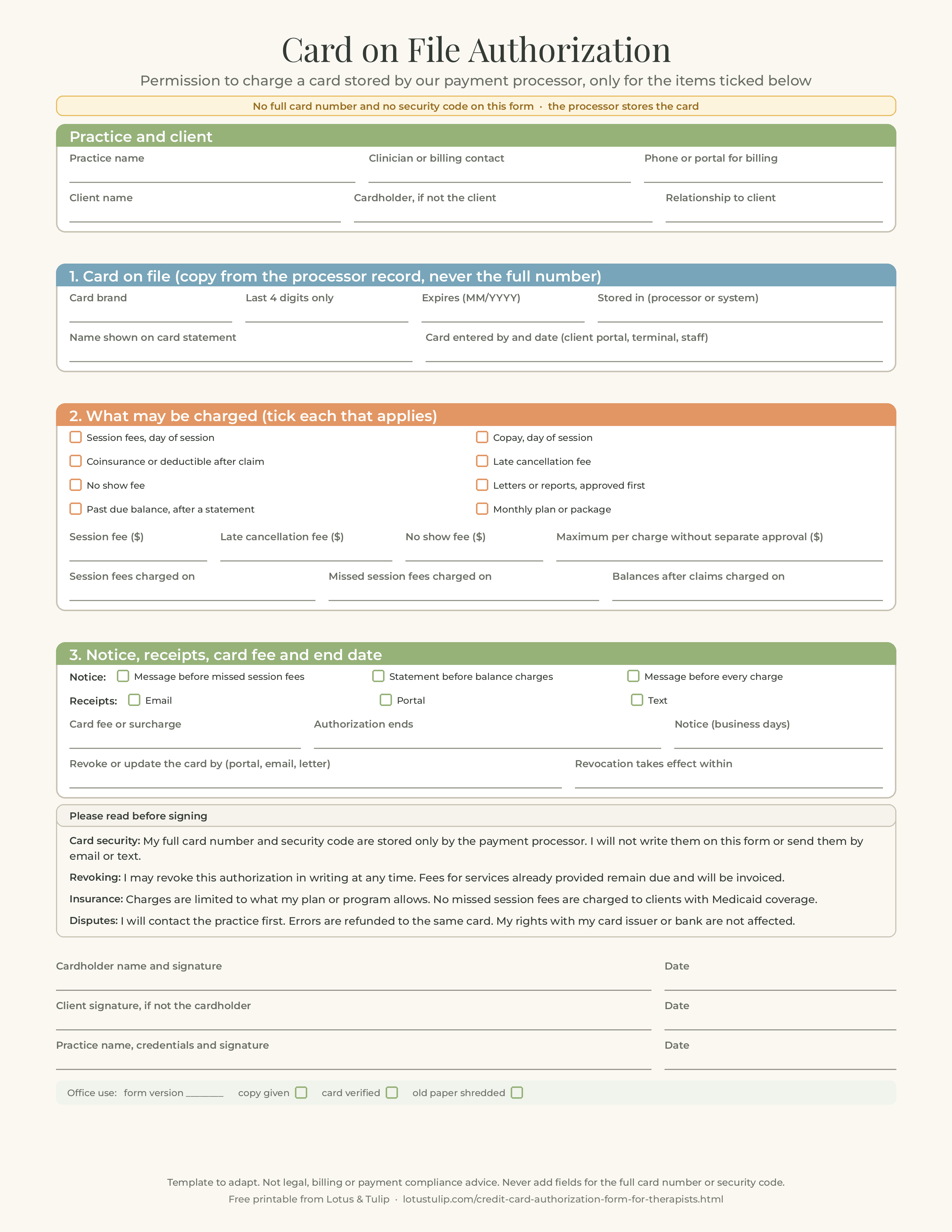
Download the free credit card authorization form template (PDF, 3 pages)
Rather type than handwrite? The free PDF above is for printing. Therapy Progress Notes and Intake Templates comes as a fillable PDF you type straight into (604 fields in Adobe Acrobat Reader), plus the printable version: SOAP, DAP and BIRP notes, intake, treatment plan and safety plan, 20 pages. Holiday 20% off: about $7.36, was $9 (EUR 8) · instant digital download
Buy on EtsyPrefer single images? Page 1: blank card on file authorization (PNG) · Page 2: filled fictional example (PNG) · Page 3: before you use checklist and charge log (PNG)
Free to print and use in your own practice. Please link to this page rather than re-uploading the file. The template is a starting point: never add fields for the full card number or security code, check your processor's card on file terms, card network rules, your payer contracts, the Medicare and Medicaid rules that apply to you and your state's consumer and licensing rules, and have an attorney or your professional association review it before use.
Related resources
- Closing a therapy private practice: checklist, timeline, client letters, records plan and free printable
- HIPAA risk assessment for therapists: security risk analysis, filled example and free worksheet
- Business associate agreement for therapists: which vendors need a BAA, breach duties, filled vendor log and free printable
- Professional will for therapists: clinical executor, records custodian, client notification scripts, filled example and free printable
- Couples therapy informed consent form: no secrets policy, individual sessions, records access, safety screening, filled example and free printable
- Treatment summary template for therapists: how to write a treatment summary letter, transfer records under HIPAA, filled example and free printable
- Notice of privacy practices for therapists: HIPAA 164.520 elements, 2026 Part 2 update, filled example and free printable
- Parental consent form for therapy of a minor: who can consent, custody orders, state minor consent laws, HIPAA, filled example and free printable
- Therapy cancellation policy template: late cancellation and no show fees, Medicare and Medicaid rules, filled example and free printable
- Sliding scale fee policy for therapists: 2026 poverty guideline tiers, copay waiver rules, filled example and free printable
- Good Faith Estimate template for therapists: No Surprises Act rules, filled example and free printable
- Superbill template for therapists: every field insurers need, CPT and POS codes, filled example and free printable
- Informed consent for therapy template: what to include, sample consent and free printable
- Release of information form for therapists: HIPAA authorization elements, psychotherapy notes, Part 2, filled example and free printable
- Therapy termination letter template: sample letters and free printable
- What to include in a therapy intake form (checklist)
- Psychotherapy notes vs progress notes: what HIPAA says, what goes where and free printable
- Therapy progress notes and intake templates
Sources: PCI Security Standards Council, PCI DSS Requirements and Testing Procedures v4.0.1 (June 2024), requirements 3.2, 3.3.1, 3.3.1.2, 3.4.1, 3.5.1, 9.4.1 and 9.4.6 and the scope guidance on paper media; PCI SSC, "Just Published: PCI DSS v4.0.1" (retirement of v4.0 on December 31, 2024; March 31, 2025 effective date); Visa, Stored Credential Transaction Framework (Visa Business News, May 2017) and Visa U.S. Merchant Surcharge Q and A; 12 CFR 1005.2, 1005.3 and 1005.10 (Regulation E), and 12 CFR 1026.13 (Regulation Z billing errors), eCFR current text; 15 U.S.C. 1681c(g) (receipt truncation); 45 CFR 164.501 (definition of payment) and 164.502(b) (minimum necessary), eCFR current text; HHS, Business Associates FAQs (financial institutions and HIPAA section 1179); CMS, Medicare Claims Processing Manual (Pub. 100-04), Chapter 1, section 30.3.13; CMS, Policy Issues in the Delivery of Dental Services to Medicaid Children and Their Families (September 22, 2008); 42 CFR 447.15; HHS OIG Special Fraud Alert on routine waiver of Medicare Part B copayments and deductibles (59 FR 65372, December 19, 1994); 45 CFR 149.610 (Good Faith Estimates); APA Ethical Principles of Psychologists and Code of Conduct (2002, amended 2010 and 2016), standards 6.04 and 6.06; ACA Code of Ethics (2014), A.2.b; NASW Code of Ethics, 1.03(a) and 1.13(a). Card network rules, processor terms and federal and state rules change; check the current versions.
FAQ
What is a credit card authorization form for therapists?
A short written agreement in which a client allows the practice to keep a payment card on file and charge it for defined amounts, such as session fees, copays, balances after insurance and missed session fees, at defined times, until the client revokes it. It names the card by brand and last four digits, lists the charge types, a maximum per charge, notice and receipts, and how to revoke.
Can I write the client's full card number and CVV on the form?
You should not. PCI DSS v4.0.1 says the card verification code must not be stored after authorization, even if encrypted, and paper holding full card numbers must be physically secured and destroyed by cross-cut shredding, incineration or pulping when no longer needed. The safer design is to have the client enter the card in your payment processor, which stores it as a token, and to record only the brand, last four digits and expiry on your form.
Is a credit card processor a HIPAA business associate?
Usually not for the payment itself. HHS guidance says a business associate agreement is not required when a financial institution processes consumer conducted card payments for health care, under section 1179 of HIPAA. A practice management system, EHR or billing service that handles client records or claims is different and generally needs a business associate agreement.
Can I charge a no show fee to the card on file?
Yes, if the client signed a cancellation policy and a card authorization that names the fee, and the client's coverage allows it. For Medicare clients, the policy and amount must be the same as for everyone else and the fee is never billed to Medicare. Medicaid policy generally does not allow missed appointment charges. In-network contracts may limit them. Send a short message before charging.
Can a client cancel a card on file authorization?
Yes. A good form says how to revoke it in writing, when the revocation takes effect, and that fees for services already provided remain due by another payment method. Once revoked, stop charging the card. The client's rights to dispute charges with their card issuer or bank also remain.
Can I add a credit card surcharge to therapy fees?
Only within card network rules and state law. Visa's US rules, for example, allow surcharges on credit cards only, not debit or prepaid cards, cap them at the lower of the merchant discount rate or 3 percent, and require notice to the acquirer and disclosure to clients. Some states restrict surcharges. Many practices simply build card costs into the fee.
Is this credit card authorization form template free?
Yes. The three page printable (a blank card on file authorization that does not collect the full card number or security code, a filled fictional example and a before you use checklist with a charge log) is free to print and use in your own practice. Please link to this page rather than re-uploading the file, and have it reviewed before use.