
Therapist practice · Updated 2026-11-09
Parental Consent Form for Therapy of a Minor: Who Can Consent, Custody Orders, State Minor Consent Laws, HIPAA and a Filled Example (Free Printable)
Ready-made printable: Therapy Progress Notes and Intake Templates Fillable PDF: includes an informed consent outline to adapt, plus intake, notes and safety plan pages (20 pages)
Holiday 20% off: about $7.36, was $9 (EUR 8) · instant digital download
Try it free first: download a fillable sample (SOAP note and DAP note, PDF, 226 KB). Type into it on screen, then get the full pack. No email needed.

Few intake calls carry as many hidden questions as the one that starts "I'd like to book therapy for my daughter." Is the caller a parent with legal authority to consent, a stepparent, a grandparent, or a parent whose decision making rights a court has limited? Are the parents together, separated or divorced, and does the other parent know? Is the young person old enough under your state's law to consent on their own? Once therapy starts, what will each parent be told, what stays between you and the teenager, and what happens when a parent asks to read the notes? A good parental consent form does not answer all of that by itself, but it forces each question to be asked and the answer to be written down before the first session.
This guide is for counselors, therapists, clinical social workers, marriage and family therapists and psychologists in the US who see children and teenagers. It covers who can consent, divorced and separated parents, guardians and other caregivers, when minors can consent for themselves (with verified state examples and a clear warning that the rules differ by state), the HIPAA personal representative rule, confidentiality agreements with parents, school versus private practice records, and telehealth across state lines. At the end you can download a free three page printable: a blank parent or guardian consent and confidentiality agreement for a minor client, the same form filled for a fictional practice and family, and a checklist with a custody and consent document log.
Jump to the free parental consent form for therapy
This is educational information for licensed clinicians and trainees in the US. It is not legal advice and does not create any professional relationship. Rules for minors are set mostly by state law, vary widely and change. The state examples were checked against official statute text on the date at the top of the page; check your own state's current law, your board's rules and any court order, and have an attorney or your professional association review your form. Every practice, clinician, family and detail in the examples on this page is fictional.
The short answer
A parental consent form for therapy is the written permission, signed by a person with legal authority to consent for a minor, that allows a clinician to assess and treat the child or teenager. A good one also records who signed it and on what authority, what the custody arrangement is, how confidentiality will work between the clinician, the young person and each parent, and the young person's own agreement (assent).
- Usually a parent or legal guardian consents. Often either parent with legal authority can consent alone, but custody orders, guardianship and state law can change that.
- Ask about custody at the first call. If the parents are separated or divorced, read the current order's decision making terms before the first session.
- Some minors can consent on their own. California and Illinois start at 12 with conditions, Washington at 13, Virginia deems a minor an adult for outpatient mental health care, and Texas allows counseling for specific problems. Check your own state.
- HIPAA follows state law for minors. A parent is normally the minor's personal representative under 45 CFR 164.502(g), with three exceptions, one of which is a parent's agreement to confidentiality between you and the minor.
- Agree on confidentiality in writing. What parents will hear, what stays private, and that you will tell the young person before you share anything where it is safe to do so.
- Get the young person's assent, as the APA and ACA codes both ask, even when a parent gives the legal consent.
What a parental consent form is, and what it is not
A parental consent form answers a narrow legal question: has someone with authority to decide for this minor agreed to this treatment? It sits next to, not in place of, your other intake documents. Your informed consent for therapy explains the service, fees, confidentiality limits, records and emergencies; for a minor, the parent signs it as the person giving consent and the young person signs or initials an assent version. Your release of information covers sharing with a school, pediatrician or the other parent's attorney. The parental consent form ties these together for one child: who the client is, who consented and on what authority, who else holds rights, and what each person will be told.
Three words that get mixed up:
- Consent is the legally effective agreement to treatment, given by someone with capacity and authority.
- Assent is the young person's own agreement to take part, given in words that fit their age and understanding. It is an ethical expectation, and it matters clinically.
- Authorization is HIPAA's word for written permission to disclose protected health information for purposes other than treatment, payment and health care operations (45 CFR 164.508). Consent to treatment is not an authorization to send records to a school.
Who can consent for a minor: the common situations
State law decides who has authority to consent to a minor's health care, and family courts can change that authority in a particular case. The table shows the situations you will meet most often and what to ask for in each. It is a starting point for questions, not a statement of the law in your state.
| Situation | Who usually consents | What to ask for or record | Watch for |
|---|---|---|---|
| Parents married or living together | Either parent, in most states | Both parents' names and contact details; whether the other parent knows about therapy | Your own policy may still ask for both signatures, especially for family work |
| Divorced or separated, joint legal custody | Often either parent, unless the order requires joint decisions on health or mental health care | The current order or parenting plan, the pages on decision making, and any clause on counseling or therapy | Orders sometimes name a specific therapist, require agreement on providers, or require notice to the other parent |
| Divorced or separated, sole legal custody | The parent with decision making authority | The order pages that give that authority | The other parent may still have a right to records under state law or the order |
| Legal guardian (not a parent) | The guardian, within the court's order | The guardianship order, its limits and end date | Temporary guardianships end |
| Child in foster care or agency custody | Usually the agency or a person it designates, under state rules | Written consent from the agency caseworker or designee, and who may receive information | Birth parents may keep some rights; follow the agency's written instructions |
| Grandparent, relative or other caregiver | Only if state law or a written authorization allows | The authorization, power of attorney or caregiver affidavit your state recognizes | Living with the child is not, by itself, legal authority to consent |
| Emancipated minor | The minor | A copy of the court order or proof of the status your state recognizes | HIPAA treats the person who acts for an emancipated minor under 164.502(g)(2), as for adults |
| Minor consenting under a state minor consent law | The minor, within the statute's limits | The statute you rely on, the minor's age, and your required findings (maturity, risk, parent involvement) | Age, number of sessions, parent notice, medication and payment rules all vary |
Texas shows how a state can let other adults step in. Family Code section 32.001 lets listed people, including a grandparent, an adult sibling, an adult aunt or uncle, or an adult with actual care of the child and written authorization from a person with the right to consent, consent to psychological treatment when the person with the right to consent cannot be contacted and has not given actual notice to the contrary. Section 32.002 requires that consent in writing, naming the child, the parents if known, any managing conservator or guardian, the person consenting and their relationship, the nature of the treatment and the start date. Stepparents generally need the same kind of legal authority; living with the child is not enough.
One parent or both?
In many states, either parent with legal authority to make health care decisions can consent to routine outpatient therapy without the other parent's signature. That is the legal minimum. Many child and adolescent therapists set a higher bar, because therapy needs both homes (a parent who opposes it can end it after three sessions), because contested custody cases pull therapists into disputes and board complaints, and because the parent who did not sign may still have a right to records. A workable policy: one parent's consent is enough when the parents live together or one parent has sole decision making; with separated parents who share legal custody, you inform the other parent and ask for their signature before or soon after the first session; and you never start when the order requires joint agreement and one parent objects. Write your policy into the form and apply it consistently.
Divorced and separated parents: custody orders and what to check
Custody orders and parenting plans usually separate physical custody (where the child lives and the parenting time schedule) from legal custody or decision making (who makes major decisions about education, health care and religion). States use different words (conservatorship in Texas, for example), but your question is the same: who may decide about mental health treatment, and does the order say anything about counseling?
Ask for the most recent order (and whether anything has been modified since), the pages on decision making for health or mental health care, any clause that names a therapist, requires agreement on providers or notice to the other parent, any protective or restraining order, contact details for both parents unless a safety concern says otherwise, and whether a guardian ad litem, parenting coordinator or custody evaluator is involved.
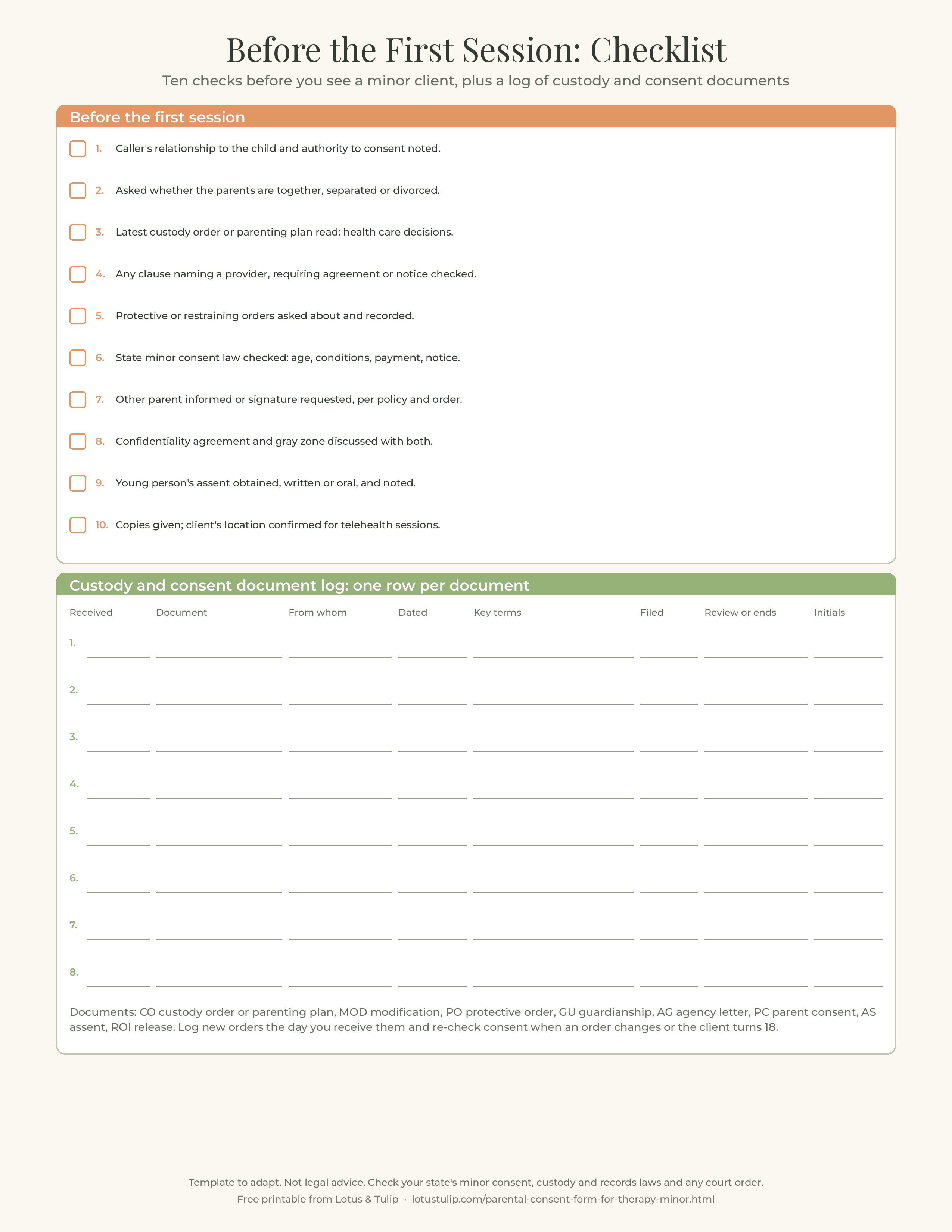
Keep a copy of the relevant pages in the client's administrative file, note the date you received them and from whom, and ask the parent to tell you promptly if the order changes. Page 3 of the free printable has a custody and consent document log for exactly this.
The other parent's right to records
Many states give a parent access to a child's records regardless of which parent has custody, unless a court limits it. California Family Code section 3025, for example, says that access to records and information pertaining to a minor child, including medical, dental and school records, shall not be denied to a parent because that parent is not the child's custodial parent. Virginia Code section 20-124.6 says neither parent, regardless of custody, shall be denied access to the child's academic or health records unless a court orders otherwise for good cause, with one more exception for health records: the treating physician, clinical psychologist, clinical social worker or licensed professional counselor may place a written statement in the record that furnishing the records to the requesting parent would be reasonably likely to cause substantial harm to the minor or another person. Other states have their own rules. The practical point: tell the consenting parent at intake that the other parent may have a right to request records, and do not promise one parent that the other will never learn about therapy.
Stay in your role
Therapy for a child in a custody dispute is not a custody evaluation. APA standard 10.02(b) asks psychologists who may be called on to perform potentially conflicting roles, such as family therapist and then witness for one party in divorce proceedings, to clarify, modify or withdraw from roles appropriately. Say in your form that you will not make custody recommendations or write letters for one parent's case, and that if a court orders records or testimony you will follow the law and tell both parents.
Guardians, foster care and other caregivers
When a child lives with someone other than a parent, ask what legal paper gives that person authority, and read it for limits and an end date. For a child in foster care, get the caseworker's written instructions on who consents, who receives updates and what may be shared with birth parents. For relatives caring for a child informally, check whether your state recognizes a caregiver affidavit, a power of attorney for a minor or a statute like Texas Family Code 32.001. If none applies, you need a parent's or guardian's consent, even if the caregiver brings the child to every session.
When minors can consent for themselves: state examples
Every state sets its own rules on when a minor can consent to outpatient mental health care without a parent, and the differences are large: the starting age, whether the clinician must find the minor mature enough, how many sessions are allowed before a parent must be involved, whether parents must be told, whether medication is covered, and who pays. The examples below were checked against the official statute text; they are examples, not a survey of all states.
| State and statute | Who may consent | Key conditions and limits |
|---|---|---|
| California, Family Code 6924 (as amended by AB 665, operative July 1, 2024) | A minor 12 or older, to outpatient mental health treatment or counseling or residential shelter services | The attending professional person must find the minor mature enough to participate intelligently. Treatment must include the parent or guardian unless the professional, after consulting the minor, decides involvement would be inappropriate, and the record must state whether and when contact was attempted, or why it would be inappropriate. Parents are not liable for payment unless they participate. Does not cover psychotropic drugs, convulsive therapy or psychosurgery without parental consent. |
| Illinois, 405 ILCS 5/3-550 | A minor 12 or older, to outpatient counseling services or psychotherapy | Without parental consent, services to a minor under 17 are initially limited to 8 sessions of 90 minutes. By the eighth session the provider decides, with the minor and using four required factors, whether seeking parental consent would be detrimental; continuing without consent needs either at least two documented unsuccessful attempts to reach the parent plus the minor's written consent, or a documented detriment finding reviewed every 60 days. Parents are not informed without the minor's written consent except as the section allows, and are not liable for costs of services they did not consent to. |
| Washington, RCW 71.34.530 (with RCW 71.34.020) | An adolescent, defined as a minor 13 or older, to outpatient treatment | Any adolescent may request and receive outpatient treatment without a parent's consent. Parental authorization, or authorization from a person who may consent for the minor under RCW 7.70.065, is required for outpatient treatment of a minor under 13. |
| Virginia, Code 54.1-2969(E) | A minor is deemed an adult for consenting to outpatient care, treatment or rehabilitation for mental illness or emotional disturbance (and for outpatient substance abuse services, among other listed services) | The minor is also deemed an adult for accessing or authorizing disclosure of the records related to those services. Read this together with Virginia's parental access provision, Code 20-124.6, and its health records exception. |
| Texas, Family Code 32.004 | A child, to counseling for suicide prevention, chemical addiction or dependency, or sexual, physical or emotional abuse | A licensed or certified physician, psychologist, counselor or social worker with reasonable grounds may counsel the child without parental consent, may advise the parents of the treatment given or needed with or without the child's consent, and may rely on the child's written statement of the grounds for capacity to consent. No counseling under this section if consent is prohibited by a court order. A parent who did not consent is not obligated to pay. |
Even these five states show that "the age of consent for therapy" is not one number (Virginia ties it to the type of care, Texas to the reason for counseling), that minor consent laws often still expect parent involvement, and that payment follows consent: a minor consenting alone may need a free, sliding scale or program funded option.
Laws vary, so check your state. Start with your licensing board's rules and FAQs, your state's minor consent statutes (often in the family code, health and safety code or mental health code), and your professional association's state chapter, which often publishes a summary. Confirm the current text, because several states have changed their rules in recent years (California's 2024 amendment and Illinois's 2021 amendment among them), and note the statute section on your form when you rely on it.
HIPAA: when a parent is the minor's personal representative
HIPAA does not set an age of consent. It defers to state law and then decides who exercises the minor's privacy rights, such as the right to access records or sign authorizations. The rule is in 45 CFR 164.502(g).
The general rule. If, under applicable law, a parent, guardian or other person acting in loco parentis has authority to make health care decisions for an unemancipated minor, the covered entity must treat that person as the minor's personal representative for protected health information relevant to that representation (164.502(g)(3)(i)). A parent who can consent to the child's therapy normally stands in the child's shoes for HIPAA purposes.
The three exceptions. The parent is not the personal representative, and the minor exercises the rights for information about a health care service, when:
- the minor consents to the service, no other consent is required by law (even if someone else also consented), and the minor has not asked for the parent to be treated as the personal representative (164.502(g)(3)(i)(A));
- the minor may lawfully obtain the service without a parent's consent, and the minor, a court or another person authorized by law consents to it (164.502(g)(3)(i)(B)); or
- the parent assents to an agreement of confidentiality between the provider and the minor for that service (164.502(g)(3)(i)(C)).
The third exception is the one most relevant to a parental consent form. If a parent signs an agreement that you will keep the details of sessions confidential between you and the young person, HIPAA treats that agreement as removing the parent's personal representative status for that information. Make the agreement explicit, so both you and the parent know what it covers.
State law still controls disclosure. Notwithstanding those exceptions, a provider may disclose information about the minor to the parent, or give the parent access, if and to the extent state or other law, including case law, permits or requires it, and may not if state law prohibits it (164.502(g)(3)(ii)(A) and (B)). Where the parent is not the personal representative and no state law addresses access, a licensed health care professional decides whether to give the parent access, using professional judgment and consistent with state law (164.502(g)(3)(ii)(C)).
Safety exception. A covered entity may elect not to treat a person as a personal representative if it reasonably believes the individual has been or may be subjected to domestic violence, abuse or neglect by that person, or that treating the person as the representative could endanger the individual, and it decides, in professional judgment, that doing so is not in the individual's best interest (164.502(g)(5)).
Access requests from parents. When a parent who is the personal representative asks for records, the access rules in 164.524 apply. One reviewable ground for denial is that a licensed health care professional has determined, in professional judgment, that giving access to the personal representative is reasonably likely to cause substantial harm to the individual or another person (164.524(a)(3)(iii)); a denial on that ground carries a right to review by another licensed professional who did not take part in the original decision. Psychotherapy notes kept separately from the record are not part of the HIPAA right of access (see psychotherapy notes vs progress notes). State law may give parents broader or narrower access, so check yours.
Privacy notice. Give the parent or other personal representative your HIPAA notice of privacy practices and ask for the acknowledgment of receipt; many child therapists also explain it to older children in plain words.
Confidential communications. A covered health care provider must accommodate reasonable requests to receive communications by alternative means or at alternative locations (164.522(b)(1)(i)). If a teenager who lawfully consented to care asks that appointment reminders go to their own phone rather than the family email, that request is part of your HIPAA obligations, not just a courtesy. Health plans must accommodate such requests when the person clearly states that disclosure could endanger them (164.522(b)(1)(ii)), which matters when a parent's insurance sends explanation of benefits statements home.
Confidentiality with parents: making the agreement work
Most trouble in child and adolescent therapy comes from expectations nobody wrote down: the parent expected a summary after each session, the teenager expected nothing to be shared. A short written agreement, discussed with both together, prevents most of it.
A common structure divides information into three groups:
| Group | Typical content | How it is handled |
|---|---|---|
| Shared with parents routinely | Attendance, scheduling, general goals, broad progress ("things are moving in the right direction"), recommendations for home | Shared at agreed check-ins, ideally with the young person present or aware |
| Kept private | What the young person says in sessions, feelings about family members, friendships, most details of behavior that does not involve serious risk | Not shared without the young person's agreement, within the limits of state law and the agreement the parent signed |
| Shared because of safety or law | Serious risk of harm to self or others, abuse or neglect that must be reported, situations where a court orders disclosure or another law requires it | Shared as needed to keep people safe or meet the law; the young person is told first where possible and safe |
Agree on the gray zone in advance: substance use, sexual activity, self-harm without suicidal intent, risky online contacts, running away, school refusal. Decide these lines before the first session, within state law, and write them down. Two promises that help: you will tell the young person before you share something with a parent, and you will encourage and help the young person to tell the parent themselves where that is better.
Mandated reporting is not negotiable by agreement. State child abuse reporting laws generally list licensed mental health professionals among mandated reporters, and a parent's signature cannot waive that duty. State it plainly on the form, and if a report may involve the consenting parent, follow your state's reporting law, not the consent form, on whether to tell them.
Assent: the young person's agreement
Legal consent from a parent does not make the young person's agreement irrelevant. APA standard 3.10(b) says that for persons legally incapable of giving informed consent, psychologists nevertheless provide an appropriate explanation, seek the individual's assent, consider their preferences and best interests, and obtain appropriate permission from a legally authorized person if such substitute consent is permitted or required by law; 3.10(d) asks psychologists to document written or oral consent, permission and assent. ACA standard A.2.d asks counselors working with minors to seek the assent of clients to services and include them in decision making as appropriate, balancing the client's ethical rights to make choices and their capacity to consent or assent with parental and family legal rights and responsibilities.
Practical assent at different ages:
- Younger children (about 5 to 9). A short spoken explanation: "This is a place to talk and play about feelings. Most of what you say is private, but if I'm worried you're not safe, I'll tell a grown-up who can help." Note how the child responded.
- Preteens (about 10 to 12). A short written assent section they read with you and sign.
- Teenagers. The same agreement the parent signs, discussed together, with the teenager's signature. Be specific about the gray zone.
If a young person refuses therapy, take it seriously. Meet with the parent, explore what is behind the refusal, and consider a short trial of sessions; forcing an unwilling teenager into weekly therapy rarely works.
Substance use treatment: 42 CFR Part 2
If you work in a federally assisted substance use disorder program covered by 42 CFR Part 2, a separate federal rule applies to minors. Under 42 CFR 2.14, where state law lets a minor acting alone apply for and obtain substance use disorder treatment, any written consent for disclosure under the Part 2 rules may be given only by the minor, including disclosure to a parent to obtain payment. Where state law requires parental consent to treatment, written consent for disclosure must be given by both the minor and the parent or guardian, and the fact of the minor's application may be told to the parent only with the minor's written consent or under the narrow lack of capacity and substantial threat conditions in 2.14(c). Most private practices are not Part 2 programs; if yours is, your minor forms need Part 2 wording.
School counseling vs private practice
Who consents, and which privacy law applies, can differ when services happen at school.
Records at school are usually education records, not HIPAA records. HIPAA's definition of protected health information excludes individually identifiable health information in education records covered by the Family Educational Rights and Privacy Act (FERPA) (45 CFR 160.103). Records that a school counselor or school psychologist makes about a student and maintains for the school are generally education records under FERPA (34 CFR 99.3), with exceptions, including records kept in the sole possession of the maker, used only as a personal memory aid and not accessible or revealed to anyone except a temporary substitute. FERPA gives parents rights over education records, and its rule for separated parents is simple: a school gives full FERPA rights to either parent unless it has evidence of a court order, state statute or legally binding document that specifically revokes those rights (34 CFR 99.4).
Consent to counseling at school follows school law and district policy. Brief school counseling may not require written parental consent in some districts; ongoing individual counseling, groups or assessments often do. State law and district policy set the rules, so school based clinicians should use the district's forms.
A private therapist seeing a student at school is still a private provider. If you see a student on campus as your own practice, not acting for the school, your records are generally your own health records, not education records. Get your own parental consent, and put in writing who the client is, who receives updates, and that the school does not see your notes.
Coordinating with a school. Even a short call to a teacher is a disclosure. Get written authorization from the parent (or from the minor, where the minor consented under state law), name the person at the school and share only what the school needs; see the release of information form for therapists.
Telehealth across state lines
Telehealth with minors adds one more question: which state's rules apply? Licensing boards generally look at where the client is physically located during the session, so you need authority to practice in that state, and the minor consent, parental access, reporting and records rules of that state are the ones to check. A move, a boarding school or summers with the other parent in another state can each change the answer. Confirm the client's location at the start of each session, keep both parents' and the young person's usual locations on file, and check with the board in the client's state before relying on a minor consent law there. Interstate licensure compacts, where they apply, address your authority to practice; they do not make your home state's consent rules travel with you. Record the location in each telehealth progress note.
Payment and insurance when the client is a minor
Record who pays as well as who consents. If a parent's insurance is billed, explanation of benefits statements may go to the policyholder, so talk with a young person who consented on their own before billing, and remember that in California, Illinois and Texas a parent who did not consent is generally not liable under the sections above. In divorced families, the custody or support order may say which parent covers health costs; do not let fee disputes give one parent control of the therapy. If you keep a card on file, the cardholder signs the card authorization and receives the receipts, which themselves reveal that the child is in therapy. Uninsured and self pay families must be offered a Good Faith Estimate.
What the ethics codes say about minors, parents and consent
| Code | Standard | What it asks | What it means for your form |
|---|---|---|---|
| APA Ethics Code (2002, amended 2010 and 2016) | 3.10(b) Informed Consent | For persons legally incapable of consent: explanation, assent, preferences and best interests, permission from a legally authorized person | An assent section for the young person, and a parent consent section that records authority |
| APA Ethics Code | 4.02(a) Discussing the Limits of Confidentiality | Discuss limits of confidentiality with persons, including, to the extent feasible, those legally incapable of consent and their legal representatives | Explain the confidentiality agreement to both the parent and the young person |
| APA Ethics Code | 10.02(a) and (b) Therapy Involving Couples or Families | Clarify at the outset which people are clients and your relationship with each; clarify, modify or withdraw from potentially conflicting roles | Name the child as the client; say you will not make custody recommendations |
| ACA Code of Ethics (2014) | A.2.d Inability to Give Consent | Seek the assent of minors and include them in decision making as appropriate, balanced with parental legal rights | Assent section, discussed in person |
| ACA Code of Ethics | B.5.a and B.5.b | Protect minors' confidentiality as specified by law, policy and ethics; inform parents about the counselor's role and the confidential nature of counseling, consistent with current legal and custodial arrangements | The three group confidentiality agreement and the custody check |
| NASW Code of Ethics | 1.03(c) Informed Consent | When clients lack capacity to consent, seek permission from an appropriate third party and inform clients consistent with their level of understanding | Parent or guardian consent plus an explanation and assent for the young person |
Marriage and family therapists should also check the AAMFT Code, and everyone should check state law and board rules, which can be stricter.
What a parental consent form should contain
Use this table as a checklist. The free printable at the end follows the same order.
| Element | What to decide | Example wording |
|---|---|---|
| Practice and clinician | Practice name, clinician name, credentials and license, state, phone or portal | "J. Rivera, LPC, licensed in [state], license no. [number]." |
| The client | The minor's name, date of birth and age, and that the minor is the client | "The client is Ellie S. Parents may attend some sessions, but the therapy is for Ellie." |
| Person consenting and authority | Name, relationship, and the basis of authority (parent with decision making, guardian, agency, other) | "I am the child's mother and have joint legal custody under the order dated 03/14/2024." |
| Other parent or guardian | Name and contact, whether informed, whether their consent is needed or obtained | "Other parent informed on 11/05/2026; consent signed below." |
| Custody and court documents | Type of order, date, relevant clauses, copy received, protective orders | "Copy of the decision making pages received 11/04/2026." |
| Minor consent law, if relied on | Statute, age, findings and any required parent involvement | "Minor consents under [statute]; clinician finding of maturity documented." |
| Confidentiality agreement | What parents receive routinely, what stays private, safety and legal exceptions, how the young person is told first | "Parents receive attendance and general progress. Session details stay private unless there is a safety concern." |
| Records access | That parents may have rights to request records under HIPAA and state law, and how requests are handled | "Requests for records go to the clinician in writing and are handled under federal and state law." |
| Court and custody disputes | No custody recommendations; what happens with subpoenas or court orders | "The clinician does not make custody recommendations." |
| Assent | The young person's agreement, in plain words, with signature or a note of oral assent | "I understand what stays private and what gets shared, and I agree to try therapy." |
| Signatures and copies | Each consenting parent or guardian, the young person, the clinician; copies given | "Copies given to both parents and the client, 11/09/2026." |
Scripts for the hard conversations
When a separated parent calls first: "Thank you for reaching out. Because you and Ellie's father are separated, I'll need a copy of the current custody order, just the pages about decision making and anything about counseling. When parents share legal custody, I ask both to sign. Would you like to tell him first, or shall I contact him?"
Explaining confidentiality to a parent and teenager together: "Here's how privacy works. Ellie, what you tell me stays between us. Your parents will know when you come, and I'll give them a general sense of how things are going. If I'm worried that you or someone else might get seriously hurt, or if I learn about abuse, I have to share that, and I'll tell you first whenever I can. Dana, does that work for you? Ellie, any questions?"
When a parent asks what their child said: "I can hear how worried you are. As we agreed, the details stay private so Ellie can be honest with me. She is coming regularly and working hard, and I'd suggest a family session where she can share some of it herself."
When parents disagree or withdraw consent
If a parent with authority withdraws consent, stop scheduling new sessions unless state law lets you continue on another basis (for example, the minor's own consent under a statute). Offer a closing session if appropriate and possible, give referrals, and document the date and how you were told; see the therapy termination letter template and the discharge summary template. If the parents disagree and the order requires joint decisions, you generally cannot resolve it for them; pause, document, and suggest they use their parenting coordinator, mediator or attorneys. If the order lets one parent decide, you may continue, keeping the other parent informed as their rights allow and your notes factual and neutral.
When the client turns 18
At the age of majority (18 in most states), the young person becomes the one who consents and exercises HIPAA rights, and parents generally lose the access they had as personal representatives. A few months ahead, explain the change, plan a new adult informed consent, and use a written authorization for anything the client wants shared with parents afterward.
How to create a parental consent form for therapy, step by step
- Look up your state's rules. Who may consent for a minor, any minor consent statutes for outpatient mental health care, parental access to records, and reporting duties. Note the statute sections you rely on.
- Write your one parent or both parents policy, including what you do when parents are separated and share legal custody, and when you will not start without both.
- List the services covered: assessment, individual, family, telehealth, groups and school coordination.
- Add an authority section that records the person consenting, their relationship, the basis of their authority and the other parent's details and status.
- Add a custody and court documents section: type of order, date, relevant clauses, copy received, protective orders, and the parent's promise to tell you about changes.
- Write the confidentiality agreement: what parents receive routinely, what stays private, the safety and legal exceptions, the gray zone decisions, and that you will tell the young person first where safe.
- Add records, communication, court, emergency and payment terms, including that you will not make custody recommendations.
- Add an assent section for the young person in plain words, and a line to record oral assent for younger children.
- Use it at intake: read the order before the first session, review the form with the parent and the young person, collect signatures, give copies and log the documents.
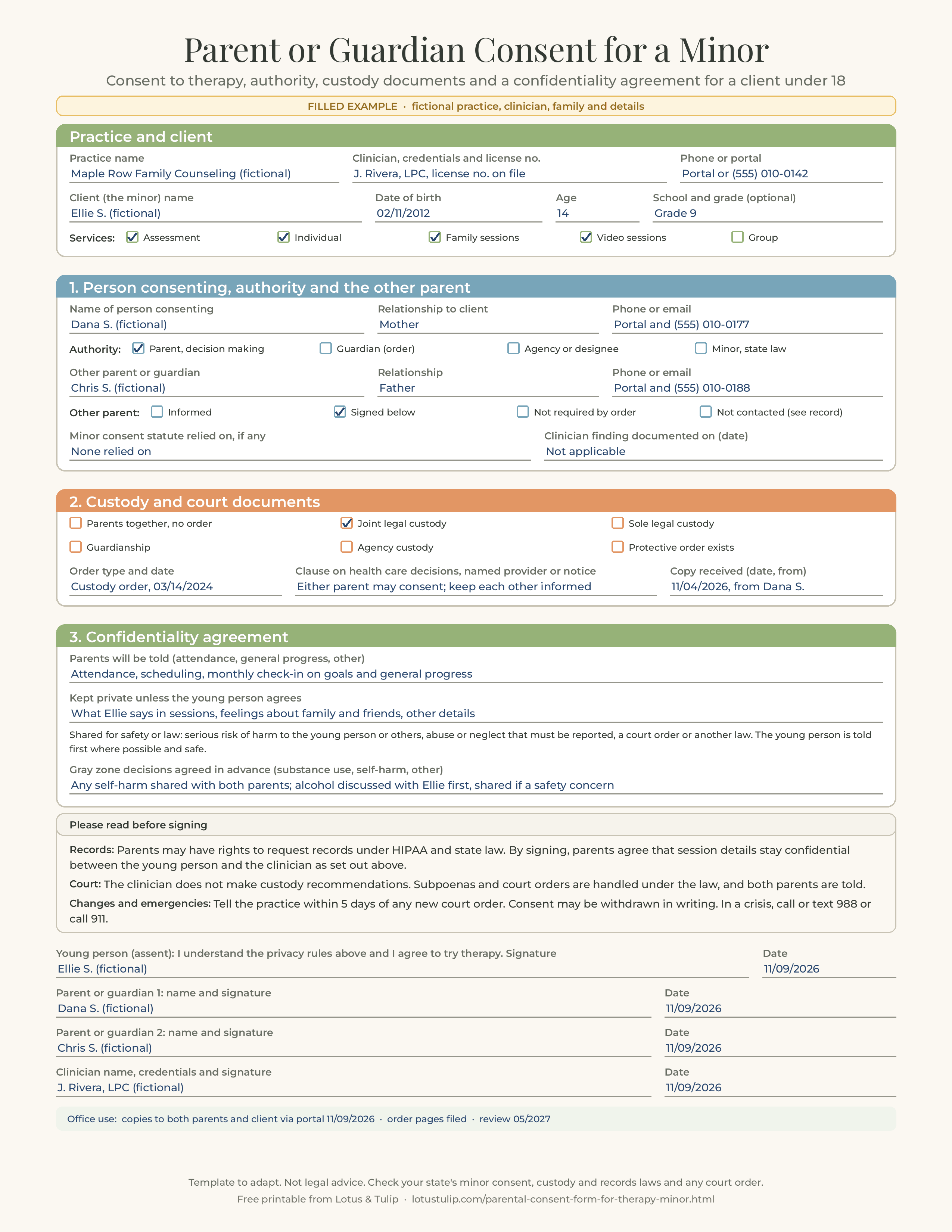
Parental consent form example (fictional, full)
The fictional clinician J. Rivera, LPC, runs Maple Row Family Counseling, a small private practice offering in person and video therapy for children and teenagers. Ellie S., age 14, has anxiety and school avoidance. Her parents, Dana S. and Chris S., are divorced and share joint legal custody under an order that lets either parent consent to routine health care but asks parents to keep each other informed. Practice policy is to ask both parents to sign; no minor consent statute is relied on.
Maple Row Family Counseling: Parent or Guardian Consent and Confidentiality Agreement for a Minor Client
Client. Ellie S., date of birth 02/11/2012, age 14. Ellie is the client. Parents may join some sessions, but the therapy is for Ellie.
Clinician. J. Rivera, LPC (fictional), license no. on file, phone (555) 010-0142, client portal.
Services. Assessment, individual therapy, family sessions as needed, and video sessions when Ellie is at either parent's home in this state. Coordination with Ellie's school counselor only with a separate signed release.
Consenting parents and authority. Dana S., mother, and Chris S., father, joint legal custody under the custody order dated 03/14/2024. Copy of the decision making pages received 11/04/2026 from Dana S. No protective orders. Both parents agree to tell the practice within 5 days if a court order changes.
What parents will be told. Attendance and scheduling; general goals and progress at a parent check-in about once a month; recommendations for home.
What stays private. What Ellie says in sessions, her feelings about family members and friends, and other details, unless Ellie agrees to share them.
When the clinician must share. If there is a serious risk to Ellie's safety or someone else's, if abuse or neglect must be reported under state law, or if a court orders it or another law requires it. Ellie will be told first whenever it is possible and safe. Agreed in advance: any self-harm will be shared with both parents; experimenting with alcohol will be discussed with Ellie first and shared if it becomes a safety concern.
Records. Parents may have rights to request records under HIPAA and state law. Requests go to the clinician in writing. By signing, both parents agree that the details of Ellie's sessions are confidential between Ellie and the clinician, as described above.
Communication. Reminders by text to Ellie and Dana; a monthly parent check-in by video.
Court. The clinician does not make custody recommendations or write letters for either parent's case. Records requested by subpoena or court order will be handled under the law, and both parents will be told.
Emergencies. In a crisis, call or text 988 or call 911. The clinician is not available around the clock.
Payment. Session fee $140. Chris S. pays session fees by card on file; insurance is not billed. Superbills on request.
Withdrawing consent. In writing, by either parent; the clinician then offers a closing session and referrals.
Ellie's agreement (assent). "I understand what stays private, what my parents will hear, and when J. Rivera has to share something. I agree to try therapy." Signed: Ellie S., 11/09/2026.
Parents: Dana S. (fictional), 11/09/2026. Chris S. (fictional), 11/09/2026. Clinician: J. Rivera, LPC (fictional), 11/09/2026. Copies given: both parents and Ellie, via portal, 11/09/2026. Form version: 2026-11.
Common mistakes with minor consent
- Starting without asking about custody. Ask on the first call; read the order before the first session.
- Accepting a stepparent's or grandparent's signature without checking what legal authority, if any, they hold.
- Promising a parent the other parent will never know. Records rights often belong to both.
- Promising a teenager total secrecy. Safety, reporting and court exceptions always apply.
- No written confidentiality agreement, so the parent and the teenager each heard something different.
- Assuming one national age of consent. Check your state's statute, conditions and payment rules.
- Ignoring the client's location on telehealth, which can change whose law applies.
- Forgetting the 18th birthday. Plan the switch to adult consent ahead of time.
Free printable: parental consent form for therapy, filled example and custody checklist
The free printable has three US Letter pages. Page 1 is a blank parent or guardian consent and confidentiality agreement for a minor client: client and services, the person consenting and their basis of authority, the other parent's status, custody and court documents, an optional minor consent law line, a three part confidentiality agreement with a gray zone line, a "please read" box, the young person's assent and signatures. Page 2 is the same form filled for the fictional Maple Row Family Counseling example. Page 3 is a ten point before the first session checklist and a custody and consent document log.
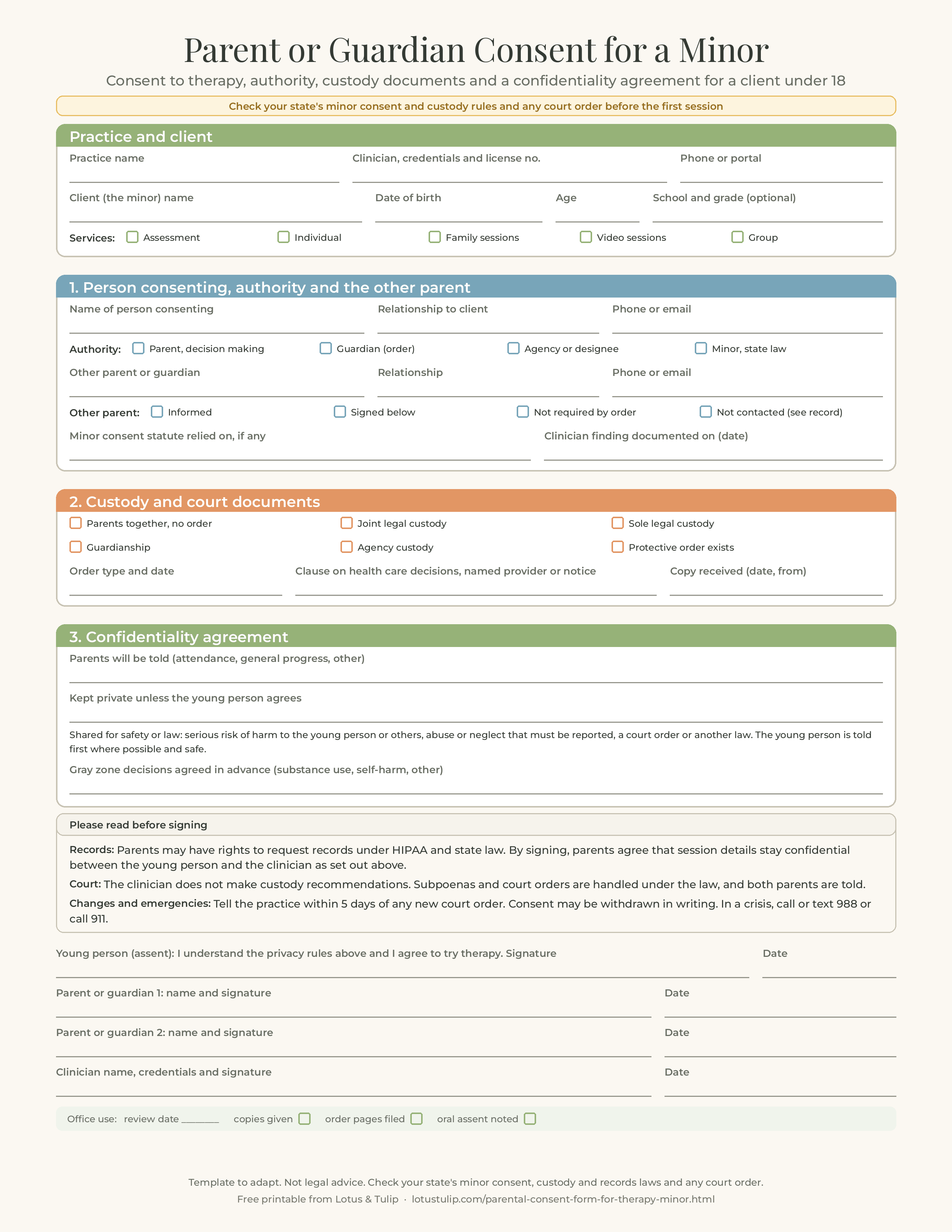
Download the free parental consent form for therapy (PDF, 3 pages)
Rather type than handwrite? The free PDF above is for printing. Therapy Progress Notes and Intake Templates comes as a fillable PDF you type straight into (604 fields in Adobe Acrobat Reader), plus the printable version: SOAP, DAP and BIRP notes, intake, treatment plan and safety plan, 20 pages. Holiday 20% off: about $7.36, was $9 (EUR 8) · instant digital download
Buy on EtsyPrefer single images? Page 1: blank parent or guardian consent and confidentiality agreement (PNG) · Page 2: filled fictional example (PNG) · Page 3: checklist and custody and consent document log (PNG)
Free to print and use in your own practice. Please link to this page rather than re-uploading the file. The template is a starting point: check your state's minor consent, custody and records laws, your licensing board's rules, any court order in the case and, if they apply, 42 CFR Part 2 and school district policies, and have an attorney or your professional association review it before use.
Related resources
- Family therapy informed consent form: who the client is, secrets policy, minors and custody, records and court, with a free printable
- Telehealth across state lines for therapists
- Closing a therapy private practice: checklist, timeline, client letters, records plan and free printable
- HIPAA risk assessment for therapists: security risk analysis, filled example and free worksheet
- Business associate agreement for therapists: which vendors need a BAA, breach duties, filled vendor log and free printable
- Professional will for therapists: clinical executor, records custodian, client notification scripts, filled example and free printable
- Couples therapy informed consent form: no secrets policy, individual sessions, records access, safety screening, filled example and free printable
- Treatment summary template for therapists: how to write a treatment summary letter, transfer records under HIPAA, filled example and free printable
- Notice of privacy practices for therapists: HIPAA 164.520 elements, 2026 Part 2 update, filled example and free printable
- Informed consent for therapy template: what to include, sample consent and free printable
- Release of information form for therapists: HIPAA authorization elements, psychotherapy notes, Part 2, filled example and free printable
- Psychotherapy notes vs progress notes: what HIPAA says, what goes where and free printable
- Credit card authorization form for therapists: card on file consent, PCI DSS rules, filled example and free printable
- Good Faith Estimate template for therapists: No Surprises Act rules, filled example and free printable
- Therapy cancellation policy template: late cancellation and no show fees, Medicare and Medicaid rules, filled example and free printable
- Telehealth progress note template and example
- Therapy termination letter template: sample letters and free printable
- What to include in a therapy intake form (checklist)
- Therapy progress notes and intake templates
Sources: 45 CFR 164.502(g) (personal representatives, including (g)(3) unemancipated minors and (g)(5) abuse, neglect and endangerment), 164.508, 164.522(b) and 164.524(a)(3), and 45 CFR 160.103 (definition of protected health information), eCFR current text; 42 CFR 2.14 (minor patients), eCFR current text; 34 CFR 99.3 (education records) and 99.4 (rights of parents), eCFR current text; California Family Code sections 6924 (as amended by Stats. 2023, ch. 338, AB 665, operative July 1, 2024) and 3025, California Legislative Information; Illinois 405 ILCS 5/3-550 (P.A. 102-558), Illinois General Assembly; Washington RCW 71.34.530 and 71.34.020, Washington State Legislature; Code of Virginia sections 54.1-2969 and 20-124.6, Virginia Law Library; Texas Family Code sections 32.001, 32.002 and 32.004, Texas Constitution and Statutes; APA Ethical Principles of Psychologists and Code of Conduct (2002, amended 2010 and 2016), standards 3.10, 4.02 and 10.02; ACA Code of Ethics (2014), A.2.d, B.5.a and B.5.b; NASW Code of Ethics, 1.03(c). State laws change; check the current versions.
FAQ
Do both parents have to consent to therapy for a minor?
Often not by law: in many states either parent with legal authority to make health care decisions can consent to routine outpatient therapy alone. A custody order can change that, for example by requiring joint decisions on health care or naming a provider. Many therapists still ask both separated parents to sign.
At what age can a minor consent to therapy without a parent?
It depends on the state, and sometimes on the type of problem. California and Illinois let minors 12 and older consent to outpatient counseling with conditions, Washington lets adolescents 13 and older request outpatient treatment, Virginia deems a minor an adult for consenting to outpatient mental health care, and Texas lets a child consent to counseling for suicide prevention, chemical dependency or abuse. Check your own state's statute and licensing board.
Can a parent see their child's therapy records?
Often, yes. Under HIPAA a parent who can make health care decisions for the child is normally the child's personal representative and can request access, but there are exceptions, including when the minor lawfully consented to the care, when the parent agreed to confidentiality between the clinician and the minor, and when a licensed professional determines access is reasonably likely to cause substantial harm. State law can widen or narrow parents' access, and psychotherapy notes are not part of the HIPAA right of access.
What should I ask for when parents are divorced?
The most recent custody order or parenting plan, the pages on decision making for health or mental health care, any clause about counseling or a named provider, and any protective orders. Log the order date and when you received it.
Can a grandparent or stepparent consent to a child's therapy?
Only if state law or a legal document gives them authority, such as guardianship, adoption, a power of attorney or a caregiver authorization your state recognizes. Texas, for example, lets certain relatives consent in writing when the parent cannot be contacted.
Do HIPAA rules apply to school counselors?
Usually not to the records. Health information in education records covered by FERPA is excluded from HIPAA's definition of protected health information, so school counselors' records maintained for the school are generally governed by FERPA, which gives either parent rights unless a court order or legal document revokes them.
Is this parental consent form template free?
Yes. The three page printable (a blank parent or guardian consent and confidentiality agreement for a minor client, a filled fictional example and a checklist with a custody and consent document log) is free to print and use in your own practice. Please link to this page rather than re-uploading it.