
Therapist practice · Updated 2026-11-09
Therapy Discharge Summary Template: How to Write One, with an Example (Free Printable)
Ready-made printable: Therapy Progress Notes and Intake Templates Fillable PDF: includes a discharge summary page, plus intake, notes and safety plan pages (20 pages)
Holiday 20% off: about $7.36, was $9 (EUR 8) · instant digital download
Try it free first: download a fillable sample (SOAP note and DAP note, PDF, 226 KB). Type into it on screen, then get the full pack. No email needed.

The discharge summary is the last note in a client's chart, and often the one that gets read most. It is what a new therapist asks for when the client starts again somewhere else. It is what a psychiatrist, a primary care doctor or a program reads to understand what was tried and what worked. It is what you will read yourself if the client calls in two years and asks to come back. And if a board complaint or a records request ever arrives, it is the page that shows how care ended.
Yet discharge summaries are often written last, late and in a hurry, or not at all when a client simply stops coming. This guide is for counselors, therapists, social workers, psychologists, marriage and family therapists and trainees in the US. It covers what a therapy discharge summary is, when to write one (planned termination, client dropout, transfer and referral), the sections it should contain, how to write it step by step, a complete fictional example, a short version for a client who stopped attending, common mistakes, and the records retention and HIPAA points that matter at the end of care, with clear caveats where rules vary by state and license board. At the end you can download a free three page printable: a blank discharge summary form, a filled fictional example and a before you sign checklist.
Jump to the free therapy discharge summary template
This is educational information for licensed clinicians and trainees, not legal, billing or clinical advice. Documentation, termination and record keeping rules differ by state, license, license board, setting and payer. Check your state law, your board's rules, your agency policy, your payer contracts and your supervisor's guidance if you are pre-licensed. Every client and clinician on this page is fictional.
What a therapy discharge summary is
A therapy discharge summary (also called a termination summary, closing summary or case closure note) is a short clinical document written when an episode of care ends. It summarizes the whole course of treatment in one place: why the client came, what you assessed, what you did, what changed, how the client was doing at the end, any remaining risk, and what should happen next.
It is different from a progress note. A progress note records one session. A discharge summary looks back across all of them and answers the questions a future reader will have:
- Who referred this person, and for what?
- What was the diagnosis at the start, and is it the same now?
- What services were provided, over what dates, and how many sessions?
- Which treatment goals were met, partly met or not met, and what is the evidence?
- How was the client doing at the last contact, including risk?
- Why did treatment end?
- What did you recommend, and who did you refer them to?
A good discharge summary lets a clinician who has never met the client pick up the thread in five minutes. A poor one says "client terminated, goals met" and leaves the next clinician to read forty progress notes.
Is a discharge summary required?
There is no single national rule that says every outpatient therapist must write a discharge summary in a particular format. Whether one is required, and what it must contain, depends on where you work and who pays. Agencies, hospitals, residential and intensive outpatient programs, community mental health centers and many Medicaid and managed care contracts require one, often within a set number of days of the last contact. Accreditation standards for behavioral health programs may also address discharge planning. In solo private practice, your state law and license board rules on record keeping are the starting point, along with your own policies and your malpractice carrier's advice.
Even where nobody requires it, the ethics codes expect the steps a discharge summary records. The ACA Code of Ethics (2014), standard A.11.c, says counselors "provide pretermination counseling and recommend other service providers when necessary," and A.11.d says that when counselors transfer or refer clients, "they ensure that appropriate clinical and administrative processes are completed and open communication is maintained with both clients and practitioners." The APA Ethics Code, standard 10.10(c), says: "Except where precluded by the actions of clients/patients or third-party payors, prior to termination psychologists provide pretermination counseling and suggest alternative service providers as appropriate." The NASW Code of Ethics, standard 1.17(b), says social workers "should take reasonable steps to avoid abandoning clients who are still in need of services." A discharge summary is where you show that you did those things.
When to write a discharge summary
Write one whenever an episode of care ends, whatever the reason. The content shifts a little depending on how it ended.
| Situation | What the summary needs to show |
|---|---|
| Planned termination (goals met or mostly met, by mutual agreement) | Progress on each goal with evidence, how termination was discussed and over how many sessions, the relapse prevention or maintenance plan, and how the client can return. |
| Client dropout (stopped attending, did not respond) | The date of the last session, the outreach you made and when, the risk picture at the last contact, any closing letter sent, and the referrals or crisis resources you gave. |
| Transfer (to another clinician in your practice or agency, or because you are leaving) | Why care is being transferred, who is taking over, what was shared and with what consent, and the open issues the next clinician needs to know about. |
| Referral out (to a higher or different level of care, a specialist, or a provider in another state) | Why the referral, the specific provider or service, whether a release of information was signed, whether the client connected, and your recommendations. |
| Ending for practical reasons (insurance ended, client moved, fees, schedule) | The reason stated plainly and without blame, how much notice was given, the alternatives discussed, and the referrals offered. Note any unmet needs. |
| Ending because continuing would not help or would harm | Your clinical reasoning, the pretermination discussion, and the referrals offered. The APA standard 10.10(a) and ACA A.11.c both describe ending when a client "is not likely to benefit, or is being harmed" (APA) or "is being harmed by continued counseling" (ACA). |
How long after the last session?
Programs and payers often set a deadline for the discharge summary, measured from the last contact or from the date the case is closed. If you work in an agency or bill a managed care plan, look for that deadline in your policy manual or contract. In private practice, a sensible habit is to write the summary within a week or two of the last session for a planned ending, and to set a clear rule for when an inactive client is considered discharged (for example, after a stated period of no contact and an attempt to reach them). Whatever rule you choose, put it in your informed consent or practice policies so clients know it too.
What about clients who just stop coming?
This is the most common way therapy ends, and the most poorly documented. Before you close the case:
- Look at risk first. Read your last two or three notes. If there was any current risk at the last contact, an unexplained absence calls for a prompt attempt to reach the client and possibly more, according to your own risk procedures. Document what you did and when.
- Make reasonable outreach and record it. A phone call, a secure message or a letter, using the contact methods the client agreed to in consent. Record the date, the method and the result of each attempt.
- Consider a closing letter. Many clinicians send a brief, warm letter saying that the file will be closed by a stated date unless the client gets in touch, that they are welcome to return, and listing crisis resources such as the 988 Suicide and Crisis Lifeline (call or text 988) and, if appropriate, other providers. Keep a copy in the chart. Whether to send one, and what it should say, is a clinical and risk management judgment; your malpractice carrier and your board's guidance are good sources.
- Then write the summary. It will be shorter, and some fields will honestly read "not assessed, client did not return." That is fine. What matters is that the record shows when care ended, what you knew, what you did and what you offered.
What a therapy discharge summary should include
Agency forms differ, but a complete discharge summary usually has the sections below. Your free printable follows this order.
1. Identifying information and dates
- Client name or ID, date of birth, and record number if you use one.
- Admission or intake date and discharge date (the date the episode of care ended, usually the last session or the date you formally closed the case).
- Date of the last session, if different from the discharge date.
- Clinician name and credentials, and supervisor if you are pre-licensed.
2. Reason for referral and presenting problem
Who referred the client (self, physician, school, court, employee assistance program, another therapist) and the presenting concerns at intake, in one to three sentences. Use the client's own words if you recorded them: "I can't get through a workday without a panic attack" tells a future reader more than "anxiety."
3. Diagnosis at intake and at discharge
List the diagnosis or diagnoses at intake and at discharge, with codes if your setting uses them, and note any change and why. A diagnosis can stay the same, be refined, move to "in partial remission" or "in full remission" where the diagnostic criteria allow, or be removed. If you added a diagnosis during treatment, say when and on what basis. If you did not diagnose (for example, in a coaching adjacent or school setting), say that instead of leaving the field blank.
4. Services provided, with dates and session count
- Type of service: individual, couples or family, group, telehealth, or a mix.
- Treatment approach in plain terms: for example, CBT with interoceptive exposure, EMDR, DBT skills, motivational interviewing.
- Dates of service (first and last) and the number of sessions attended, plus the number scheduled but missed or cancelled if that matters clinically.
- Frequency (weekly, then every other week, for example).
- Any assessments or measures used, with scores at intake and at discharge.
- Coordination of care: contact with a prescriber, physician, school or other provider, and the releases in place.
5. Progress on treatment goals
This is the heart of the summary. Take each goal and objective from the treatment plan, in the plan's wording, and record the status (met, partly met, not met, or discontinued) with evidence. Evidence can be a score change on a measure, a behavior count compared with baseline, the client's own report, or something you observed. "Goal 1 met" is a claim; "Goal 1 met: PHQ-9 from 17 at intake to 5 at session 14; back at work full time since week 9" is a record. If you use a treatment plan with measurable objectives, this section nearly writes itself.
6. Reason for discharge
Check one and explain in a line: goals met, mutual agreement, client chose to end, client stopped attending, transfer, referral to another level of care, moved or insurance ended, or clinician initiated (with the reason). Be factual and neutral. "Client did not return after 10/2; three outreach attempts" is better than "client was noncompliant."
7. Status at discharge
A brief clinical picture at the last contact: mood and affect, symptoms compared with intake, functioning at work, school, home and in relationships, engagement in treatment, and strengths and supports. If the client did not attend a final session, say so and describe the picture at the last session you had, with its date.
8. Risk assessment at discharge
Record whether risk was assessed at the last contact and the result: suicidal thoughts, intent, plan and history, self harm, harm to others, and relevant factors such as access to lethal means, substance use and recent losses. Name any tool you used. Record whether a safety plan exists and whether it was reviewed at discharge, and that crisis resources were given. If risk was not assessed because the client did not return, write that plainly, along with the risk level at the last session you had. If there is current elevated risk, discharge is usually a time for a warm handoff, not a closing letter; your own risk procedures and supervisor come first. Our safety plan worksheet has a free printable if the client does not have one.
9. Medications, if known
Therapists who do not prescribe can still record what they know: current psychiatric medications as reported by the client or the prescriber, the prescriber's name, and whether you coordinated with them. Mark it as client reported if you have not verified it. If you do not know, write "unknown" or "client reports none" rather than leaving it blank.
10. Aftercare recommendations
What you recommend now that treatment is ending: continued use of specific skills, a relapse prevention plan, follow up with a prescriber or physician, a support group, a booster session at a set interval, or a return to therapy if specific warning signs appear. Be concrete. "Continue to use skills" is a wish; "Use the panic coping card and weekly exposure practice; return if panic attacks occur more than once a week for two weeks" is a recommendation.
11. Referrals
Each referral with the provider or service type, the name if you gave one, the reason, whether a release of information was signed, and whether you know the client connected. If you offered referrals and the client declined, record that too. Crisis resources belong here or in the risk section: in the US, the 988 Suicide and Crisis Lifeline by call or text to 988, and 911 for emergencies.
12. Prognosis
Your professional view of the likely course, with the reasons: good, fair, guarded or poor, and what it depends on. "Prognosis good, given full goal attainment, strong supports and early recognition of warning signs; guarded if work stress returns without continued exposure practice" is useful to a future reader. A bare word is not.
13. Signature
Your signature, credentials, and the date signed; your supervisor's co signature if required. If you add something later, use a dated addendum rather than editing the original.
How to write a therapy discharge summary, step by step
- Gather the chart before you write. Pull the intake, the treatment plan and every plan review, your session log or attendance record, any measures, releases of information, and your last two or three progress notes. Writing from memory is how session counts and dates go wrong.
- Fill in the dates and counts first. Intake date, first and last session dates, discharge date, number of sessions attended and missed, service type and frequency. These are facts a reader will check against billing records, so get them exactly right.
- State the reason for referral and the diagnosis at intake. One to three sentences on who referred the client and why, in the client's words where you have them, and the diagnosis you gave at intake.
- Summarize the services and approach. What you did in plain terms, any measures with intake and discharge scores, and any coordination of care. Keep it to a short paragraph; the detail is in the progress notes.
- Go goal by goal. Copy each goal and objective from the treatment plan, mark it met, partly met, not met or discontinued, and give the evidence. Do not drop goals that were not met; explain them.
- Record the diagnosis at discharge and the status at discharge. Note any change in diagnosis and why. Then describe the client at the last contact: symptoms, functioning, strengths and supports.
- Document the risk assessment. Whether risk was assessed at the last contact, the result, the safety plan status and the crisis resources given. If it was not assessed, say why and give the most recent risk picture with its date.
- Write the reason for discharge, aftercare and referrals. The reason in neutral words; concrete aftercare recommendations; each referral with its status; and how the client can return. Note any outreach and closing letter for clients who stopped attending.
- Add the prognosis, read it as a stranger would, then sign. Give the prognosis with reasons. Then reread the summary as a clinician who has never met the client, and as the client might, and fix anything vague, judgmental or missing. Sign and date it within your agency's or payer's timeframe, and use a dated addendum for anything added later.
Discharge summary example (fictional)
The example below is fictional and simplified. It shows a planned termination after a course of outpatient CBT for panic disorder, written in the order of the template. In a real record, use your own setting's required fields and wording.
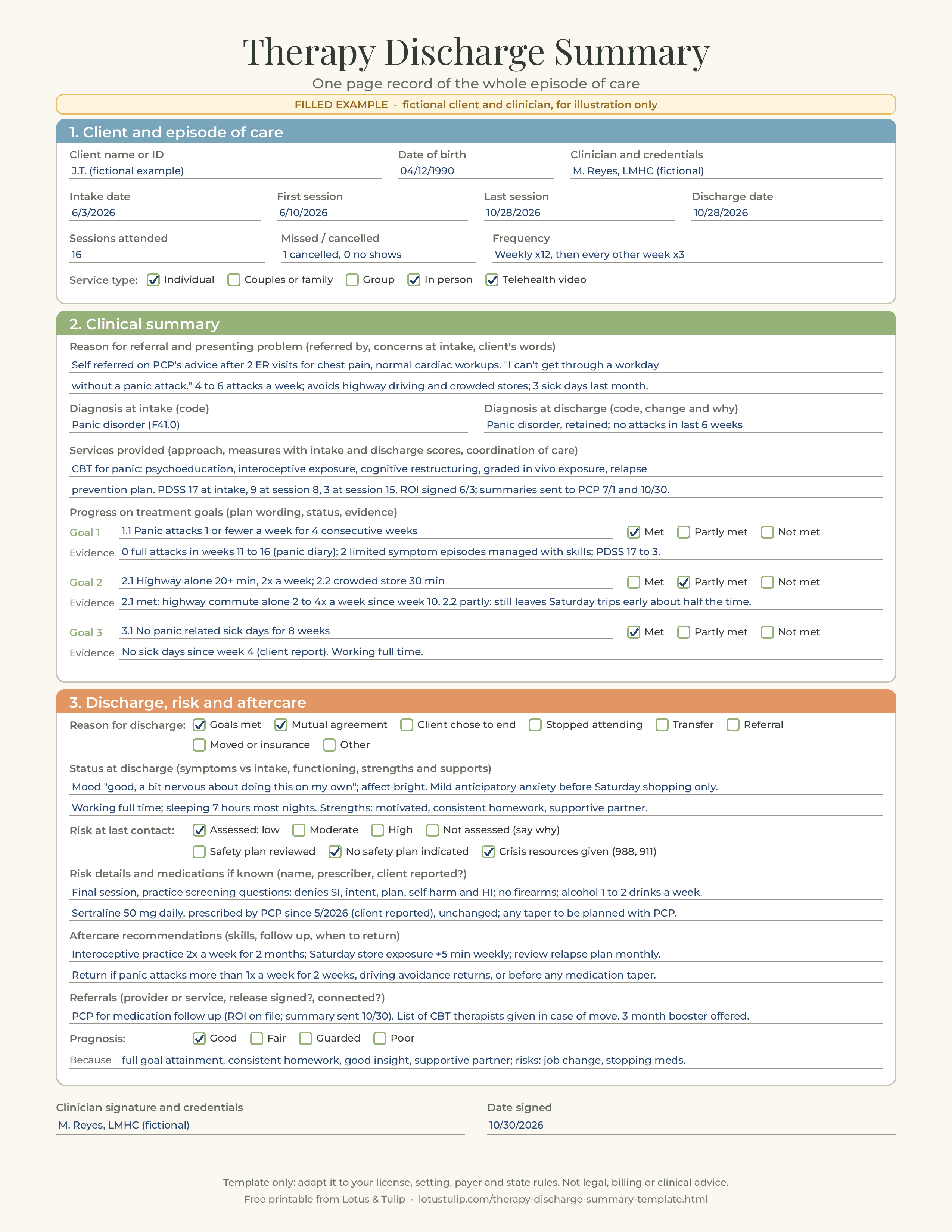
Client: "J.T." (fictional), adult. Clinician: M. Reyes, LMHC (fictional). Setting: outpatient private practice, in person and telehealth video.
Dates: Intake 6/3/2026. First treatment session 6/10/2026. Last session 10/28/2026. Discharge date 10/28/2026. Sessions: 16 attended (intake plus 15 treatment sessions), 1 cancelled with notice, 0 no shows. Weekly for 12 weeks, then every other week for the final 3 sessions as part of a planned taper.
Reason for referral: Self referred on the advice of her primary care physician after two emergency department visits for chest pain with normal cardiac workups. At intake she said, "I can't get through a workday without a panic attack, and I've stopped driving on the highway." Reported 4 to 6 panic attacks a week, avoidance of highway driving and crowded stores, and 3 sick days in the month before intake.
Diagnosis at intake: Panic disorder (F41.0). Agoraphobia considered and not diagnosed: avoidance was limited to highway driving and crowded stores and did not meet full criteria. Diagnosis at discharge: Panic disorder, with symptoms markedly reduced (no panic attacks in the last 6 weeks). Diagnosis retained for the record; the client and clinician discussed that recurrence is possible and what to do if it happens.
Services provided: Individual CBT for panic: psychoeducation on the panic cycle, interoceptive exposure (spinning, breathing through a straw, stair climbing), cognitive restructuring of catastrophic interpretations of body sensations, graded in vivo exposure to highway driving and crowded stores, and relapse prevention planning. Measures: Panic Disorder Severity Scale (PDSS) at intake, session 8 and session 15; weekly panic diary. Coordination of care: release of information signed 6/3/2026; summary letter sent to her primary care physician on 7/1/2026 and a copy of this discharge summary sent on 10/30/2026 at the client's request.
Progress on treatment goals:
- Goal 1: Reduce panic attacks. Objective 1.1: reduce panic attacks from 4 to 6 a week to 1 or fewer a week for 4 consecutive weeks. Met. Panic diary: 0 full panic attacks in weeks 11 to 16; 2 limited symptom episodes in that period, both managed with skills. PDSS 17 at intake, 9 at session 8, 3 at session 15.
- Goal 2: Return to avoided situations. Objective 2.1: drive on the highway alone for at least 20 minutes, 2 times a week. Met. Has driven the highway commute alone 2 to 4 times a week since week 10, the longest trip 45 minutes. Objective 2.2: shop in a crowded store for 30 minutes without leaving early. Partly met. Completes weekday shopping trips; still leaves Saturday trips early about half the time. Included in the aftercare plan.
- Goal 3: Restore work functioning. Objective 3.1: no panic related sick days for 8 weeks. Met. No sick days since week 4 (client report).
Reason for discharge: Planned termination by mutual agreement, goals met or substantially met. Termination was first discussed at session 11, and sessions were tapered to every other week for the last three sessions. Client agreed with the plan.
Status at discharge: Mood "good, a bit nervous about doing this on my own," affect bright and appropriate. Reports occasional mild anticipatory anxiety before Saturday shopping. Working full time. Sleeping 7 hours most nights. Strengths: highly motivated, completed exposure homework consistently, supportive partner who joined one session to learn how to respond to panic without reassurance seeking.
Risk assessment at discharge: Risk assessed at the final session using the practice's standard screening questions. Denies current or past suicidal thoughts, intent or plan; denies self harm and thoughts of harming others; no firearms in the home; alcohol 1 to 2 drinks a week, no other substances. Risk assessed as low. No safety plan was indicated during treatment. Crisis resources given in writing: 988 Suicide and Crisis Lifeline (call or text 988) and 911 for emergencies.
Medications (client reported): Sertraline 50 mg daily, prescribed by her primary care physician since 5/2026, unchanged during treatment. Client plans to discuss tapering with her physician; clinician recommended she make any change with her physician and not on her own.
Aftercare recommendations: Continue interoceptive practice twice a week for the next 2 months and keep the panic coping card in her bag. Continue Saturday store exposure, staying 5 minutes longer each week. Review the written relapse prevention plan (completed at session 15) at the start of each month. Return to therapy if panic attacks occur more than once a week for 2 consecutive weeks, if avoidance of driving returns, or before a planned medication taper if she would like support.
Referrals: Primary care physician for medication follow up (release on file; copy of summary sent 10/30/2026). Offered a list of local CBT therapists in case she moves, as she mentioned a possible job change; client accepted the list. Booster session offered at 3 months; client will call to schedule if she wants one.
Prognosis: Good, based on full attainment of the main goals, consistent homework, good insight and a supportive partner. Main risks are a major stressor such as the job change or stopping medication without support; the relapse prevention plan addresses both.
Signed: M. Reyes, LMHC (fictional), 10/30/2026.
Notice what makes this summary useful: exact dates and counts that match the session log; every goal from the plan accounted for, including one that was only partly met; scores at intake and discharge; a risk statement with what was asked and what was given; and aftercare recommendations with clear return triggers. A clinician seeing J.T. in two years would know exactly where to start.
Short example: a client who stopped attending (fictional)
Not every summary is long. Here is a dropout summary for a different fictional client, written after outreach.
Client: "D.L." (fictional), adult. Clinician: K. Osei, LCSW (fictional). Dates: Intake 7/15/2026. Last session attended 9/16/2026. Discharge date 10/21/2026. Sessions: 8 attended, 2 no shows (9/23 and 9/30).
Reason for referral and diagnosis: Referred by employee assistance program for low mood after a divorce. Diagnosis at intake: adjustment disorder with depressed mood (F43.21). Diagnosis at discharge: unchanged; not reassessed, client did not return.
Services and progress: Individual telehealth sessions weekly, behavioral activation and problem solving. PHQ-9 14 at intake, 9 at session 7. Goal 1 (increase pleasant and social activities to 3 a week): partly met at last session (2 a week). Goal 2 (complete a plan for shared parenting schedule): met at session 6.
Reason for discharge: Client stopped attending. Outreach: phone call and voicemail 9/23; secure portal message 9/30; closing letter mailed 10/7 stating the file would be closed on 10/21 unless the client got in touch, welcoming a return, and listing crisis resources. No response.
Status and risk at last contact: At the 9/16 session, mood "better than August," denied suicidal thoughts, intent or plan, and denied thoughts of harming others; risk assessed as low at that session. Risk not assessed after 9/16 because the client did not return. Safety plan not indicated during treatment.
Aftercare and referrals: Closing letter recommended returning to therapy or contacting the EAP if low mood returns, and gave the 988 Suicide and Crisis Lifeline (call or text 988) and 911. Client is welcome to resume care.
Prognosis: Fair to good, given improvement on the PHQ-9 and partial goal attainment before stopping; uncertain without a final assessment.
Signed: K. Osei, LCSW (fictional), 10/21/2026.
This summary does not pretend to know more than the clinician knew. It records the last known risk with its date, every outreach attempt, the content of the closing letter and the open door. A short honest summary is far better than a missing one.
Discharge summary vs other closing documents
| Document | What it is | Who it is for |
|---|---|---|
| Discharge summary | The clinical summary of the whole episode of care, kept in the record. | The record, future clinicians (with consent), reviewers, and the client if they request their records. |
| Treatment summary | A new, dated summary written from the record for one reader, such as a new therapist, a psychiatrist or the client. See the treatment summary template and records transfer guide. | The named reader, with the client's permission or at the client's request. |
| Closing or termination letter | A brief letter to the client confirming that care has ended or will end, welcoming a return and listing resources. See the therapy termination letter template and sample letters. | The client. Keep a copy in the chart. |
| Transfer or referral letter | A focused summary sent to a specific provider, with only what they need for the referral. | The receiving provider, with the client's consent where required. |
| Final progress note | The note for the last session, in your usual format (SOAP, DAP, BIRP or GIRP). | The record. It does not replace the discharge summary. |
| Treatment plan review | A periodic review of goals during treatment. | The record. The last review is a good source for the discharge summary. |
If your final session note and your discharge summary would say the same thing, you can write the final note briefly and put the detail in the summary. For the session note formats, see SOAP vs DAP notes, BIRP notes and GIRP notes; if the client attended groups, the group therapy progress notes guide explains how to keep other members out of their record, which applies to the discharge summary too.
Words to watch in discharge summaries
| Vague or risky | Better |
|---|---|
| "Goals met." | "Goal 1 met: panic attacks from 4 to 6 a week to 0 in weeks 11 to 16; PDSS 17 to 3." |
| "Client terminated." | "Planned termination by mutual agreement; first discussed at session 11; tapered to every other week." |
| "Client was noncompliant and dropped out." | "Client did not return after 9/16; outreach 9/23, 9/30 and closing letter 10/7; no response." |
| "Client improved." | "PHQ-9 from 14 at intake to 9 at session 7; back to 2 social activities a week (baseline 0)." |
| "No risk." | "Risk assessed at final session: denies suicidal thoughts, intent or plan, and thoughts of harm to others; no firearms in the home; risk low." |
| "Referred out." | "Referred to an intensive outpatient program for eating disorders (name on file); release signed 10/12; intake scheduled 10/20 per client." |
| "Prognosis good." | "Prognosis good, given full goal attainment and strong supports; guarded if medication is stopped without support." |
| "Client's husband is abusive and drinks." | "Client reports ongoing conflict at home; safety discussed; resources given." (Describe the client's experience; avoid diagnosing or labeling people who are not your client.) |
Common discharge summary mistakes
- Never writing one. Especially for clients who stop coming. An open chart with no closing note leaves it unclear whether you still consider yourself responsible for the client's care.
- Dates and session counts that do not match. If the summary says 16 sessions and the billing record says 14, a reviewer will notice. Count from the session log.
- Goals that disappear. Only the goals that were met are mentioned. Account for every goal on the treatment plan, including ones that were dropped or not met, and say why.
- No evidence. "Met" or "improved" with no scores, counts, client report or observation behind it.
- A risk section that says nothing. Either no risk statement at all, or "no risk" with no indication of what was asked or when. Record what you assessed, the result and the date.
- Blame or labels in the reason for discharge. "Resistant," "noncompliant" and "unmotivated" read badly to a client who requests their records and tell a reader nothing useful. Describe what happened.
- Vague aftercare. "Continue skills" with no specifics and no signs that should prompt a return.
- Referrals with no follow through recorded. No provider named, no release noted, no record of whether the client connected or declined.
- Copying the whole chart into the summary. A summary that runs to many pages defeats its purpose. Summarize; the detail lives in the notes.
- Information about other people. Details about family members, partners or other group members that are not needed for the client's care. Keep the focus on the client.
- Editing old notes at discharge. If you find a gap, write a dated addendum. Do not change earlier notes.
- Writing it months later. Memory fills in what the chart does not. Set a deadline for yourself if your setting does not.
Records, retention and HIPAA at the end of care
These are general points, not legal advice. Records rules vary by state, by license type and license board, by setting and by payer contract, and they change. Check your state law, your board's rules, your payer contracts and your professional association, and ask a health care attorney if you are unsure.
How long to keep the record
Discharging a client does not end your duty to keep and protect their record. A few points are worth knowing:
- HIPAA does not set a medical record retention period. The US Department of Health and Human Services (HHS) answers this directly in its HIPAA FAQ: "No, the HIPAA Privacy Rule does not include medical record retention requirements. Rather, State laws generally govern how long medical records are to be retained." The same FAQ says the Privacy Rule requires appropriate safeguards for records "for whatever period such information is maintained by a covered entity, including through disposal."
- The six year HIPAA rule is about compliance paperwork, not charts. HIPAA requires covered entities to keep their required HIPAA documentation, such as policies and procedures, for six years from creation or from the date it was last in effect, whichever is later (45 CFR 164.530(j)). It is often misquoted as a rule for clinical records.
- State law and your license board set the minimum. Periods differ from state to state and between professions in the same state, and records of minors are often kept until a set number of years after the client reaches the age of majority. Look up the rule for your state and license, and for every state where you see clients by telehealth.
- Professional guidance can suggest longer. The APA's Record Keeping Guidelines (2007) say that, "in the absence of a superseding requirement, psychologists may consider retaining full records until 7 years after the last date of service delivery for adults or until 3 years after a minor reaches the age of majority, whichever is later." The ACA Code of Ethics, standard B.6.h, asks counselors to store records after termination to ensure "reasonable future access," to keep them in line with federal and state laws, licensure laws and records policies, and to dispose of them in a way that protects confidentiality.
- Contracts can add more. Insurance, Medicare, Medicaid and managed care contracts can set their own retention periods. When several rules apply, many practices follow the longest.
- Plan for disposal and for your own absence. Write down your retention schedule and how records will be destroyed when the time comes. A professional will that names who will hold your records if you cannot practice is increasingly seen as part of ethical practice.
Sharing the discharge summary
- With the client. Under the HIPAA Privacy Rule (45 CFR 164.524), clients generally have a right to inspect and get a copy of the information in their designated record set, with limited exceptions, including psychotherapy notes. A discharge summary is part of the record. Write it in language you would be comfortable having the client read.
- With another provider for treatment. HHS guidance says the Privacy Rule permits health care providers to share protected health information with other providers for treatment purposes without the client's authorization, and that the minimum necessary standard does not apply to disclosures to a provider for treatment. Separately kept psychotherapy notes are different and generally require the client's authorization. In practice, many therapists still get a signed release before sending a summary, because state law, professional ethics and some settings set stricter rules, and because it is good care to involve the client.
- Stricter rules can apply. Records of federally assisted substance use disorder programs are protected by 42 CFR Part 2, which has its own consent rules. Many states have extra protections for mental health records, minors' records or HIV information. School based records may fall under FERPA instead of HIPAA. If one of these applies, follow the stricter rule.
- Is a discharge summary a psychotherapy note? No. The HIPAA definition of psychotherapy notes (45 CFR 164.501) excludes "medication prescription and monitoring, counseling session start and stop times, the modalities and frequencies of treatment furnished, results of clinical tests, and any summary of the following items: Diagnosis, functional status, the treatment plan, symptoms, prognosis, and progress to date." A discharge summary is built from exactly those items, so it is part of the clinical record.
- Is HIPAA even the rule for you? HIPAA applies to covered entities, which include health care providers who transmit health information electronically in connection with standard transactions such as insurance claims. A self pay practice that never bills electronically may not be a covered entity, but state law, board rules and your ethics code still govern your records.
A faster way to write good discharge summaries
- Write the treatment plan with the discharge summary in mind. Measurable objectives with a baseline make the progress section a matter of copying numbers.
- Keep a running session log. A single page with every date, attended or missed, makes the dates and counts take a minute instead of twenty.
- Repeat your measures. A brief standard measure at intake, at each plan review and at the last session gives you a before and after for every client.
- Draft the summary before the last session. Fill in the dates, history and goals in advance, then add status, risk, aftercare and prognosis after the final session.
- Use the final sessions for the content. Review progress and write the relapse prevention plan with the client; then the aftercare section is already agreed.
- Set a rule for inactive clients. A written policy on outreach and closing (and a template closing letter, such as our free therapy termination letter template) means dropouts get closed out properly instead of drifting.
Free printable: therapy discharge summary template, filled example and checklist
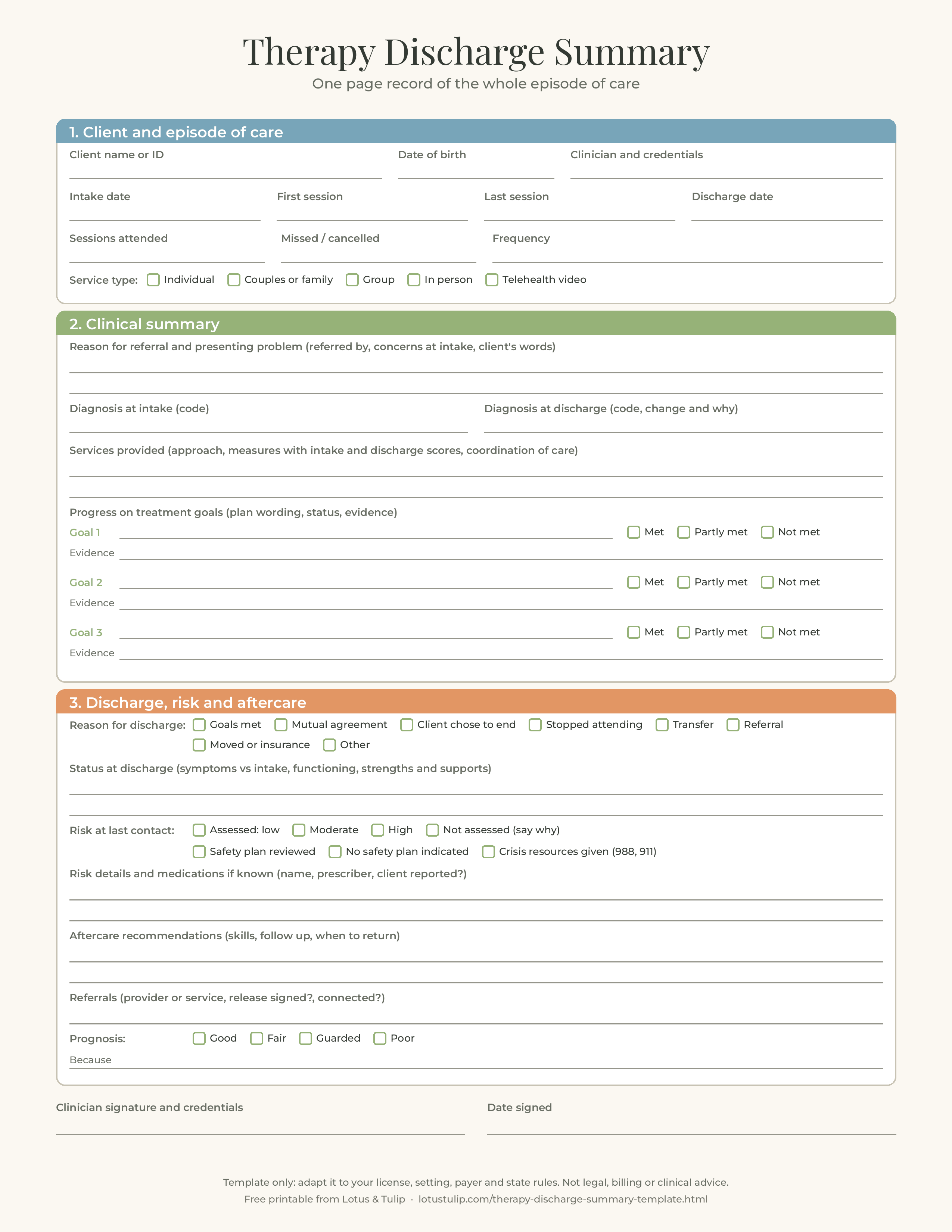
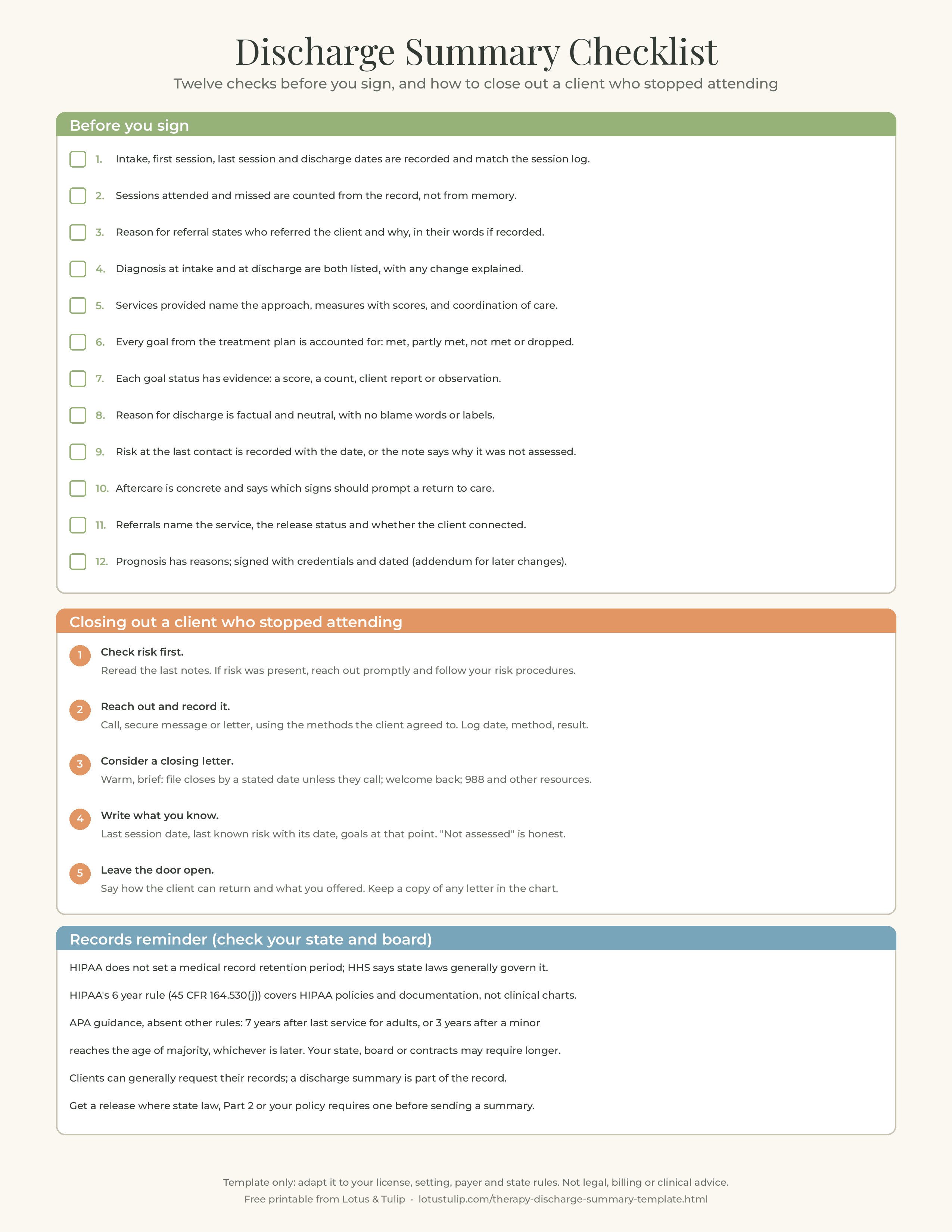
The free printable has three US Letter pages: a blank therapy discharge summary form with sections for identifying information and dates, sessions attended and missed, reason for referral, diagnosis at intake and at discharge, services provided, progress on up to three treatment goals (with met, partly met and not met boxes), reason for discharge, status at discharge, risk assessment, medications, aftercare, referrals, prognosis and signature; a filled example for the fictional client "J.T." from this page; and a before you sign checklist with twelve checks, a short guide to closing out a client who stopped attending, and a records reminder box.
Download the free therapy discharge summary template (PDF, 3 pages)
Rather type than handwrite? The free PDF above is for printing. Therapy Progress Notes and Intake Templates comes as a fillable PDF you type straight into (604 fields in Adobe Acrobat Reader), plus the printable version: SOAP, DAP and BIRP notes, intake, treatment plan and safety plan, 20 pages. Holiday 20% off: about $7.36, was $9 (EUR 8) · instant digital download
Buy on EtsyPrefer single images? Page 1: blank discharge summary form (PNG) · Page 2: filled discharge summary example (PNG) · Page 3: before you sign checklist and records reminder (PNG)
Free to print and use in your own practice or program. Please link to this page rather than re-uploading the file. The template is a starting point: adapt it to your license, setting, payer and state rules. Using it does not guarantee that any payer, auditor or board will accept your documentation.
Related resources
- Clinical supervision agreement for therapists: template, board rules and a supervision log
- Closing a therapy private practice: checklist, timeline, client letters, records plan and free printable
- HIPAA risk assessment for therapists: security risk analysis, filled example and free worksheet
- Business associate agreement for therapists: which vendors need a BAA, breach duties, filled vendor log and free printable
- Professional will for therapists: clinical executor, records custodian, client notification scripts, filled example and free printable
- Couples therapy informed consent form: no secrets policy, individual sessions, records access, safety screening, filled example and free printable
- Treatment summary template for therapists: how to write a treatment summary letter, transfer records under HIPAA, filled example and free printable
- Notice of privacy practices for therapists: HIPAA 164.520 elements, 2026 Part 2 update, filled example and free printable
- Parental consent form for therapy of a minor: who can consent, custody orders, state minor consent laws, HIPAA, filled example and free printable
- Credit card authorization form for therapists: card on file consent, PCI DSS rules, filled example and free printable
- Sliding scale fee policy for therapists: 2026 poverty guideline tiers, copay waiver rules, filled example and free printable
- Therapy cancellation policy template: late cancellation and no show fees, Medicare and Medicaid rules, filled example and free printable
- Release of information form for therapists: HIPAA authorization elements, psychotherapy notes, Part 2, filled example and free printable
- Superbill template for therapists: every field insurers need, CPT and POS codes, filled example and free printable
- Good Faith Estimate template for therapists: No Surprises Act rules, filled example and free printable
- Psychotherapy notes vs progress notes: what HIPAA says, what goes where and free printable
- Therapy termination letter template: how to end therapy ethically, sample letters and free printable
- Informed consent for therapy template: what to include, sample consent and free printable
- Biopsychosocial assessment template: example, 4 Ps formulation and free printable
- Therapy treatment plan template with SMART objectives (free printable)
- BIRP notes for therapists: template, 5 examples and free printable
- GIRP notes for therapists: template, 5 examples and free printable
- Group therapy progress notes: template, examples and free printable
- Telehealth progress note template: examples, checklist and free printable
- Mental status exam template: examples, word bank and free printable
- SOAP vs DAP notes for therapists, with examples
- What to include in a therapy intake form (checklist)
- Safety plan worksheet (free printable)
- Relapse prevention plan worksheet (free printable)
- Therapy progress notes and intake templates
Sources: HHS HIPAA FAQ "Does the HIPAA Privacy Rule require covered entities to keep patients' medical records for any period of time?" and HHS guidance on sharing health information for treatment; eCFR 45 CFR 164.501, 164.524 and 164.530; APA Record Keeping Guidelines (2007), Guideline 7; APA Ethical Principles of Psychologists and Code of Conduct, standard 10.10; ACA Code of Ethics (2014), standards A.11.c, A.11.d and B.6.h; NASW Code of Ethics, standard 1.17. Diagnosis codes are shown for illustration only. Rules change; check the current versions and your state's rules.
FAQ
What should a therapy discharge summary include?
Identifying information, intake and discharge dates, the number of sessions, the reason for referral, the diagnosis at intake and at discharge, the services provided, progress on each treatment goal with evidence, the reason for discharge, status at discharge, a risk assessment, medications if known, aftercare recommendations, referrals, a prognosis and your signature with credentials and date.
When should I write a discharge summary?
Whenever an episode of care ends: planned termination, a client who stops attending, a transfer to another clinician, or a referral to another service or level of care. Agencies and payers often set a deadline after the last contact; in private practice, set your own rule and write it soon after the last session or the formal closing date.
How do I write a discharge summary for a client who stopped coming?
Record the last session date, the risk picture at that session, each outreach attempt with its date and method, any closing letter and what it said, and the referrals and crisis resources you offered. Mark the fields you could not assess as "not assessed, client did not return" rather than guessing.
Is a discharge summary the same as a termination letter?
No. The discharge summary is the clinical summary kept in the record. A termination or closing letter is a short letter to the client confirming that care has ended or will end, welcoming a return and listing resources. Many clinicians use both and keep a copy of the letter in the chart.
How long do I have to keep a client's record after discharge?
It depends on your state law, your license board and your contracts. HHS says HIPAA does not set a medical record retention period and that state laws generally govern it. The APA's Record Keeping Guidelines suggest, absent a superseding requirement, 7 years after the last service for adults or 3 years after a minor reaches the age of majority, whichever is later. Check your own state's rule.
Can I send a discharge summary to the client's new therapist?
HHS guidance says HIPAA permits providers to share information with other providers for treatment without the client's authorization, while separately kept psychotherapy notes generally require authorization. State law, 42 CFR Part 2 for substance use disorder programs, and your ethics code can be stricter, so many therapists get a signed release first.
Can a client read their discharge summary?
Generally yes. Under HIPAA, clients have a right to inspect and get a copy of their designated record set, with limited exceptions such as psychotherapy notes. A discharge summary is part of the clinical record, so write it in neutral, respectful language.
Is this therapy discharge summary template free?
Yes. The three page printable (blank discharge summary form, filled example and checklist) is free to print and use in your own practice or program. Please link to this page rather than re-uploading the file, and adapt it to your setting and payer requirements.