
Therapist practice · Updated 2026-11-10
Family Therapy Informed Consent Form: Who the Client Is, Secrets Policy, Minors and Custody, Records and Court (Free Printable)
Ready-made printable: Therapy Progress Notes and Intake Templates Fillable PDF: includes an informed consent outline to adapt, plus intake, notes and safety plan pages (20 pages)
Holiday 20% off: about $7.36, was $9 (EUR 8) · instant digital download
Try it free first: download a fillable sample (SOAP note and DAP note, PDF, 226 KB). Type into it on screen, then get the full pack. No email needed.

A family walks into a first session and, within ten minutes, the therapist has heard four different ideas of what therapy is for. The mother wants help with her fifteen year old. The teenager wants her mother to stop reading her messages. The stepfather is not sure he is allowed to say anything. The father, who shares legal custody and lives across town, joined by video and wants to know whether anything said today can end up in front of the family court judge. None of those are clinical questions yet. They are consent questions, and if they are not answered in writing before the work starts, they tend to get answered later, under pressure, in the worst possible way.
This guide is for marriage and family therapists, counselors, social workers and psychologists in the United States who see families, couples, parents with children, adult siblings, blended families and other relational units. It explains what a family therapy informed consent should cover and why, with the ethics code text and federal rules quoted where the wording matters: deciding and writing down who the client is; listing every participant and their role; choosing a secrets policy (no secrets, limited secrets or therapist discretion) and getting every adult to initial it; individual sessions inside joint therapy; one family record or several, and who can request copies; consent to treat a minor, custody orders and state minor consent laws, with verified examples from California, Illinois, Washington and Texas; HIPAA's personal representative rule for parents; what happens if the couple separates or divorces, and your stance on custody evaluations, testimony and subpoenas; safety screening; the limits of confidentiality in a family; telehealth when family members join from different places; and fees when more than one person pays. It ends with a ten step process, sample consent wording for a fictional practice, six short scenarios, the mistakes that cause the most trouble, and a free three page printable: a blank family and couples therapy consent addendum, the same addendum filled in, and a first session checklist with a contact and decision log.
If your work is mainly with two adult partners, our couples therapy informed consent guide goes deeper into partner specific issues such as intimate partner violence screening and the affair disclosure problem. This page is the family system version: it covers couples too, but its focus is on households with children, more than two adults and custody arrangements.
Jump to the free family therapy consent form, filled example and log
This is educational information for clinicians in the US. It is not legal advice and does not create any professional relationship. Consent to treat minors, parents' access to records, privilege and subpoena procedure are governed by state law and by court orders, and they differ a great deal from state to state; check your own statutes, your licensing board's rules and a health care attorney before relying on any form. The standards quoted here were checked on November 10, 2026 against the AAMFT Code of Ethics (the revised code effective January 1, 2026, which replaced the 2015 code), the APA Ethical Principles of Psychologists and Code of Conduct (2002, with 2010 and 2016 amendments), the ACA Code of Ethics (2014), the NASW Code of Ethics, the eCFR text of 45 CFR 164.501, 164.502(g), 164.508, 164.510(b), 164.522(b) and 164.524, California Family Code sections 6924 and 3025, Illinois 405 ILCS 5/3-550, Washington RCW 71.34.530, and Texas Family Code sections 32.001, 32.004, 153.010, 153.073 and 153.132. Every practice, family, name, number and date in the examples on this page is fictional.
The short answer
A family therapy informed consent is your general informed consent plus a written addendum that answers the questions only multi person therapy raises. The essentials:
- Say who the client is. The family as a unit, the couple, or one person with others joining. Write it down before the first joint session. The APA, ACA, NASW and AAMFT codes all expect this to be clarified at the outset.
- List every participant and their role. Parent, stepparent, child, grandparent, adult sibling, partner. Note who has legal authority to consent for each minor, and how you know.
- Choose a secrets policy and get it initialed. No secrets, limited secrets or therapist discretion. Under the 2026 AAMFT code, a marriage and family therapist must not reveal one person's confidences to others in the client unit without that person's prior written permission, so a no secrets policy has to be agreed in writing before anything is shared.
- Explain individual sessions. Whether you offer them inside joint therapy, how long they are, and that the same secrets policy applies to them.
- Explain records. Whether there is one family record, who can ask for copies, whose signatures you need to release them, and that federal law may give each person rights you cannot sign away.
- Get the custody paperwork for every minor. Read the order or parenting plan yourself, check your state's minor consent law, and note the young person's assent.
- Set your court stance in advance. You will not do a custody evaluation or act as an expert for one side; what you will do if subpoenaed; what legal work costs.
- Screen for safety before joint work. See each adult alone first, and do not hold joint sessions that put anyone at risk.
- Every adult signs. Each adult participant signs the addendum and the general consent. Give everyone a copy, and review the agreement when the family changes.
How family therapy consent differs from individual and couples consent
Most of a general informed consent still applies in family work: who you are and how you work, fees, cancellations, contact between sessions, emergencies, the limits of confidentiality, records and complaints. What changes is that the person who signs, the person whose information is in the room, and the person who may later ask for the file are no longer the same person. That is why the AAMFT code opens its confidentiality standard by noting that marriage and family therapists "have unique confidentiality concerns because the client in a therapeutic relationship may be more than one person."
| Question | Individual therapy | Couples therapy | Family therapy |
|---|---|---|---|
| Who is the client? | One person | Usually the couple, sometimes one partner | Usually the family unit, sometimes one member (often a child) with others joining |
| Who consents? | The client | Each partner | Each adult participant, plus a parent or guardian with legal authority for each minor, or the minor where state law allows |
| Secrets | Not an issue between clients | Central: one partner's private disclosure | Central and more complex: parent to child, child to parent, between adults, between siblings |
| Records access | The client | Each partner, with limits | Each adult, parents for minors (subject to state law and custody orders), the minor in some cases |
| Court risk | Occasional | Divorce | Divorce and custody, child protection, guardianship, sometimes juvenile court |
| Telehealth | One location | One or two locations | Several locations, sometimes in different states, with children present |
| Fees | One payer | Shared or one partner | Often one parent, sometimes split by court order, sometimes a minor who consented alone |
The practical rule: use your normal informed consent for everyone, and add a family and couples addendum that every adult signs. Our informed consent for therapy template covers the general sections; this page covers the addendum.
Who is the client? Decide before the first session
Every other decision in family therapy flows from this one. If the family is the client, your loyalty runs to the system and its goals, and information shared in joint sessions belongs to the work. If one person is the client and others are joining, the others are collateral participants: they help the client's treatment, but they are not your clients, and you will usually not diagnose them, keep a chart on them or owe them the same duties. The difference affects who can consent, whose records exist, who can request them, and what you will do if the family splits.
All four major codes ask you to clarify this at the outset:
- APA 10.02(a), Therapy Involving Couples or Families: "When psychologists agree to provide services to several persons who have a relationship (such as spouses, significant others, or parents and children), they take reasonable steps to clarify at the outset (1) which of the individuals are clients/patients and (2) the relationship the psychologist will have with each person. This clarification includes the psychologist's role and the probable uses of the services provided or the information obtained."
- ACA A.8, Multiple Clients: counselors clarify "at the outset which person or persons are clients and the nature of the relationships the counselor will have with each involved person." And ACA B.4.b, Couples and Family Counseling: "counselors clearly define who is considered 'the client' and discuss expectations and limitations of confidentiality. Counselors seek agreement and document in writing such agreement among all involved parties regarding the confidentiality of information. In the absence of an agreement to the contrary, the couple or family is considered to be the client."
- NASW 1.06(d): "When social workers provide services to two or more people who have a relationship with each other (for example, couples, family members), social workers should clarify with all parties which individuals will be considered clients and the nature of social workers' professional obligations to the various individuals who are receiving services."
- AAMFT 1.12, Relationships with Third Parties: when a marriage and family therapist agrees to provide services at the request of a third party, they clarify, to the extent feasible and at the outset, "the nature of the relationship with each party and the limits of confidentiality." That matters when a school, a court or one parent is the one asking for therapy for someone else.
| Model | What it means | When it fits | What to write |
|---|---|---|---|
| The family unit is the client | The relationships are the focus; everyone who attends is part of the client system | Family conflict, a parent and teen relationship, blended family adjustment, communication problems | "The family, as a group, is my client. My work is with the relationships among you, not on behalf of any one of you." |
| The couple is the client | Two adults are the client system; children may attend occasionally | Couples work where children are not the focus | "The two of you, as a couple, are my client." See the couples consent guide. |
| One person is the client; others join | One identified client; family members are collateral participants | A child's or adult's own treatment where family sessions support it | "Avery is my client. Parents and others who join are participating to support Avery's treatment and are not my clients." |
Two practical notes. First, insurance often forces an identified client even when the family is the clinical client: family psychotherapy is commonly billed under one person's diagnosis, using codes such as 90847 (family psychotherapy, with the patient present) or 90846 (without the patient present). Say so in the addendum, so nobody is surprised to see one name on the claim and a diagnosis attached to it. Our superbill guide explains what a claim or superbill shows. Second, the model can change. A family that starts as the client may later become a series of individual referrals, or a child's individual therapy may grow into family work. When that happens, write a new addendum rather than letting the old one drift.
Participants and roles: who is in the room, and who can consent
Family therapy brings in people with very different legal positions. A biological parent with joint legal custody, a stepparent who has raised the child for ten years, a grandparent who does the school run, a sixteen year old and a nine year old may all sit in the same room, but they do not have the same rights. A short participant table at the top of the addendum prevents most of the confusion that follows.
For each participant, record:
- Name or client code. Use a family code and a letter for each person (F-31a, F-31b) if you keep a log outside the chart.
- Role in the family. Mother, father, stepmother, partner, grandparent, aunt, adult son, daughter, foster parent, guardian.
- Age if under 18. Age decides whether state minor consent law, assent or emancipation questions apply.
- Authority to consent for each minor. Who has it, and what document shows it: a custody order, a parenting plan, a guardianship order, a placement agreement, or simply being a married or unmarried parent with no order at all.
- How they take part. All sessions, some sessions, one or two collateral sessions, by video.
Some roles need extra care:
- Stepparents and partners. A stepparent usually has no legal authority to consent to a stepchild's treatment unless an adoption, a court order, a guardianship or a written authorization from a parent gives it, depending on state law. They can absolutely take part in family therapy as an adult participant who consents to their own participation; they just cannot be the person whose consent authorizes the child's treatment unless the law says so.
- Grandparents and other relatives. Some states let relatives consent in narrow situations. Texas Family Code 32.001(a), for example, lets a grandparent, an adult brother or sister, or an adult aunt or uncle consent to a child's psychological treatment, among other treatment, but only "when the person having the right to consent as otherwise provided by law cannot be contacted and that person has not given actual notice to the contrary." Texas 32.002 then requires that consent to be in writing and to include specific details. That is an emergency backstop, not a way to run ongoing family therapy around a parent.
- Foster parents, guardians and agencies. When a child is in foster care or under a guardianship, the agency or the court order decides who consents and who receives information. Get the authority in writing and follow it.
- Adult children and elderly parents. In family work with adults, every adult consents for themselves. If an adult participant may lack capacity, the person with legal authority (a guardian or health care agent) is involved, and HIPAA treats that person as the personal representative under 45 CFR 164.502(g)(2) for information relevant to the representation.
- Young children. A young child cannot give legal consent, but the APA (3.10(b)), ACA (A.2.d) and NASW (1.03(c)) codes all ask you to explain what is happening in words the child can understand and to seek their assent. Note how you did it.
The AAMFT code frames consent itself in a way that fits family work well. Standard 1.2 says informed consent "generally necessitates that the client: (a) has the capacity to consent; (b) has been adequately informed of significant information concerning treatment processes and procedures; (c) has been adequately informed of potential risks and benefits of treatments; (d) has freely and without undue influence expressed consent; and (e) has provided consent that is appropriately documented." In a family, point (d) deserves attention: a teenager brought by a parent, or a partner who feels they cannot say no, may sign without really agreeing. Ask each person, alone if needed, whether they are there by choice.
The secrets policy: no secrets, limited secrets or therapist discretion
Sooner or later in family therapy someone will tell you something privately and ask you not to share it. A father calls between sessions to say he is planning to move out. A teenager mentions in a hallway that she has a boyfriend her parents have forbidden. A mother emails that her own mother, who attends sessions, was abusive to her as a child. A stepchild tells you in an individual check in that he hates his stepfather and is only coming because he has to. What you do next depends on what you agreed before any of this happened.
What the codes require
The AAMFT code is the most specific. Standard 2.2, Written Authorization to Release Client Information, says: "When providing couple, family, or group treatment, the marriage and family therapist does not disclose information outside the treatment context without a written authorization from each individual competent to provide written authorization. In the context of couple, family, or group treatment, the marriage and family therapist must not reveal any individual's confidences to others in the client unit without the prior written permission of that individual." In other words, for a marriage and family therapist, the default is that a private confidence stays private, and a no secrets policy only works if each person gave written permission in advance. Standard 2.1 adds that therapists disclose to clients "and other parties with a legal interest at the outset of services the nature of confidentiality and possible limitations of the clients' right to confidentiality."
The NASW code asks for an agreement and honesty about its limits. Standard 1.07(f): "When social workers provide counseling services to families, couples, or groups, social workers should seek agreement among the parties involved concerning each individual's right to confidentiality and obligation to preserve the confidentiality of information shared by others. This agreement should include consideration of whether confidential information may be exchanged in person or electronically, among clients or with others outside of formal counseling sessions. Social workers should inform participants in family, couples, or group counseling that social workers cannot guarantee that all participants will honor such agreements." Standard 1.07(g) asks social workers to tell clients in family, couples, marital or group counseling about "the social worker's, employer's, and agency's policy concerning the social worker's disclosure of confidential information among the parties involved in the counseling."
The ACA code (B.4.b) asks counselors to "seek agreement and document in writing such agreement among all involved parties regarding the confidentiality of information." The APA code does not name a secrets policy, but 4.02 requires psychologists to discuss "the relevant limits of confidentiality" with the people they work with, "at the outset of the relationship and thereafter as new circumstances may warrant," and 10.02(a) asks for clarity about "the probable uses of the services provided or the information obtained." A written secrets policy is the simplest way to meet all of these at once.
The three policies
| Policy | What it says | Strengths | Risks |
|---|---|---|---|
| No secrets | Anything one person tells the therapist privately, about matters relevant to the therapy, may be raised in a joint session. The therapist will usually help the person share it themselves first. | Keeps the therapist from holding one member's secret against the others; protects the therapy's integrity | People may stop sharing important things, including safety concerns; harsh on children and on adults who are afraid; must be agreed in writing in advance |
| Limited secrets | Private information is generally kept private, but if keeping it would undermine the therapy, the therapist will ask the person to share it within a set time, and may end or change the joint work if they will not | Lets people speak; gives a clear path when a secret blocks the work | Needs careful explanation of what "undermine the therapy" means and what happens next |
| Therapist discretion | The therapist decides case by case whether and how private information is shared, explaining the reasoning to each person | Flexible; fits complex families | Unpredictable for clients; under AAMFT 2.2 an MFT still needs prior written permission before revealing an individual's confidence, so "discretion" cannot mean disclosing without that permission |
Whatever you choose, it sits on top of the legal limits of confidentiality, not instead of them. A secrets policy never stops you from making a child abuse report, acting on serious risk of harm, or complying with a court order, and it never means you will tell a parent something that would put a child in danger.
Family specific secrets
Couples therapists mostly worry about one kind of secret: an affair or a plan to leave. Family therapists deal with more directions:
- A child tells you something about a parent. If it is abuse or neglect, you follow your state's mandated reporting law, whatever your secrets policy says. If it is a feeling, a fear, or a habit the child does not want the parent to know about, your policy and the child's age and safety decide, and you think about how and when it can be brought into the room.
- A parent tells you something they do not want the child to know. A diagnosis, a debt, an adoption, a planned move or separation. Under a no secrets policy this may come into joint sessions, but timing and wording matter more with children; a parent may need individual help to tell the child in an age appropriate way.
- An adult tells you something about another adult. One parent reports the other's drinking or a new partner. Clarify what you can do with it and when.
- A teenager tells you something risky. Substance use, sex, self harm, a dangerous friend. Here the secrets policy, the minor's confidentiality agreement with parents (see the minors section below), state minor consent law and your safety duties all interact. Write a short paragraph about what you will and will not share with parents, and explain it to the teen and the parents together.
Sample wording for each policy
No secrets (family): "In family therapy, my client is your family as a group. If any of you tells me something privately, by phone, message, email or in an individual session, and I believe it matters for our work together, I may bring it into a family session. I will usually give you the chance to raise it yourself first, and I will help you think about how. Some things are not covered by this, because the law decides them: I must report suspected abuse or neglect of a child, and I will act if someone is at serious risk. By initialing below, each of you gives me written permission in advance to share private information in this way."
Limited secrets (family): "If any of you tells me something privately, I will generally keep it private. If I believe keeping it would seriously get in the way of our work as a family, I will tell you so, and I will help you decide how to share it within a set time, usually within two sessions. If you decide not to, I may need to change the way we work, for example by pausing family sessions or recommending individual therapy. I will not reveal what you told me to the others without your written permission, except where the law requires it."
Therapist discretion (family): "Families are different, so I decide case by case how to handle information that one of you shares with me privately. Before I share anything private, I will talk with the person who told me, explain why I think it matters, and ask for their written permission. If I believe I cannot continue family sessions without it being shared and permission is not given, I will tell you that and discuss options. The legal limits of confidentiality described in my general consent still apply."
When someone discloses something under the policy
Slow down. Thank the person, remind them of the policy you agreed, and ask what they would like to happen. If the policy says you may share it, offer to help them share it first. Make an individual note of what was said and what you advised; the AAMFT code (1.9, 1.10) and the other codes expect you to make reasonable referrals and avoid abandonment if the family work cannot continue. Then use the contact and decision log on page 3 of the free printable to record the contact and the policy you applied.
Individual sessions within joint therapy
Many family therapists see members individually at some point: an assessment interview with each parent, a check in with a teenager, a session with one partner after a crisis. These can be useful, but they are also where secrets, alliances and role confusion begin. The addendum should say:
- Whether individual sessions are offered at all, and if so, what for (assessment, safety screening, a specific skill, a crisis) and roughly how long.
- That the same secrets policy applies. This is the single most important sentence. People assume that a one on one session is private in the way individual therapy is; under a no secrets policy, it is not.
- That individual time is offered fairly, or why it is not. A therapist who meets alone with one parent three times and never with the other will look aligned, and in a later custody dispute that perception matters.
- How individual sessions are documented and billed. Whether they go in the family record or a separate note, and whether they are billed as family or individual sessions.
- That individual therapy for one member is a different service. If someone needs ongoing individual therapy, you will usually refer them, because treating one member individually while treating the family can create a conflict of interest. The AAMFT code (3.4) says marriage and family therapists "do not knowingly provide services that create a conflict of interest that may impair work performance, compromise clinical judgment, or cause harm to a client."
The APA code adds a role warning that applies here too. Standard 10.02(b): "If it becomes apparent that psychologists may be called on to perform potentially conflicting roles (such as family therapist and then witness for one party in divorce proceedings), psychologists take reasonable steps to clarify and modify, or withdraw from, roles appropriately." The ACA (A.8) and NASW (1.06(d)) codes say much the same.
Sample clause: "From time to time I may meet with one or more of you alone, for example to understand each person's view or to check on safety. These meetings are part of our family work, not separate individual therapy, and the private information policy you initialed above applies to them. If one of you needs ongoing individual therapy, I will help you find another therapist so that I can stay fair to all of you."
Records: one family record or several, and who can request them
Records are where family therapy ethics and federal law can pull in different directions, so the addendum needs to describe your practice honestly rather than promise something you cannot deliver.
One shared record, separate records, or both
Some practices keep one record for the family, with notes on each joint session. Others keep a record for each participant who is a client, or for the identified client only, with family sessions noted there. Many use a hybrid: one family record for joint sessions and short individual notes for individual contacts. There is no single right answer, but there is a wrong one: not deciding. Tell the family which model you use, because it affects what each person will see if they ask for copies.
Each person's right of access under HIPAA
If your practice is a HIPAA covered entity, each individual generally has a right to inspect and obtain a copy of protected health information about them in a designated record set (45 CFR 164.524(a)(1)), with a response due no later than 30 days after the request (164.524(b)(2)), subject to the limited extension the rule allows. A family record that contains information about several people is, for each of them, partly their information. Three parts of the rule matter most in family therapy:
- Psychotherapy notes are excluded from the right of access (164.524(a)(1)(i)). The HIPAA definition in 164.501 covers notes "documenting or analyzing the contents of conversation during a private counseling session or a group, joint, or family counseling session and that are separated from the rest of the individual's medical record." So process notes from family sessions can qualify, if they are kept separately and are not the summary items the definition excludes (diagnosis, treatment plan, symptoms, progress and the like). Our psychotherapy notes vs progress notes guide explains the difference.
- Information about another person is a reviewable ground for denial. Under 164.524(a)(3)(ii), you may deny access when "the protected health information makes reference to another person (unless such other person is a health care provider) and a licensed health care professional has determined, in the exercise of professional judgment, that the access requested is reasonably likely to cause substantial harm to such other person." That is a judgment, documented, with a right to review under 164.524(a)(4). It is not a blanket permission to refuse a family member their own file.
- Requests by a personal representative. Under 164.524(a)(3)(iii), you may deny a personal representative, such as a parent requesting a child's record, when a licensed professional determines that access "is reasonably likely to cause substantial harm to the individual or another person." Again, that is a reviewable denial, not a free choice.
What the ethics codes add
The AAMFT code is stricter than HIPAA on its face. Standard 2.3: "When providing couple, family, or group treatment, the marriage and family therapist does not provide access to records without a written authorization from each individual competent to provide written authorization." It also says marriage and family therapists limit a client's access to their records "only in exceptional circumstances when there is compelling evidence that such access could cause serious harm to the client," and that they "take steps to protect the confidentiality of other individuals identified in client records." The ACA code (B.6.e) says that "in situations involving multiple clients, counselors provide individual clients with only those parts of records that relate directly to them and do not include confidential information related to any other client." The NASW code (1.08(c)) asks social workers to "take steps to protect the confidentiality of other individuals identified or discussed in such records."
Be honest about the tension. An ethics code can set a higher standard for your own conduct, but it cannot take away a right that federal or state law gives an individual. If one adult asks for their own information and another adult refuses to authorize release, you will usually need to separate what relates to the requester, consider the reviewable denial grounds, and get advice. The addendum should not promise that "nobody will ever see the record without everyone's signature" if the law might require otherwise. A safer sentence: "Each of you may have a legal right to request information about yourself. I will handle any request under the law, protect information about the others as far as the law allows, and tell all of you if a request is made."
Releases to anyone outside the family
For anyone outside the treatment, such as a school, a pediatrician, a lawyer or another therapist, AAMFT 2.2 asks for written authorization "from each individual competent to provide written authorization," and HIPAA requires a valid authorization under 45 CFR 164.508 unless another permission applies. In practice: one release per person whose information is going out, with each adult signing for themselves and the parent with authority signing for a minor (or the minor, where state law lets the minor control that information). Our release of information guide has a template.
Family involvement, contact preferences and safety
HIPAA's rule on disclosures to people involved in a person's care (45 CFR 164.510(b)) lets a covered entity share information "directly relevant to such person's involvement with the individual's health care or payment" in limited situations, for example when the individual is present and agrees or does not object. In family therapy that comes up when a parent who is not attending calls for an update, or an adult child asks about an elderly parent's sessions. Decide in advance what you will say to callers and write it down.
Contact preferences matter more than usual. Each adult may want appointment reminders, invoices or portal messages sent differently, and in a separating family, a shared email account or a shared phone can expose information. Under 45 CFR 164.522(b), providers must accommodate reasonable requests to receive communications by alternative means or at alternative locations. Ask each adult how they want to be contacted, and do not send one person's information to an address another person reads.
Minors, custody and consent to treat a minor
When a child or teenager is part of family therapy, three separate questions need answers, and they are often confused: who can legally consent to the minor's treatment; who can receive information about it; and whether the minor can consent, or control information, alone. The answers come from state law, the custody order and HIPAA's personal representative rule. Our parental consent form guide covers minor consent in depth; here is what the family addendum needs.
Read the custody order yourself
When parents are separated or divorced, the custody order or parenting plan usually says who makes health care decisions: each parent independently, both jointly, or one exclusively. Some orders name a therapist, require both parents' agreement for counseling, or restrict one parent's access to records. Ask for the most recent order, read the decision making and health care pages yourself, and keep a copy. Do not rely on one parent's summary of what the order says; in a conflicted separation, each parent may honestly remember it differently.
Texas shows how much depends on the order's wording. Under Texas Family Code 153.132(3), a parent appointed sole managing conservator has, unless limited by court order, "the right to consent to psychiatric and psychological treatment" as an exclusive right. But under 153.073(a), unless limited by court order, a parent appointed as a conservator has at all times the right "of access to medical, dental, psychological, and educational records of the child" and the right "to consult with a physician, dentist, or psychologist of the child." So in Texas, the parent who cannot consent to therapy may still be entitled to records and to consult with the child's psychologist, unless the order says otherwise. California's Family Code 3025 makes a similar point about records: "access to records and information pertaining to a minor child, including, but not limited to, medical, dental, and school records, shall not be denied to a parent because that parent is not the child's custodial parent."
One parent or both?
In many situations either parent with legal authority can consent to outpatient therapy alone, but an order can change that, and many family therapists choose to ask both legal parents to sign anyway, or at least to inform the other parent. That is a policy decision, not always a legal requirement. Write down which you require, and what you will do if one parent objects. The page 2 example in the free printable shows a practice that requires both parents' signatures as its own policy even though the fictional order would let either parent consent.
When the minor can consent alone: four verified examples
- California, Family Code 6924: "A minor who is 12 years of age or older may consent to mental health treatment or counseling on an outpatient basis, or to residential shelter services, if the minor, in the opinion of the attending professional person, is mature enough to participate intelligently in the outpatient services or residential shelter services." The treatment "shall include involvement of the minor's parent or guardian unless the professional person who is treating or counseling the minor, after consulting with the minor, determines that the involvement would be inappropriate," and the professional must state in the record whether and when they attempted to contact the parent, or why it would be inappropriate. Parents are not liable to pay unless they participate, and then only for services rendered with their participation (6924(e)). The current version became operative on July 1, 2024.
- Illinois, 405 ILCS 5/3-550: "Any minor 12 years of age or older may request and receive counseling services or psychotherapy on an outpatient basis." Until a parent's consent is obtained, services to a minor under 17 are initially limited to "not more than 8 90-minute sessions," with detailed rules on what the provider must decide and document by the eighth session.
- Washington, RCW 71.34.530: "Any adolescent may request and receive outpatient treatment without the consent of the adolescent's parent." Parental authorization is required for outpatient treatment of a minor under 13.
- Texas, Family Code 32.004: a child may consent to counseling for "suicide prevention," "chemical addiction or dependency," or "sexual, physical, or emotional abuse." The counselor may advise the parents of the treatment given or needed with or without the child's consent (32.004(b)(2)), may not counsel the child if consent is prohibited by a court order unless consent is otherwise allowed by law (32.004(c)), and a parent who did not consent is not obligated to pay (32.004(e)).
Minor consent laws are mostly written with individual treatment in mind. Family therapy, by definition, involves the parents, so the question in a family case is usually less "can the teen consent alone?" and more "what does the teen's legal position mean for what parents will hear?" That is where HIPAA comes in.
HIPAA: when a parent is the minor's personal representative
Under 45 CFR 164.502(g)(3)(i), a parent, guardian or person acting in loco parentis who has authority under applicable law to make health care decisions for an unemancipated minor is generally treated as the minor's personal representative, with respect to information relevant to that representation. But a parent is not the personal representative, and the minor has the authority to act as an individual, for a health care service if:
- "(A) The minor consents to such health care service; no other consent to such health care service is required by law, regardless of whether the consent of another person has also been obtained; and the minor has not requested that such person be treated as the personal representative;"
- "(B) The minor may lawfully obtain such health care service without the consent of a parent, guardian, or other person acting in loco parentis, and the minor, a court, or another person authorized by law consents to such health care service; or"
- "(C) A parent, guardian, or other person acting in loco parentis assents to an agreement of confidentiality between a covered health care provider and the minor with respect to such health care service."
Even then, 164.502(g)(3)(ii) lets state or other law, including case law, permit, require or prohibit disclosure to parents, and where no such law applies, a licensed health care professional may decide in professional judgment whether to give a parent access. Separately, 164.502(g)(5) lets you decline to treat a person as a personal representative if you reasonably believe the individual has been or may be subjected to domestic violence, abuse or neglect by that person, or that doing so could endanger the individual, and you decide in professional judgment that it is not in the individual's best interest. (The rule adds that this belief cannot be based on the person having provided or facilitated reproductive health care for and at the request of the individual.)
Point (C) is the practical tool in family therapy with teenagers. If parents agree, in writing, that you will keep the details of the teen's individual conversations confidential, apart from safety concerns, you have created exactly the kind of confidentiality agreement the rule describes. The addendum is a good place for it.
Sample clause: "Teenagers do better in therapy when they can talk freely. Parents, by signing below you agree that I will not share the details of what [name] tells me privately. I will tell you about the general progress of our work, and I will tell you right away if I believe [name] or someone else is at serious risk, or if the law requires me to share something. [Name], you understand that I cannot keep safety concerns private, and that I will tell you before I share anything with your parents whenever I can."
Assent: the young person's own agreement
Even when a minor cannot legally consent, the codes ask for assent. APA 3.10(b) asks psychologists to "provide an appropriate explanation," "seek the individual's assent," "consider such persons' preferences and best interests," and "obtain appropriate permission from a legally authorized person." ACA A.2.d asks counselors to "seek the assent of clients to services and include them in decision making as appropriate." APA 3.10(d) asks psychologists to document "written or oral consent, permission, and assent." Use the "minor's assent noted" line on the free form to record how you explained it and what the young person said.
Separation, divorce, custody and court: set the limits in advance
Family therapy and family court are close neighbors. Couples who start therapy to repair their marriage may separate during it; parents in therapy to co-parent better may end up in a custody dispute; a court may order the family into counseling. The time to decide your stance is before any of that happens, when everyone is still calm enough to agree.
What the codes say
- AAMFT 1.7, Client Autonomy in Decision Making: marriage and family therapists "clearly advise clients that clients have the responsibility to make decisions regarding relationships such as cohabitation, marriage, divorce, separation, reconciliation, custody, and visitation or parenting time." You do not decide whether a couple divorces or where a child lives.
- AAMFT 7.5, Avoiding Dual Roles: marriage and family therapists "must not provide forensic services or act as an expert witness for current or former therapy clients, unless otherwise mandated by legal systems."
- AAMFT 7.6, Separation of Custody Evaluation from Therapy: marriage and family therapists "must not provide custody evaluations for current or former therapy clients unless mandated by law or judicial order," but "may provide the court or mental health professional performing the evaluation with information about the minor, so long as appropriate authorization to disclose information is obtained."
- AAMFT 7.4, Avoiding Conflicts: "when legal systems are involved or when therapy is mandated, marriage and family therapists take reasonable steps to define their roles and clarify the extent of confidentiality."
- APA 10.02(b) (quoted above) names "family therapist and then witness for one party in divorce proceedings" as the example of a conflicting role, and APA 3.05(c) asks psychologists who are required to serve in more than one role in judicial proceedings to "clarify role expectations and the extent of confidentiality" at the outset.
- NASW 1.06(d) gives the example of "when a social worker is asked to testify in a child custody dispute or divorce proceedings involving clients," and NASW 1.07(j) asks social workers to protect confidentiality in legal proceedings "to the extent permitted by law," and, when a court orders disclosure that could cause harm, to "request that the court withdraw the order or limit the order as narrowly as possible or maintain the records under seal."
- ACA A.8 says that if it becomes apparent the counselor "may be called upon to perform potentially conflicting roles, the counselor will clarify, adjust, or withdraw from roles appropriately."
Subpoenas, court orders and privilege
A subpoena and a court order are not the same thing, and the rules for responding to each are set by state law and court rules, as is the scope of the therapist and client privilege. In some states, privilege in joint or family therapy can be complicated, because the participants are present for each other's statements. Your addendum should not promise that nothing will ever reach a court. It can promise a process: you will tell all the adults if you receive a subpoena or a request, you will not hand over records on a subpoena alone without the authorizations or the legal process your state requires, you will raise privilege where the law allows, and you will get legal advice. Many practices also set a separate rate for legal work, such as preparing records, responding to subpoenas, depositions and court appearances, and say who pays.
Court ordered family counseling
Courts sometimes order families into counseling. Texas Family Code 153.010 lets a court order a party to participate in counseling with a mental health professional who "has a background in family therapy" and "has a mental health license that requires as a minimum a master's degree," when the parties have a history of conflict over conservatorship or possession. It also says that if credible evidence of family violence or sexual abuse is presented, the court may not order "counseling in which a victim of the violence or abuse participates in counseling sessions together with the perpetrator of the violence or abuse." When therapy is court ordered, the APA (3.10(c)) asks psychologists to inform the person "of the nature of the anticipated services, including whether the services are court ordered or mandated and any limits of confidentiality, before proceeding." Get a copy of the order, find out what reports the court expects and who receives them, and put that in the addendum.
If the couple separates during family therapy
Decide what happens next and write it down. Common options: family sessions pause and you meet with the family to review; you continue with the children and both parents in a co-parenting format; or you refer everyone to new providers to avoid appearing aligned. Whatever you choose, say that you will not take sides, will not recommend custody arrangements, and will not see one parent individually as their therapist during a custody dispute.
Sample clause: "If the adults in this family separate or begin a court case about the children, family sessions will pause and I will meet with all of you to decide together how to continue. I will not act as a custody evaluator or as an expert witness for any of you, and I will not recommend where the children should live. If I am subpoenaed, I will tell each adult, respond only as the law requires, and raise any privilege the law allows. Time I spend on legal matters is billed at my legal work rate, as set out in my fee policy."
Safety screening before joint sessions
Joint sessions assume that everyone in the room can speak safely. In families where there is partner violence, child abuse or coercive control, that assumption is false, and joint work can increase risk: the person who speaks honestly may pay for it at home. Before joint sessions start, see each adult alone at least once, ask behavior based questions about fear, physical harm, threats, control of money or movement, and the children's safety, and document the answers in an individual note.
When there is current violence, credible fear or active abuse, the family work usually changes: separate sessions, referral to specialized services, safety planning, and in many cases no joint sessions at all. That matches the reasoning behind Texas Family Code 153.010(c) and the codes' general duty to avoid harm (APA 3.04(a)). Suspected child abuse or neglect is reported under your state's law, regardless of any secrets policy. Have current resources ready: in the US, the National Domestic Violence Hotline is 1-800-799-7233 (text START to 88788), the 988 Suicide and Crisis Lifeline is 988 by call or text, and 911 is for immediate danger. Our couples consent guide has more on intimate partner violence screening, and our duty to warn guide covers threats to others.
The limits of confidentiality in a family
Your general consent already lists the legal limits of confidentiality. In family work, say them again in plain words, in front of everyone, including the children, and add two family specific points.
- Suspected child abuse or neglect. Every state has a mandated reporting law, and licensed mental health professionals are generally among the required reporters. In family therapy, the child may be in the room with the person suspected. Plan how you would handle a disclosure in session.
- Abuse of an older or dependent adult. Many states require or permit reports; check yours, especially when grandparents or adult children with disabilities take part.
- Serious risk of harm to self. Including a teenager's risk, which you will share with parents to the extent needed for safety.
- Threats to others. Duty to warn or protect rules vary by state; see our duty to warn guide.
- Court orders and other legal duties. As above.
- Family members are not bound by your confidentiality. You are bound by law and ethics; the family members are not. A teenager may repeat what a parent said; a parent may post about a session online. NASW 1.07(f) asks social workers to tell participants that they "cannot guarantee that all participants will honor such agreements." Ask everyone to agree to keep what others say in session private, and be honest that you cannot enforce it.
- Information goes into a shared space. Anything said in a joint session is heard by everyone present. That sounds obvious, but people forget it, especially children who have just been told that therapy is a private place.
Telehealth when family members join from different places
Video family sessions often have two or three locations: a parent at home with the children, the other parent at their own home, a grandparent in another state, a college student in a dorm. Each location adds three questions: is everyone allowed to receive services from you there, is each person in a private enough space, and what is the emergency plan for each place?
- Licensure follows the client's location. AAMFT 6.6: marriage and family therapists "follow all applicable laws regarding location of practice and services" and "do not use technology-assisted means for practicing in jurisdictions where they are not legally allowed to practice." A family member who joins from another state may require you to hold a license, a compact privilege or a temporary authorization there. Our telehealth across state lines guide explains the options.
- Consent to technology. AAMFT 6.3 says marriage and family therapists "must obtain informed consent prior to treating clients through technology-assisted means" and "must inform clients in writing of the risks associated with the technology-assisted means." NASW 1.03(f) asks social workers to "verify the identity and location of clients" when using technology, and APA 4.02(c) asks psychologists to inform clients "of the risks to privacy and limits of confidentiality" of electronic services.
- Who is in each room. Ask at the start of every session who is present at each location, including anyone off camera. Agree that nobody joins or listens without everyone knowing.
- Recording. AAMFT 1.11 requires informed consent and written authorization from clients or legally authorized persons before recording, using transcription services or permitting observation; APA 4.03 requires permission from "all such persons." In a family, that means every participant, and a legally authorized person for minors. Say that participants may not record sessions either, unless everyone agrees.
- Emergency plan for each location. Note each location's address, the local emergency number and a local contact. If a child is alone in one location, decide who is responsible for them during the session.
Our telehealth progress note template shows how to document the location and participants for each session.
Fees, insurance and who pays when several people attend
Money is a common source of conflict in separated families. The AAMFT code (8.2) asks marriage and family therapists to "clearly disclose and explain to clients" in writing, before services start, "all financial arrangements and fees related to professional services, including charges for canceled or missed appointments," the use of collection agencies or legal measures, and the policy if a third party payer denies payment. APA 6.04(a) asks psychologists and recipients of services to reach "an agreement specifying compensation and billing arrangements" as early as feasible.
In the addendum, say who is financially responsible (one parent, both, split as a court order directs), whose insurance is used, whose name is on the claim, what happens if one adult cancels a family session, and who receives invoices and statements. Remember that some minor consent laws limit parents' liability: California 6924(e), Illinois 405 ILCS 5/3-550(b) and Texas 32.004(e) all say, in different words, that a parent who did not consent (or, in California, did not participate) is not liable for those services. Our cancellation policy guide and sliding scale guide cover the general fee policies.
What to include in a family therapy informed consent form
| Section | What it covers | Basis |
|---|---|---|
| Who the client is | Family unit, couple, or one person with others joining; how insurance shows it | APA 10.02(a); ACA A.8, B.4.b; NASW 1.06(d) |
| Participants and roles | Each person, role, age if a minor, how they take part | APA 10.02(a) "the relationship the psychologist will have with each person" |
| Authority for each minor | Who consents, what document shows it, custody order on file | State law; custody order; AAMFT 1.2; APA 3.10(b) |
| Minor consent and assent | Whether the minor can consent under state law; assent noted | e.g. CA Fam. Code 6924; 405 ILCS 5/3-550; RCW 71.34.530; Tex. Fam. Code 32.004; APA 3.10(b), (d); ACA A.2.d |
| Secrets policy | No secrets, limited secrets or discretion, initialed by each adult | AAMFT 2.2; NASW 1.07(f), (g); ACA B.4.b |
| Individual sessions | Whether offered, purpose, same policy applies, referral for ongoing individual therapy | APA 10.02(b); AAMFT 3.4; NASW 1.06(d) |
| Records model | One family record, separate notes, psychotherapy notes kept separately or not | 45 CFR 164.501, 164.524; AAMFT 2.3, 3.5 |
| Access and copies | Who may request, whose signatures you ask for, legal rights you cannot remove | 45 CFR 164.524(a)(3), (a)(4), (b)(2); AAMFT 2.3; ACA B.6.e; NASW 1.08(c) |
| Teen confidentiality agreement | What parents will and will not hear | 45 CFR 164.502(g)(3)(i)(C) |
| Releases outside the family | One authorization per person whose information is shared | AAMFT 2.2; 45 CFR 164.508 |
| Separation and divorce | What happens to the therapy; no taking sides | AAMFT 1.7; APA 10.02(b) |
| Court stance | No custody evaluations or expert role; subpoena process; legal work rate | AAMFT 7.4, 7.5, 7.6; APA 3.05(c); NASW 1.07(j) |
| Safety | Individual screening; when joint sessions are not offered; resources | APA 3.04(a); e.g. Tex. Fam. Code 153.010(c) |
| Limits of confidentiality | Mandated reporting, risk, threats, court; family members not bound | AAMFT 2.1; APA 4.02; NASW 1.07(e), (f) |
| Telehealth from several places | Locations, privacy, licensure, emergency plan for each, recording | AAMFT 1.11, 6.3, 6.6; APA 4.02(c), 4.03; NASW 1.03(f) |
| Fees and payers | Who pays, whose insurance, missed family sessions, legal work | AAMFT 8.2; APA 6.04(a) |
| Contact preferences | How each adult is contacted; no shared inboxes for private information | 45 CFR 164.522(b) |
| Signatures | Every adult participant, the clinician, the minor's assent | AAMFT 1.2(e); APA 3.10(d) |
How to set up family therapy informed consent, step by step
- Decide who the client is. Choose the family unit, the couple, or one identified client with others joining, and write it in one plain sentence. Note how insurance will show it.
- Gather the participants and the paperwork. List each person, role and age, and collect the custody order, parenting plan, guardianship or placement papers for every minor before the first joint session.
- Check the law for each minor. Look up your state's minor consent statute, any parent access to records rule, and what the custody order says about health care decisions and records.
- Choose your secrets policy. Pick no secrets, limited secrets or discretion, adapt the sample wording, and decide how individual sessions fit it.
- Decide your records model. One family record, separate notes for individual contacts, whether you keep psychotherapy notes, and what you will do with a request for copies.
- Write your court stance. No custody evaluations or expert role for any of them, your subpoena process, what happens if the couple separates, and your legal work rate.
- Screen each adult alone. Ask about safety, fear and control before joint sessions start, and change the plan if joint work is not safe.
- Add telehealth and fee details. Locations, privacy, licensure for each state involved, emergency plans, recording, who pays and whose insurance is billed.
- Talk it through in the first session. Read the key parts aloud, in words the children understand, invite questions, and give the teenager a chance to ask about privacy with you alone.
- Sign, copy, log and review. Every adult signs, you note the minor's assent, everyone gets a copy, and you review the addendum whenever someone joins, leaves, separates or turns 18.
Family therapy consent example (fictional, full)
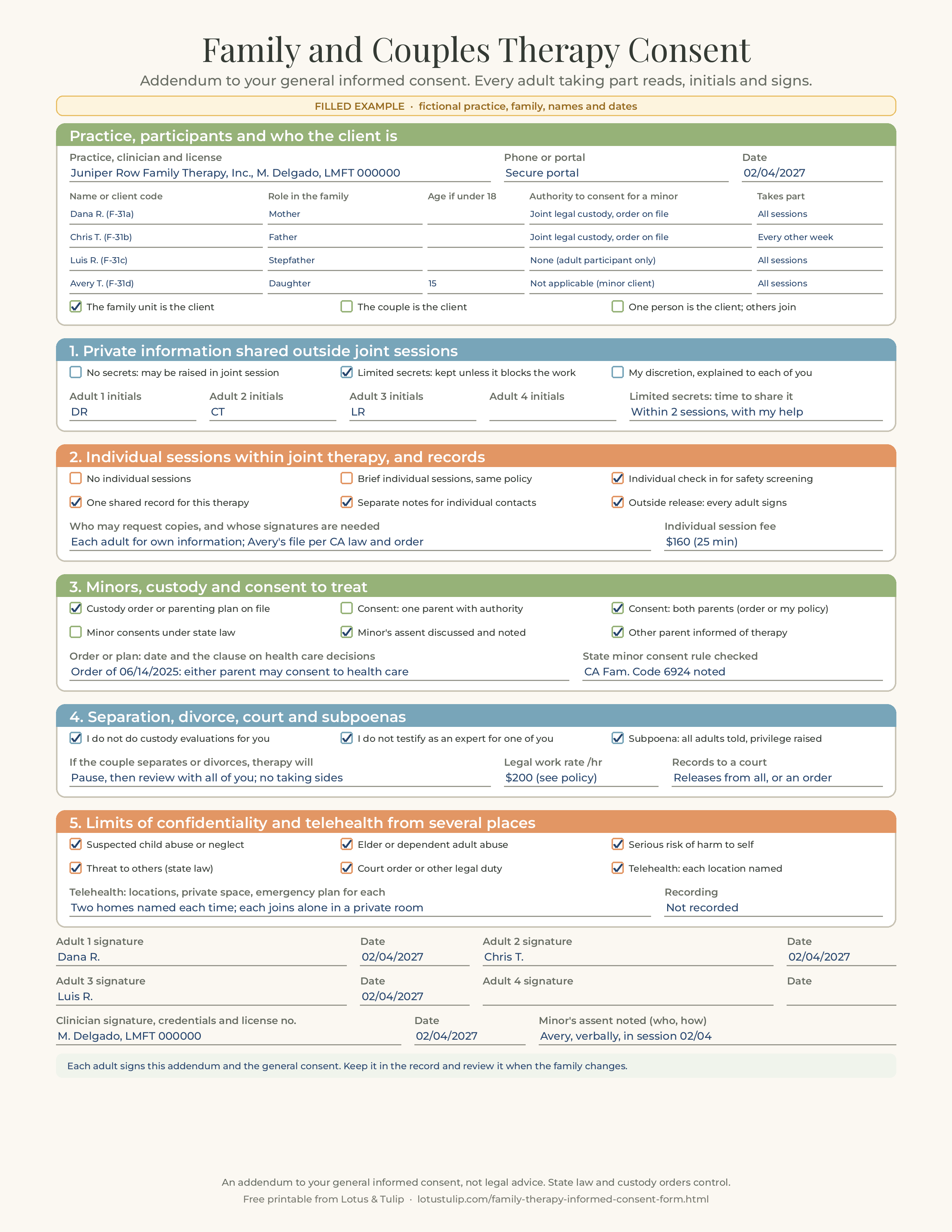
Juniper Row Family Therapy, Inc. is a fictional group practice in California. M. Delgado, LMFT, is seeing the R. and T. family: Dana R. (mother), Chris T. (father, who lives separately and shares joint legal custody), Luis R. (Dana's husband and Avery's stepfather) and Avery T., 15. Dana and Chris both have authority under their fictional custody order to consent to health care for Avery; the practice's own policy is to ask both parents to sign. Here is the addendum's wording; the filled form on page 2 of the free printable shows the same choices in form format.
Family therapy consent addendum. This addendum adds to the general informed consent each of you received. Please read it, ask me anything, and initial and sign where shown.
Who my client is. My client is your family as a group. I work with the relationships among you, not on behalf of any one of you. For insurance, Avery is listed as the identified patient and a diagnosis for Avery will appear on claims.
Who is taking part. Dana R. (mother), Chris T. (father), Luis R. (stepfather) and Avery T. (15). Dana and Chris share legal custody under an order dated 06/14/2025, which I have read; either may consent to Avery's health care. My own policy is to ask both of you to sign. Luis takes part as an adult family member and consents for himself; he is not consenting for Avery.
Private information. If one of you tells me something privately, I will generally keep it private. If I believe keeping it would seriously get in the way of our family work, I will tell you, and I will help you share it within about two sessions. If you decide not to, I may need to change how we work. I will not share what you told me with the others without your written permission, except where the law requires it.
Individual time. I will meet briefly with each adult alone at the start, to understand your view and check on safety, and I may meet with Avery alone from time to time. These meetings are part of family therapy and the private information policy above applies. If one of you needs ongoing individual therapy, I will help you find another therapist.
Avery's privacy. Dana and Chris, by signing you agree that I will not share the details of what Avery tells me privately. I will tell you about general progress, and I will tell you right away about any serious risk to Avery or anyone else, or anything the law requires me to share. Avery, I will tell you before I share anything with your parents whenever I can. Under California law, a minor 12 or older may in some circumstances consent to outpatient counseling; we have discussed what that means for you.
Records. I keep one family record of our joint sessions and short separate notes of individual contacts. Each of you may have a legal right to ask for information about yourself, and parents may have rights regarding Avery's records under California law and your custody order. I will handle any request as the law requires, protect information about the others as far as the law allows, and tell all of you when a request is made. I will not release information to anyone outside the family, such as a school or a lawyer, without a written authorization from each person whose information would be shared, unless the law requires it.
If the family situation changes. If any of you start or reopen a court case about Avery, or if Dana and Luis separate, family sessions will pause and I will meet with all of you to decide how to continue. I do not do custody evaluations for clients, I will not act as an expert witness for any of you, and I will not recommend where Avery should live. If I receive a subpoena, I will tell each adult, respond only as the law requires, and raise any privilege the law allows. Legal work is billed at $200 per hour as described in my fee policy.
Limits of confidentiality. I must report suspected abuse or neglect of a child or an elder or dependent adult, act if someone is at serious risk of harming themselves or others, and comply with court orders and other legal duties. I am bound to keep what you say confidential; the members of your family are not legally bound in the same way, so I ask each of you to keep what others say in session private, and I cannot guarantee that everyone will.
Video sessions. When Chris joins from his home, I will confirm at the start of each session where each of you is and who is in the room. Each person should be somewhere private. Sessions are not recorded by me, and I ask that none of you record them.
Fees. Family sessions are $180 and individual check ins $160. Dana and Chris have told me they will split fees equally, and invoices go to each of them separately through the portal.
Signatures. Dana R., Chris T., Luis R., M. Delgado, LMFT. Avery's assent: discussed verbally in session on 02/04/2027; Avery agreed to take part and asked about privacy, which we discussed alone.
Every name, date, fee and the custody order above are fictional; your fees, policies and the wording your state requires will differ.
Six short family consent scenarios
1. A parent asks you to keep something from the children
Under a limited secrets policy, Dana calls to say she and Luis are thinking about moving to another state next summer, and asks you not to mention it in front of Avery yet. You remind Dana of the policy, agree it does not need to come into the next session, and offer an individual meeting to plan how and when to tell Avery, given that a move would also involve Chris and the custody order. You note the call in the log as "limited secrets: private for now, plan to share."
2. A teenager discloses self harm
In an individual check in, a fifteen year old says she has been cutting. The confidentiality agreement with parents covers details of private conversations, but not safety. You assess risk, tell her you need to involve her parents, discuss with her how, and then inform the parents with her present if possible. Document the assessment, the disclosure to parents and the plan.
3. The non attending parent wants an update
A father with joint legal custody, who has not attended, calls and asks how his son is doing in family therapy. Check the custody order and your state's rules: California Family Code 3025 and Texas Family Code 153.073, for example, give a parent rights to a child's records that do not depend on having custody or attending sessions. Confirm his identity and authority, consider whether the child's own consent rights or a confidentiality agreement apply, share what the law and the agreement allow, and tell the attending parent that he called.
4. The couple separates and one parent asks for a letter for court
Three months into family therapy, one parent files for divorce and asks you for a letter saying the children are better off with her. You decline, explain that your consent addendum says you will not take sides, do custody evaluations or act as an expert for either parent, and pause family sessions to meet with both parents about next steps. If you receive a subpoena, you follow the process in the addendum and get legal advice.
5. A grandparent brings the child
A grandmother brings her eight year old grandson to a family session and says his mother, who has custody, is working. Check who has authority: a grandparent usually cannot consent to ongoing treatment, though some states, like Texas under 32.001, allow relatives to consent in narrow circumstances when the parent cannot be contacted. If the mother consented to the therapy and agreed in writing that the grandmother may bring him and take part, proceed as agreed; if not, reschedule and call the mother.
6. An adult sibling asks for the family file
After family therapy with three adult siblings about an elderly parent's care ends, one sibling asks for the whole file. Each sibling may have a right to information about themselves, and the record also contains information about the others and the parent. Provide what relates to the requester, consider the reviewable denial grounds for information about other people, document your reasoning, tell the others a request was made, and follow your state's law. AAMFT 2.3's expectation of each individual's written authorization shapes what you release beyond the requester's own information.
Common family consent mistakes
- Using the individual consent unchanged. One client signature line and no secrets policy leave every family question unanswered.
- Not saying who the client is. The question will come up later, usually in a records request or a court case.
- Taking one parent's word about custody. Read the order yourself, every time, and check for newer orders.
- Letting a stepparent or grandparent consent for a child without legal authority. They can participate; they usually cannot authorize.
- A no secrets policy that nobody signed. Under AAMFT 2.2, sharing an individual's confidence needs their prior written permission.
- Promising that nobody will ever see the record without everyone's signature. Federal and state law may give individuals and parents rights you cannot sign away.
- Individual sessions with one parent only. It looks like an alliance, and in a later custody dispute that matters.
- Writing a letter for court for one side. The codes are clear about dual roles; set the boundary in writing before anyone asks.
- Joint sessions before safety screening. See each adult alone first, and do not hold joint sessions that put someone at risk.
- Never revisiting the addendum. Families change: separations, new partners, a child turning 18 or moving out. Review the agreement each time.
Free printable: family and couples therapy consent form, filled example, checklist and log
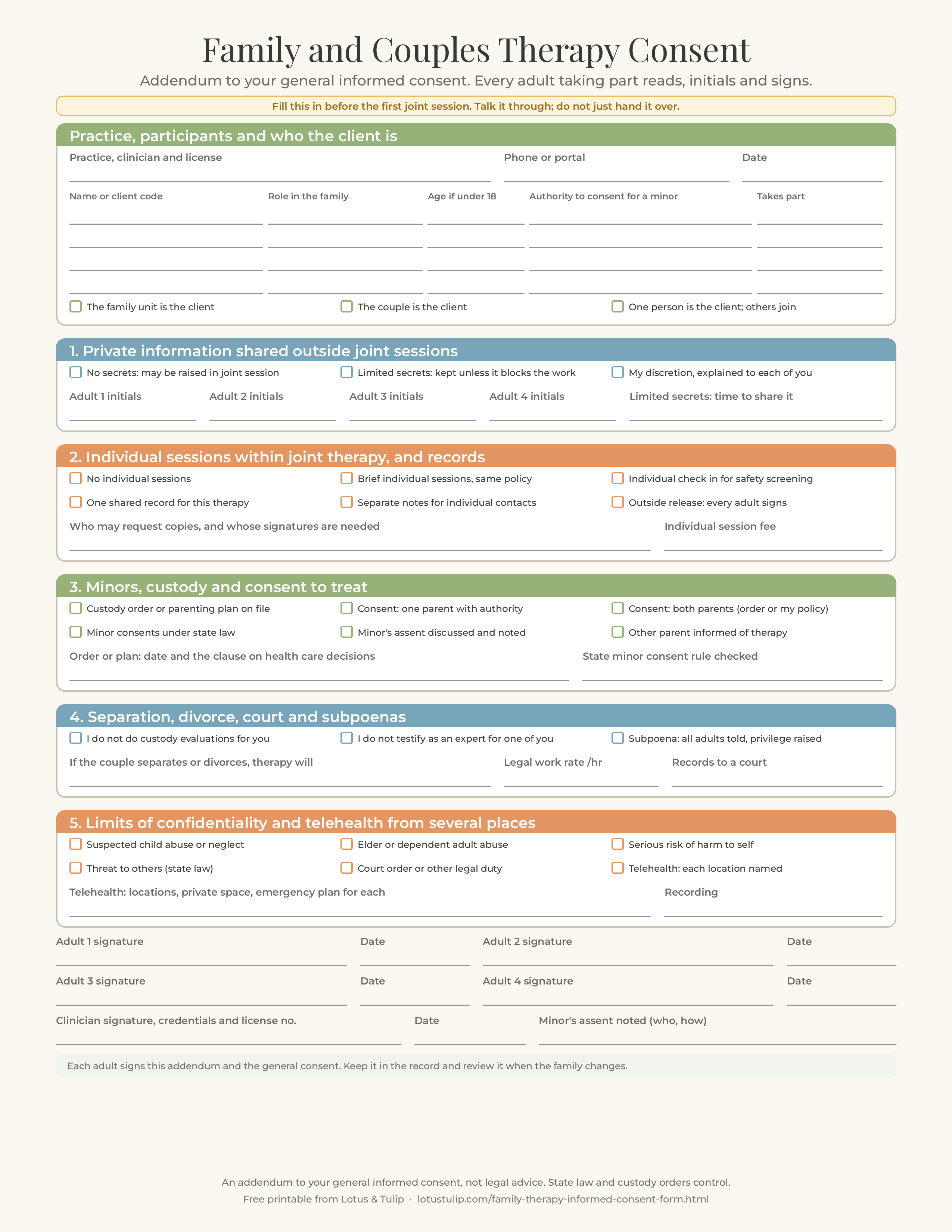
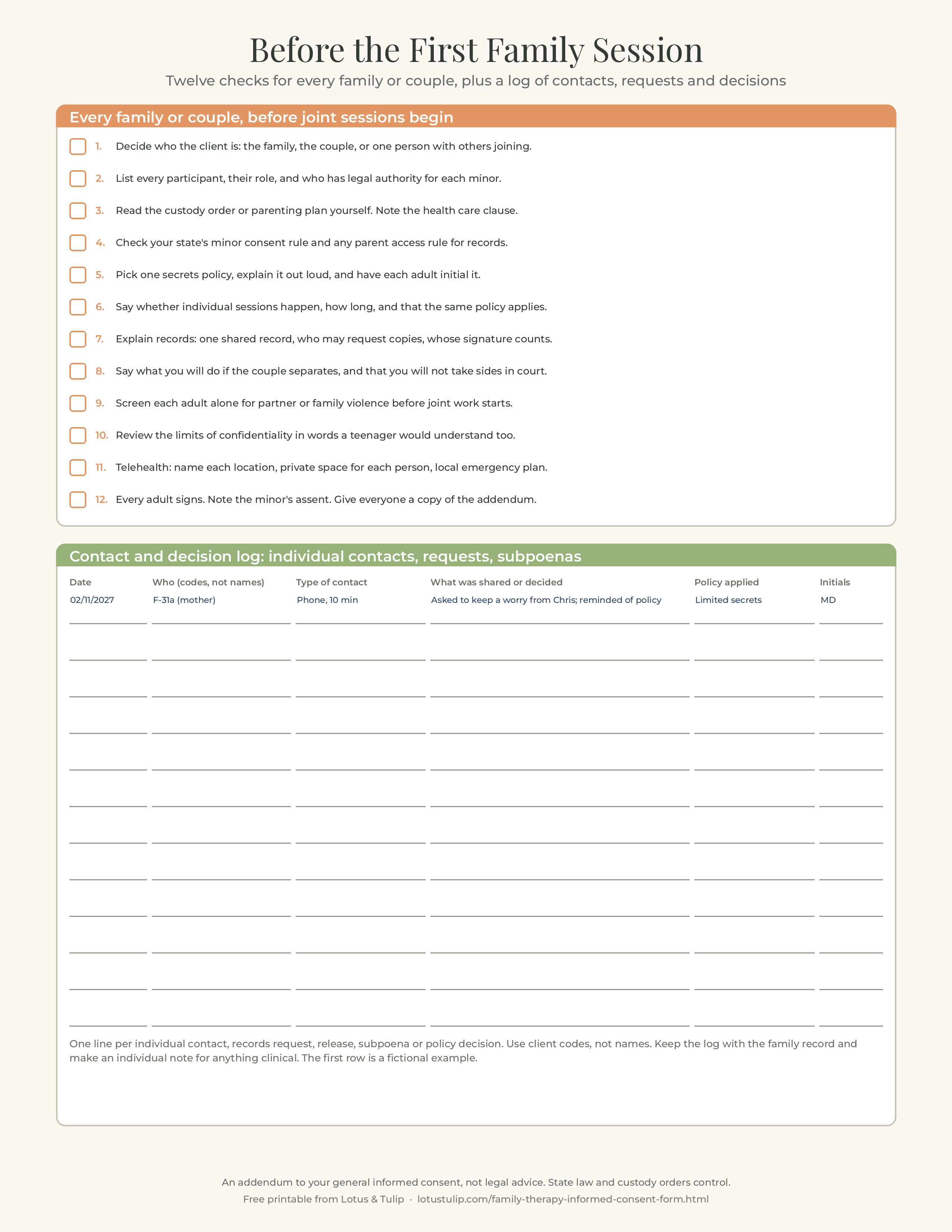
The free printable has three US Letter pages. Page 1 is a blank family and couples therapy consent addendum: practice, clinician and date; a participant table with name or client code, role in the family, age if under 18, authority to consent for a minor and how each person takes part; who the client is (family unit, couple, or one person with others joining); (1) the private information policy with tick boxes for no secrets, limited secrets and therapist discretion, initials for up to four adults and the time allowed under limited secrets; (2) individual sessions within joint therapy and records, including who may request copies and whose signatures are needed; (3) minors, custody and consent to treat, with the custody order, one parent or both, minor consent under state law, assent and whether the other parent was informed; (4) separation, divorce, court and subpoenas, with your stance on custody evaluations and expert testimony and what happens if the couple separates; (5) limits of confidentiality and telehealth from several places; and signature lines for four adults, the clinician and the minor's assent. Page 2 is the same addendum filled in for the fictional Juniper Row Family Therapy example above. Page 3 is a twelve point "before the first family session" checklist and a twelve row contact and decision log for individual contacts, records requests, releases, subpoenas and policy decisions.
Download the free family therapy consent form, example and log (PDF, 3 pages)
Rather type than handwrite? The free PDF above is for printing. Therapy Progress Notes and Intake Templates comes as a fillable PDF you type straight into (604 fields in Adobe Acrobat Reader), plus the printable version: SOAP, DAP and BIRP notes, intake, treatment plan and safety plan, 20 pages. Holiday 20% off: about $7.36, was $9 (EUR 8) · instant digital download
Buy on EtsyPrefer single images? Page 1: blank consent addendum (PNG) · Page 2: filled fictional example (PNG) · Page 3: first session checklist and contact log (PNG)
Free to print and use in your own practice. Please link to this page rather than re-uploading the file. This addendum goes with your general informed consent; it does not replace it, it is not legal advice, and it does not reflect any particular state's minor consent, records or privilege law. Check your state's statutes, your licensing board and the custody order for each minor before using it, and keep signed copies in the record.
Related resources
- Couples therapy informed consent form: no secrets policy, individual sessions and safety screening
- Parental consent form for therapy of a minor, custody orders and state minor consent laws
- Informed consent for therapy template, with a sample consent and free printable
- Psychotherapy notes vs progress notes: what HIPAA says
- Release of information form for therapists
- Telehealth across state lines for therapists
- Telehealth progress note template and examples
- Duty to warn for therapists, by state
- Notice of privacy practices for therapists
- HIPAA breach notification for therapists
- Clinical supervision agreement for therapists
- Parenting worksheets
Sources: AAMFT Code of Ethics (revised, effective January 1, 2026), Standard II introduction and standards 1.2, 1.7, 1.9, 1.10, 1.11, 1.12, 2.1, 2.2, 2.3, 3.4, 3.5, 6.3, 6.6, 7.4, 7.5, 7.6 and 8.2; APA Ethical Principles of Psychologists and Code of Conduct (2002, amended effective June 1, 2010 and January 1, 2017), standards 3.04(a), 3.05(c), 3.10(a) to (d), 4.02, 4.03, 6.04(a), 10.01(a) and 10.02; ACA Code of Ethics (2014), A.2.d, A.8, B.4.b, B.5.a to B.5.c and B.6.e; NASW Code of Ethics, 1.03(c) and (f), 1.06(d), 1.07(e), (f), (g) and (j), 1.08(a) and (c); 45 CFR 164.501 (psychotherapy notes), 164.502(g)(2), (g)(3) and (g)(5) (personal representatives), 164.508 (authorizations), 164.510(b) (involvement in care), 164.522(b) (confidential communications) and 164.524(a)(1), (a)(3), (a)(4) and (b)(2) (right of access), eCFR text as in effect on November 10, 2026; California Family Code sections 6924 (Stats. 2023, ch. 338, AB 665, operative July 1, 2024) and 3025, California Legislative Information; Illinois 405 ILCS 5/3-550 (P.A. 102-558), Illinois General Assembly; Washington RCW 71.34.530, Washington State Legislature; Texas Family Code sections 32.001, 32.002, 32.004, 153.010, 153.073 and 153.132, Texas Constitution and Statutes; National Domestic Violence Hotline (thehotline.org). Laws and codes change; check the current versions.
FAQ
Who is the client in family therapy?
Whoever you and the family agree it is, in writing, at the start: usually the family as a unit, sometimes the couple, and sometimes one person (often a child) with other family members joining as collateral participants. The APA (10.02(a)), ACA (A.8 and B.4.b), NASW (1.06(d)) and AAMFT codes all expect this to be clarified at the outset. Under ACA B.4.b, if there is no agreement to the contrary, the couple or family is considered the client.
What is a no secrets policy in family therapy?
A written agreement that anything one family member tells the therapist privately, about matters relevant to the therapy, may be brought into a joint session, usually after the person is given a chance to share it themselves. The alternatives are a limited secrets policy and therapist discretion. For marriage and family therapists, AAMFT standard 2.2 says an individual's confidences must not be revealed to others in the client unit without that person's prior written permission, so a no secrets policy must be agreed and signed before anything is shared. Mandated reporting and safety duties apply whatever the policy says.
Do both parents have to consent to family therapy for a child?
Not always by law. In many situations either parent with legal authority can consent to outpatient therapy, but a custody order can require joint decisions, give one parent exclusive authority or name a provider. In Texas, for example, a sole managing conservator has the exclusive right to consent to psychological treatment unless the order says otherwise. Read the current order yourself, and consider asking both legal parents to sign as a practice policy.
Can a parent who does not attend see the family therapy records?
Often, yes, subject to state law, the custody order and HIPAA. A parent with authority to make health care decisions is usually the minor's personal representative, California Family Code 3025 says a parent may not be denied a child's records because they are not the custodial parent, and Texas gives conservator parents a right of access to psychological records unless a court order limits it. Exceptions include a minor who lawfully consented to their own care, a confidentiality agreement the parent agreed to, and a professional judgment that access is reasonably likely to cause substantial harm.
Can I write a custody letter for one parent after family therapy?
Generally no. The AAMFT code says marriage and family therapists must not provide custody evaluations for current or former therapy clients unless mandated by law or judicial order, and must not act as expert witnesses for current or former clients unless mandated by legal systems. The APA and NASW codes warn against the same conflicting roles. Put this in your consent addendum before anyone asks, and get legal advice if you receive a subpoena.
Does each adult in family therapy need to sign the consent form?
Yes, in practice. Each adult participant consents to their own participation and to the secrets policy, so each should sign the general consent and the family addendum, and initial the secrets policy. A parent or guardian with legal authority also signs for each minor, unless the minor is consenting under state law, and you note the minor's assent.