
Therapist practice · Updated 2026-11-09
Sliding Scale Fee Policy for Therapists: 2026 Poverty Guideline Tiers, Copay Waiver Rules, the Good Faith Estimate and a Filled Example (Free Printable)
Ready-made printable: Therapy Progress Notes and Intake Templates Fillable PDF, 20 pages: SOAP, DAP and BIRP notes, intake, treatment plan and safety plan
Holiday 20% off: about $7.36, was $9 (EUR 8) · instant digital download
Try it free first: download a fillable sample (SOAP note and DAP note, PDF, 226 KB). Type into it on screen, then get the full pack. No email needed.

Most therapists who open a private practice want to see some clients who could never pay the full fee. The trouble starts when the reduced rate is decided in the moment: a kind yes on a first call, a number that feels right, no paperwork, no review date. A year later the practice has eleven clients on eleven different rates, nobody remembers how any of them were set, two clients have had a raise and never mentioned it, and the clinician quietly resents the hours that were meant to be generous. A written sliding scale fee policy fixes that. It decides in advance who qualifies, what each tier pays, how income is checked, how many reduced fee places you can afford, and when the rate is reviewed, so every client is treated the same way and you can keep offering the places for years.
This guide is for counselors, therapists, clinical social workers, marriage and family therapists and psychologists in the US. It covers how to structure a sliding scale, income tiers from the 2026 HHS poverty guidelines (with a ready table), household and income definitions, self attestation versus documents, how many slots to offer, the review interval, what your ethics code says, and the parts that cause real legal trouble: offering a "discount" to insured clients that is really a routine copay waiver, writing a superbill for more than the client paid, and forgetting that sliding scale clients who pay out of pocket still need a Good Faith Estimate. At the end you can download a free three page printable: a blank sliding scale fee policy and agreement with an income tier table, the same policy filled for a fictional practice, and a before you adopt checklist with a sliding scale slot and review log.
Jump to the free sliding scale fee policy template
This is educational information for licensed clinicians and trainees in the US. It is not legal, billing, tax or financial advice, and it does not create any professional relationship. Payer contracts, state law, licensing board rules and federal program rules vary and change. Check them, and have an attorney or your professional association review your final policy. Every practice, clinician, client, fee and figure in the examples on this page is fictional, except the published HHS poverty guideline amounts.
The short answer
A sliding scale fee policy is a short written policy, signed by the client, that explains how a reduced fee is set for clients who cannot afford your full fee. It names the full fee, the reduced fee tiers and who qualifies for each (usually by household size and annual income), what proof of income you ask for or whether you accept a signed self attestation, how many reduced fee places you offer, how often the fee is reviewed, and what the client must tell you if their income changes. It belongs in your intake paperwork next to your informed consent and financial policy.
The rules that matter most in the US:
- Base tiers on something you can explain. Many practices use multiples of the HHS poverty guidelines. For 2026 the guideline for the 48 contiguous states and DC is $15,960 for a household of one and $33,000 for a household of four (HHS ASPE, 2026 Poverty Guidelines). Alaska and Hawaii have higher figures.
- A sliding scale is for self pay fees. If you bill Medicare, routinely waiving or "discounting" a client's coinsurance or deductible is not a sliding scale. HHS OIG has long warned that routine copay waivers can create false claims and anti kickback problems. A waiver after a good faith, individual determination of financial need, not advertised and not routine, is the narrow exception written into federal law (42 U.S.C. 1320a-7a(i)(6)(A)).
- Bill what you actually charge. If a client pays $80 on your sliding scale, the receipt or superbill says $80, not your $150 full fee. Ethics codes require accurate reports to payors (APA 6.06).
- Self pay sliding scale clients still get a Good Faith Estimate. Under the No Surprises Act rule, the "expected charge" for an uninsured or self pay client is your cash rate "reflecting any discounts for such individuals" (45 CFR 149.610). Put the sliding scale rate on the estimate and issue a new one if the rate changes.
- Ethics codes support it and ask for clarity. ACA A.10.c lets counselors adjust fees when legally permissible; NASW 1.13(a) asks social workers to consider ability to pay; APA 6.04(a) asks for fee agreements as early as feasible.
What a sliding scale fee policy should contain
Most sliding scale problems come from something the clinician never decided: who counts in the household, what happens when income rises, whether the reduced rate applies to every service, or what happens when all the reduced places are full. Use this table as a checklist; each item is explained in the sections that follow.
| Element | What to decide | Example wording |
|---|---|---|
| Full fee | Your standard self pay fee for each service, stated in dollars | "The full fee for a 53 minute session is $150." |
| Purpose and eligibility | Who the sliding scale is for, and whether it is open to insured clients who choose to self pay | "Reduced fees are for clients who pay out of pocket and cannot afford the full fee." |
| Tiers | The fee for each tier and the income range by household size | "Tier 2: households from 151% to 200% of the HHS poverty guideline pay $80." |
| Household and income | Who counts in the household and which income counts (gross or net, yearly or monthly) | "Household means you and anyone you support or share finances with. Use total yearly income before tax." |
| Proof or attestation | Documents you ask for, or a signed self attestation, and what you do with them | "You may sign a self attestation. I do not keep copies of tax returns." |
| Which services | Whether the reduced fee covers intake, individual, couples, family and group sessions, and letters or reports | "The sliding scale applies to individual and couples sessions. Letters and reports are billed separately." |
| Number of places | How many sliding scale slots you offer and what happens when they are full | "I hold four sliding scale places. When they are full, I keep a waitlist and share low cost referrals." |
| Review interval | How often the fee is reviewed, and the client's duty to report changes | "We review your fee every six months, and sooner if your income or household changes." |
| Fee changes | How much notice you give before a new fee starts | "If your fee changes, it starts after 30 days' written notice." |
| Insurance and public programs | That the scale is for self pay fees; how Medicare, Medicaid and in-network clients are handled | "If you use insurance, your plan's copay or coinsurance applies. The sliding scale does not replace it." |
| Other policies | How the reduced fee interacts with cancellation fees, the Good Faith Estimate and superbills | "Your Good Faith Estimate and receipts show your sliding scale fee." |
| Agreement | Tier assigned, fee, effective date, next review date and signatures | "Tier 2, $80 per session, effective 11/09/2026, next review 05/2027." |
Should you offer a sliding scale? The honest math
A sliding scale is a decision about money and capacity before it is about values. Burnout from too many low fee hours helps nobody, and quietly closing the scale after a hard year strands clients mid treatment. Do the math once and let the policy carry it.
A fictional example. A clinician sees 24 clients a week at a full fee of $150. If four of those hours become sliding scale places at an average of $85, weekly income drops by four times $65, or $260. Over 46 working weeks that is $11,960 a year before tax. That may be entirely affordable, and it may be the most meaningful part of the week, but it is a real number, and knowing it lets you choose four places instead of drifting into nine.
Questions to answer before you write the policy:
- What is your true cost per clinical hour? Add rent, insurance, licensing, EHR, training, supervision, taxes and unpaid admin time, then divide by the hours you actually see clients. Your lowest tier should be a fee you can keep offering, or be labeled clearly as a pro bono place.
- How many places can you hold? A fixed number (for example 10 to 20 percent of your caseload) is easier to keep than an open ended promise.
- Who are you trying to reach? Students, people between jobs, families with several children, young adults who have lost a parent's plan. The answer shapes your tiers and how you describe the scale in public.
- What else exists locally? Community mental health centers, health centers, university training clinics and low fee programs. Your policy should say what you do when your places are full.
Ethics codes treat reduced fee work as encouraged, not required. APA's General Principle B says psychologists "strive to contribute a portion of their professional time for little or no compensation or personal advantage." The ACA Code (C.6.e, Contributing to the Public Good) says counselors make a reasonable effort to provide services for which there is little or no financial return, and names offering reduced fees as an example. The NASW Code's value of service encourages social workers to volunteer some portion of their professional skills with no expectation of significant financial return (pro bono service). None of them sets a number.
Three ways to structure a sliding scale
There is no official sliding scale for private practice. Choose one you can explain in two sentences.
| Structure | How it works | Strengths | Watch out for |
|---|---|---|---|
| Income tiers (poverty guideline based) | Fee tiers set by household size and income as a percentage of the HHS poverty guidelines | Objective, consistent, easy to update each year, familiar from health centers and public programs | Needs an income figure; the guidelines do not reflect local cost of living outside Alaska and Hawaii |
| Flat income bands | Simple dollar bands (for example under $40,000, $40,000 to $70,000) without household size | Simplest to read on a website | Treats a single person and a family of five with the same income the same way; less fair |
| Fixed reduced rate with limited places | One or two reduced rates (for example $90 and $60) for a fixed number of clients who say they need it | Very simple; easy to hold to a set number of places | Less transparent; you need a clear, written rule for who gets a place so it is not decided by how comfortable a client is asking |
Whatever you choose, write the rule down and use it for everyone. APA standard 3.01 bars unfair discrimination based on socioeconomic status, among other factors, and a scale that depends on how a client "seems" invites exactly that. A clear rule also protects you: when a client asks why a friend pays less, you point to the table.
Building income tiers from the 2026 HHS poverty guidelines
The HHS poverty guidelines are published each January by the Office of the Assistant Secretary for Planning and Evaluation (ASPE) and are used to set eligibility for programs such as Head Start, SNAP, the National School Lunch Program and the Children's Health Insurance Program. They are designated by the year they are issued, so the figures below are the 2026 guidelines. HHS notes that, because the October 2025 federal government shutdown meant no CPI-U was published for that month, the 2026 calculation compared the average CPI-U for 11 available months of 2025 with all 12 months of 2024.
2026 HHS poverty guidelines (annual household income):
| Persons in household | 48 contiguous states and DC | Alaska | Hawaii |
|---|---|---|---|
| 1 | $15,960 | $19,950 | $18,360 |
| 2 | $21,640 | $27,050 | $24,890 |
| 3 | $27,320 | $34,150 | $31,420 |
| 4 | $33,000 | $41,250 | $37,950 |
| 5 | $38,680 | $48,350 | $44,480 |
| 6 | $44,360 | $55,450 | $51,010 |
| 7 | $50,040 | $62,550 | $57,540 |
| 8 | $55,720 | $69,650 | $64,070 |
| Each additional person | add $5,680 | add $7,100 | add $6,530 |
Source: HHS ASPE, 2026 Poverty Guidelines (aspe.hhs.gov). Check for the new figures each January and update your table; a policy that still shows last year's numbers is the most common sliding scale error.
A model from federally funded health centers
Private practices are not required to follow any federal sliding scale rule. Federally funded community health centers are, and their rule is a useful reference point. Under 42 CFR 51c.303(f), a health center's schedule of discounts must give a full discount to individuals and families with annual incomes at or below the poverty guidelines, and no discount to those with incomes greater than twice the guidelines, though nominal fees may be collected from people at or below those levels. Many private practices use a wider range, up to 300 or 400 percent of the guidelines, because many clients above 200 percent still cannot afford weekly sessions at full fee.
Worked tiers (48 contiguous states and DC, 2026)
Here are the 2026 income limits at common multiples of the guidelines, rounded to the dollar. The fees on the right are fictional, for a practice with a full fee of $150; set your own.
| Tier (percent of guideline) | 1 person | 2 persons | 3 persons | 4 persons | 5 persons | 6 persons | Example fee |
|---|---|---|---|---|---|---|---|
| Tier 1: up to 150% | $23,940 | $32,460 | $40,980 | $49,500 | $58,020 | $66,540 | $60 |
| Tier 2: 151% to 200% | $31,920 | $43,280 | $54,640 | $66,000 | $77,360 | $88,720 | $80 |
| Tier 3: 201% to 300% | $47,880 | $64,920 | $81,960 | $99,000 | $116,040 | $133,080 | $100 |
| Tier 4: 301% to 400% | $63,840 | $86,560 | $109,280 | $132,000 | $154,720 | $177,440 | $125 |
| Above 400% | Above the Tier 4 limit for the household size | $150 (full fee) | |||||
Each figure is the top of the tier: a household of two with income up to $43,280 is in Tier 2 or below. To find a client's percentage, divide household income by the guideline for their household size and multiply by 100. A fictional client in a household of two with a yearly income of $38,500 is at 38,500 divided by 21,640, or about 178 percent of the guideline, so Tier 2.
Keep the number of tiers small; four or five is plenty, and more tiers only create more boundary arguments. Decide whether your lowest tier is a fee or a fully free pro bono place capped at one or two clients. And decide how to handle high cost areas: the guidelines are national, with separate figures only for Alaska and Hawaii, so in an expensive city you might widen every tier. Write the rule down so you apply it the same way each time.
Defining household and income
Most awkward sliding scale conversations are about definitions, not amounts. Programs that use the HHS guidelines each define household and income in their own rules; a private practice has no single required definition, so choose simple ones and print them on the policy.
Household
A practical definition: "you, plus anyone who lives with you and shares income or expenses with you, plus anyone you support financially." Decide in advance how you treat:
- Adult students. Many practices count only the adult client's own household unless someone else pays the fee.
- Minors. For a client under 18, the household and income are the parent or guardian's, and the person who signs the financial agreement is responsible for the fee.
- Couples and family therapy. One fee per session, set from the combined household if the couple share a household, or from the paying partner's household if they do not. Write which.
Income
Choose one measure and stick to it. Total yearly income before tax is the most common; monthly take home pay also works if the tier table uses the same measure. Say whether you count wages, self employment income, unemployment benefits, Social Security, child support, alimony, pensions, regular help from family and student stipends, and whether you subtract anything (for example, child support paid out). If you take significant debt, medical bills or assets into account, write down how, or you will be making case by case decisions again.
Leave room for judgment, in writing. A policy can say: "If your situation is not captured by this table (for example, a recent job loss, large medical bills or caring for a family member), tell me, and I will consider an exception and note the reason." That sentence keeps the scale humane without turning it back into guesswork, because the exception and its reason are recorded.
Proof of income or self attestation?
You have three realistic options, and each has a cost.
| Option | What the client provides | Pros | Cons |
|---|---|---|---|
| Self attestation | A signed statement of household size and income range | Low barrier, respectful, little sensitive paperwork to store | You rely on honesty; some clinicians find it harder to raise a fee later |
| Attestation with documents on request | A signed statement; a recent pay stub, benefits letter or the first page of a tax return only if unclear | Balanced; documents only when needed | You need a written rule for when you ask, so it is not selective |
| Documents required | A recent pay stub, benefits letter or tax return for everyone on the scale | Most objective | Higher barrier, more sensitive financial data to protect, can feel like an audit at the start of therapy |
Most solo and small group practices use self attestation or attestation with documents on request. If you ask for a document, ask for the least sensitive one, record what you saw ("pay stub reviewed 11/09/2026, consistent with Tier 2") and do not keep a copy without a reason. Protect client financial information as carefully as clinical information.
Whichever option you choose, apply it to every sliding scale client the same way. Asking only some clients for proof is the inconsistency the codes warn against.
How many sliding scale places, and the waitlist
A fixed number of places is the most useful line in the policy: it lets you say yes with confidence and no without guilt. Decide:
- How many places you hold at each tier, or in total. Four places in a caseload of 24, for example, or two places at Tier 1 and three at Tier 2 or 3.
- What happens when places are full. A waitlist, less frequent sessions, a group, or a referral to a community or training clinic.
- How places open. When a sliding scale client finishes therapy or moves to a higher tier, the next person on the waitlist is offered the place, in order.
- Whether existing clients can move onto the scale. A full fee client who loses a job is often a higher priority than a new enquiry. Say so.
Be accurate in public. APA standard 5.01(b) says psychologists do not make false, deceptive or fraudulent statements about their fees, and the same principle applies to every profession: if your website or directory profile says "sliding scale available," it should be true or should say "limited sliding scale places, waitlist may apply." When the places are full, update the profile. Our Psychology Today profile audit for therapists covers how to write fees clearly on a directory listing.
Review interval and fee changes
A sliding scale fee is an agreement for a period, not forever. Write three things into the policy:
- A regular review. Every six or twelve months is common, and many practices also review each January when the new poverty guidelines are published.
- A duty to report changes. "Please tell me if your income or household changes in a way that would move you to a different tier."
- Notice before a fee change. Thirty days of written notice gives the client time to plan.
Stepping a client's fee up is easier when the agreement said from the start that it would be reviewed. It also connects to an ethics duty: APA standard 6.04(d) says that if limitations to services can be anticipated because of limitations in financing, this is discussed with the client as early as feasible. If a client may not be able to continue when the fee rises, talk about it before the rise, not after. Plan options together. If treatment ends because of fees, follow your code's termination standards (APA 10.10(c), ACA A.11.c, NASW 1.17(c)) and see our therapy termination letter template.
Insurance, Medicare and Medicaid: where sliding scales go wrong
A sliding scale is a schedule of self pay fees. Once an insurer, Medicare or Medicaid pays part of the bill, different rules apply, and the instinct to "just take less" can create real legal exposure.
Medicare: a reduced copay is not a sliding scale
If you bill Medicare for a client's sessions, the client owes the Part B deductible and coinsurance. Since January 1, 2024, under section 4121 of the Consolidated Appropriations Act, 2023, marriage and family therapists and mental health counselors can enroll in Medicare and bill it directly, so this applies to more therapists than it used to. Do not treat "I'll only charge you $10 of your coinsurance" as a sliding scale.
The HHS Office of Inspector General's Special Fraud Alert on the routine waiver of copayments or deductibles under Medicare Part B (issued May 1991, reprinted in the Federal Register on December 19, 1994) explains why. Routine waiver of deductibles and copayments by charge based providers "is unlawful because it results in (1) false claims, (2) violations of the anti-kickback statute, and (3) excessive utilization of items and services paid for by Medicare." The alert says providers may forgive the copayment "in consideration of a particular patient's financial hardship," but that the hardship exception "must not be used routinely; it should be used occasionally to address the special financial needs of a particular patient," and that otherwise a good faith effort to collect must be made. Among the warning signs it lists are the "routine use of 'Financial hardship' forms" with no good faith attempt to determine the patient's actual financial condition, advertisements that promise discounts to Medicare beneficiaries, and charges to Medicare beneficiaries that are higher than those made to other people for similar services.
Federal law writes the narrow exception into the civil monetary penalties statute. Under 42 U.S.C. 1320a-7a(i)(6)(A), a waiver of coinsurance and deductible amounts is not treated as prohibited remuneration only if (i) it is not offered as part of any advertisement or solicitation, (ii) the person does not routinely waive coinsurance or deductible amounts, and (iii) the waiver follows a good faith determination that the individual is in financial need, or the amounts could not be collected after reasonable collection efforts.
In practice, for a Medicare enrolled clinician:
- Do not advertise a sliding scale or discount to Medicare beneficiaries.
- Collect the coinsurance and deductible as the rule. Treat any hardship waiver as an individual, documented, occasional decision based on a real look at the client's finances, and keep a record of how you decided.
- Do not set a higher "Medicare fee" than you charge others to make up for waived coinsurance.
- Be careful with your "usual charges." Federal law allows exclusion of a provider who bills Medicare or a state health care program charges "substantially in excess of such individual's or entity's usual charges," unless there is good cause (42 U.S.C. 1320a-7(b)(6)(A)). How a large share of discounted self pay clients affects your usual charge is a technical question; if most of your caseload pays a reduced fee and you also bill Medicare, ask a health care attorney.
- If you have opted out of Medicare, separate private contract rules apply; check them first.
Medicaid
If you are enrolled in your state Medicaid program and see a Medicaid client for a covered service, the Medicaid payment (plus any cost sharing the state allows) is payment in full under 42 CFR 447.15. A sliding scale fee on top of that is not appropriate. If you are not enrolled in Medicaid, whether and how you may see Medicaid members privately depends on your state and plan rules; check them before you offer a sliding scale fee to someone with Medicaid.
Commercial insurance, in network
If you are in network with a plan, your contract sets the allowed amount and usually requires you to collect the member's cost sharing. Many contracts and provider manuals address waivers and discounts, and some restrict self pay arrangements for members; read yours, and if in doubt ask provider relations in writing and keep the answer.
Out of network clients and superbills
Many sliding scale clients have insurance with out of network benefits and want a superbill. The rule is simple: the superbill shows the fee the client was actually charged. If the client paid $80 on your sliding scale, the superbill says $80. Listing your $150 full fee when the client paid $80 misrepresents your charge to the insurer, and APA standard 6.06 requires psychologists to take reasonable steps to ensure accurate reporting of "the fees, charges, or payments" to payors. Our superbill template for therapists walks through every field.
If a client asks for a superbill at the full fee "so the insurance pays more," say no kindly; there is a script below.
The Good Faith Estimate still applies
Sliding scale clients are usually uninsured or self pay, exactly who the No Surprises Act Good Faith Estimate protects. Under 45 CFR 149.610, providers must inform uninsured (or self pay) individuals that a Good Faith Estimate is available and give one when a service is scheduled or requested. "Self pay" includes a client who has insurance but does not want a claim submitted.
The regulation defines the "expected charge" on the estimate as "the cash pay rate or rate established by a provider or facility for an uninsured (or self-pay) individual, reflecting any discounts for such individuals." In other words, the estimate shows the sliding scale fee you agreed, not your full fee. Three practical points:
- Set the tier before you issue the estimate, or issue it at the full fee and replace it once the tier is agreed. The rule requires a new estimate when expected charges change for scheduled services, no later than 1 business day before the services are furnished (149.610(b)(1)(vii)).
- Recurring sessions can be covered by one estimate whose scope is no more than 12 months (149.610(b)(1)(x)). A six or twelve month sliding scale review fits neatly with that cycle.
- Raise fees with a new estimate. If the review moves a client up a tier, give a new estimate with the new fee. A client may start the patient provider dispute resolution process if total billed charges are at least $400 more than the estimate (45 CFR 149.620), so keep estimates current.
Our Good Faith Estimate template for therapists has a free printable and a filled example.
What the ethics codes say about fees and sliding scales
No major code requires a sliding scale, and none sets tiers. They do set expectations about fairness, clarity and honesty that a written policy helps you meet.
| Code | Standard | What it says, in short | What it means for your policy |
|---|---|---|---|
| ACA Code of Ethics (2014) | A.10.c Establishing Fees | Counselors consider the financial status of clients and locality; if usual fees create undue hardship, counselors may adjust fees, when legally permissible, or assist the client in locating comparable, affordable services | A sliding scale or a referral are both recognized responses; "when legally permissible" points to payer and program rules |
| ACA Code of Ethics (2014) | C.6.e Contributing to the Public Good | Counselors make a reasonable effort to provide services for which there is little or no financial return, including offering reduced fees | Reduced fee places are encouraged, not mandated |
| NASW Code of Ethics | 1.13(a) Payment for Services | Fees should be fair, reasonable and commensurate with the services performed; consideration should be given to clients' ability to pay | Ability to pay is an expected consideration |
| NASW Code of Ethics | 1.13(c) | Social workers should not solicit a private fee for providing services to clients who are entitled to those services through the social worker's employer or agency | Do not move agency clients into a private sliding scale practice |
| APA Ethics Code (2002, amended 2010 and 2016) | 6.04(a) to (e) Fees and Financial Arrangements | Agree compensation and billing as early as feasible; fee practices consistent with law; do not misrepresent fees; discuss anticipated financial limits early; give notice before collection steps | Put the tier, fee and review date in writing at intake; plan ahead for fee rises |
| APA Ethics Code | 6.06 Accuracy in Reports to Payors | Accurate reporting of the service, fees, charges and payments | Superbills and claims show the fee actually charged |
| APA Ethics Code | 3.01 Unfair Discrimination; 5.01(b) public statements about fees | No unfair discrimination, including on socioeconomic status; no false or deceptive statements about fees | Apply one written rule to everyone; keep "sliding scale available" accurate |
Marriage and family therapists should also check the AAMFT Code of Ethics and their state board rules on financial arrangements, and every clinician should check state law and licensing board rules, which can add requirements about fee disclosure.
Introducing the sliding scale at the first call and at intake
Clients often find it harder to ask about a reduced fee than to talk about the reason they are calling. A calm, routine process makes it easier for both of you.
- Mention it before they have to ask. On the first call: "My full fee is $150. I also have a limited number of sliding scale places for people who pay out of pocket. Would it help to talk about that?"
- Explain the rule, not your feelings about it, and check first whether they plan to use insurance, Medicare or Medicaid.
- Send the policy and table with the intake packet, with your informed consent, cancellation policy, Good Faith Estimate notice and, if you keep a card on file, a card authorization showing the sliding scale fee.
- Agree the tier before or at the first session, give a copy, issue the Good Faith Estimate at the agreed fee and diary the review date in your scheduling system.
The fee conversation is part of informed consent. APA standard 10.01(a) asks psychologists to tell clients about fees as early as feasible, and the ACA and NASW codes make the same point in their informed consent standards (ACA A.2.b, NASW 1.03(a)). Our informed consent for therapy template has a fees clause you can point to the sliding scale policy from, and the therapy intake form checklist shows where the financial pages fit in the packet.
Scripts for the money conversations
When a client asks for a lower fee on the first call: "Thank you for asking; lots of people do. I have a sliding scale based on household size and income. I'll email you the table and a short form. If one of my sliding scale places is open, we can agree your fee before the first session."
When the places are full: "My sliding scale places are full right now. I can add you to the waitlist, and the wait is usually around [number] weeks. In the meantime, here are two low fee options nearby that may be able to see you sooner."
At the six month review, when income has gone up: "It's time for our fee review. From what you've shared, your household now fits Tier 3, which is $100 per session. That would start after 30 days, on [date]. How does that land for you, and is there anything we should plan for?"
When a client asks for a superbill at the full fee: "I understand why that would help, but I can only list the fee you actually pay. Your superbill will show $80 per session. I'm glad to help you check what your plan reimburses at that amount."
When a Medicare client asks you to waive the coinsurance: "Because I bill Medicare, I'm required to collect the coinsurance as a rule. If paying it is a real hardship, tell me, and we can look at your situation properly together; any exception has to be an individual decision based on your finances."
Documenting sliding scale fees
Keep fee paperwork with your billing and administrative records, not in progress notes. Record:
- The signed policy and agreement, with the version date.
- Household size, the income figure or range the client reported, the method (self attestation, or the document reviewed and the date), and the resulting tier and percentage of the guideline.
- The fee, effective date and next review date.
- Any exception to the table and the reason.
- Each review: what changed, the new tier and fee, the notice date and the date the new fee started.
- For Medicare clients, any hardship waiver, how you assessed financial need and the date.
- The Good Faith Estimate issued at the sliding scale fee, and any replacement estimate.
Keep a simple slot log as well: who holds each sliding scale place, from when, at which tier, and who is next on the waitlist. It turns "I think I have room" into a fact.
How to create a sliding scale fee policy, step by step
- Check the rules that apply to your practice. Read your in-network contracts and provider manuals, the Medicare rules if you are enrolled or opted out, your state Medicaid rules, and any licensing board guidance on fees and fee disclosure.
- Work out your numbers. Calculate your cost per clinical hour, set your full fee, and decide how much reduced fee income you can give up each year.
- Choose a structure and the number of places. Pick income tiers, flat bands or fixed reduced rates, and set how many sliding scale places you hold and what happens when they are full.
- Build the tier table from the current HHS poverty guidelines, using the right column for the 48 states and DC, Alaska or Hawaii, and set a fee for each tier.
- Define household and income, including minors, couples, students and which kinds of income count.
- Decide how income is confirmed: self attestation, attestation with documents on request, or documents for everyone, and how you protect and store what you see.
- Set the review interval and notice rule, and the client's duty to report changes.
- Write the insurance, Medicare, Medicaid, superbill and Good Faith Estimate lines so the policy is clearly for self pay fees and every document shows the fee actually charged.
- Add the agreement section and use it at intake: tier, fee, effective date, next review date and signatures; give a copy, issue the estimate and diary the review.
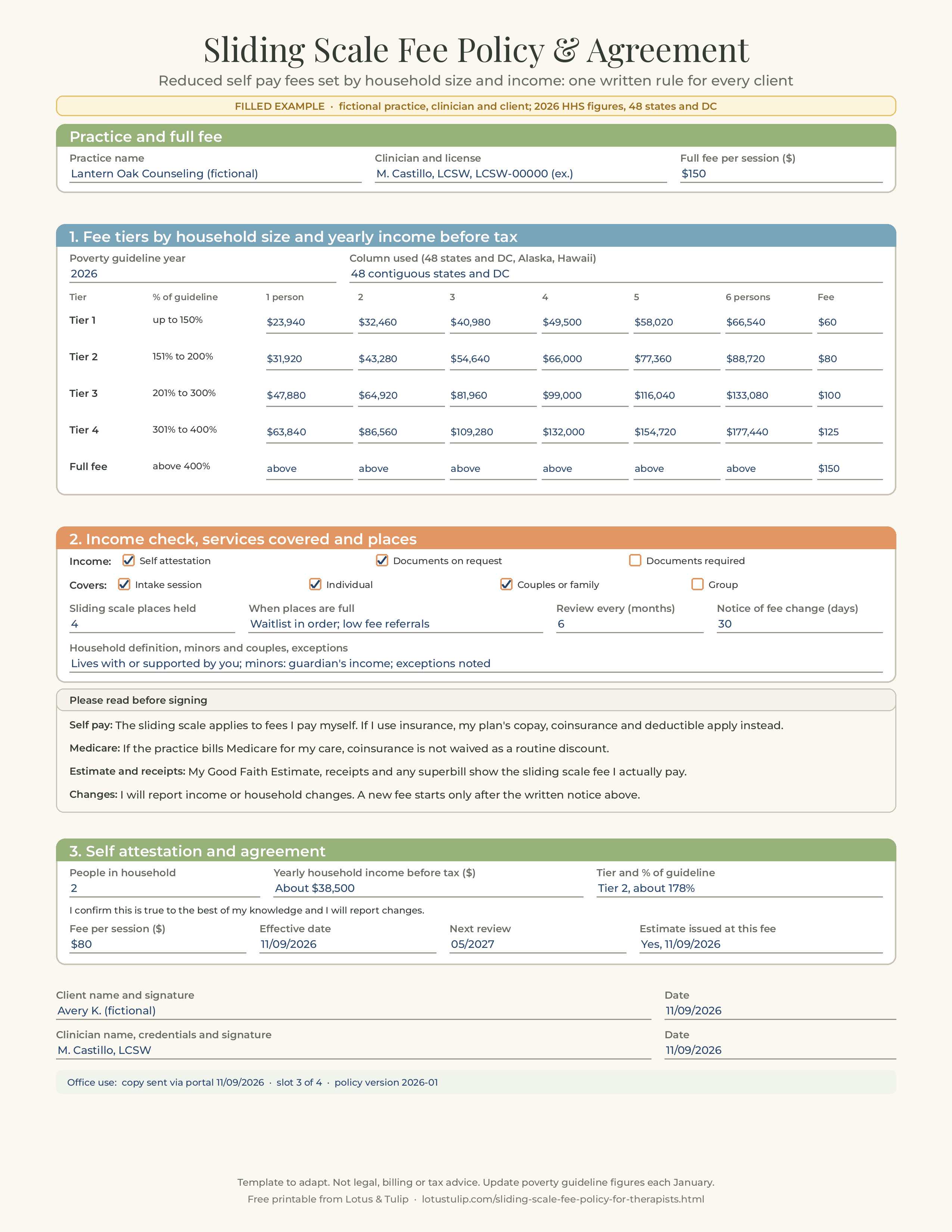
Sliding scale fee policy example (fictional, full)
The fictional clinician M. Castillo, LCSW, runs a small self pay and out of network practice, Lantern Oak Counseling, in one of the 48 contiguous states, with in person and video sessions. The full fee is $150 for a 53 minute session. The practice is not enrolled in Medicare or Medicaid and holds four sliding scale places in a caseload of about 24. The client, Avery K., lives with a partner, has a household income of about $38,500 a year and does not want to use insurance.
Lantern Oak Counseling: Sliding Scale Fee Policy and Agreement
Why this policy exists. I want therapy to be possible for people who cannot afford my full fee. This policy explains how reduced fees work so that everyone is treated the same way and I can keep offering these places over time.
Full fee. The full fee for a 53 minute individual or couples session is $150. The first intake session is the same fee.
Who the sliding scale is for. Reduced fees are for clients who pay out of pocket and cannot afford the full fee. If you use insurance, your plan's copay, coinsurance and deductible apply instead.
Fee tiers. Your fee depends on your household size and total yearly household income before tax, compared with the HHS poverty guidelines for the current year. Tier 1, up to 150% of the guideline: $60. Tier 2, 151% to 200%: $80. Tier 3, 201% to 300%: $100. Tier 4, 301% to 400%: $125. Above 400%: full fee. The income limits for each household size are in the attached table, which I update each January.
Household and income. Your household is you, anyone who lives with you and shares income or expenses with you, and anyone you support financially. Income includes wages, self employment income, benefits, pensions, support payments and regular help from family. For clients under 18, the parent or guardian's household and income are used.
How income is confirmed. You may sign the self attestation below. If the information is unclear, I may ask to see one recent document, such as a pay stub or a benefits letter. I will note that I saw it and will not keep a copy.
Places. I hold four sliding scale places. When they are full, I keep a waitlist in the order people ask and share low fee referrals. Current clients whose income drops are offered the next place first.
Reviews and changes. We review your fee every six months, and sooner if your income or household changes in a way that would move you to another tier. Please tell me if that happens. If your fee goes up, the new fee starts after 30 days' written notice, and we will talk about what that means for your therapy.
Other policies. Your Good Faith Estimate, receipts and any superbill show your sliding scale fee, the amount you actually pay. Missed appointment fees under my cancellation policy are half of your sliding scale fee for a late cancellation and your full sliding scale fee for a no show.
Exceptions. If your situation is not captured by the table, such as a recent job loss or large medical bills, tell me. I will consider an exception and note the reason.
Self attestation. I confirm that my household has 2 people and our total yearly income before tax is about $38,500. The information I have given is true to the best of my knowledge, and I will tell you if it changes.
Agreement. Tier assigned: Tier 2 (about 178% of the 2026 guideline for 2 people, $21,640). Fee: $80 per session. Effective: 11/09/2026. Next review: 05/2027. Good Faith Estimate issued at $80 per session on 11/09/2026.
Client: Avery K. (fictional). Signature: Avery K. Date: 11/09/2026.
Clinician: M. Castillo, LCSW (fictional), License no. LCSW-00000 (example). Date: 11/09/2026. Copy given: via portal, 11/09/2026.
Common sliding scale mistakes
- No written rule. Fees set by feel drift, vary by client and are hard to explain or defend.
- Outdated poverty figures. The guidelines change each January. Update the table and the version date.
- No review date. A crisis rate becomes permanent and raising it feels personal.
- Unlimited places. An open ended promise leads to burnout or to quietly closing the scale mid treatment.
- Using the scale to waive insured clients' copays. For Medicare and many contracted plans, routine waivers are a compliance problem, not a kindness.
- A superbill at the full fee. List the fee the client actually paid.
- No Good Faith Estimate, or one at the wrong fee. Self pay sliding scale clients need one at the agreed rate, replaced when the rate changes.
- Asking only some clients for proof. Use the same confirmation rule for everyone on the scale.
- Advertising a scale that is full. Keep website and directory wording accurate.
- Raising the fee without notice or a conversation. Give written notice and plan for clients who may not be able to continue.
Free printable: sliding scale fee policy template, filled example and before you adopt checklist
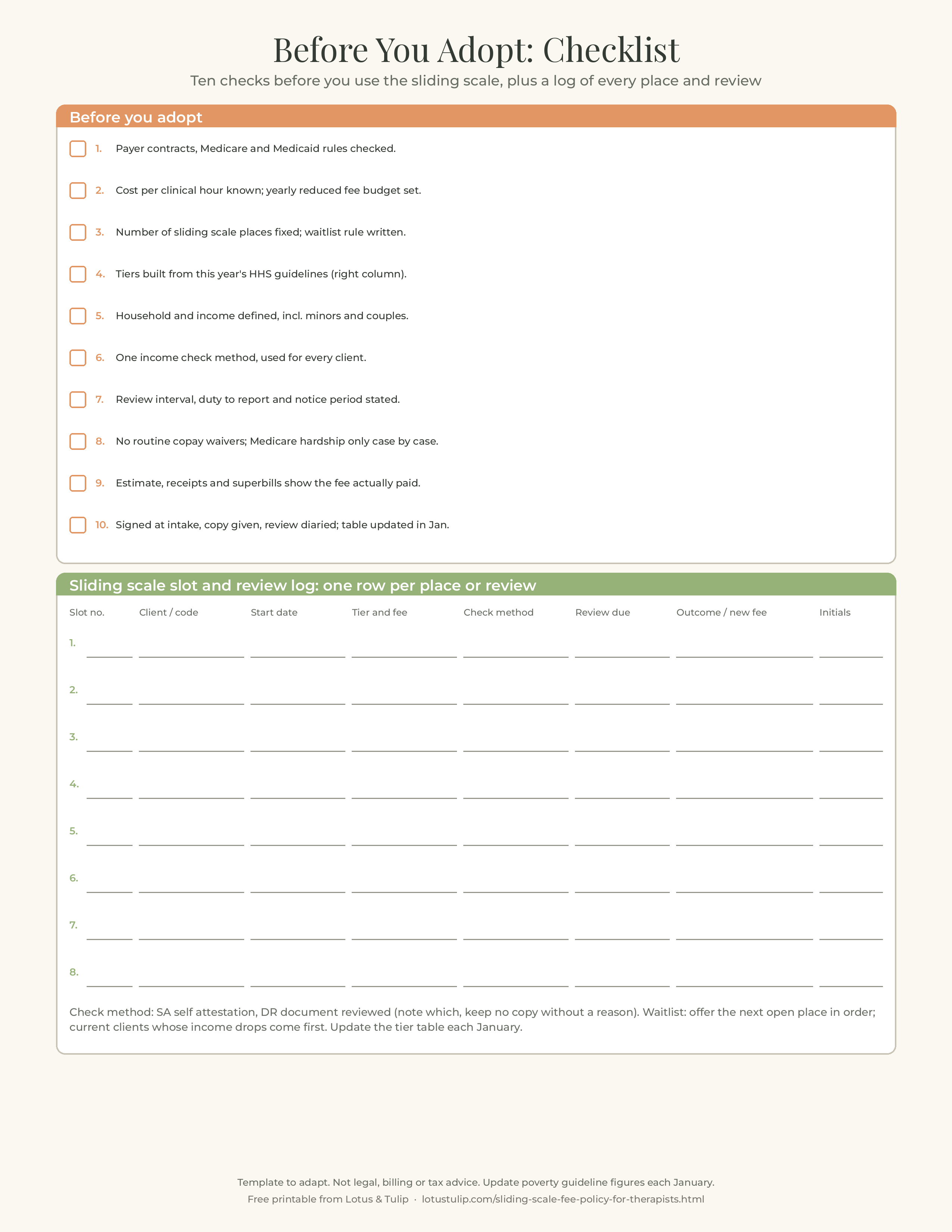
The free printable has three US Letter pages. Page 1 is a blank sliding scale fee policy and agreement: practice details and full fee, a fee tier table by household size (one to six people) with the guideline year, how income is confirmed, which services the scale covers, the number of places, the review interval and notice period, insurance, Medicare, Good Faith Estimate and superbill lines, a client self attestation, the tier and fee assigned with effective and review dates, and signatures. Page 2 is the same policy filled for the fictional Lantern Oak Counseling example, using the 2026 figures for the 48 contiguous states and DC. Page 3 is a ten point before you adopt checklist and a sliding scale slot and review log.
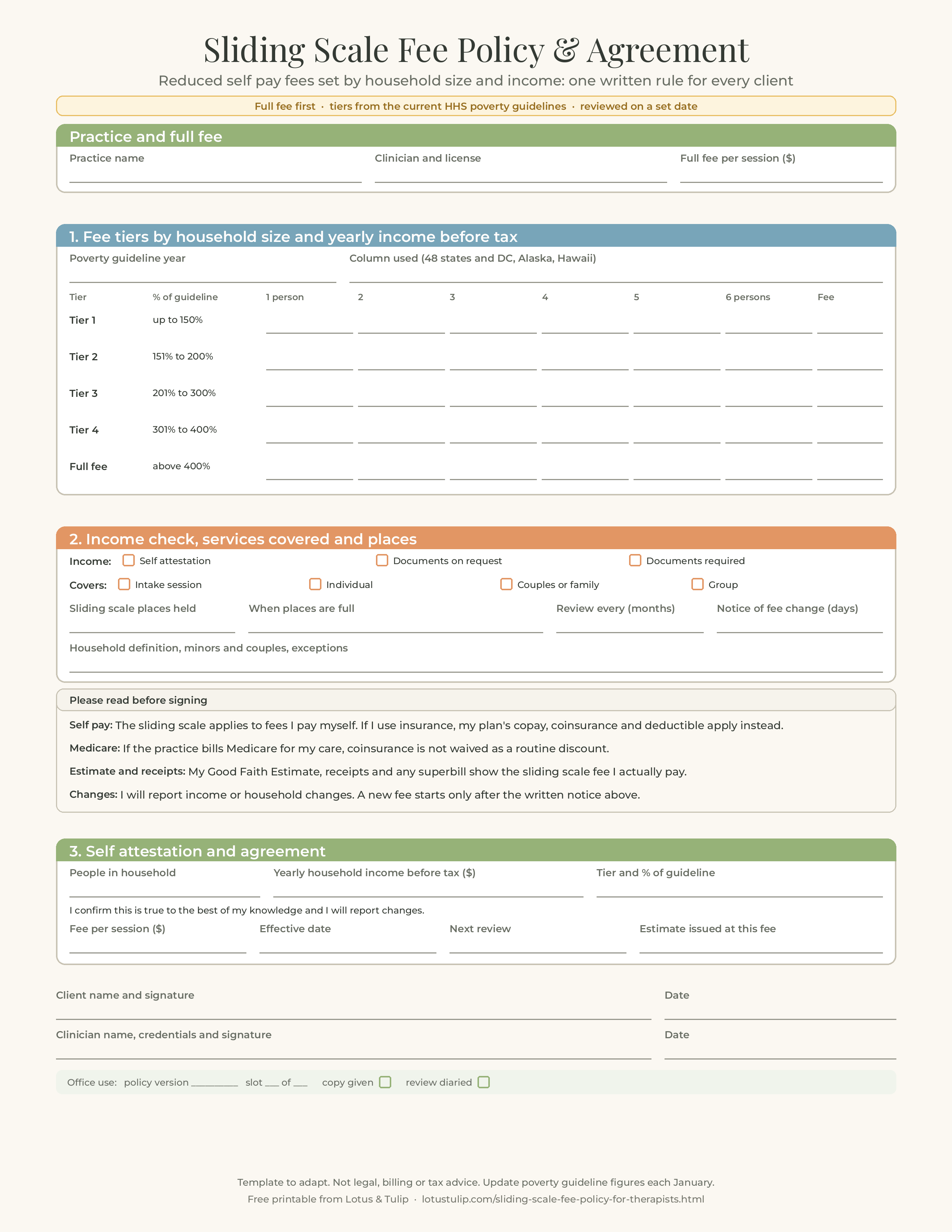
Download the free sliding scale fee policy template (PDF, 3 pages)
Rather type than handwrite? The free PDF above is for printing. Therapy Progress Notes and Intake Templates comes as a fillable PDF you type straight into (604 fields in Adobe Acrobat Reader), plus the printable version: SOAP, DAP and BIRP notes, intake, treatment plan and safety plan, 20 pages. Holiday 20% off: about $7.36, was $9 (EUR 8) · instant digital download
Buy on EtsyPrefer single images? Page 1: blank sliding scale policy and agreement (PNG) · Page 2: filled fictional example (PNG) · Page 3: before you adopt checklist and slot and review log (PNG)
Free to print and use in your own practice. Please link to this page rather than re-uploading the file. The template is a starting point: update the poverty guideline figures each January, check your payer contracts, the Medicare and Medicaid rules that apply to you and your state's licensing and consumer rules, and have an attorney or your professional association review it before use.
Related resources
- Closing a therapy private practice: checklist, timeline, client letters, records plan and free printable
- HIPAA risk assessment for therapists: security risk analysis, filled example and free worksheet
- Business associate agreement for therapists: which vendors need a BAA, breach duties, filled vendor log and free printable
- Professional will for therapists: clinical executor, records custodian, client notification scripts, filled example and free printable
- Couples therapy informed consent form: no secrets policy, individual sessions, records access, safety screening, filled example and free printable
- Treatment summary template for therapists: how to write a treatment summary letter, transfer records under HIPAA, filled example and free printable
- Notice of privacy practices for therapists: HIPAA 164.520 elements, 2026 Part 2 update, filled example and free printable
- Parental consent form for therapy of a minor: who can consent, custody orders, state minor consent laws, HIPAA, filled example and free printable
- Credit card authorization form for therapists: card on file consent, PCI DSS rules, filled example and free printable
- Good Faith Estimate template for therapists: No Surprises Act rules, filled example and free printable
- Superbill template for therapists: every field insurers need, CPT and POS codes, filled example and free printable
- Therapy cancellation policy template: late cancellation and no show fees, Medicare and Medicaid rules, filled example and free printable
- Informed consent for therapy template: what to include, sample consent and free printable
- Therapy termination letter template: sample letters and free printable
- Release of information form for therapists: HIPAA authorization elements, psychotherapy notes, Part 2, filled example and free printable
- What to include in a therapy intake form (checklist)
- Psychology Today profile audit for therapists
- Psychotherapy notes vs progress notes: what HIPAA says, what goes where and free printable
- Therapy treatment plan template with SMART objectives (free printable)
- Therapy progress notes and intake templates
Sources: U.S. Department of Health and Human Services, Office of the Assistant Secretary for Planning and Evaluation, 2026 Poverty Guidelines (aspe.hhs.gov), including the note on the October 2025 CPI-U; 42 CFR 51c.303(f) (community health center schedule of discounts), eCFR current text; 45 CFR 149.610 (Good Faith Estimates for uninsured or self pay individuals) and 45 CFR 149.620 (patient provider dispute resolution), eCFR current text; HHS Office of Inspector General, Special Fraud Alert: Routine Waiver of Copayments or Deductibles Under Medicare Part B (issued May 1991; reprinted 59 FR 65372, December 19, 1994); 42 U.S.C. 1320a-7a(i)(6)(A) (waiver of coinsurance and deductibles); 42 U.S.C. 1320a-7(b)(6)(A) (charges substantially in excess of usual charges); 42 CFR 447.15 (Medicaid payment in full); CMS, Marriage and Family Therapists and Mental Health Counselors (section 4121 of the Consolidated Appropriations Act, 2023, payment from January 1, 2024); APA Ethical Principles of Psychologists and Code of Conduct (2002, amended 2010 and 2016), Principle B and standards 3.01, 5.01(b), 6.04, 6.06, 10.01(a) and 10.10(c); ACA Code of Ethics (2014), standards A.2.b, A.10.c, A.11.c and C.6.e; NASW Code of Ethics, Value: Service and standards 1.03(a), 1.13(a) and (c), 1.17(c), 6.01 and 6.04(a). Payer contracts, federal and state rules and professional codes change and vary; check the current versions.
FAQ
What is a sliding scale fee in therapy?
A reduced self pay fee set by a written rule, usually based on household size and income, for clients who cannot afford the therapist's full fee. A good sliding scale policy states the full fee, the tiers, how income is confirmed, how many reduced fee places exist and when the fee is reviewed.
What are the 2026 federal poverty guidelines?
For the 48 contiguous states and DC, the 2026 HHS poverty guideline is $15,960 for one person, $21,640 for two, $27,320 for three and $33,000 for four, plus $5,680 for each additional person. Alaska and Hawaii have separate, higher figures. HHS publishes new guidelines each January.
Do therapists have to verify income for a sliding scale?
No federal rule requires private practice therapists to verify income for a self pay sliding scale. Many use a signed self attestation, or ask for one document only when the information is unclear. Whatever you choose, apply it the same way to every sliding scale client and protect any financial information you see.
Can I offer a sliding scale to clients who use insurance or Medicare?
A sliding scale is for self pay fees. If you bill Medicare, routinely waiving or reducing coinsurance and deductibles can create false claims and anti kickback problems; the narrow exception is an individual, non advertised waiver after a good faith finding of financial need. In-network contracts usually require you to collect the plan's cost sharing. Check your contracts before offering any discount to insured clients.
Do sliding scale clients need a Good Faith Estimate?
Yes, if they are uninsured or self pay. Under 45 CFR 149.610, the expected charge on the estimate is your cash pay rate reflecting any discounts for such individuals, so the estimate shows the sliding scale fee. Issue a new estimate if the fee changes.
What should the superbill show for a sliding scale client?
The fee the client was actually charged. If the client pays $80 on your sliding scale, the superbill lists $80, not your full fee. Listing a higher fee misrepresents your charge to the insurer.
Is this sliding scale fee policy template free?
Yes. The three page printable (a blank sliding scale fee policy and agreement with an income tier table, a filled fictional example using the 2026 guidelines and a before you adopt checklist with a slot and review log) is free to print and use in your own practice. Please link to this page rather than re-uploading the file, and have it reviewed before use.