
Therapist practice · Updated 2026-11-09
Therapy Cancellation Policy Template: Late Cancellation and No Show Fees, Medicare and Medicaid Rules, and a Filled Example (Free Printable)
Ready-made printable: Therapy Progress Notes and Intake Templates Fillable PDF, 20 pages: SOAP, DAP and BIRP notes, intake, treatment plan and safety plan
Holiday 20% off: about $7.36, was $9 (EUR 8) · instant digital download
Try it free first: download a fillable sample (SOAP note and DAP note, PDF, 226 KB). Type into it on screen, then get the full pack. No email needed.

Every therapist has an empty hour story. The client who texts ten minutes before the session to say they cannot make it. The new client who never shows for the intake. The regular who has missed three of the last six Thursdays and is apologetic every time. A held hour that goes unused is real lost income for a private practice, and a pattern of missed sessions often means something clinically, too. A clear, fair cancellation and no show policy protects both: it tells clients exactly what to expect, it gives you a calm script for a conversation that can feel awkward, and it stops you making up the rules client by client.
This guide is for counselors, therapists, clinical social workers, marriage and family therapists and psychologists in the US. It covers what a therapy cancellation policy should contain (the notice window, the fee, how and when it is charged, exceptions for emergencies, illness and weather, the option to switch to telehealth, repeated no shows and ending services, how clients should cancel, and consent to keep a card on file), how to introduce the policy at intake and in your informed consent, how to document missed sessions in the record, and the insurance realities that trip clinicians up: what Medicare allows, why Medicaid is different, what your in-network contracts may say, and how the policy relates to the Good Faith Estimate. At the end you can download a free three page printable: a blank cancellation and no show policy with an acknowledgment signature, the same policy filled for a fictional practice, and a ten point before you adopt checklist with a missed appointment log.
Jump to the free therapy cancellation policy template
This is educational information for licensed clinicians and trainees in the US. It is not legal, billing or financial advice, and it does not create any professional relationship. State consumer protection law, licensing board rules, payer contracts and public program rules vary and change. Check them, and have an attorney or your professional association review your final policy. Every practice, clinician, client, fee and identifier on this page is fictional.
The short answer
A therapy cancellation policy (often called a late cancellation and no show policy) is a short written agreement that explains how much notice a client must give to cancel or reschedule, what counts as a late cancellation or a no show, what fee applies and how it will be charged, which situations are exceptions, and what happens if sessions are missed repeatedly. It belongs in your intake paperwork, it should be explained in plain language before the first session, and the client should sign or initial it.
The rules that matter most in the US:
- A missed appointment is not a service. Insurers, Medicare and Medicaid do not pay for sessions that did not happen. Never bill a missed session to a payer as if it had taken place, and do not list a missed appointment fee on a superbill as a service.
- Medicare: CMS allows providers to charge Medicare beneficiaries for missed appointments, but only if the same policy and the same amount apply to all patients, Medicare and non-Medicare. Medicare does not pay missed appointment charges, and they should not be billed to Medicare (Medicare Claims Processing Manual, Chapter 1, section 30.3.13).
- Medicaid: CMS guidance says Medicaid policy does not allow providers to bill beneficiaries for missed appointments. Many state Medicaid programs say the same, including for managed care members. Check your state Medicaid rules before you charge anyone with Medicaid coverage.
- Commercial plans and in-network contracts may limit or set conditions on missed appointment fees for members. Read your contracts and provider manuals; do not assume.
- Ethics codes expect fees and billing arrangements, including this one, to be agreed as early as feasible and explained as part of informed consent.
What a cancellation and no show policy should contain
Most disputes about missed session fees come from a gap in the policy, not from the fee itself. A client who knew the window, knew the amount, knew how they would be charged and knew what counts as an exception rarely argues. Use this table as a checklist; each item is explained in the sections that follow.
| Element | What to decide | Example wording |
|---|---|---|
| Notice window | How many hours before the session a client must cancel or reschedule without a fee | "Please cancel or reschedule at least 24 hours before your session." |
| Definitions | What is a late cancellation, a no show and a late arrival | "A no show is a session you miss without letting us know before the start time." |
| Fee amount | A fixed dollar amount for each type, the same for every client it applies to | "Late cancellation: $70. No show: $140." |
| How and when it is charged | Card on file, invoice, or added to the next session; when the charge happens | "We charge the card on file the next business day and email a receipt." |
| Exceptions | Emergencies, sudden illness, unsafe weather, a first time courtesy, clinician discretion | "We waive the fee for genuine emergencies, sudden illness and unsafe travel conditions." |
| Telehealth switch | Whether a client who cannot come in may switch to a video or phone session instead | "If you cannot travel, ask to switch to a video session. Where possible, no fee applies." |
| Late arrivals | Whether the session ends on time and when a late arrival counts as a no show | "Sessions end at the scheduled time. After 15 minutes without contact, we treat it as a no show." |
| Repeated missed sessions | What happens after several no shows or late cancellations | "After two no shows in 90 days, we will meet to review whether this schedule still works for you." |
| How to cancel | Which channels count and what time stamp you use | "Cancel through the client portal or by phone or voicemail. The time we receive the message counts." |
| Insurance and public programs | That insurance does not pay; how Medicare, Medicaid and contracted plans are handled | "Insurance does not pay for missed sessions. We do not charge missed appointment fees to clients with Medicaid." |
| Who is responsible | For minors, couples and families, who pays and who may cancel | "For clients under 18, the parent or guardian who signs this policy is responsible for fees." |
| Your own cancellations | What you do when you cancel, and how much notice you give | "If I need to cancel, I will give as much notice as I can and offer another time." |
| Acknowledgment | Signature, date and, if you keep a card, a separate card authorization | "I have read this policy, had my questions answered and agree to it." |
The notice window
Twenty four hours is the most common window in outpatient therapy, and 48 hours is common in practices with long waitlists or where a held hour is hard to fill. If you have a waitlist and a quick way to message it, 24 hours is enough. If your clients book weeks ahead and you rarely fill last minute openings, a longer window protects more income but asks more of clients.
Two details prevent most arguments. First, say how weekends and holidays work: a Monday 9 am session with a 24 hour window means the deadline is Sunday 9 am. Some practices use "by 5 pm the business day before" instead, which is easier to remember. Second, say which clock counts. If a client in another time zone sees you by video, write the deadline in the client's time zone or name yours explicitly.
Definitions: late cancellation, no show and late arrival
Spell out three terms so nobody has to guess:
- Late cancellation: the client tells you they cannot attend, but with less notice than the policy requires.
- No show: the client does not attend and does not let you know before the session start time.
- Late arrival: the client arrives or logs in after the start time. Most clinicians end the session at the scheduled time and charge the full session fee, because the hour was held. Many also set a cut off, often 15 or 20 minutes, after which an absence counts as a no show. If you start telehealth sessions by calling the client, say how many times you will try.
Decide whether a late cancellation and a no show carry different fees. Many practices charge a partial fee for a late cancellation and the full fee for a no show, which rewards clients for letting you know. Others charge the same amount for both, which is simpler.
The fee amount
State a fixed dollar amount, not "up to" a figure and not "at the therapist's discretion." A fixed amount is easier to explain, easier to apply consistently and easier to defend if a client disputes a charge. Common choices are the full session fee, half the session fee, or a flat amount. Whatever you choose, it must be reasonable for what was lost: a held clinical hour. A fee that is much higher than your session fee looks like a penalty and is likely to cause problems with clients, payers and, in some states, consumer protection rules.
For Medicare beneficiaries there is a specific rule: the amount must be the same as the amount you charge non-Medicare patients (more below). Even where no rule requires it, charging everyone the same is the fairest and safest practice. If you offer a sliding scale, you may set the missed session fee as a percentage of each client's agreed session fee; write that into the policy so it is still a defined amount for each client.
How and when the fee is charged
The three usual methods are a card on file charged after the missed session, an invoice sent by email or the portal, or adding the fee to the balance due at the next session. Write down which one you use, when the charge happens (for example "the next business day"), and that the client will receive a receipt. If you are charging a card on file, see the card authorization section below.
Say what happens if a fee is not paid. The ACA Code of Ethics (A.10.d) asks counselors who intend to use collection agencies or legal measures to include that information in their informed consent documents, to inform clients in a timely fashion of intended actions, and to offer the opportunity to pay. The APA Ethics Code (6.04(e)) similarly requires psychologists to inform the person first and give them an opportunity to make prompt payment. A sentence in the policy covers this: "If a fee remains unpaid for 60 days, we will contact you before taking any further step."
Exceptions: emergencies, illness and weather
Most practices waive the fee for situations a client could not reasonably have planned for. Typical exceptions:
- A medical or family emergency, including a crisis that needed emergency care.
- Sudden illness, especially anything contagious. Many practices offer a video session instead.
- Unsafe travel conditions such as severe weather, or a road closure on the day.
- A first late cancellation or no show, as a one time courtesy, in a defined period such as a calendar year.
- Your own professional judgment, for example when a missed session was linked to the very symptoms you are treating.
Write exceptions in a way that you can apply consistently. "Genuine emergencies" is fine; you do not need proof, and asking for a doctor's note is rarely worth the damage to the relationship. What matters is that the same kind of situation gets the same answer for every client, and that you record each waiver in the log so you can see patterns.
A missed session can also be a clinical signal. Depression, avoidance, trauma symptoms, substance use and chaotic life circumstances all show up as missed appointments. A policy that says the fee may be waived "when we agree the missed session is related to the reasons you are in therapy" gives you room to treat the pattern as material for therapy rather than only as a billing event.
The telehealth switch option
If you offer video or phone sessions, a switch option is one of the kindest and most practical things a cancellation policy can include. A client with a cold, a car that will not start, a sick child at home or snow on the roads can often still attend by video. The policy can say that a client who cannot travel may ask to switch to a telehealth session, and that no fee applies when the session goes ahead.
Three conditions belong in the clause. The client needs to have signed your telehealth consent already. The client must be in a location where you are allowed to practice: in general, licensing rules look at where the client is physically located during the session, so a client who is traveling out of state may not be eligible. And the client needs a private, safe place to talk; a session from a car in a parking lot may be fine, a session while driving is not. If the switch is not possible, the normal policy applies. For documentation of the switched session, see the telehealth progress note template.
Repeated no shows and ending services
Fees alone rarely fix a pattern. A policy works better when it describes a review step: after a set number of missed sessions in a set period (for example two no shows, or three late cancellations, in 90 days), you and the client will meet to talk about what is getting in the way and whether the schedule, frequency, format or fit still works. Options include moving to a different time, switching to telehealth, reducing frequency, a short break, or a referral to a service that fits better.
The policy may also say that continued missed sessions can lead to ending services, as long as you follow your professional obligations when you do. The APA Ethics Code (10.10(c)) asks psychologists, except where precluded by the client's actions or third party payors, to provide pretermination counseling and suggest alternative service providers as appropriate. The ACA Code (A.11.c) allows counselors to terminate when clients do not pay fees as agreed, and asks them to provide pretermination counseling and recommend other service providers when necessary. The NASW Code (1.17(b)) asks social workers to take reasonable steps to avoid abandoning clients who are still in need of services, and 1.17(c) allows termination in fee for service settings for an overdue balance only if the financial arrangements were made clear, the client does not pose an imminent danger, and the consequences have been addressed and discussed. A written policy that the client signed at intake is the first step in making the arrangement clear. For the letter itself, see the therapy termination letter template, which includes a lost contact closing letter.
Never let a missed session go unanswered when there is risk. If the client's last session involved suicidal thoughts, a recent crisis, or a safety concern, a no show is a clinical event first. Reach out promptly, follow your safety plan and emergency contact procedures as your consent allows, and document what you did.
How clients should cancel
List the channels that count: client portal, phone, voicemail, text through your practice number, secure messaging. If you do not monitor a channel (for example a social media inbox or your personal phone), say that cancellations sent there do not count. Say that the time you receive the message is the time that counts, so a voicemail left at 8 pm for a session at 7 pm the next day is within a 24 hour window even if you hear it in the morning.
Minors, couples and families
For clients under 18, the policy should name who is financially responsible, usually the parent or guardian who signs the intake paperwork. Say who may cancel: a teen who consented to their own care under state law may be the one to cancel, while the fee may be owed by a parent. In couples and family work, decide what happens when one person cannot attend. Some therapists hold the session with whoever attends; others treat it as a late cancellation. Write down the choice.
Card on file: consent and safe handling
Keeping a card on file is the easiest way to collect missed session fees, and it is also the part of the policy most likely to cause a dispute if it is vague. Use a separate card authorization, not a sentence buried in the general policy, and make it specific (our credit card authorization form for therapists has a free template that never collects the full card number or security code):
- What may be charged: session fees, copays or coinsurance, and late cancellation and no show fees, each at the amounts in your fee policy.
- When: for example, on the day of each session for session fees, and the next business day for missed session fees.
- Notice: that the client will receive a receipt for each charge, and, if you choose, an advance message before a missed session fee is charged.
- How to change or cancel the authorization: in writing, with any balance owed still due.
- Disputes: who to contact first if the client thinks a charge is wrong.
Store card details only in your payment processor's secure system, not in the clinical record, on paper, or in an email. Card networks and payment processors set their own rules for storing a card and charging it later, so read your processor's terms and use its card on file feature as designed. Your free printable includes a fill in policy and acknowledgment; if you use a card on file, attach your processor's authorization or a separate authorization page with the points above, such as the free card on file authorization template.
Some clinicians worry that charging a card after a missed session will feel cold. A short message before the charge helps: "Hi Sam, I missed you at today's 3 pm session. Per our cancellation policy, the $140 no show fee will be charged to your card on file tomorrow. If something urgent happened, let me know. I hope you are OK, and I look forward to seeing you next Thursday." That message checks in, applies the policy, and leaves room for an exception.
Insurance realities: Medicare, Medicaid and commercial plans
The single most important point: a missed appointment is not a covered service. No session took place, so there is nothing to bill to a health plan. Submitting a claim for a session that did not happen, or coding a no show as a brief session, is a false claim. Missed appointment fees, where allowed, are a matter between you and the client, and payer rules decide whether you may charge them at all.
Medicare
Medicare's position is set out in the Medicare Claims Processing Manual (Pub. 100-04), Chapter 1, section 30.3.13, Charges for Missed Appointments. The policy was introduced by CMS Change Request 5613 (Transmittal 1279, issued June 29, 2007, effective October 1, 2007). It says:
- CMS allows physicians and suppliers to charge Medicare beneficiaries for missed appointments, provided they do not discriminate against Medicare beneficiaries but also charge non-Medicare patients for missed appointments.
- The charge for a missed appointment is not a charge for a service, so the assignment and limiting charge provisions do not apply to it. CMS calls it a charge for a missed business opportunity.
- The amount charged to Medicare beneficiaries must be the same as the amount charged to non-Medicare patients.
- Medicare does not make any payment for missed appointment fees, and charges to beneficiaries for missed appointments should not be billed to Medicare. If they are, the claim is denied (the manual lists claim adjustment reason code 204).
In practice, for a clinician who sees Medicare clients: have one written missed appointment policy that applies to everyone, charge the same amount to everyone, collect it directly from the client, and never put it on a Medicare claim. If you charge a missed appointment fee to non-Medicare clients but quietly waive it for every Medicare client, or the reverse, you are not applying the policy equally. If a beneficiary also has Medicaid, read the Medicaid section below and your state's rules before charging.
Medicaid
Medicaid works differently. In a 2008 resource on Medicaid policy issues (Policy Issues in the Delivery of Dental Services to Medicaid Children and Their Families, September 22, 2008, published on Medicaid.gov), CMS answered the question "May States permit providers to directly bill patients for missed appointments?" this way: current Medicaid policy does not allow for billing beneficiaries for missed appointments, in part because if no service was delivered, no reimbursement is available, and missed appointments are not a distinct, reimbursable Medicaid service but are considered part of providers' overall cost of doing business. The same answer says providers may not impose separate charges on beneficiaries, and notes that managed care organizations may have more flexibility to pay providers directly for missed appointments. The document was written for dental care, but it states general Medicaid policy, and state Medicaid agencies apply the same position across provider types.
The underlying rules are that a Medicaid provider must accept the agency's payment, plus any cost sharing the state plan requires, as payment in full (42 CFR 447.15), and that charges to beneficiaries are limited to the cost sharing the state plan allows. Several state Medicaid agencies have published their own statements. Pennsylvania tells providers they may not bill recipients enrolled in fee for service or managed care for missed appointments. Illinois says any customer who is Medicaid eligible, whether Medicaid is primary or secondary and including managed care, may not be billed a no show fee. Colorado says charging a missed appointment fee to members with no other coverage is not permitted, but that fees may be charged in some circumstances to members who have Medicare or commercial insurance as the primary payer. States clearly differ on clients with dual coverage, so check your state Medicaid rules, your Medicaid managed care contracts and your provider manual before applying any fee to a client with Medicaid. Most practices that see Medicaid clients simply write "We do not charge missed appointment fees to clients with Medicaid coverage" into the policy and handle missed sessions through reminders, the review step and flexible scheduling.
Commercial plans, in-network contracts and EAPs
Commercial insurers do not pay for missed sessions either. Whether you may charge a member a missed appointment fee depends on your contract with the plan, the plan's provider manual, and state law. Some in-network agreements say nothing, some allow fees if a signed policy is on file, and some restrict or prohibit charging members for anything beyond cost sharing. Employee assistance program (EAP) agreements often have their own terms. Read the documents you signed, ask the plan's provider relations team if you are unsure, and keep the answer in writing.
For out of network clients who pay you and seek reimbursement with a superbill, the missed session fee is not a reimbursable service. Keep it off the superbill; list only sessions that actually took place, with their codes. See the superbill template for therapists for what belongs on one.
Insurance and public program checklist for your policy
| Client's coverage | May you charge a missed appointment fee? | What to do |
|---|---|---|
| Self pay, no insurance | Generally yes, if agreed in writing in advance | Apply your written policy; check state consumer law and your board's rules. |
| Medicare | Yes, if the same policy and amount apply to all patients | Collect from the client directly. Never bill it to Medicare. |
| Medicaid (fee for service or managed care) | Generally no under CMS policy | Check your state Medicaid rules and managed care contracts. Most practices exempt Medicaid clients in writing. |
| Medicare and Medicaid (dual eligible) | Varies by state | Check your state Medicaid agency's guidance before charging. |
| Commercial plan, you are in network | Depends on your contract and the plan's provider manual | Read the contract; get written confirmation if unclear. |
| Commercial plan, you are out of network | Usually a matter of your agreement with the client | Keep missed session fees off the superbill. |
| EAP or other third party program | Depends on the program agreement | Check the agreement and tell the client what applies. |
How the policy fits with the Good Faith Estimate
Under the No Surprises Act rules, therapists must give uninsured and self pay clients a Good Faith Estimate of expected charges for scheduled or requested items and services. A missed session fee is not an item or service, so it is not something the client is scheduling. Still, a client reading your estimate and your fee policy should see the same numbers and no surprises. Many clinicians list their late cancellation and no show fees in the financial policy that they hand out alongside the estimate, and some note on the estimate itself that such fees may apply under the signed policy. CMS has not, to our knowledge, published therapist specific guidance on this point, so ask your professional association or attorney how to treat missed session fees in your estimates. For the estimate itself, including timing and required contents, see the Good Faith Estimate template for therapists.
Communicating the policy at intake and in informed consent
Ethics codes treat fees and billing arrangements as part of what clients need to know before they agree to therapy. The APA Ethics Code (6.04(a)) says that as early as is feasible in a professional relationship, psychologists and recipients of services reach an agreement specifying compensation and billing arrangements, and standard 10.01(a) includes fees in what psychologists discuss when obtaining informed consent to therapy. The ACA Code of Ethics (A.2.b) asks counselors to inform clients about fees and billing arrangements, including procedures for nonpayment of fees. The NASW Code (1.03(a)) asks social workers to use clear and understandable language to inform clients of relevant costs as part of informed consent. A missed session fee is a billing arrangement, so it belongs in that conversation.
A process that works:
- Mention it before the first session. On your website, in the welcome email or in the scheduling confirmation: "Our cancellation policy asks for 24 hours' notice. You will find it in your intake paperwork."
- Put it in writing in the intake packet, either as a section of your informed consent or as a separate financial policy page. The informed consent for therapy template shows where fees and cancellations sit in a full consent.
- Ask for a signature or initials next to the policy. A separate acknowledgment line makes it easy to show the client saw and agreed to this specific term.
- Talk it through in the first session. Say the window, the amount, the exceptions and the telehealth option in your own words. Ask whether anything about their schedule (shift work, childcare, a long commute) makes the policy hard to meet, and problem solve before the first missed session, not after.
- Give the client a copy and keep the signed version in the record.
- Remind gently, especially early on. Appointment reminders that include "To cancel without a fee, please let us know by 3 pm tomorrow" teach the policy without lectures.
- Give notice of changes. If you change the window or the fee, tell current clients in writing before the change takes effect (30 days is a reasonable minimum) and ask them to sign the updated policy.
Documenting late cancellations and no shows in the record
A missed session still belongs in the record, even though no service was provided. The entry is short and factual: it documents the appointment, what happened, any contact or risk follow up, and what was done about the fee. It is not a progress note, and it should not read like one. Keep the billing detail factual and neutral; the record may be read by the client, another clinician or a court.
What to record for each missed or late cancelled appointment:
- Date and scheduled time, and format (in person, video or phone).
- What happened: late cancellation (with when and how notice came in), no show, or late arrival past the cut off.
- Reason, if the client gave one, in brief and neutral words.
- Outreach: who contacted whom, when, by which method, and the outcome.
- Risk: whether there were current risk factors and what follow up you did, if any.
- Fee: charged, waived (with the reason, for example "first courtesy" or "illness exception") or not applicable (for example "Medicaid, no fee").
- Next appointment or plan.
Example entries (fictional):
No show, routine: "11/05/2026, 3:00 pm video session. Client did not log in. Called at 3:05 and 3:15, left voicemail asking client to call back; sent portal message. No current risk indicators at last session (10/29). Client replied at 5:40 pm: forgot due to work schedule change. No show fee of $140 charged per signed policy (policy signed 09/12/2026); receipt sent. Next session confirmed 11/12/2026, 3:00 pm."
Late cancellation, exception applied: "11/04/2026, 10:00 am in person. Client called at 8:15 am with fever. Offered video session; client declined due to feeling unwell. Fee waived under illness exception. Rescheduled to 11/06/2026, 10:00 am."
No show with risk follow up: "11/03/2026, 4:00 pm in person. Client did not attend. Last session (10/27) client reported passive suicidal thoughts; safety plan in place. Called at 4:10 pm, no answer; voicemail left. Called emergency contact at 4:40 pm per signed consent; contact reached client, who is safe at home and agreed to call clinician. Client called at 5:20 pm; brief check in, denies current intent or plan, reviewed safety plan, 988 reminder. Fee waived (clinical judgment). Session rescheduled for 11/05/2026."
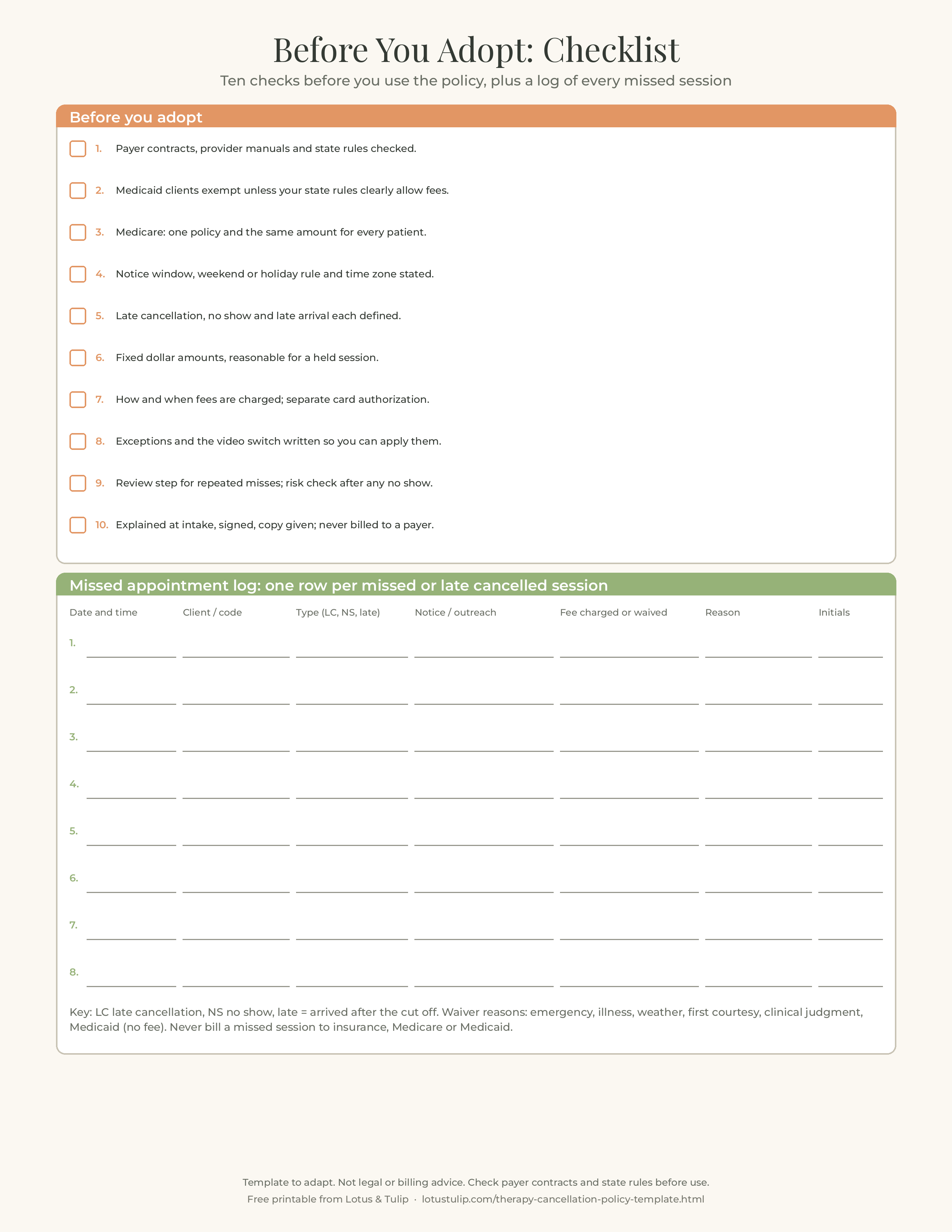
Keep a missed appointment log as well, either in your EHR's attendance report or on paper. It lets you apply the policy consistently, see patterns early and show what you charged and waived if anyone asks. The session log and attendance page in our paid set and page 3 of the free printable both work for this. If a pattern of missed sessions leads to a treatment plan change, record that in the plan review; see the therapy treatment plan template.
How to create a therapy cancellation policy, step by step
- Check the rules that apply to your practice. Read your in-network contracts and provider manuals, your state Medicaid rules if you see Medicaid clients, the Medicare rule if you see Medicare clients, and any state consumer protection or licensing board guidance on fees.
- Choose the notice window. Pick 24 hours, 48 hours or "by 5 pm the business day before," and say how weekends, holidays and time zones work.
- Define late cancellation, no show and late arrival, including how long you wait before a late arrival counts as a no show.
- Set fixed fee amounts that are reasonable for a held hour and the same for every client the policy applies to.
- Decide how and when you will charge (card on file, invoice or next session), and write the unpaid balance steps and your notice before any collection step.
- List the exceptions and the telehealth switch option, with the conditions (telehealth consent on file, client in a location where you can practice, private space).
- Add the review step for repeated missed sessions and what may follow, consistent with your code's termination standards.
- Write the insurance and public program lines that apply: insurance does not pay, Medicare handled equally, Medicaid exempt unless your state allows otherwise, contract terms followed.
- Add an acknowledgment and a separate card authorization, review the policy with each client at intake, give a copy and keep the signed original.
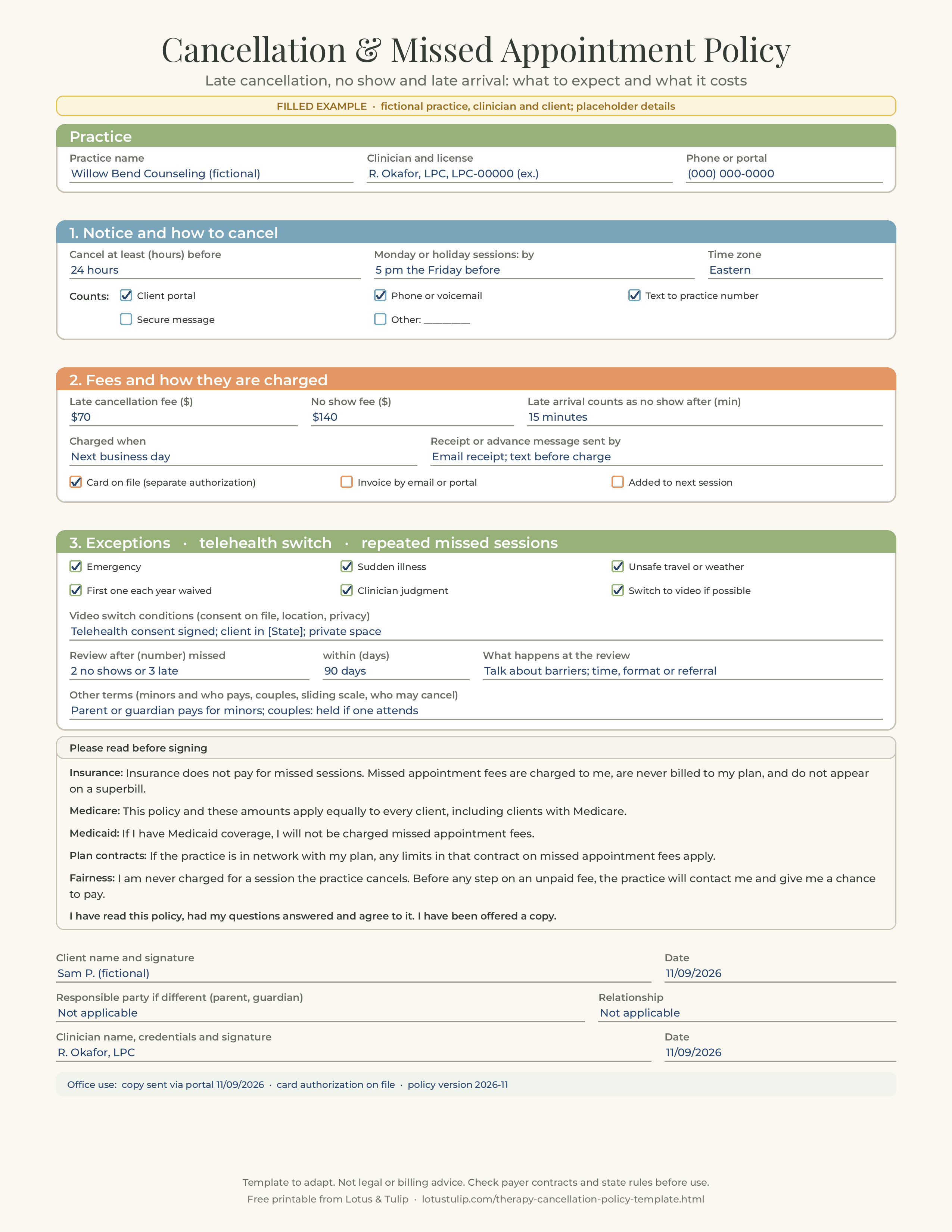
Therapy cancellation policy example (fictional, full)
The fictional clinician R. Okafor, LPC, runs a small self pay and out of network practice, Willow Bend Counseling, with in person and video sessions. The standard session fee is $140 for a 53 minute session. The practice does not participate in Medicaid, but the policy still covers what happens if a client has Medicaid coverage, because clients sometimes gain coverage mid treatment. This is the full policy as clients receive it.
Willow Bend Counseling: Cancellation and Missed Appointment Policy
Why this policy exists. When you book a session, that time is held for you alone. If you cannot attend, I need enough notice to offer the time to someone on the waitlist. This policy explains how cancellations work so there are no surprises.
Notice. Please cancel or reschedule at least 24 hours before your session. For Monday sessions, please let me know by 5 pm on the Friday before. Times are in Eastern Time unless we agree otherwise.
How to cancel. Use the client portal, call or text the practice number (000) 000-0000, or leave a voicemail. The time I receive your message counts. Messages through social media or my personal accounts do not count.
Fees. Late cancellation (less than 24 hours' notice): $70. No show (missed without notice before the start time): $140. If you arrive late, the session still ends at the scheduled time and the full session fee applies. If you have not arrived or logged in and I have not heard from you 15 minutes after the start time, the session counts as a no show.
How fees are charged. Missed appointment fees are charged to your card on file the next business day, under the separate card authorization you signed, and you will receive an email receipt. I will message you before the charge. Missed appointment fees are not covered by insurance and will not appear on your superbill.
Exceptions. I waive the fee for genuine emergencies, sudden illness, and unsafe travel conditions. Your first late cancellation or no show in each calendar year is waived as a courtesy. I may also waive the fee when we agree a missed session is related to what we are working on in therapy.
Switching to video. If you cannot come in, you may ask to switch to a video session at the same time, as long as you are in [State] at the time of the session, are somewhere private, and have signed the telehealth consent. When the session goes ahead by video, no fee applies.
Repeated missed sessions. If two sessions are missed without notice, or three are cancelled late, within 90 days, we will meet to talk about what is getting in the way and whether a different time, format or frequency would work better. If missed sessions continue, we may decide together that another service would fit better, and I will help with referrals.
Insurance and public programs. Insurance does not pay for missed sessions. This policy and these amounts apply equally to all clients, including clients with Medicare. If you have Medicaid coverage, I will not charge missed appointment fees. If your coverage changes, please tell me.
When I cancel. If I need to cancel, I will give as much notice as I can and offer another time. You will never be charged for a session I cancel.
Unpaid fees. If a fee is unpaid for 60 days, I will contact you to talk about it and give you a chance to pay before taking any further step.
Acknowledgment. I have read this policy, had my questions answered, and agree to it. I understand I will receive a copy.
Client: Sam P. (fictional). Signature: Sam P. Date: 11/09/2026. Responsible party if different: not applicable.
Clinician: R. Okafor, LPC (fictional), License no. LPC-00000 (example). Date: 11/09/2026. Copy given: via portal, 11/09/2026.
Scripts for the conversations that feel awkward
Explaining the policy at intake. "One more practical thing. Your session time is held just for you, so I ask for 24 hours' notice if you need to cancel. If you cancel later than that, the fee is $70, and if a session is missed without any notice it is the full $140. If you are ever sick or something urgent comes up, tell me; I waive the fee for real emergencies, and we can often switch to video instead. Does anything about your schedule make that hard?"
Applying the fee for the first time. "I missed you on Thursday, and I hope everything is OK. As we went over at the start, a missed session without notice is charged at the session fee. Since it is your first one this year, I have waived it. From here on, the policy applies as written."
Talking about a pattern. "We have missed a few sessions lately, and I do not want to treat that only as a scheduling issue. Sometimes missing sessions tells us something about how therapy is going or what else is happening. Can we talk about what has been getting in the way, and whether a different time or format would help?"
A client with Medicaid asks why they were not charged. "Medicaid rules do not allow me to charge missed appointment fees, so you will not see one. What I do ask is that you let me know as early as you can if you cannot make it, so I can offer the time to someone who is waiting."
Common cancellation policy mistakes
- Vague amounts. "A fee may be charged" invites disputes. State the dollar amount for each type.
- Applying the policy unevenly. Waiving for clients you like and charging others is unfair, and for Medicare it breaks the equal treatment condition.
- Billing a missed session to insurance. A missed appointment is not a service. Never submit it as one, and never code it as a short session.
- Charging Medicaid clients. CMS policy and many state rules do not allow it. Check your state's rules and exempt Medicaid clients in writing.
- Ignoring your in-network contracts. Read what you signed before you charge a plan member.
- Putting the fee on a superbill. Only sessions that took place belong there.
- A card on file without a specific authorization. Say what can be charged, when, and how the client is notified.
- No exceptions, or exceptions you cannot apply consistently. Name them and log every waiver.
- Not offering the telehealth switch when you could. A video session that goes ahead is better for everyone than a fee.
- Treating a no show as only a billing issue. Check for risk, and talk about patterns in therapy.
- Ending services abruptly over missed sessions. Follow your code: review, pretermination discussion, referrals, a clear letter.
- Changing the policy without notice. Tell current clients in writing before the change and ask them to sign the new version.
Free printable: therapy cancellation policy template, filled example and before you adopt checklist
The free printable has three US Letter pages. Page 1 is a blank fill in cancellation and missed appointment policy: practice details, notice window with weekend rule, how to cancel, late cancellation and no show fee amounts with the late arrival cut off, how and when fees are charged, exceptions with tick boxes, the telehealth switch conditions, repeated missed sessions, insurance and public program lines (Medicare equal treatment, Medicaid, contracted plans), clinician cancellations, unpaid fees, and an acknowledgment with client, responsible party and clinician signatures and a card authorization reference. Page 2 is the same policy filled for the fictional Willow Bend Counseling example on this page, with placeholder details. Page 3 is a ten point before you adopt checklist and a missed appointment log with fee charged or waived and reason columns.
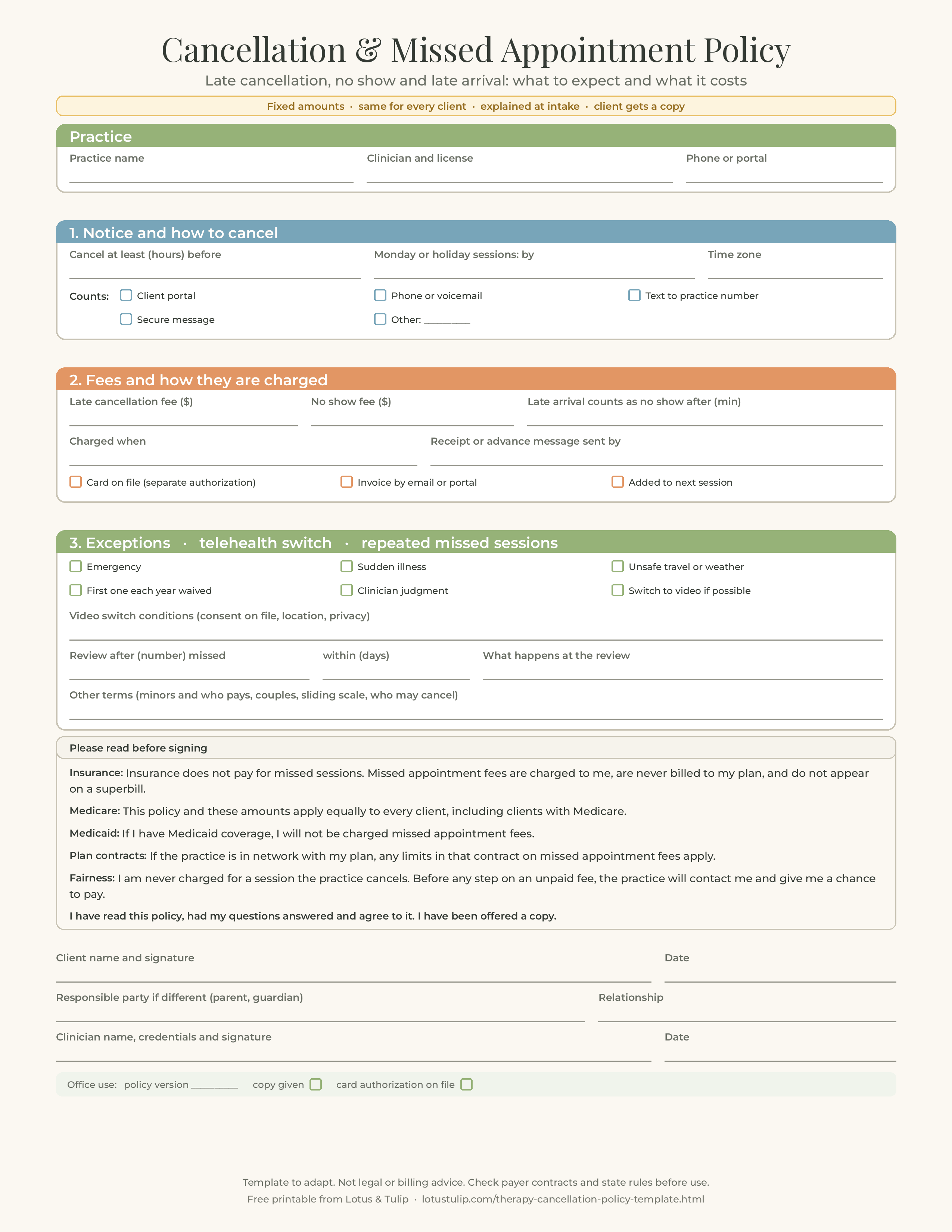
Download the free therapy cancellation policy template (PDF, 3 pages)
Rather type than handwrite? The free PDF above is for printing. Therapy Progress Notes and Intake Templates comes as a fillable PDF you type straight into (604 fields in Adobe Acrobat Reader), plus the printable version: SOAP, DAP and BIRP notes, intake, treatment plan and safety plan, 20 pages. Holiday 20% off: about $7.36, was $9 (EUR 8) · instant digital download
Buy on EtsyPrefer single images? Page 1: blank cancellation policy (PNG) · Page 2: filled fictional example (PNG) · Page 3: before you adopt checklist and missed appointment log (PNG)
Free to print and use in your own practice. Please link to this page rather than re-uploading the file. The template is a starting point: check your payer contracts, your state Medicaid rules and your state's consumer and licensing rules, use a separate card authorization if you keep a card on file, and have an attorney or your professional association review it before use.
Related resources
- Closing a therapy private practice: checklist, timeline, client letters, records plan and free printable
- HIPAA risk assessment for therapists: security risk analysis, filled example and free worksheet
- Business associate agreement for therapists: which vendors need a BAA, breach duties, filled vendor log and free printable
- Professional will for therapists: clinical executor, records custodian, client notification scripts, filled example and free printable
- Couples therapy informed consent form: no secrets policy, individual sessions, records access, safety screening, filled example and free printable
- Treatment summary template for therapists: how to write a treatment summary letter, transfer records under HIPAA, filled example and free printable
- Notice of privacy practices for therapists: HIPAA 164.520 elements, 2026 Part 2 update, filled example and free printable
- Parental consent form for therapy of a minor: who can consent, custody orders, state minor consent laws, HIPAA, filled example and free printable
- Credit card authorization form for therapists: card on file consent, PCI DSS rules, filled example and free printable
- Sliding scale fee policy for therapists: 2026 poverty guideline tiers, copay waiver rules, filled example and free printable
- Informed consent for therapy template: what to include, sample consent and free printable
- Good Faith Estimate template for therapists: No Surprises Act rules, filled example and free printable
- Superbill template for therapists: every field insurers need, CPT and POS codes, filled example and free printable
- Therapy termination letter template: sample letters and free printable
- Release of information form for therapists: HIPAA authorization elements, psychotherapy notes, Part 2, filled example and free printable
- What to include in a therapy intake form (checklist)
- Telehealth progress note template: examples, checklist and free printable
- Psychotherapy notes vs progress notes: what HIPAA says, what goes where and free printable
- Therapy treatment plan template with SMART objectives (free printable)
- Therapy discharge summary template: example and free printable
- Biopsychosocial assessment template: example and free printable
- SOAP vs DAP notes for therapists, with examples
- Therapy progress notes and intake templates
Sources: CMS, Medicare Claims Processing Manual (Pub. 100-04), Chapter 1, section 30.3.13, Charges for Missed Appointments (current text, Rev. 3510), originally issued by Transmittal 1279, Change Request 5613 (June 29, 2007, effective October 1, 2007); CMS, Policy Issues in the Delivery of Dental Services to Medicaid Children and Their Families (September 22, 2008, Medicaid.gov), Question 11.a; 42 CFR 447.15 (acceptance of state payment as payment in full), eCFR current text; Pennsylvania Department of Human Services, Medical Assistance bulletin on billing recipients for missed appointments; Illinois Department of Healthcare and Family Services, Customer Liability and Co Payments Q&A; Colorado Department of Health Care Policy and Financing, Policy Statement: Charging Members for Missed Appointments; APA Ethical Principles of Psychologists and Code of Conduct (2002, amended 2010 and 2016), standards 6.04 and 10.01(a) and 10.10(c); ACA Code of Ethics (2014), standards A.2.b, A.10.d and A.11.c; NASW Code of Ethics, standards 1.03(a), 1.13(a) and 1.17(b) and (c); 45 CFR 149.610 (Good Faith Estimates for uninsured or self pay individuals). Payer contracts, state rules and professional codes change and vary; check the current versions.
FAQ
What should a therapy cancellation policy include?
The notice window, definitions of late cancellation, no show and late arrival, fixed fee amounts, how and when fees are charged, exceptions such as emergencies, illness and unsafe weather, any option to switch to telehealth, what happens after repeated missed sessions, how to cancel, how insurance, Medicare and Medicaid are handled, what happens when the therapist cancels, and an acknowledgment signature. If you keep a card on file, use a separate card authorization.
Can therapists charge for no shows and late cancellations?
Generally yes for self pay clients, when the fee was agreed in writing in advance. For clients with insurance or public coverage, payer rules decide: Medicare allows it if the policy applies equally to all patients, Medicaid policy generally does not allow it, and in-network contracts may restrict it. Missed sessions are never billed to insurance as a service.
Can I charge Medicare patients a no show fee?
Yes, if your missed appointment policy and the amount you charge apply equally to Medicare and non-Medicare patients. The fee is charged to the patient directly. Medicare does not pay missed appointment charges and they should not be billed to Medicare (Medicare Claims Processing Manual, Chapter 1, section 30.3.13).
Can I charge Medicaid clients for missed appointments?
Generally no. CMS guidance states that current Medicaid policy does not allow billing beneficiaries for missed appointments, because missed appointments are not a distinct reimbursable Medicaid service and are considered part of the cost of doing business. State rules for clients with Medicaid as secondary coverage differ, so check your state Medicaid rules and managed care contracts.
How much should a therapist charge for a late cancellation?
Common choices are the full session fee, half the session fee, or a flat amount, often with a lower fee for a late cancellation than for a no show. Choose a fixed amount that is reasonable for a held session, apply it to every client the policy covers, and state it in dollars in the written policy.
Where does the cancellation policy go in my intake paperwork?
Either as a section of your informed consent or as a separate financial policy page in the intake packet, with its own signature or initials. Ethics codes expect fees and billing arrangements to be agreed as early as feasible, so explain it before or at the first session and give the client a copy.
How do I document a no show in the client record?
Write a short, factual entry: date, time and format of the missed appointment, whether it was a late cancellation or no show, any reason given, outreach attempts and outcome, any risk follow up, whether the fee was charged or waived and why, and the next appointment. It is not a progress note, because no service was provided.
Is this therapy cancellation policy template free?
Yes. The three page printable (a blank cancellation and missed appointment policy, a filled fictional example and a before you adopt checklist with a missed appointment log) is free to print and use in your own practice. Please link to this page rather than re-uploading the file, and have it reviewed before use.