
Therapists and counselors · Updated 2026-11-08
ACT Worksheets: Values, Defusion, and Committed Action (with Free Printable)
Ready-made printable: ACT Worksheets for Therapists Fillable PDF, 20 pages: values compass, defusion record, choice point, committed action plan and weekly values tracker
Holiday 20% off: about $9.20, was $12 (EUR 10) · instant digital download
Try it free first: download a fillable sample (values compass and unhooking from thoughts, PDF, 259 KB). Type into it on screen, then get the full pack. No email needed.

ACT worksheets give therapists, counselors and their adult clients a shared way to practice acceptance and commitment therapy skills: making room for difficult inner experiences, unhooking from sticky thoughts, noticing the present moment, contacting a larger sense of self, clarifying values and taking committed action. A good ACT worksheet asks: if you treat this thought as a command, does your life get bigger or smaller? This guide is written for US clinicians in private practice, community mental health, integrated care, college counseling and telehealth. Adults can use the free printable on their own too, ideally alongside a clinician.
You will get core ideas from the hexaflex model, twelve worksheet backed practices, a six session starter table, a nine step HowTo, adaptations, tips, mistakes, myths, three fictional examples, when-not guidance, verified research notes, eight FAQs and a free three page US Letter printable: ACT Care Steps, My ACT Plan and an ACT Practice Log with nine pocket cards.
This page is the adult clinician umbrella. It gathers all six ACT processes into one practical worksheet workflow. For a deep dive on a single skill, see our cognitive defusion worksheet and our ACT values worksheet. Nearby guides cover neighboring treatments rather than the full ACT model: anxiety worksheets, depression worksheets, behavioral activation, trauma worksheets, CBT-I worksheets, ERP worksheets for OCD, the CBT thought record, our self compassion worksheet and the urge surfing worksheet. This page shows how the six processes fit together in session.
We draw on published research and clinical guidance without claiming any affiliation or endorsement, including Hayes, Strosahl and Wilson's ACT model; Hayes, Luoma, Bond, Masuda and Lillis (2006); A-Tjak and colleagues (2015); Ost (2014) and the Atkins, Ciarrochi, Gaudiano and colleagues (2017) response; Gloster, Walder, Levin, Twohig and Karekla (2020); Twohig and Levin (2017); Veehof and colleagues (2011); and NICE guideline NG193. Full citations are in the research notes below. The printable is an original Lotus and Tulip layout.
This guide is educational. Worksheets do not diagnose mental health conditions, do not cure them by themselves and do not replace assessment, therapy, medication or crisis care. They are skill practice aids, not a standalone trial or a manualized ACT protocol. If you or someone you support is thinking about suicide, call or text 988 (Suicide and Crisis Lifeline) or text HOME to 741741 (Crisis Text Line). For immediate danger, call 911.
What ACT worksheets are (and are not)
ACT worksheets are short, structured pages that help an adult notice how they respond to inner experiences and choose a next step that serves a valued life. The best ones are specific. A page that asks "What thought hooked you, what did you do next, and did that move take you toward or away from what matters?" will teach more than vague reflection questions. Useful worksheets capture one real moment: the hook, the move, the value and the cost or gain.
Adults often bring years of practiced control strategies: suppressing worry, arguing with self criticism, avoiding hard conversations or treating every uncomfortable feeling as a problem to solve before life can start. Adult worksheets should use plain grown up language and connect practice to the life the person wants back.
What they are not.
- Not a diagnosis. A flexibility worksheet or a symptom checklist is a starting point for a conversation. Diagnosis requires a clinical evaluation by a qualified professional.
- Not a thought stopping trick. ACT does not try to delete, block or "correct" a thought until it goes away. Defusion changes the person's relationship with the thought so it can be present without running the day.
- Not forcing positivity or "just accept everything." Acceptance in ACT means willingness to have an inner experience when doing so serves a value. It is not approval, resignation or pretending something painful is fine, and it is not accepting harmful situations such as abuse.
- Not a standalone cure printable. Filling in pages does not treat a disorder by itself. The trials summarized later tested structured, clinician delivered ACT, not a three page handout used alone.
- Not a replacement for assessment, therapy, medication or crisis care. Worksheets sit inside care. They do not replace a safety plan, a medical evaluation or a higher level of care when that is needed.
- Not the same as CBT thought challenging or DBT distress tolerance. A CBT thought record often tests whether a thought is accurate and then builds a more balanced alternative. ACT asks whether treating the thought as a rule is workable. DBT distress tolerance helps someone survive a painful moment without making it worse. ACT willingness is in the service of valued action, not only of getting through the peak. The approaches can sit beside each other.
Core ideas that shape good ACT worksheets
The ideas below come from the ACT model developed by Steven Hayes, Kirk Strosahl and Kelly Wilson. Lotus and Tulip is not affiliated with those authors, with the Association for Contextual Behavioral Science (ACBS), with Russ Harris or with any training institute. We describe the model so worksheets have a clear clinical target.
Psychological flexibility. The central aim of ACT is psychological flexibility: contacting the present moment more fully and changing or persisting in behavior when doing so serves chosen values. In plain language, can this person notice what is here, unhook from unhelpful mental rules and take a step toward what matters even when discomfort shows up? Useful pages track towards moves, values contact and workability, not only symptom drop.
The hexaflex: six processes. ACT organizes flexibility around six related processes, often drawn as a hexagon:
- Acceptance or willingness. Making room for thoughts, feelings, urges and sensations instead of spending the day trying to get rid of them. Willingness is a choice in the service of a value, not a demand to like the feeling.
- Cognitive defusion. Seeing thoughts as thoughts (words, pictures, stories) rather than as orders or as literal truth. Our cognitive defusion worksheet is the single skill deep dive.
- Present moment contact. Noticing what is here now (breath, feet, sounds, the person in front of you) instead of living only in rumination or future threat.
- Self as context, or the observing self. Contacting the perspective from which experiences are noticed: "I am the one who notices this anxiety," rather than "I am an anxious person."
- Values. Chosen life directions that can be lived now, such as being a caring partner, a curious learner or a fair colleague. Our ACT values worksheet goes deeper on clarification and action planning.
- Committed action. Building larger patterns of effective behavior in the service of those values, including first steps and the return after a slip.
These six are not six separate therapies. A stuck moment usually involves more than one. Someone who will not make a phone call may be fused with "I will sound stupid," avoiding tightness in their chest and unclear on why the call matters. A worksheet can start at the process that is most workable that day.
Workability, not "is this thought true?" Traditional cognitive work often asks how accurate a thought is and what a more balanced thought would be. That can be useful, and our thought record and cognitive restructuring pages support it. ACT adds a different test: if you buy this thought and let it drive your next hour, does your life work better? A thought can be plausible and still be a poor guide. Using "my presentation might go badly" as a reason to cancel again may be unworkable if contributing at work is a value.
Experiential avoidance is the loop. Much suffering in this model comes from experiential avoidance: trying to escape, suppress or control unwanted inner experiences even when that effort shrinks life. Avoidance often works in the next five minutes and costs something over the next five months. Mapping that loop in the client's own words is often the first time they see control as a strategy with a price.
Towards moves and away moves. A common clinical teaching tool, sometimes called a choice point, asks: when a hook shows up, did the next action move the person toward a value or away from it? Towards and away are about the function of the behavior, not about whether the person felt brave. Calling a friend while anxious can be a towards move. Spending three hours researching symptoms to feel certain can be an away move, even if it feels responsible.
Twelve worksheet backed ACT practices for adults
Each practice below lists what it is, how long it usually takes and a few debrief questions. You do not need all twelve. Most adults do well with four or five chosen to fit the main stuck pattern.
1. Workability and control agenda map
Pick one struggle (worry, shame, pain, urge to isolate). Write what the person has already tried in order to control or get rid of the inner experience, how well each strategy worked in the short term, and what it has cost. End with: "If controlling this feeling were the main project of the next year, what would your life look like?" Fifteen to twenty minutes in session.
Debrief: Which strategy worked fastest in the moment, and which one cost the most over time?
2. Willingness: making room for one inner experience
Choose one sensation, feeling or urge that shows up when the person moves toward a value, such as a tight chest before a conversation. Name it, locate it in the body if that is tolerable, and practice allowing it to be present for one or two minutes while staying with the task. This is not flooding and not a demand to like the feeling. Ten to fifteen minutes, with a clear opt out if distress becomes too high.
Debrief: Did the feeling have to shrink before you could stay? What did willingness make possible that forcing the feeling away would have blocked?
3. Defusion menu
Take one sticky thought and try two ways of holding it more lightly: "I am having the thought that...," saying it slowly, or labeling it as a familiar story. The aim is not to mock the person. It is to see the thought as an event in awareness. Our cognitive defusion worksheet gives a fuller menu and a practice log. Ten minutes.
Debrief: Which method created a little space? Did the thought have to go away before you could choose a next step?
4. Present moment noticing
A brief contact practice tied to a real situation: five things you can see, the feel of your feet, three sounds, or one slow breath out before the next sentence. Use it to come back to the room so values and action are available. Five to ten minutes to choose and rehearse. This can sit beside our 5 4 3 2 1 grounding worksheet, with a different purpose: returning to life, not escaping the feeling.
Debrief: Where does your attention go first when you are hooked? How will you use a ten second reset before a towards move?
5. Observer self / self as context
Help the person notice that thoughts, roles and feelings come and go while a stable observing perspective remains. A simple prompt is: "The thought I noticed was... The feeling I noticed was... The part of me that noticed them is..." Keep this experiential and brief. Ten minutes.
Debrief: Are you the anxiety, or the person who can notice anxiety?
6. Values clarification
Name what matters in a few life areas (relationships, work or education, health, leisure, community). Ask for qualities of action, not trophies: "being present with my kids" rather than "be a perfect parent." Our ACT values worksheet goes deeper if you need more space. Fifteen to twenty minutes, often across two sessions.
Debrief: Which value is most neglected right now? If no one were watching and fear were quieter, what would you do more of?
7. Values versus goals
A two column page. Goals are finish lines (apply for the job, send the apology). Values are directions you can keep living after the goal is met or missed (being a contributor, repairing relationships). Write one value, two goals that express it and one action that would still count even if the goal slipped. Ten minutes.
Debrief: What is one action that would count today, even if the larger goal is delayed?
8. Committed action plan
Turn one value into a specific towards move for the coming week: what, when, where, for how long, and what hook is likely to show up. Include the willingness or defusion skill the person will take along. Keep the first step hard enough to matter and small enough to be doable. Ten to fifteen minutes.
Debrief: Is this a towards move or a hidden away move, such as overpreparing so you never have to start? What would "good enough" look like?
9. Hooks, unhooking and barriers
List the usual hooks (thoughts, feelings, memories, urges) that appear right before an away move. For each hook, write an unhooking response and the towards move that still counts. Put real external limits (no childcare, an inaccessible workplace) in a different column from internal hooks.
Debrief: Which hook is most reliable? Which barrier needs a practical change, not more willingness?
10. Choice point: towards and away
Draw or write a choice point for one recurring situation. In the middle: the hook. To one side: away moves you already know. To the other: towards moves that would express a value. After a real week, record two or three actual choice points. Ten minutes to set up, then between session logging.
Debrief: What did the away move buy you in the next five minutes, and what did it cost by the next day?
11. Weekly review
A one page look back: values contacted, towards moves, hooks, skills used and what to try next. If you use a measure such as the GAD-7 or PHQ-9, record it alongside flexibility, not instead of it. Five to ten minutes.
Debrief: Did life get a little larger, even if the feeling was still there? What is one towards move worth repeating?
12. Setback and values recommitment plan
Write early warning signs that an away pattern is returning (canceled plans, more checking, longer time in bed), the hook that usually arrives with them, and a recommitment step smaller than the original goal. Include who to contact and, when relevant, a safety plan. Ten minutes near the end of a block of work.
Debrief: What is the smallest towards move that would count as beginning again after a slip?
A six session starter plan (skills practice, not a protocol)
This outline is a practical sequence for a first block of ACT informed worksheet work with an adult. It is not a manualized ACT protocol, not a claim that this order has been tested as an RCT and not a substitute for ACT training. Many clients need more sessions. Adjust the order: heavy fusion may need defusion earlier, depression may need values and action sooner, and chronic pain work may spend longer on willingness when eliminating symptoms is not a realistic first goal.
| Session | Focus | Worksheets | Between sessions |
|---|---|---|---|
| 1 | Safety, assessment, the control agenda | Workability and control agenda map | Notice two control strategies and what they cost |
| 2 | Willingness and present moment | Willingness practice, present moment noticing | One brief willingness practice in a real situation |
| 3 | Unhooking from thoughts | Defusion menu, observer self | Log two sticky thoughts and one defusion method |
| 4 | What matters | Values clarification, values versus goals | Notice one value already showing up in small ways |
| 5 | Towards moves | Committed action plan, choice point, hooks and unhooking | Take one planned towards move and log it |
| 6 | Review and recommitment | Weekly review, setback and values recommitment plan | Keep one towards move, book follow-up |
Use a symptom measure when it fits your setting, and also ask whether the person's life got a little larger. A drop in anxiety that comes from more avoidance is not the same as a life being lived.
How to use ACT worksheets, step by step
- Check safety and whether these pages fit. Ask about suicidal thoughts, harm to others, psychosis, mania and immediate medical concerns. If risk is present, use crisis care and a safety plan first. Worksheets wait when safety is in question.
- Assess the stuck pattern, not only the symptom list. Learn what the person has been trying to control, what that control costs and which values have gone quiet. Worksheets are not diagnostic.
- Map workability in one real situation. Trace one recent moment from hook to control strategy to short term relief and longer term cost.
- Practice willingness with one inner experience. Choose a feeling, sensation or urge that shows up on the way toward a value and practice making room for it briefly, with an opt out if needed.
- Practice defusion. Pick one sticky thought and try two ways of holding it more lightly, then see whether a next step becomes available. Use the cognitive defusion worksheet when this skill needs more room.
- Contact the present moment and the observing self. Return attention to the room and notice "I am the one who is noticing this," so the person is not fused with a single story about who they are.
- Clarify values and separate them from goals. Name directions that can be lived now. The ACT values worksheet can carry this step if you want more space on the page.
- Plan and take committed action. Choose one towards move, predict the hook, pick an unhooking skill and do the move in real life. Log what happened.
- Review weekly and plan for setbacks. Keep what helped, write early warning signs and a smaller recommitment step, and return to safety planning if risk appears.
Print the free three page set and keep a stack in your office or share the PDF for telehealth. Page two works well on a phone photo, where the plan is visible when a hook shows up.
Adaptations
Generalized anxiety and other anxiety patterns. ACT worksheets can sit beside exposure rather than replace it. Willingness and defusion often make it more possible to approach a feared situation, and values answer "approach for the sake of what?" When planned exposure is indicated, use an exposure structure. Our anxiety worksheets cover worry time, prediction checks, fear ladders and safety behaviors. ACT does not cancel the need for that work.
Depression. Committed action is not the same as behavioral activation, even though both ask people to do more of what matters. Behavioral activation targets the loop between withdrawal and low mood by scheduling activities and tracking mood, as in our depression worksheets and behavioral activation worksheet. ACT committed action is explicitly values based and expects difficult inner experiences to come along. Use activation for the calendar, and use ACT pages when fusion or avoidance is what keeps the calendar empty.
Chronic pain. Acceptance based interventions for chronic pain have been studied as a group. Veehof, Oskam, Schreurs and Bohlmeijer (2011), writing in Pain, meta-analyzed 22 studies with 1,235 patients and reported controlled effect sizes of 0.37 for pain and 0.32 for depression. That review covered acceptance based approaches, not ACT pages used alone, so do not overclaim. NICE guideline NG193 (2021) says clinicians should consider ACT or CBT for pain for people aged 16 years and over with chronic primary pain, delivered by healthcare professionals with appropriate training. Worksheets here support willingness, values and action when eliminating pain is not the first realistic goal. They do not replace a pain informed assessment or medical care.
OCD. Exposure and response prevention remains the exposure engine for OCD. Do not present ACT worksheets as a substitute for ERP. Defusion and willingness may help someone approach an exposure and refrain from a ritual, but the learning still comes from staying with the obsession without the compulsion. Use our ERP worksheets for OCD when OCD is the main issue.
Trauma. Stabilization comes first. Do not use these pages to force exposure or a detailed trauma narrative. If someone is outside their window of tolerance, start with safety, choice and grounding on our trauma worksheets. Values and present moment work can have a place once the person is steady enough. Never treat acceptance as a reason to stay in an unsafe situation.
Teens. This set is written for adults. For younger clients, start with pages such as anxiety activities for teens and depression activities for teens, and simplify the language (hooks, towards moves, what matters). Self as context and long values lists often need more scaffolding with adolescents.
Telehealth. Share the PDF ahead of time, fill page two together on screen and ask the client to photograph the log before the next session. Confirm the client's location at the start of each session in case crisis help is needed.
When to refer. Refer or consult when risk is elevated, when psychosis or mania may be untreated, when OCD needs structured ERP you are not trained to provide, when trauma processing is needed beyond stabilization, or when symptoms are not shifting after a fair trial.
Tips for therapists and counselors
- Start with the client's value, not with a lecture on the hexaflex. "Be present at dinner" is a better anchor than naming all six processes in session one.
- Do the experiential piece in the room. Reading about willingness is not the same as sitting with a tight chest for sixty seconds while you keep talking.
- Watch your own agenda to make feelings go away. If every worksheet secretly aims at "feel better," you may recreate the control agenda you are trying to loosen.
- Celebrate towards moves, not just calmer ratings. Making the call while anxious counts, even if the anxiety score stayed high.
- Keep metaphors short and check that they landed. A clever image that the client does not recognize will not transfer to Tuesday afternoon.
- Coordinate with prescribers and other providers. Do not change medication advice yourself. ACT pages can sit beside medication, ERP, activation or trauma focused work when roles are clear.
Common mistakes
- Using "acceptance" as a shutdown. "Just accept it" said sharply is another form of control.
- Turning defusion into thought stopping. If success means the thought vanished, you are back in the control agenda.
- Confusing values with goals or with social shoulds. "I should be more productive" may be a fused rule, not a chosen value.
- Assigning too many pages or skipping action. One well used choice point log beats a stack of unread diagrams. Insight about hooks without a towards move can become another way to stay in the head.
- Ignoring context. A person facing discrimination, poverty, inaccessible care or abuse does not need a page that treats every barrier as experiential avoidance.
Myths about ACT and worksheets
- "ACT means giving up." Willingness is not resignation. People often take more action once they stop waiting for inner experiences to disappear first.
- "ACT is anti-CBT." ACT grew from the behavioral tradition. Meta-analyses summarized below generally find ACT better than waitlists or usual care and not clearly superior or inferior to traditional CBT. Many clinicians use tools from both.
- "You must like painful feelings." You do not have to like them or call them gifts. You practice making room for them when doing so helps you live your values.
- "Values are the same as goals." Goals can be finished. Values can be lived on the day a goal is missed.
- "Worksheets alone treat disorders." They do not. They are skill practice aids inside a broader plan that may include therapy, medication, ERP, activation or crisis support.
Three fictional examples
These are fictional composites written for teaching. Names and details are invented.
Example 1 (fictional): Elena, 38, project lead, work anxiety. Elena's control agenda map showed extra rehearsals, skipped meetings, late night slide rewrites and asking a colleague to "just check if this sounds stupid." Each strategy lowered anxiety for an evening and left her less visible at work. Her value was "being a contributor who shares what I know." She practiced a defusion line ("I am having the 'you will freeze' thought") and two minutes of willingness with heat in her face. Her committed action was a five minute meeting update. Her log noted one away move and two towards moves, including answering a question while the hook was still present. The anxiety was still there. Her life at work got a little larger.
Example 2 (fictional): Jordan, 45, low mood after a job change. Jordan had stopped running, cooking and calling friends, waiting to "feel like myself again" first. A thought record helped a little, but the story "nothing I do matters now" kept winning. Values work named caring for their body and staying connected. The values versus goals page separated "run a 10K" from "treat my body as if it matters," a value that could be lived with a ten minute walk. Committed action started with two walks and one text to a friend, alongside an activity and mood log from behavioral activation. After four weeks Jordan was not "cured." They had three towards moves most weeks and less waiting for motivation to arrive first.
Example 3 (fictional): Sam, 29, paused for safety. Sam came in to work on values and social avoidance. In session two their weekly review showed a sharp drop in sleep and hope, and when asked directly they said they had been thinking that other people would be better off if they were gone and had looked up methods. Their clinician paused the ACT worksheets, completed a written safety plan, shared 988 and the Crisis Text Line (text HOME to 741741), assessed for depression and arranged closer follow-up. Values work resumed later, once safety was steadier. The lesson: worksheets wait when safety is in question.
How this page compares to nearby Lotus and Tulip guides
| Guide | Best for | How it differs |
|---|---|---|
| Cognitive defusion worksheet | Unhooking from thoughts | One ACT skill in depth; here defusion is one process in a six process workflow |
| ACT values worksheet | Clarifying values and planning action | Values and committed action in depth; here they sit beside willingness, defusion, present moment and self as context |
| Anxiety worksheets | Worry, panic, exposure | Anxiety cycle, worry time, fear ladders and safety behaviors; use that page when exposure structure is the main need |
| Depression worksheets and behavioral activation | Low mood and withdrawal | Activity scheduling and mood tracking; committed action can sit beside BA but is not the same method |
| CBT thought record | Testing and balancing thoughts | Asks how accurate a thought is; ACT worksheets ask how workable it is as a guide to action |
| Trauma worksheets | Stabilization after trauma | Safety, window of tolerance and grounding first; do not use the ACT umbrella page to force trauma processing |
| ERP worksheets for OCD | Obsessions and compulsions | Exposure and response prevention is the engine; ACT pages are not a substitute |
When not to use these worksheets (or when to refer)
- Acute crisis or suicidal thinking with a plan or intent. Use crisis care first: 988, text HOME to 741741, emergency services or an emergency department, and a written safety plan.
- Possible untreated psychosis or mania. If someone may be in a manic or psychotic episode, they need prompt specialized assessment. Experiential exercises and values worksheets are not the first task. Some ACT research has examined psychotic symptoms in specialized protocols; that is not a reason for a general practice worksheet to stand in for psychiatric care.
- Someone who needs a medical evaluation. New or unexplained physical symptoms, possible withdrawal, or a sudden change in mood, sleep or thinking deserve medical review before they are treated only as hooks.
- Using "acceptance" to stay in abuse or ongoing danger. Anxiety or despair about an abusive partner, stalking or another unsafe situation is not a thinking problem to defuse. Focus on safety planning and resources such as the National Domestic Violence Hotline at 1-800-799-7233 or text START to 88788.
- OCD without a plan for ERP. Do not use ACT worksheets as a way around exposure and response prevention. If you are not trained to provide ERP, refer to someone who is.
- Severe impairment or no progress after a fair trial. If the person cannot work, leave home or care for themselves, or if nothing is shifting after consistent practice, revisit the formulation and consider a higher level of care.
- Outside your scope. Coaches, teachers and peer supporters can use these pages to support someone already in care, but moderate or severe problems should be guided by a licensed clinician with appropriate training.
Free 3 page ACT worksheets printable (US Letter)
Download the free printable, print on US Letter and use it in session or between sessions.
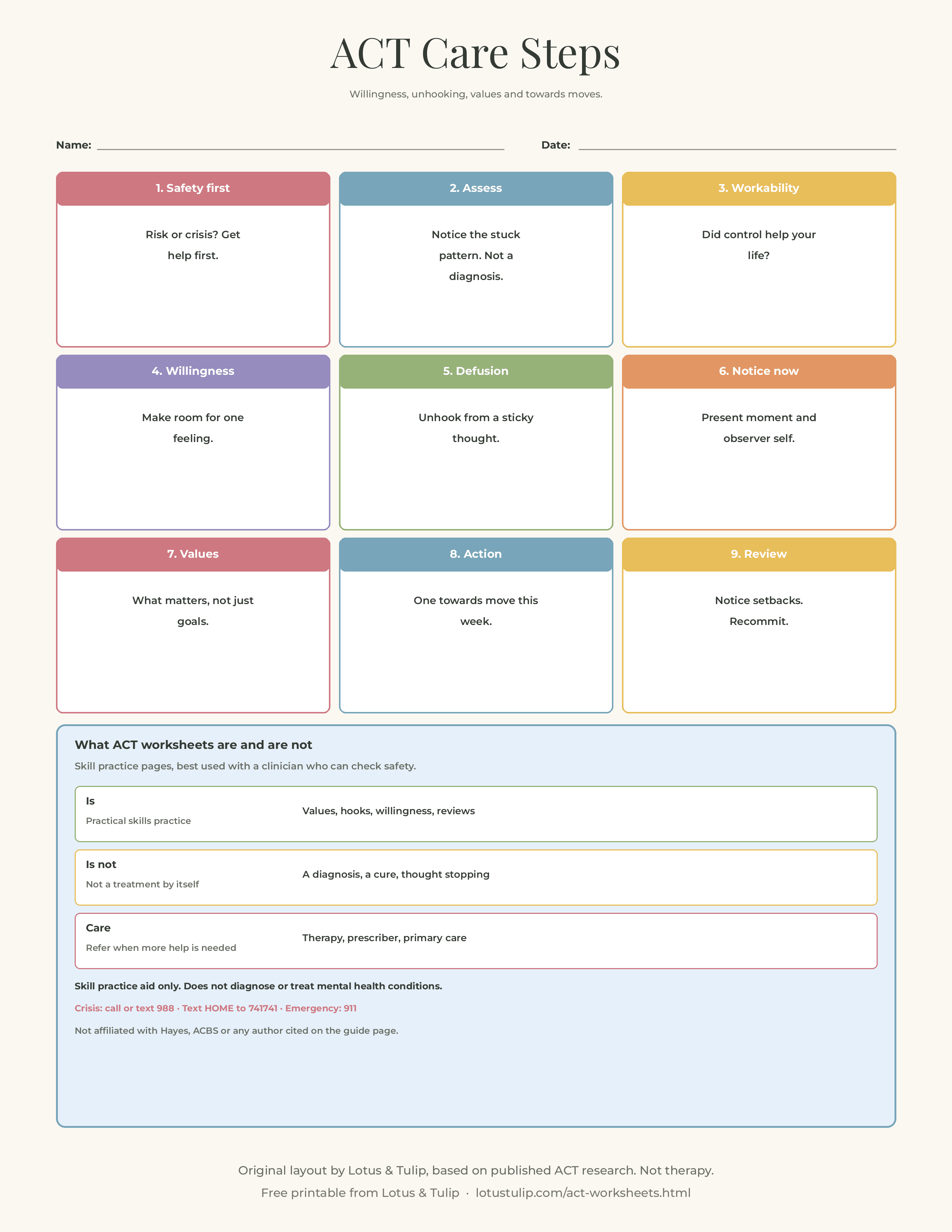
- Page 1: ACT Care Steps. Nine steps that match the HowTo above, what ACT worksheets are and are not, and crisis resources.
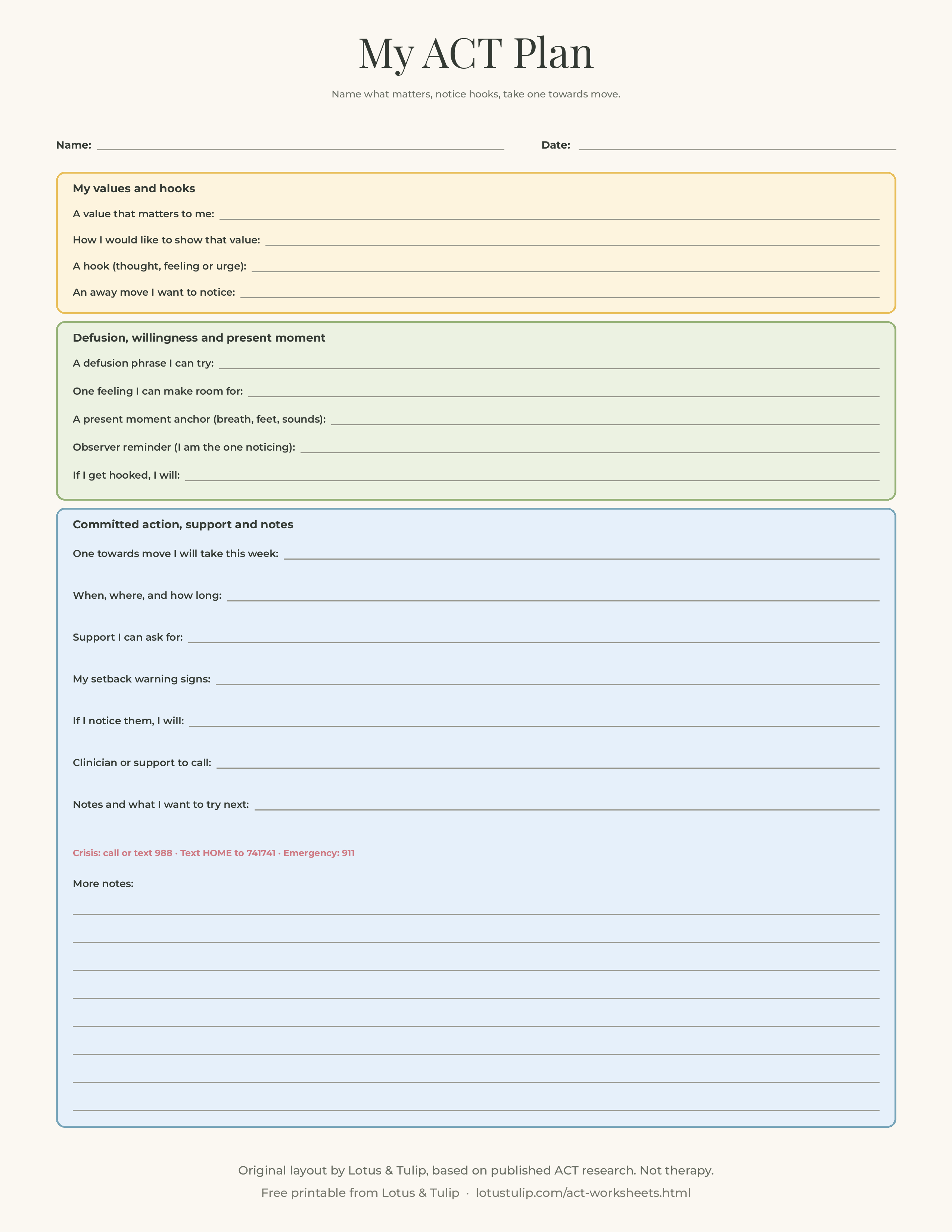
- Page 2: My ACT Plan. Values, hooks, a defusion phrase, willingness, a present moment anchor, a committed towards move, support and notes.
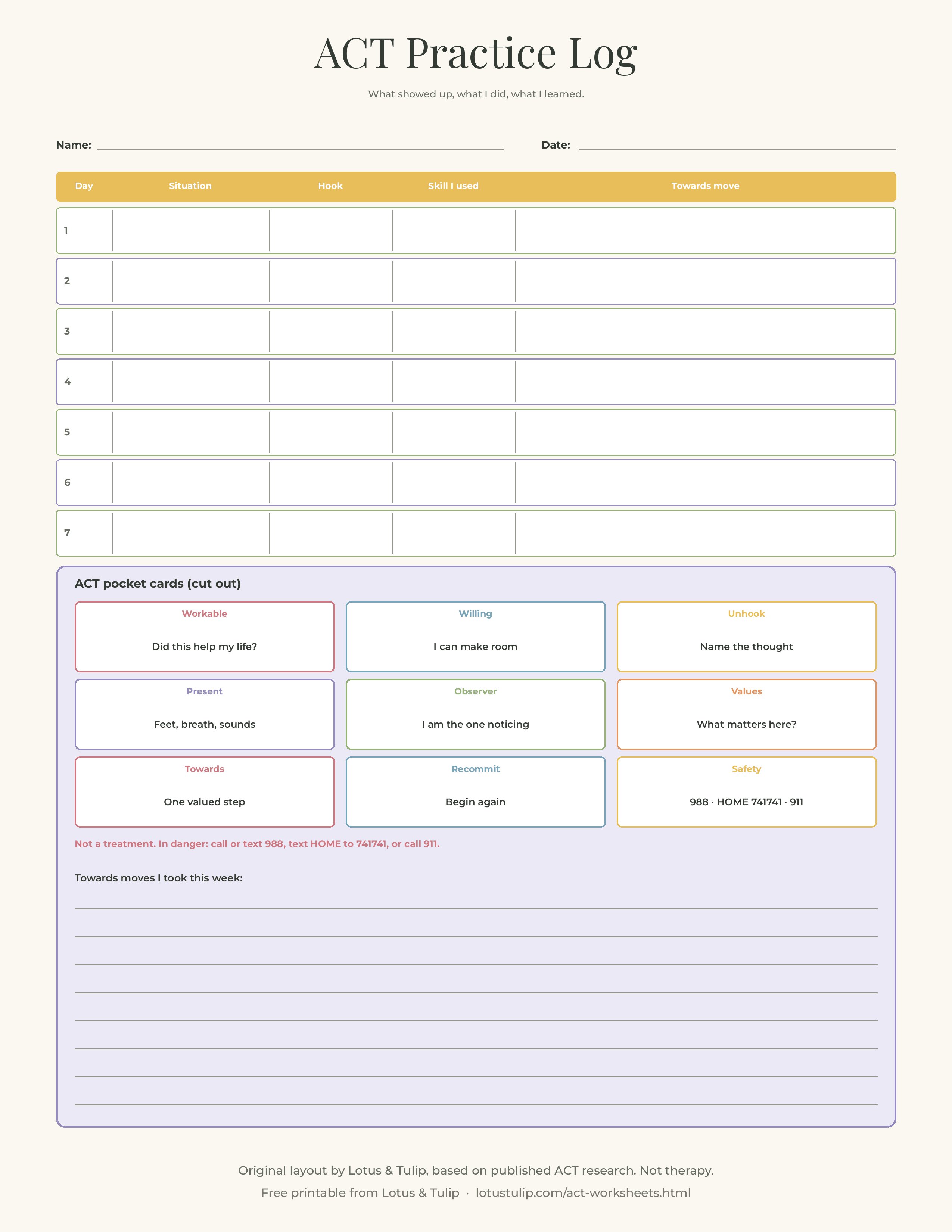
- Page 3: ACT Practice Log. Seven rows for day, situation, hook, skill used and towards move, plus nine pocket cards.
Download free PDF · Page 1 PNG · Page 2 PNG · Page 3 PNG
Research notes (verified, with caveats)
- Hayes SC, Strosahl KD, Wilson KG. Acceptance and Commitment Therapy. The hexaflex model of psychological flexibility (acceptance or willingness, cognitive defusion, present moment contact, self as context, values and committed action) is the source model for the worksheet targets on this page. We describe that model without claiming affiliation or endorsement.
- Hayes SC, Luoma JB, Bond FW, Masuda A, Lillis J. Acceptance and commitment therapy: model, processes and outcomes. Behav Res Ther. 2006;44(1):1-25. Reviews the ACT model and early outcome and process evidence through about summer 2005. The authors concluded that available evidence was broadly supportive, that ACT appeared to work through different processes than traditional CBT in the studies then available, and that there were not enough well controlled studies to conclude that ACT is generally more effective than other active treatments.
- A-Tjak JGL, Davis ML, Morina N, Powers MB, Smits JAJ, Emmelkamp PMG. A meta-analysis of the efficacy of acceptance and commitment therapy for clinically relevant mental and physical health problems. Psychother Psychosom. 2015;84(1):30-36. 39 randomized trials and 1,821 participants. ACT outperformed control conditions on primary outcomes (Hedges' g = 0.57 overall; 0.54 at posttreatment in 32 studies / 1,767 participants; 0.36 at follow-up in 25 studies / 1,259 participants). Versus waitlist g = 0.82, psychological placebo g = 0.51 and treatment as usual g = 0.64. Secondary outcomes g = 0.30, life satisfaction or quality of life g = 0.37 and process measures g = 0.56. The comparison with established treatments such as CBT was not statistically significant (p = 0.140).
- Ost LG. The efficacy of Acceptance and Commitment Therapy: an updated systematic review and meta-analysis. Behav Res Ther. 2014;61:105-121. 60 randomized trials and 4,234 participants. The mean effect size across comparisons was small (0.42). Compared with Ost's 2008 review, methodological quality had not improved significantly and the overall effect size had dropped from 0.68. Versus various cognitive or behavioral treatments the effect size was small and not significant (0.16). Ost concluded that ACT did not yet meet criteria for a well established treatment for any disorder, described it as probably efficacious for chronic pain and tinnitus, and flagged methodological issues such as treatment as usual comparisons in which control participants often received fewer therapy hours.
- Atkins PWB, Ciarrochi J, Gaudiano BA and colleagues. Departing from the essential features of a high quality systematic review of psychotherapy: a response to Ost (2014) and recommendations for improvement. Behav Res Ther. 2017;97:259-272. The authors argued that Ost's review contained many factual or interpretive errors (they reported 91, touching 80 percent of the studies reviewed), that his quality ratings did not match independent teams using the same scale, and that the errors ran mainly in a direction unfavorable to ACT. We include both Ost and this response so the evidence section is not one sided.
- Gloster AT, Walder N, Levin ME, Twohig MP, Karekla M. The empirical status of acceptance and commitment therapy: a review of meta-analyses. J Contextual Behav Sci. 2020;18:181-192. 20 meta-analyses reporting 100 controlled effect sizes across 12,477 participants (133 studies). The authors concluded that ACT is efficacious for the conditions they examined, including anxiety, depression, substance use, pain and transdiagnostic groups; that ACT was generally superior to inactive controls, treatment as usual and most active interventions other than CBT; and that ACT was generally comparable to CBT. They noted limitations, including overlapping studies across meta-analyses.
- Twohig MP, Levin ME. Acceptance and Commitment Therapy as a treatment for anxiety and depression: a review. Psychiatr Clin North Am. 2017. Summarizing 36 randomized trials, the authors reported that ACT appeared more efficacious than waitlist conditions and treatment as usual, with largely equivalent effects relative to traditional CBT, and that several trials found outcomes were mediated through increases in psychological flexibility.
- Veehof MM, Oskam MJ, Schreurs KMG, Bohlmeijer ET. Acceptance-based interventions for the treatment of chronic pain: a systematic review and meta-analysis. Pain. 2011;152(3):533-542. 22 studies and 1,235 patients. In controlled studies the authors reported effect sizes of 0.37 for pain and 0.32 for depression. This review covers acceptance based interventions as a group, not a claim that ACT worksheets by themselves treat chronic pain.
- National Institute for Health and Care Excellence. Chronic pain (primary and secondary) in over 16s (NG193). 2021. Recommendation 1.2.3: consider ACT or CBT for pain for people aged 16 years and over with chronic primary pain, delivered by healthcare professionals with appropriate training. This is UK guidance offered here as context, not as a US practice standard and not as an endorsement of our printable.
We do not invent effect sizes. The trials and reviews above tested structured interventions, usually delivered by trained clinicians, not standalone worksheets. The free printable is a skill practice aid inspired by the same process targets and has not been tested in a randomized trial. Reviews disagree about study quality and about how ACT compares with well established treatments, which is why Ost (2014) and the Atkins and colleagues (2017) response both appear here. Lotus and Tulip is not affiliated with Hayes, Strosahl, Wilson, ACBS, Russ Harris, APA, NICE or any author cited above.
ACT worksheets: FAQ
What are ACT worksheets?
They are short, structured pages that help adults practice ACT skills: mapping whether control strategies are workable, making room for inner experience, unhooking from sticky thoughts, noticing the present moment, clarifying values and taking committed towards moves. Therapists use them in session and between sessions.
What is the difference between ACT worksheets and CBT thought records?
A CBT thought record often asks how accurate a thought is and what a more balanced thought would be. An ACT worksheet more often asks whether treating that thought as a rule helps the person live their values. Many clinicians use both. They are different questions, not competing brand names for the same page.
Do ACT worksheets mean I have to accept everything, including abuse?
No. Acceptance in ACT means willingness to have inner experiences (thoughts, feelings, sensations) when that stance helps you take valued action. It does not mean approving of harm or staying in an unsafe situation. Danger calls for safety planning and outside help, not a willingness exercise.
Can ACT worksheets replace ERP for OCD or exposure for anxiety?
No. When exposure or exposure and response prevention is indicated, that structure remains the engine. ACT skills can make it more possible to approach a feared situation or refrain from a ritual. They are companions, not substitutes. See our anxiety worksheets and ERP worksheets for OCD for those workflows.
Is ACT anti-CBT?
No. ACT comes from the behavioral tradition. Reviews generally find it more helpful than waitlists or usual care and similar to traditional CBT, though individual studies and reviewers disagree about quality and about how large any added benefit is. You do not have to pick a team.
Do worksheets replace therapy or medication?
No. They are tools inside care, not a substitute for it. Some adults do well with therapy alone, some with medication and some with both. Medication questions belong with a prescriber.
Can adults use the free printable without a therapist?
Yes, many adults use the values, choice point and practice log pages on their own. If distress lasts for weeks, keeps you from work, relationships or leaving home, or comes with thoughts of death or suicide, please reach out to a clinician. Call or text 988, text HOME to 741741 or call 911 in an emergency.
Are these worksheets suitable for teens or kids?
This set is written for adults and for clinicians who work with adults. For younger clients, see our teen activity pages, and simplify the language if you adapt a practice. Self as context and long values lists usually need more support with adolescents.