
Therapist practice · Updated 2026-11-09
Good Faith Estimate Template for Therapists: No Surprises Act Rules, Timing and a Filled Example (Free Printable)
Ready-made printable: Therapy Progress Notes and Intake Templates Fillable PDF, 20 pages: SOAP, DAP and BIRP notes, intake, treatment plan and safety plan
Holiday 20% off: about $7.36, was $9 (EUR 8) · instant digital download
Try it free first: download a fillable sample (SOAP note and DAP note, PDF, 226 KB). Type into it on screen, then get the full pack. No email needed.

If you see even one client who pays out of pocket, the No Surprises Act applies to your practice. Since January 1, 2022, health care providers in the US, therapists included, have had to give a written Good Faith Estimate (GFE) of expected charges to clients who are uninsured or who are not using their insurance. Many clinicians handle it with a line in the intake packet or a quick email quoting the session fee. Neither meets the rule. A GFE is its own written document with specific content, deadlines measured in business days, required disclaimers and a direct link to a federal dispute process if the bill comes in at least $400 higher.
This guide is for counselors, therapists, clinical social workers, marriage and family therapists, psychologists, and associates or trainees in private practice, group practices and clinics in the US. It covers who counts as uninsured or self pay, when the GFE is due (the 1 and 3 business day rules), the notice you have to post and say out loud, every item the regulation at 45 CFR 149.610 requires, how to write one estimate for up to 12 months of recurring sessions, what happens with co-providers, the $400 threshold and the patient-provider dispute resolution process, delivery and record keeping (including the 6 year copy rule), a step by step process, a full fictional GFE, short examples for common therapy situations, mistakes to avoid and an FAQ. At the end you can download a free three page printable: a blank Good Faith Estimate form laid out for therapy, a filled fictional example, and a before you send checklist with a GFE log.
Jump to the free Good Faith Estimate template for therapists
This is educational information for licensed clinicians and trainees. It is not legal, billing, tax or compliance advice, and it does not create any professional relationship. The rules summarized here come from the No Surprises Act (Public Health Service Act section 2799B-6), the HHS regulations at 45 CFR 149.610 and 149.620, and CMS guidance as published at the time of writing. Federal guidance can change, enforcement policies can be updated, and states can add their own rules. Check the current CMS No Surprises Act pages and talk to your professional association, your malpractice carrier's risk management line or a health care attorney before you rely on any of this for your practice. Every practice, clinician, client and number on this page is fictional.
The short answer
A Good Faith Estimate is a written, itemized estimate of what you expect to charge a client who is uninsured or self pay for scheduled or requested services. For therapy it usually lists the intake or diagnostic assessment and the expected number of sessions, with service codes, diagnosis codes where needed, your fee for each, a total, your NPI and Tax ID, where the services happen, and a set of required disclaimers about the estimate not being a contract and the client's right to dispute the bill.
You must give it within 1 business day after scheduling when the service is at least 3 business days away, within 3 business days after scheduling when it is at least 10 business days away, and within 3 business days of a request. For ongoing therapy, one GFE can cover recurring sessions for up to 12 months. If the bill from you ends up at least $400 more than your total on the estimate, the client can start the federal patient-provider dispute resolution process. Keep the GFE with the client record, and give the client a copy of any GFE you issued in the last 6 years if they ask.
Good Faith Estimate rules at a glance
| Topic | The rule | Where it comes from |
|---|---|---|
| Who gets one | Uninsured clients, and clients with private or FEHB coverage who are not having a claim submitted for the service | 45 CFR 149.610(a)(2)(xiii) |
| Who must give it | The convening provider: the one who gets the request and schedules the primary service (for therapy, usually you or your practice) | 149.610(a)(2)(ii) |
| Notice of the right to a GFE | In writing on your website (findable by search engines), in the office and where scheduling happens, and said out loud when scheduling or when cost comes up | 149.610(b)(1)(iii) |
| Cost questions | Any discussion or inquiry about potential costs counts as a request for a GFE | 149.610(b)(1)(iv) |
| Deadline after scheduling | 1 business day if scheduled at least 3 business days ahead; 3 business days if scheduled at least 10 business days ahead | 149.610(b)(1)(vi)(A) and (B) |
| Deadline after a request | 3 business days | 149.610(b)(1)(vi)(C) |
| Recurring sessions | One GFE may cover recurring services, with timeframe, frequency and total number stated, for no more than 12 months | 149.610(b)(1)(x) |
| Changes | New GFE when the scope changes (fee, frequency, number of sessions, provider), no later than 1 business day before the service | 149.610(b)(1)(vii) |
| Form | Written, on paper or electronically as the client prefers; electronic copies must be possible to save and print | 149.610(e)(1) |
| Records | Part of the medical record; give a copy of any GFE issued in the last 6 years on request | 149.610(f)(1) |
| Dispute threshold | Total billed charges from a provider at least $400 more than that provider's total expected charges on the GFE | 45 CFR 149.620(a)(2)(ii) and (b)(1) |
| Dispute window and fee | Client starts the process within 120 calendar days of receiving the initial bill; CMS charges the client a $25 administrative fee | 149.620(c)(1); CMS dispute a bill page |
Who needs a Good Faith Estimate
Uninsured and self pay clients
The regulation defines an uninsured (or self-pay) individual in two parts. The first is someone who has no benefits for the service under a group health plan, individual or group health insurance, a federal health care program (such as Medicare or Medicaid) or a Federal Employees Health Benefits plan. The second is someone who does have benefits under a group health plan, individual or group health insurance or an FEHB plan, but who is not seeking to have a claim submitted to that plan for the service.
To find out which group a client is in, the convening provider has to ask two questions when the client schedules or asks about cost (149.610(b)(1)(i) and (ii)):
- Are you enrolled in a health plan, health insurance, a federal health care program or an FEHB plan?
- If so, do you want a claim submitted to that plan for this service?
If the answer to the first question is no, or the answer to the second is no, the client is uninsured or self pay and needs a GFE. Put both questions on your inquiry form or scheduling script so the answer is recorded every time.
Clients with Medicare, Medicaid or other federal programs
CMS says that under the statute, providers are "generally not required to provide GFEs to individuals insured under Medicare, Medicaid, or other federal health care programs" (GFE FAQs Part 1, Q4). Those programs have their own rules about billing beneficiaries privately, which are outside the scope of this guide. If you see Medicare or Medicaid clients, check those program rules and your enrollment status before you take private payment.
Clients using their insurance
The law also describes GFEs sent to a client's health plan, which then sends the client an Advanced Explanation of Benefits. CMS has deferred enforcement of that requirement until it issues rules to implement it (GFE FAQs Part 1, Q6). In practice, as of November 2026, the GFE you have to send is the one for uninsured and self pay clients.
Out of network clients who use a superbill
A common gray area: the client has insurance, pays you directly, and later sends a superbill to their plan for out of network reimbursement (see the superbill template for therapists for what goes on one). You are not submitting a claim, but the client is. The regulation does not name this situation and CMS has not addressed it directly in its GFE FAQs. Many practices give these clients a GFE anyway, since it costs little, protects the client, and the codes and fees match the superbill. Ask your professional association or attorney how they read it for your setting.
Sliding scale, reduced fee and free sessions
The GFE must show the expected charge, defined as the cash pay rate for an uninsured or self pay individual "reflecting any discounts for such individuals" (149.610(a)(2)(v)). If a client is on your sliding scale, the GFE shows the reduced fee, not your full fee (see the sliding scale fee policy for therapists for building the tiers). A GFE is still required when the client is expected to owe nothing: CMS explains that billed charges are not guaranteed to be $0 and that a GFE is needed to start the dispute process (GFE FAQs Part 1, Q11). CMS's model materials include an abbreviated GFE for no cost items or services for that case.
When the Good Faith Estimate is due
The deadlines run in business days, from the day of scheduling or the day of the request. Write the due date on your log the moment a self pay client books.
| Situation | GFE due |
|---|---|
| First session scheduled fewer than 3 business days ahead | Not required by the scheduling rule (GFE FAQs Part 2, Q5). Many therapists still send one before or at the first session, and a request triggers the 3 business day rule. |
| Scheduled at least 3 business days ahead (3 to 9 business days) | No later than 1 business day after scheduling |
| Scheduled at least 10 business days ahead | No later than 3 business days after scheduling |
| Client asks for an estimate, or asks what therapy will cost, without scheduling | No later than 3 business days after the request |
| Client got an estimate on request, then schedules | A new GFE for the scheduled service, within the 1 or 3 business day scheduling timeframes (149.610(b)(1)(ix)) |
| Fee, frequency, number of sessions or provider changes | A new GFE no later than 1 business day before the changed services |
| Recurring services continue past 12 months | A new GFE, explaining what changed from the last one |
A practical habit: issue the GFE the same day the client books, with the intake paperwork. Then the deadline never depends on counting business days around holidays.
One trap is the cost question. Under 149.610(b)(1)(iv), "any discussion or inquiry regarding the potential costs of items or services under consideration" counts as a request for a GFE. A prospective client who emails "what do you charge?" has, in the regulation's terms, requested an estimate. Answer the question, ask the two insurance questions, and if they are self pay, send a GFE within 3 business days.
The notice of the right to a Good Faith Estimate
Separate from the estimate itself, convening providers must tell every uninsured or self pay individual that GFEs are available. Under 149.610(b)(1)(iii), the information must be:
- Written in a clear and understandable manner, prominently displayed and easily searchable from a public search engine on your website, in the office, and on site where scheduling or questions about cost happen;
- Said out loud when scheduling or when questions about cost come up; and
- Accessible, available in accessible formats and in the languages spoken by the people considering or scheduling services with you.
CMS publishes a standard notice titled "Right to Receive a Good Faith Estimate of Expected Charges." HHS considers use of the model notice good faith compliance with the requirement to inform people of their right, though using it is not required. Its key lines tell clients they can get an estimate when scheduling or on request, the 1 and 3 business day timeframes, that a bill at least $400 more than the estimate can be disputed, and where to learn more: www.cms.gov/nosurprises or the No Surprises Help Desk at 1-800-985-3059. Download the current version from CMS rather than copying it from another practice's website, and fill in the blanks.
For a solo telehealth practice, "on site" usually means your website, your scheduling page or client portal, and your intake paperwork. A short paragraph in your informed consent for therapy is a good place to repeat it, but the consent does not replace the notice or the estimate.
A short script for the phone or a consultation call: "Since you are not using insurance for our sessions, you have the right to a Good Faith Estimate of what you can expect to pay. I will send it to you in writing by [date], and you can ask me for a new one at any time."
What a Good Faith Estimate must include
Here is the content list from 45 CFR 149.610(c)(1), with what each item usually means in a therapy practice.
| Required item | What it means for therapy |
|---|---|
| Patient name and date of birth | The client's full legal name and date of birth. For couples or family therapy, name the client the services are billed to and list the participants in the description. |
| Description of the primary item or service in clear language, and the scheduled date if any | For example "Individual psychotherapy, 53 minute sessions, weekly, starting December 1, 2026" or "Initial diagnostic assessment, scheduled December 1, 2026." |
| Itemized list of items or services, grouped by provider or facility, reasonably expected for the period of care | Each type of service on its own line: diagnostic assessment, individual sessions, family sessions, any expected add ons. Group lines by clinician if more than one bills. |
| Applicable diagnosis codes, expected service codes and expected charges for each item | CPT codes such as 90791 or 90837, an ICD-10-CM code where one is needed to calculate the estimate, and your fee per unit and in total. Diagnosis codes can be left off when no diagnosis has been made yet, for example before the first assessment (GFE FAQs Part 2, Q1). |
| Name, NPI and Tax Identification Number of each provider or facility, and the state(s) and office or facility location(s) where services will be furnished | Your name and credentials, your Type 1 NPI (and the group NPI if the practice bills), your TIN, and your office address. For telehealth, state that services are by telehealth and name the state where the client will be located, as well as your office address. |
| List of items or services expected to be scheduled separately, before or after the period of care, with a disclaimer directly above it | For example a psychiatric medication evaluation or psychological testing by another provider. The disclaimer explains that separate GFEs will be issued on scheduling or request, that codes, charges and provider details are not needed for those items here, and how to get those estimates. |
| Disclaimer: additional recommended services may need separate scheduling and are not reflected | For example a later course of couples sessions or a higher level of care. |
| Disclaimer: this is only an estimate, and actual items, services or charges may differ | Required wording point; CMS's standard form has model language. |
| Disclaimer: right to start patient-provider dispute resolution if billed charges are substantially in excess of the estimate | Must say where to find information on starting the process, and that starting it will not adversely affect the quality of care the client receives. |
| Disclaimer: the GFE is not a contract and does not require the client to get services from any provider listed | Required in every GFE. |
The regulation also requires the estimate to be written "using clear and understandable language and in a manner calculated to be understood by the average uninsured (or self-pay) individual" (149.610(e)(1)). Avoid billing shorthand without explanation: if you list 90837, add "individual psychotherapy, 60 minutes (53 minutes or more)."
CMS also publishes a standard GFE form (Appendix 2 to its guidance) with a summary of expected charges, an estimate section for each provider, a list of separately scheduled services and the full disclaimer text, including the $25 dispute fee, the 120 day window, the pause on collections during a dispute, and contact details for questions. HHS considers use of the model good faith compliance; it is not required, but your form must contain all the required information. The free template on this page follows the same order in a shorter layout for a therapy practice. Before you use it, compare it with the current CMS form and copy in the current CMS disclaimer wording.
Recurring sessions: one estimate for up to 12 months
Therapy is the textbook case for recurring services. CMS's own example of recurring items and services is "periodic counseling services or physical therapy services" (GFE FAQs Part 2, Q3). Under 149.610(b)(1)(x), you may issue a single GFE for recurring primary services if:
- it states, clearly, the expected scope: timeframe, frequency and total number of sessions; and
- the scope does not exceed 12 months.
If you expect sessions to continue beyond 12 months, you issue a new GFE and tell the client what changed from the previous one (timeframes, frequency, total number). CMS's standard form suggests the line "The estimated costs are valid for 12 months from the date of the Good Faith Estimate" for recurring services.
How many sessions to estimate
The estimate is of services reasonably expected. At intake you rarely know how long therapy will last, so base the number on your clinical plan and your usual pattern, and say how you got there. Some ways clinicians approach it:
- Plan based: "Weekly individual sessions for 6 months, about 24 sessions, then a review." Re-issue the GFE at the review if the plan changes.
- Full year at the current frequency: weekly for 12 months, minus your usual breaks, for example 48 sessions. This gives a higher total that is less likely to be exceeded, but it can look alarming to a new client, so explain that it is a maximum expected over the year, not a commitment.
- Protocol based: for a time limited treatment such as a 12 to 16 session protocol, estimate the protocol length plus the assessment.
Whatever you choose, the client should be able to read the GFE and know the fee per session, how often sessions are expected, for how long, and the total. If the client attends fewer sessions, the bill is lower than the estimate, which raises no dispute issue. The risk is the other direction: more sessions than estimated, a fee increase, or new services without a new GFE.
Fee increases
If you raise your fees during the year, issue a new GFE to each self pay client before the new fee applies, at least 1 business day before the first session at the new rate (149.610(b)(1)(vii)), and keep the old one on file. Many practices give clients 30 days' notice of fee changes as a matter of policy and ethics; the GFE rule sets the floor, not the courtesy.
Co-providers, group practices and separately scheduled services
The regulation describes a convening provider (who receives the request and schedules the primary service) and co-providers (other providers who furnish services customarily provided in conjunction with the primary service). In theory the convening provider collects co-provider estimates within set deadlines and combines them into one GFE.
In practice, HHS has extended enforcement discretion, pending future rulemaking, for GFEs to uninsured or self pay individuals that do not include expected charges from co-providers or co-facilities (GFE FAQs Part 3, Q1). CMS's implementation status page states that HHS is not currently requiring GFEs to include cost estimates from co-providers and co-facilities. So a therapist's GFE usually covers only that therapist's or that practice's own services.
What still applies:
- Separately scheduled services: list services you expect the client to schedule separately, such as a medication evaluation with a psychiatric prescriber or psychological testing, under the separately scheduled heading with the required disclaimer above the list. No codes or charges are needed for those lines, but the client should know how to request estimates from those providers.
- Group practices: if the practice schedules and bills, the practice is typically the convening provider and lists the treating clinician with their NPI. If two clinicians in the same practice will both bill (for example individual therapy plus a separate group), group the lines by clinician.
- If the client books directly with another provider: that provider becomes the convening provider for that service and issues its own GFE (149.610(b)(2)(iv)).
Watch for updates. If HHS finishes rulemaking on co-provider estimates, combined GFEs may become enforceable.
The $400 rule and patient-provider dispute resolution
The GFE matters most when the bill and the estimate do not match. Under 45 CFR 149.620, a client can use the federal patient-provider dispute resolution (PPDR) process when the total billed charges from a provider are substantially in excess of the estimate, defined as "at least $400 more than the total amount of expected charges listed on the good faith estimate for the provider or facility." The comparison is per provider or facility, on totals.
How the process works, in short:
- The client starts it by sending an initiation notice to HHS within 120 calendar days of receiving the initial bill with the charges in dispute, with a copy of the bill and the GFE. CMS currently charges the client a $25 non-refundable administrative fee, and the dispute does not start until it is paid.
- An independent selected dispute resolution (SDR) entity reviews eligibility and notifies both sides.
- While the dispute is pending, you must not send the disputed bill to collections or threaten to, must stop collection efforts if it is already there, must suspend late fees on the unpaid amount, and must not take or threaten retributive action against the client (149.620(c)(5) and (6)).
- You submit documents within 10 business days of the SDR entity's request: a copy of the GFE, a copy of the bill, and, if available, documentation that the difference reflects a medically necessary service based on unforeseen circumstances that could not reasonably have been anticipated when the GFE was given.
- The SDR entity decides within 30 business days of receiving that information. For a service on the GFE, if you do not provide credible information that the difference was medically necessary and unforeseen, the amount due is the expected charge on the GFE. CMS's model disclaimer tells clients that if the SDR entity agrees with them, they pay the price on the GFE reduced by the $25 fee.
- You can still settle. If you and the client agree on an amount before the decision, you notify the SDR entity within 3 business days, and the settlement must reduce the client's amount by at least half of the administrative fee (149.620(f)(1)).
For a therapist, the realistic ways to end up there are an outdated GFE after a fee increase, sessions far beyond the estimated number, a second service line that was never estimated (adding family sessions, for example), or no GFE at all. CMS's consumer page notes that a client cannot dispute a bill without an estimate, but a client who should have received one can file a complaint. The fix is the same in every case: issue a new GFE whenever the scope changes.
Delivering, correcting and keeping Good Faith Estimates
- In writing, the way the client prefers. Paper or electronic, for example through your client portal or by email, according to the client's requested method. Electronic GFEs must be possible to save and print (149.610(e)(1)). If you email, follow your HIPAA security practices; the GFE contains the client's name, date of birth and possibly a diagnosis code.
- Oral is not enough. If a client asks for the estimate by phone or in person, you may go over it orally, but you must still issue it in writing (149.610(e)(2)).
- Accessible and readable. Clear language, and accessible formats or translation where needed.
- Part of the medical record. A GFE "is considered part of the patient's medical record and must be maintained in the same manner as a patient's medical record" (149.610(f)(1)). Keep each version, including superseded ones.
- Copies for 6 years. You must give the client a copy of any GFE furnished within the last 6 years on request (149.610(f)(1)). Your state's record retention rules may require you to keep records longer.
- Mistakes. A provider acting in good faith and with reasonable due diligence does not fail to comply solely because of an error or omission, as long as the information is corrected as soon as practicable (149.610(f)(3)). If services are furnished before the error is fixed, the dispute process can still apply.
- State processes. A GFE issued under a state process that does not meet the federal requirements does not comply with the federal rule (149.610(f)(2)). If your state has its own estimate or price transparency rule, meet both.
Estimating common therapy situations
| Situation | What to put on the GFE |
|---|---|
| New individual client, weekly sessions | Diagnostic assessment (90791) x 1, then individual psychotherapy (for example 90837 or 90834) x the expected number of sessions for the stated timeframe, fee each and total. Diagnosis code "to be determined after assessment" if none yet. |
| Biweekly or monthly maintenance | State the frequency and count, for example "every other week for 12 months, about 24 sessions." |
| Couples or family therapy | Family psychotherapy with the client present (90847) or without (90846) as expected, the number of sessions, and who the GFE is addressed to. If partners pay separately or each has individual sessions too, issue estimates that make clear who is billed for what. |
| Therapy group | Group psychotherapy (90853) x the number of group meetings, with the start date and length of the group. |
| Intensive or extended sessions | Each expected service and add on code with its quantity, for example a 60 minute session plus the add on code your billing uses for extended time, if you bill that way. Describe the format in words. |
| Sliding scale or reduced fee | The reduced fee the client will actually be charged, and the date the scale will be reviewed. Issue a new GFE if the fee changes after review. |
| Free or pro bono sessions | A GFE stating the expected charge of $0, or the CMS abbreviated GFE for no cost services. |
| Late cancellation and no show fees | The rule covers items or services; fees for missed sessions are a policy question many clinicians handle in their financial policy. Some practices note their cancellation fee on the GFE as a possible additional charge so the client is not surprised. Ask your association or attorney how to treat them. See the therapy cancellation policy template. |
| Letters, forms or record copies billed separately | If you expect to charge for them, list them; if not expected, they are not required, but a new GFE is needed if they become expected. |
| Telehealth only | Your office or business address, the statement that services are by telehealth, and the state where the client will be located during sessions. |
Code choices depend on your license, your services and your documentation. The codes on this page are examples, not billing advice; for code rules see your billing resources, and for telehealth documentation see the telehealth progress note template.
How to write a Good Faith Estimate for therapy, step by step
- Post the notice and set up your script. Put the current CMS "Right to Receive a Good Faith Estimate" notice, filled in, on your website where search engines can find it, in your office and in your scheduling or portal pages, and add one spoken sentence to your consultation call and scheduling script.
- Ask the two insurance questions every time. At inquiry and scheduling, ask whether the client has coverage and whether they want a claim submitted for your services. Record the answers.
- Treat every cost question as a request. Start the 3 business day clock when a prospective client asks what therapy will cost, and the scheduling clock when they book.
- Define the primary service and its scope. Assessment, session type and length, frequency, start date and timeframe (12 months or less), and the expected total number of sessions.
- Itemize with codes and fees. One line per service type: CPT code with a plain language description, diagnosis code if one is needed and known, quantity, fee each (after any sliding scale) and line total. Add the total expected charges.
- Add your identifiers and location. Name and credentials, NPI, Tax ID, office address, telehealth statement and state(s) where services will be furnished. Many solo clinicians use an Employer Identification Number from the IRS rather than printing their Social Security number as the Tax ID.
- List separately scheduled services and add the disclaimers. Under the required disclaimer, list services you expect the client to get elsewhere, then add the four required disclaimers, using the current CMS model wording.
- Deliver it in writing on time and keep a copy. Send it the way the client prefers, in a format they can save and print, before the deadline. File it with the client record and note the date sent.
- Re-issue whenever the scope changes. New fee, new frequency, more sessions than estimated, a new service or a new clinician: issue a new GFE at least 1 business day before the change takes effect, and a new one at the 12 month mark.
Good Faith Estimate example for therapy (fictional, full)
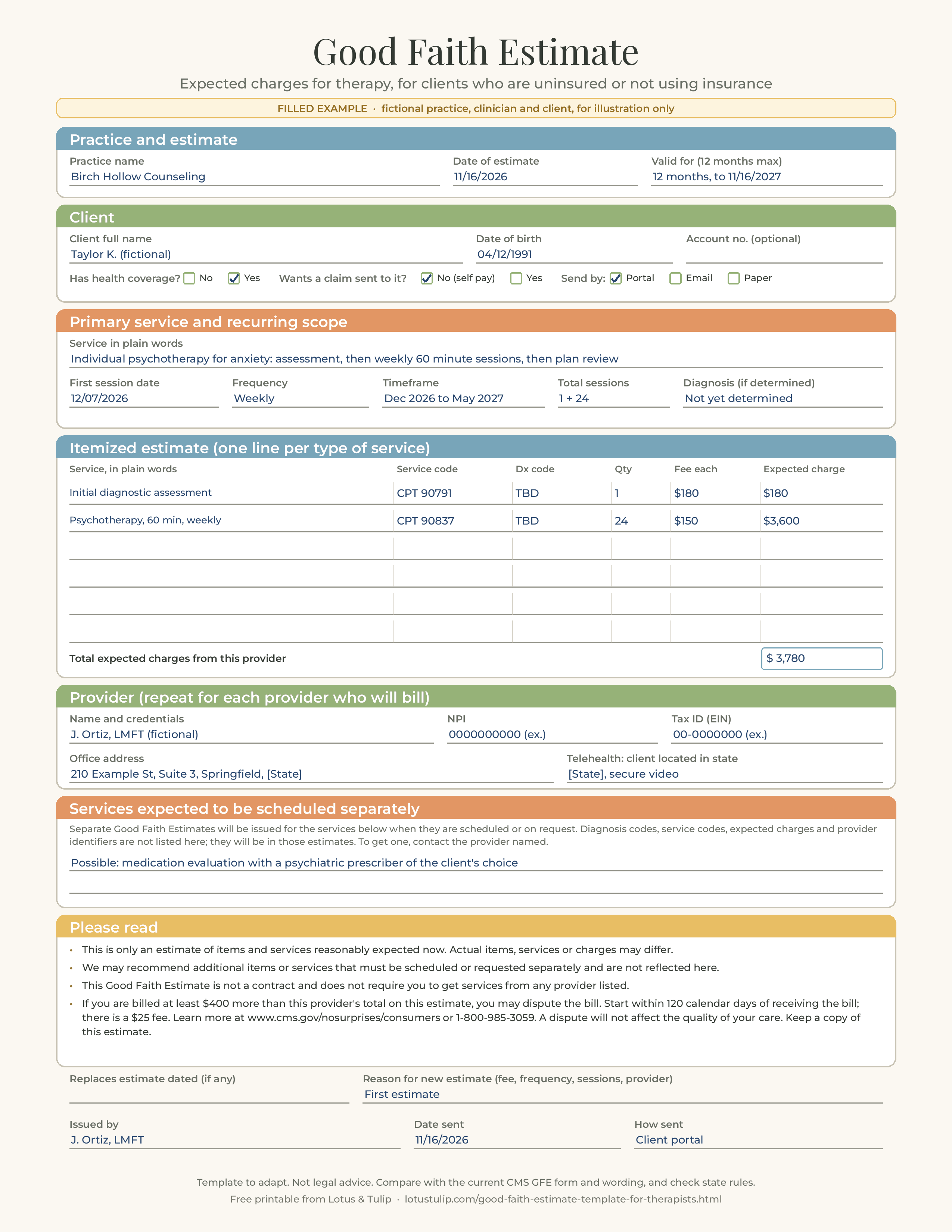
The fictional clinician J. Ortiz, LMFT, of Birch Hollow Counseling schedules a fictional client, Taylor K., who has employer insurance but has chosen not to use it. Taylor books an assessment on December 7, 2026, more than 10 business days after the call on November 16, so the GFE is due within 3 business days. J. Ortiz sends it the same day through the client portal, which is how Taylor asked to receive it.
Birch Hollow Counseling: Good Faith Estimate for Health Care Items and Services
Date of estimate: November 16, 2026. Estimate valid for: 12 months from this date, for the services and schedule below.
Client: Taylor K. (fictional). Date of birth: 04/12/1991. Contact preference: client portal. Coverage: has employer health insurance; has chosen not to submit claims for these services (self pay).
Primary service: Individual psychotherapy for anxiety, starting with an initial diagnostic assessment on December 7, 2026, followed by weekly 60 minute sessions for about 6 months, then a review of the plan with you. Diagnosis: not yet determined; to be confirmed after the assessment.
Provider: J. Ortiz, LMFT (fictional), Birch Hollow Counseling. NPI: 0000000000 (example). Tax ID (EIN): 00-0000000 (example). Location: 210 Example Street, Suite 3, Springfield, [State] 00000, or by secure video while you are located in [State].
| Service | Code | Diagnosis code | Quantity | Fee each | Expected charge |
|---|---|---|---|---|---|
| Initial diagnostic assessment | CPT 90791 | Not yet determined | 1 | $180 | $180 |
| Individual psychotherapy, 60 minutes (53 minutes or more), weekly, December 2026 to May 2027 | CPT 90837 | To be added after assessment | 24 | $150 | $3,600 |
| Total expected charges from J. Ortiz, LMFT | $3,780 | ||||
Services expected to be scheduled separately. For the services listed below, separate Good Faith Estimates will be issued when they are scheduled or on request. Diagnosis codes, service codes, expected charges and provider identifiers are not included here; they will be in those separate estimates. To get an estimate, contact the provider directly. Possible: medication evaluation with a psychiatric prescriber of your choice, if we agree a referral would help.
Please note. There may be additional items or services we recommend as part of your care that must be scheduled or requested separately and are not reflected in this estimate. This Good Faith Estimate is only an estimate based on what is reasonably expected now; actual items, services or charges may differ. This Good Faith Estimate is not a contract and does not require you to get services from any provider listed.
Your right to dispute. If you are billed at least $400 more than the total expected charges for this provider on this estimate, you may have the right to dispute the bill through the federal patient-provider dispute resolution process. You must start within 120 calendar days of receiving the bill. There is a $25 fee to use the process. To learn more and get a form, visit www.cms.gov/nosurprises/consumers or call 1-800-985-3059. Starting a dispute will not affect the quality of care you receive from us. Keep a copy of this estimate.
Issued by: J. Ortiz, LMFT. Sent: November 16, 2026, via client portal (save and print enabled).
Why this example works: it names the client and date of birth, explains the service in plain words, states the timeframe, frequency and number of sessions for the recurring service within 12 months, itemizes each service with code, quantity, fee and total, leaves the diagnosis code off honestly because no diagnosis has been made, gives the NPI, Tax ID, address and telehealth state, lists a possible separately scheduled service under the required disclaimer, includes every required disclaimer, and records how and when it was delivered. In a real GFE, use the current CMS disclaimer wording in full and your real identifiers.
What happens next in the fictional case: after the assessment J. Ortiz diagnoses an anxiety disorder and the plan stays at weekly sessions. No new GFE is needed just to add the diagnosis code to the record, though some clinicians re-issue the estimate with the code so the two documents match. In March, Taylor asks to add four family sessions with a parent. J. Ortiz issues a new GFE adding four sessions of 90847 before the first family session is scheduled to happen, and keeps both versions in the record.
Five short Good Faith Estimate examples
Inquiry email, no booking yet. A prospective client asks, "How much are your sessions?" The clinician replies with the fee, asks about coverage and whether they plan to use it, and, when the person says they will pay privately, sends a GFE for an assessment and 12 weekly sessions within 3 business days. When the person books two weeks later, a new GFE for the scheduled services follows within 3 business days of booking.
Sliding scale review. A client on a $70 sliding scale fee reaches the six month review and the fee moves to $90. The clinician issues a new GFE at $90 for the remaining sessions in the 12 month window, at least 1 business day before the first $90 session, and notes the change on the estimate.
Couples therapy. Two partners book joint sessions, paid by one partner. The GFE is addressed to the paying partner as the client for billing, describes joint sessions with both partners present, and lists 90847 x 16 over 6 months at the agreed fee. If the other partner later books individual sessions, that is a separate GFE.
Eight week therapy group. An uninsured client joins a group starting in 3 weeks. The GFE lists a brief intake (if billed) and group psychotherapy 90853 x 8, the start date, weekly frequency and the fee per meeting.
Year two. A client has been in weekly therapy for 11 months. The clinician issues a new GFE for the next 12 months before the old one runs out, notes the new estimated number of sessions and the current fee, and explains in one line what changed from the last estimate.
Common Good Faith Estimate mistakes
- Treating the fee in the consent form as the GFE. A fee paragraph is not an itemized estimate with codes, identifiers and disclaimers.
- Answering a cost question without sending a GFE. A cost inquiry counts as a request.
- Missing the business day deadline. Send it the day the client books.
- No notice on the website. The right to a GFE must be posted where search engines can find it, as well as in the office and at scheduling.
- Estimating one session for an ongoing client. If weekly therapy is expected, estimate the recurring scope; one session at $150 against a year of bills invites a dispute.
- Going past 12 months. A recurring GFE cannot cover more than 12 months.
- Raising fees without a new GFE. Re-issue before the new fee applies.
- Adding a service line without a new GFE. Family sessions, groups or extended sessions need to be estimated.
- Leaving out NPI, Tax ID or location. These are required for each provider listed. If you do not have an NPI yet, apply for one through NPPES; it is free.
- Missing disclaimers. All four required disclaimers, the dispute information and the separately scheduled services disclaimer (if you list any) must be there.
- Oral estimate only. The GFE must be in writing.
- Not keeping the old versions. GFEs are part of the record, and clients can ask for copies of any issued in the last 6 years.
Free printable: Good Faith Estimate form for therapists, filled example and before you send checklist
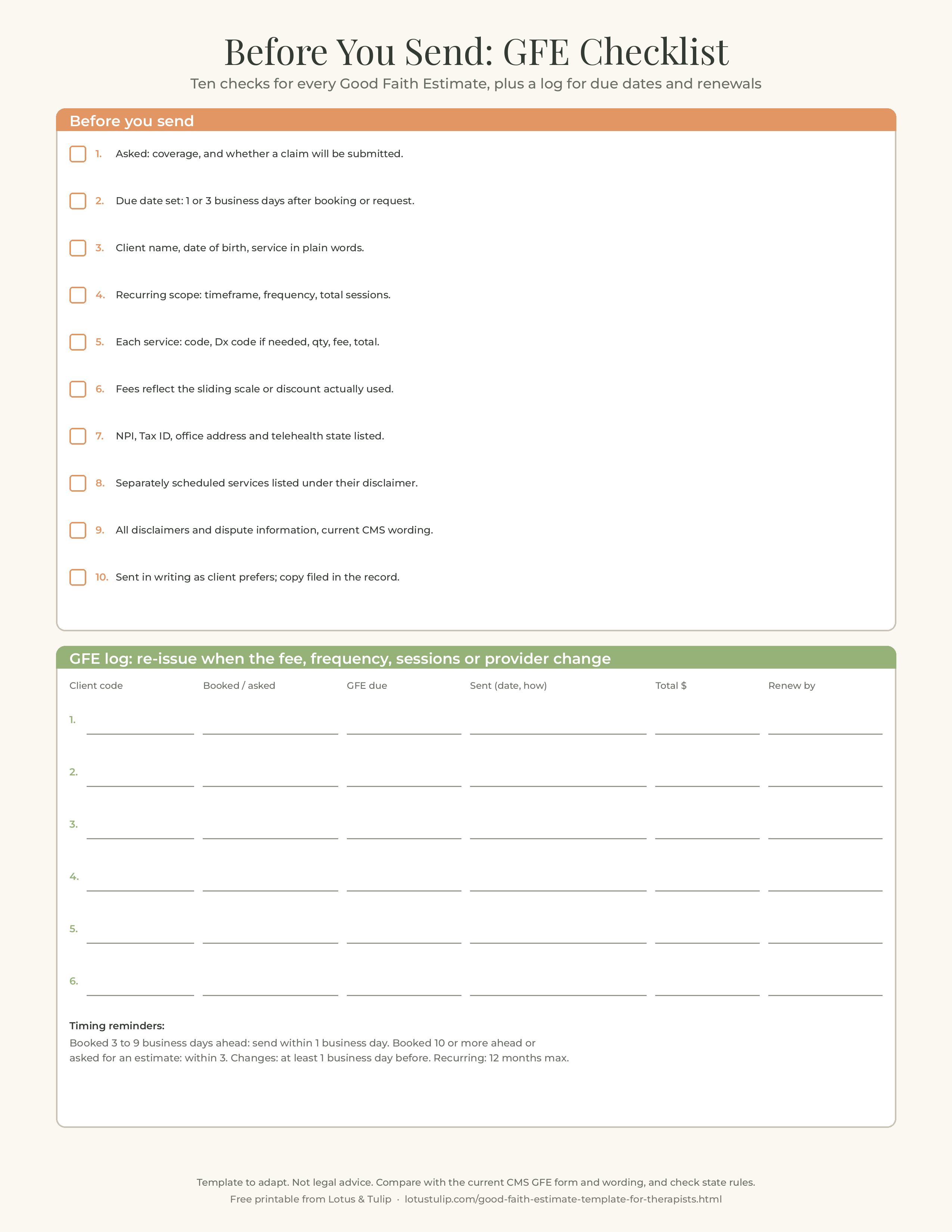
The free printable has three US Letter pages. Page 1 is a blank Good Faith Estimate laid out for a therapy practice: practice and estimate details, client name, date of birth and contact preference, the two coverage questions, the primary service in plain words with recurring scope (timeframe, frequency, number of sessions), an itemized table for services with CPT code, diagnosis code, quantity, fee and expected charge, your NPI, Tax ID and locations including telehealth, a separately scheduled services box with its disclaimer, and the required disclaimers with dispute information. Page 2 is a filled fictional example from this page (Birch Hollow Counseling, J. Ortiz, LMFT, client Taylor K.). Page 3 is a ten point before you send checklist plus a GFE log for due dates, delivery and renewal.
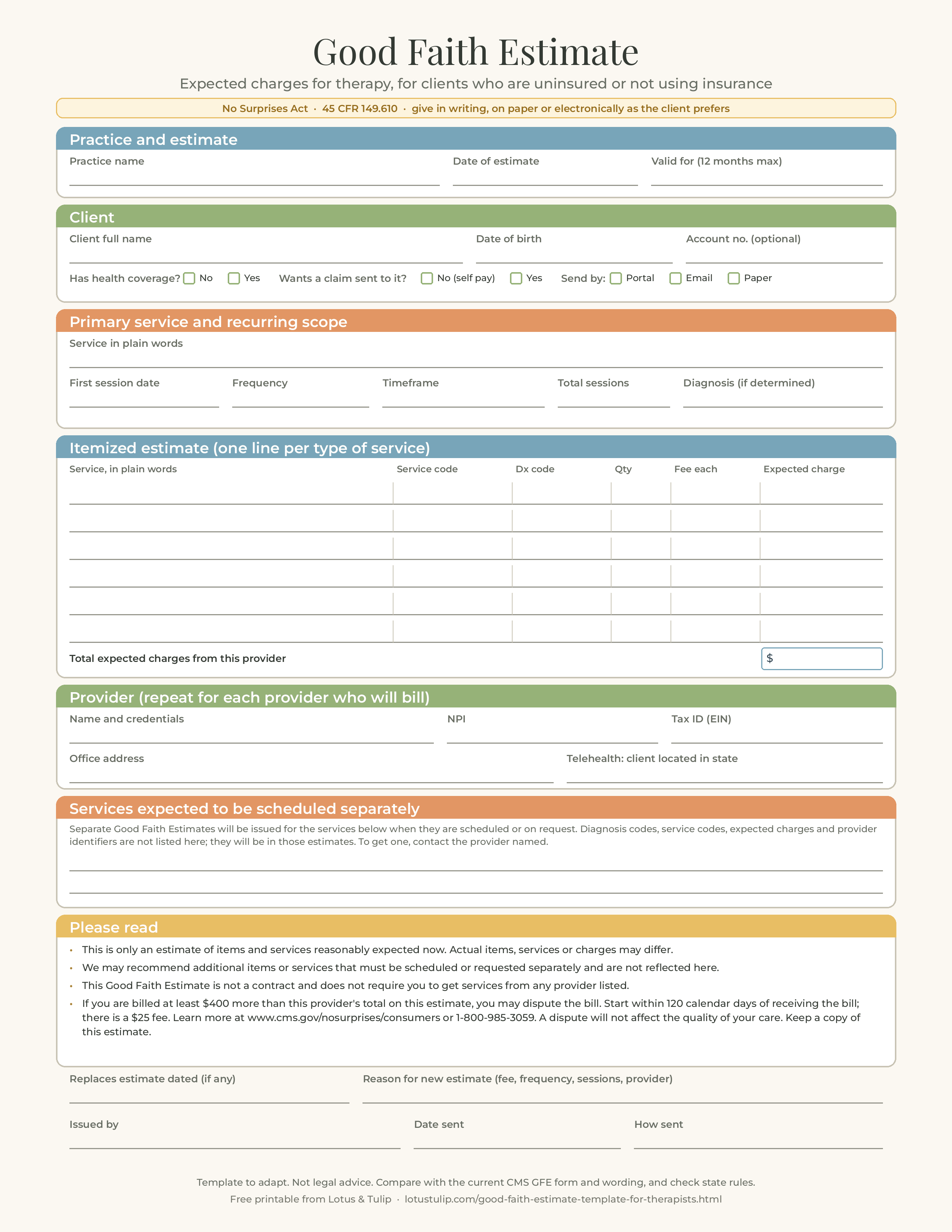
Download the free Good Faith Estimate template for therapists (PDF, 3 pages)
Rather type than handwrite? The free PDF above is for printing. Therapy Progress Notes and Intake Templates comes as a fillable PDF you type straight into (604 fields in Adobe Acrobat Reader), plus the printable version: SOAP, DAP and BIRP notes, intake, treatment plan and safety plan, 20 pages. Holiday 20% off: about $7.36, was $9 (EUR 8) · instant digital download
Buy on EtsyPrefer single images? Page 1: blank GFE form (PNG) · Page 2: filled fictional example (PNG) · Page 3: before you send checklist and GFE log (PNG)
Free to print and use in your own practice. Please link to this page rather than re-uploading the file. The form is a starting point: compare it with the current CMS standard GFE form and notice, use the current CMS disclaimer wording, and check state rules. Using it does not by itself guarantee compliance with any law or regulation.
Related resources
- Closing a therapy private practice: checklist, timeline, client letters, records plan and free printable
- HIPAA risk assessment for therapists: security risk analysis, filled example and free worksheet
- Business associate agreement for therapists: which vendors need a BAA, breach duties, filled vendor log and free printable
- Professional will for therapists: clinical executor, records custodian, client notification scripts, filled example and free printable
- Couples therapy informed consent form: no secrets policy, individual sessions, records access, safety screening, filled example and free printable
- Treatment summary template for therapists: how to write a treatment summary letter, transfer records under HIPAA, filled example and free printable
- Notice of privacy practices for therapists: HIPAA 164.520 elements, 2026 Part 2 update, filled example and free printable
- Parental consent form for therapy of a minor: who can consent, custody orders, state minor consent laws, HIPAA, filled example and free printable
- Credit card authorization form for therapists: card on file consent, PCI DSS rules, filled example and free printable
- Sliding scale fee policy for therapists: 2026 poverty guideline tiers, copay waiver rules, filled example and free printable
- Therapy cancellation policy template: late cancellation and no show fees, Medicare and Medicaid rules, filled example and free printable
- Release of information form for therapists: HIPAA authorization elements, psychotherapy notes, Part 2, filled example and free printable
- Superbill template for therapists: every field insurers need, CPT and POS codes, filled example and free printable
- Informed consent for therapy template: what to include, sample consent and free printable
- Psychotherapy notes vs progress notes: what HIPAA says, what goes where and free printable
- Therapy termination letter template: sample letters and free printable
- What to include in a therapy intake form (checklist)
- Biopsychosocial assessment template: example and free printable
- Telehealth progress note template: examples, checklist and free printable
- Therapy treatment plan template with SMART objectives (free printable)
- SOAP vs DAP notes for therapists, with examples
- BIRP notes for therapists: template, 5 examples and free printable
- GIRP notes for therapists: template, 5 examples and free printable
- Group therapy progress notes: template, examples and free printable
- Mental status exam template: examples, word bank and free printable
- Therapy discharge summary template: example and free printable
- Therapy progress notes and intake templates
Sources: Public Health Service Act section 2799B-6 (No Surprises Act, Consolidated Appropriations Act, 2021); 45 CFR 149.610 (good faith estimates for uninsured or self-pay individuals), including (a)(2) definitions, (b)(1)(iii) to (x), (b)(2)(iv), (c)(1), (e) and (f); 45 CFR 149.620 (patient-provider dispute resolution), including (a)(2)(ii), (b)(1), (c)(1), (c)(5), (c)(6) and (f); CMS, FAQs About Consolidated Appropriations Act, 2021 Implementation: Good Faith Estimates for Uninsured (or Self-Pay) Individuals, Part 1 (December 1, 2021), Part 2 (April 5, 2022) and Part 3 (December 2, 2022); CMS, Standard Notice "Right to Receive a Good Faith Estimate of Expected Charges" (Appendix 1) and Standard Form "Good Faith Estimate for Health Care Items and Services" (Appendix 2); CMS, Guidance on Good Faith Estimates and the Patient-Provider Dispute Resolution Process (individuals and providers); CMS consumer pages "What is a good faith health insurance estimate?" and "Dispute a medical bill"; CMS, Providers: payment resolution with patients; CMS, No Surprises Act Protections: Status of Implementation. Rules and enforcement policies change; check the current versions and your state's laws.
FAQ
Do therapists have to give a Good Faith Estimate?
Yes, in most cases. Under the No Surprises Act and 45 CFR 149.610, health care providers, including therapists, counselors, social workers and psychologists, must give a written Good Faith Estimate to clients who are uninsured or who are not having a claim submitted to their insurance, when a service is scheduled at least 3 business days ahead or when the client asks. Clients in Medicare, Medicaid and other federal health care programs are generally not covered by this requirement.
How far in advance must a Good Faith Estimate be given?
Within 1 business day after scheduling when the service is at least 3 business days away; within 3 business days after scheduling when it is at least 10 business days away; and within 3 business days after a request. If the scope changes, a new GFE is due no later than 1 business day before the changed service.
Can one Good Faith Estimate cover ongoing therapy sessions?
Yes. A single GFE can cover recurring services if it clearly states the timeframe, frequency and total number of sessions, and the scope does not exceed 12 months. If therapy continues longer, issue a new GFE and explain what changed.
What happens if a client is billed more than the Good Faith Estimate?
If a provider's total billed charges are at least $400 more than that provider's total expected charges on the GFE, the client can start the federal patient-provider dispute resolution process within 120 calendar days of receiving the initial bill, paying a $25 administrative fee. While the dispute is pending, the provider cannot send the bill to collections or charge late fees on it, and an independent entity decides the amount due.
Does a Good Faith Estimate need a diagnosis code?
Only where one is required to calculate the estimate. CMS says diagnosis codes are not required when no diagnosis has been made yet, such as before an initial assessment, but service codes and expected charges are still required.
Do I need a Good Faith Estimate for a client paying a sliding scale or nothing?
Yes. The GFE shows the expected charge after any discount, so a sliding scale client's estimate uses the reduced fee. A GFE is required even when the client is expected to owe nothing; CMS offers an abbreviated form for no cost services.
How long do I keep Good Faith Estimates?
A GFE is part of the client's medical record and is kept the same way as the record. You must give the client a copy of any GFE issued in the last 6 years on request, so keep every version for at least that long, and longer if your state's record retention rules require it.
Is this Good Faith Estimate template free?
Yes. The three page printable (a blank GFE form laid out for therapy, a filled fictional example and a before you send checklist with a GFE log) is free to print and use in your own practice. Please link to this page rather than re-uploading the file, compare it with the current CMS form and wording, and check your state's rules before use.