
Therapist worksheets · Updated 2026-11-08
Therapy Office Decor Ideas: Printable Posters That Help (with Free Printable)
Ready-made printable: Therapy Office Decor Posters Holiday 20% off: about $11.04, was $14 (EUR 12) · instant digital download
Buy on Etsy
Therapy office decor ideas work best when the room does two jobs at once: it helps a new client feel they can sit down, and it gives both of you something clear to look at when words get hard. A pillow, a plant, a tidy desk and a few readable psychoeducation posters will not treat anyone. They can lower the temperature of the first minutes, signal that this is a working room rather than a waiting room full of slogans, and become tools you point to in session.
This guide is written for US therapists, counselors, school counselors, social workers and group facilitators who want practical therapy office decor ideas, especially printable psychology posters they can use with teens and adults (several also suit older kids). You will get a plain language view of what walls can and cannot do, what research on office impressions actually shows, a trauma informed way to choose what stays on the wall, how to use twelve common psychoeducation posters in session (window of tolerance, CBT triangle, feelings wheel, anger iceberg, 5 4 3 2 1 grounding, stress responses, thinking traps, box breathing, circle of control, a coping skills menu, distress tolerance skills and a self care wheel), a nine step HowTo, placement and print tips, room type notes, mistakes, myths, three fictional examples, guidance on when not to decorate this way, verified research notes, eight FAQs and a free three page US Letter printable: Therapy Office Decor Steps, a Room Planner and a Poster Use Plan with pocket cards.
This page is about the room and about posters as working tools. It sits beside, and is not a substitute for, our window of tolerance worksheet, CBT triangle worksheet, feelings wheel printable, anger iceberg worksheet, 5 4 3 2 1 grounding worksheet, cognitive distortions worksheet, circle of control worksheet, DBT TIPP skills worksheet, distress tolerance worksheets and self care plan template. A comparison table further down shows which page fits which job.
We draw on published research and public guidance without claiming any affiliation or endorsement, including Nasar and Devlin (2011) on impressions of psychotherapists' offices, SAMHSA's 2014 trauma informed approach, Daniel J. Siegel's window of tolerance idea and Marsha M. Linehan's published descriptions of the DBT skills STOP and TIPP. Full citations are below. The printable is an original Lotus and Tulip layout, not a copy of any published program or paid poster set.
This guide is educational. Office decor does not diagnose a client, does not treat trauma, anxiety, depression, PTSD or any other condition, and does not replace clinical judgment, informed consent or a treatment plan. The posters described here are psychoeducation aids, not a protocol. They are not affiliated with APA, NASW, SAMHSA, Siegel or Linehan. If a client is thinking about suicide or self-harm, call or text 988 (Suicide and Crisis Lifeline) or text HOME to 741741 (Crisis Text Line). For immediate danger, call 911. If someone describes abuse or a plan to seriously hurt another person, follow your mandated reporting and safety procedures first. A pretty wall never outranks safety.
What therapy office decor is (and is not)
Clients notice the room before they notice your theoretical orientation. They notice whether the chair looks like a place a person can sit for fifty minutes, whether papers are stacked in a way that says "your story will be handled carefully," and whether the walls are shouting, whispering or offering a tool. Therapy office decor, in this guide, means the things a client can see from their seat: color, light, seating, order, personal touches and any words or diagrams on the wall.
Useful therapy office decor ideas share a few traits:
- They help a person settle. Soft seating, a clear path to the door, decent light and a room that does not feel like a storage closet make it easier to begin.
- They stay orderly without feeling sterile. A bare white box can feel cold. A cluttered desk can feel unsafe. The middle is a room that looks cared for.
- They include a few working tools. A poster earns its place if you will point to it, not if it merely matches the rug.
- They do not lecture. "Choose joy" on the wall after a client has described a funeral is not comfort. It is a demand.
- They leave room for the person in front of you. Cultural humility, language access and the option to turn a poster around matter more than a perfect gallery wall.
What this kind of decor is not matters just as much:
- Not treatment. No arrangement of posters is a substitute for a relationship, a formulation or a plan.
- Not a personality test you administer through throw pillows. Clients should not have to decode your taste in order to feel welcome.
- Not a collage of every modality you have ever studied. Twelve competing diagrams teach overwhelm, not skill.
- Not a replacement for privacy, sound control or a working door. If people in the hall can hear session content, fix that before you pick a frame.
- Not a place to display other clients' art, names or stories. Confidentiality applies to the walls.
- Not an excuse to ignore access. Text that is too small to read from the chair, glare on glass, or a cramped path for a wheelchair or a stroller undercuts everything else.
What clients actually notice about a therapy office
There is less experimental research on therapy rooms than on the therapies that happen inside them, and most of it measures first impressions rather than outcomes after six months. That is still useful, because many clients decide in the first visit whether they will come back.
Nasar and Devlin (2011) showed 242 college students thirty color photographs of real psychotherapist offices in Manhattan, taken from the client's point of view by photographer Saul Robbins (used with permission in the study). Separate groups rated the offices and then rated the quality of care and comfort they would expect, how qualified, bold and friendly the therapist would be, and which offices they would choose or avoid. As ratings of softness and personalization and of order went up, so did expected quality of care, comfort, perceived qualifications and boldness, and the chance that someone would choose that therapist based on the office. Friendliness rose with softness and personalization. People agreed more about which offices were worst (cluttered, cramped, messy, uncomfortable, unprofessional) than about which were best. The top offices were described as comfortable, nice, clean, warm and inviting. About 60 percent of the students had been in therapy themselves; results did not differ by that history, by gender or by whether they lived in a small Northeastern town or a large Midwestern city.
Caveats belong next to that finding, not in a footnote you skip. The raters were students looking at still photos, not clients sitting through a course of therapy. The study cannot tell you that a sage pillow causes better outcomes. It can tell you that disorder and harsh, bare rooms consistently look worse to strangers, and that softness (comfortable seating, lamps, plants, rugs) plus modest personalization (a diploma, a photo, a lived-in but tidy desk) plus order tend to look better. If you only change one thing after reading this page, make the room neat and the seating look like a human can rest in it. Then add posters you will actually use.
Softness in that study meant things like cushioned chairs, carpet, table lamps, plants and throw rugs, not "make everything beige." Personalization meant the office looked like a particular professional worked there, not that every surface held a souvenir. Order meant you could see the floor, the desk and a place to put a bag. Printable posters fit this picture when they are aligned, readable and few, and they hurt it when they curl off the wall in a crooked stack of twenty.
Trauma informed walls
SAMHSA's 2014 guidance on a trauma informed approach names six principles: safety; trustworthiness and transparency; peer support; collaboration and mutuality; empowerment, voice and choice; and cultural, historical and gender issues. None of those principles is about throw pillows. All of them can be honored or ignored by what you hang up.
- Safety. Can the client see the door? Is the path clear? Are there objects that look like they could be thrown? Does any image show violence, medical procedures or surprise faces that startle people? A grounding poster that you will practice together supports safety; a chaotic collage does not.
- Trustworthiness and transparency. If a poster names a skill (TIPP, box breathing, a feelings wheel), be ready to explain it in ordinary words and to say what it is not. Do not display a copyrighted clinical form you are not licensed to reproduce.
- Collaboration and choice. Ask whether a poster is helpful. Offer to take one down or turn it around for a session. Some clients find a feelings wheel relieving. Others feel tested by it.
- Empowerment. Prefer posters that describe options ("here are ways people come back into their window") over posters that issue commands ("just breathe" or "good vibes only").
- Culture, history and gender. Check who is pictured, which feelings are named, and whether the language assumes one kind of family, body or faith. A wheel full of English feeling words will not serve every client equally; keep simpler visuals or bilingual copies if your caseload needs them.
A practical test: sit in the client chair, read every word out loud, and ask, "If I had just described a trauma, a divorce or a panic attack, would this sentence feel like help or like homework I am already failing?" If you wince, take it down.
Twelve psychoeducation posters and how to use them in session
The posters below match common US searches (window of tolerance poster, CBT triangle poster, feelings wheel for office, anger iceberg, 5 4 3 2 1 grounding, and so on) and match the twelve titles in our printable set. You can use any clear, accurate version you have the right to display. Each note covers what the idea is, how to point to it, a caution and a link to a deeper worksheet page when we have one. None of these notes is a complete treatment manual.
1. Window of tolerance
Daniel J. Siegel described the window of tolerance as the zone of arousal in which a person can think, feel and stay connected enough to make use of the moment. Above the window (hyperarousal) the body may feel wired, panicked, angry or unable to sit still. Below it (hypoarousal) the body may feel numb, shut down, foggy or far away. A good poster shows the window, names those two sides in plain language, and offers ways to downshift (slow the body) and upshift (gently re-engage) without promising a quick fix. In session, ask "Where do you notice yourself on this picture right now?" and let the client point. Then pick one small skill that matches the direction they need to go. Our window of tolerance worksheet walks through the same idea on paper. Caution: do not treat the poster as a diagnosis of PTSD. Many people leave their window during ordinary stress. For a fuller trauma focused set of pages, see trauma worksheets.
2. The CBT triangle
The cognitive behavioral triangle is a simple picture of how thoughts, feelings and behaviors influence one another. It comes from the broader cognitive model associated with Aaron T. Beck and is taught in almost every introductory CBT course. A useful poster shows the three corners and one worked example (a thought, a feeling and an action that feed each other). In session, fill a blank triangle together on paper while the wall poster holds the map. Ask which corner feels most changeable today. Our CBT triangle worksheet and CBT thought record go further. Caution: the triangle is a teaching picture, not proof that thoughts "cause" every feeling. Biology, relationships and real danger also matter.
3. Feelings wheel
A feelings wheel helps people move from "I feel bad" to a more exact word (disappointed, lonely, ashamed, hopeful). Many wheels start with a few core feelings and branch into more precise ones. Our poster set uses 6 core feelings and 24 more exact words; other wheels use different lists. In session, invite the client to point rather than perform vocabulary. "Which word is closest?" is enough. Our feelings wheel printable is built for kids and also works as a take-home. Caution: some clients, including some autistic clients and people who have been punished for emotion, find wheels overwhelming or childish. Offer them; do not require them.
4. The anger iceberg
The anger iceberg is a counseling metaphor: anger is the part people see, and other feelings (hurt, fear, embarrassment, fatigue, unfairness) often sit under the waterline. Our poster set names 18 feelings that can sit under anger. In session, draw or point to the waterline and ask "What else might be under there?" after a specific event, not as a fishing expedition for trauma. Our anger iceberg worksheet is the paper version, and anger management small group activities shows how school counselors use the idea in a group. Caution: the metaphor is not a licensed test. Do not tell a client their "real" feeling. They are the expert on what is under their own waterline.
5. 5 4 3 2 1 grounding
This is a widely used sensory grounding practice: name five things you can see, four you can feel, three you can hear, two you can smell and one you can taste (some teachers swap smell and taste). It pulls attention into the present through the senses. In session, do it with the client rather than pointing at the poster and waiting. Go slowly. Skip a sense if it is aversive (smell after nausea, for example). Our 5 4 3 2 1 grounding worksheet includes a script and adaptations. Caution: grounding is a here-and-now skill. It is not exposure therapy and it is not a substitute for 988 when someone is in crisis.
6. Stress responses: fight, flight, freeze and fawn
Fight, flight and freeze are long standing descriptions of how bodies react to threat. Many trauma informed clinicians add a fourth response, often called fawn, meaning a person goes along, appeases or people-pleases in order to stay safe. That fourth term is used in clinical education (including work by Pete Walker) and is less established as a separate laboratory circuit than the first three. Teach the poster as a useful map of patterns, not as four proven biological switches. In session, ask which pattern showed up in a specific moment and what the body was trying to do (get safe). Caution: do not label a client's personality as "a fawn type." Patterns shift with context. See trauma worksheets for early phase, stabilization focused pages that avoid detailed trauma narrative prompts.
7. Thinking traps
Thinking traps (cognitive distortions) are habits of interpretation such as all or nothing thinking, mind reading, fortune telling, catastrophizing, "should" statements, labeling, overgeneralizing, mental filtering, personalizing and emotional reasoning. The idea traces to Beck's cognitive work and to later teaching lists (including David D. Burns's popular writing). A poster that names about ten common patterns, in ordinary language, gives you a shared vocabulary. In session, pick one trap that actually appeared in the client's words that day. Do not hunt for all ten. Our cognitive distortions worksheet and cognitive restructuring worksheet support the next step: checking the thought rather than mocking it. Caution: calling something a trap is not the same as saying the client is irrational. Sometimes the feared outcome is realistic.
8. Box breathing
Box breathing is a paced breathing practice: inhale, hold, exhale and hold again for equal counts (often four). It is used in clinical settings and in performance settings because the even pace is easy to remember. A poster can show the four sides of the box. In session, breathe with the client at a pace they can do. Shorten the holds if they feel panicky. Our breathing exercises for kids page has related scripts you can adapt. Caution: some people with respiratory conditions, panic that worsens when they notice their breath, or a trauma history tied to restricted breathing need a different skill first (feet on the floor, looking around the room, 5 4 3 2 1).
9. Circle of control
The circle of control separates what a person can influence (their next action, their breathing, who they ask for help) from what they cannot (other people's choices, the past, many institutional rules). In session, write one stressful situation on a sticky note and sort the pieces into the two regions. Our circle of control worksheet is the paper version. Caution: do not use the circle to dismiss injustice. "You cannot control your landlord" is true; it is not the same as "so stop feeling angry." Name both the limit and the next step inside the circle.
10. Coping skills menu
A coping menu groups skills so a flooded person is not asked to invent a strategy from scratch. Categories often include body based skills, thinking skills, connection, rest, senses and movement, though menus vary. In session, help the client circle two skills they will actually use this week, not twelve they admire. Our coping skills list for kids and coping skills worksheets for teens are written lists you can pair with a wall menu. Caution: a menu is not a moral ranking. "Call a friend" is not more virtuous than "take a shower." Fit the skill to the moment and to the person's values and access.
11. Distress tolerance skills: STOP and TIPP
STOP and TIPP are crisis survival skills from dialectical behavior therapy, described in Marsha M. Linehan's skills manuals (the second edition of the DBT Skills Training Manual was published in 2015). STOP is a pause sequence (Stop, Take a step back, Observe, Proceed mindfully). TIPP is a set of body based ways to change arousal quickly: Temperature, Intense exercise, Paced breathing and Paired muscle relaxation. A responsible poster includes a short safety note. Cold water or ice on the face is not for everyone (heart conditions, eating disorder histories that involve ice, or any situation where it could cause harm). Intense exercise should match the person's medical reality. In session, teach one letter at a time and practice when the client is not in crisis. Our TIPP worksheet and distress tolerance worksheets cover cautions in more detail. This page is not affiliated with Linehan or Behavioral Tech. Caution: these skills buy time in a wave of distress. They are not a reason to skip 988, emergency care or a written safety plan when suicide or self-harm is on the table.
12. Self care wheel
A self care wheel is a reminder that care has more than one slice (body, mind, relationships, rest, play, practical life and similar domains). Many published wheels exist; they are not interchangeable and some are copyrighted. Use whatever wheel you have the right to display as a conversation starter: "Which slice has gone quiet this month?" Then write one small, realistic action. Our self care plan template turns that conversation into a plan a person might actually keep. Caution: self care is not a cure for an unsafe workplace, poverty or untreated illness. Do not let a pretty wheel become a way to hand systemic problems back to the client as a personal failing.
Size, printing and placement
Readable type from the client chair beats a designer layout no one can see. If you print at home, US Letter works for a door, a file cabinet side or a small wall beside your chair. If you want a true wall poster, 18 x 24 in at a print shop is a common size; 12 x 16 and 9 x 12 also work in smaller rooms. Vector text stays sharp when you scale it. Use a simple frame or clip rail so you can change posters without damaging the wall. Avoid heavy glass glare under overhead lights; matte paper or non-glare acrylic is easier to read on camera and in person.
Place working posters where both of you can see them without twisting: usually the wall the client faces or a side wall between your chairs. Do not put the only calming poster behind the client's head. Do not block the door. In a school office, keep confidential student work off the walls and keep posters at a height students can point to. In telehealth, one clear poster behind you or a screen share of the same file is plenty; a busy background competes with your face.
License basics for any download you buy: display it in your own office, classroom or counseling room, print copies for your own clients and students if the license allows it, and show it on screen in telehealth if the license allows it. Do not resell the files, share them with an entire agency staff unless you bought that right, or post them publicly. When a listing says the file was made with the help of an AI generator and then reviewed by hand, that same line belongs on the Etsy page; it does not change the clinical cautions above.
Ideas by room type
Private practice office
Lead with comfort and order: two decent chairs, a side table, a lamp, a clock both of you can see, tissues within reach and a clear surface. Add two to four working posters, not twelve at once. Rotate the ones you are teaching this month. Keep credentials visible if you use them as personalization, and keep family photos modest so the room does not become about you.
School counseling office
Students read walls quickly and take them literally. Prefer concrete skills (feelings words, grounding, circle of control, anger iceberg) over abstract quotes. Hang posters at student height. Have paper copies ready, because a student may not want to stare at a wall in front of peers who walk by the door. Follow your school's rules about religious or political decorations.
Group room
One large visual the whole group can see is better than a ring of small print. Agreements, a feelings check and one skill poster for that day's lesson are enough. Take down last week's poster if it will confuse this week's topic.
Telehealth background
Your face, a calm wall and decent light do more than a row of frames behind you. If you use a poster on camera, make sure the type is large. Otherwise share the file on screen when you need the diagram, then return to your face. Clients should not have to squint at a wall behind your shoulder.
What not to put on the walls
- Toxic positivity. "Good vibes only," "choose happiness" and "everything happens for a reason" can shame people who are grieving, depressed or angry for good reasons.
- Unsolicited advice framed as wisdom. "Let it go" is easy to hang and hard to sit under after a betrayal.
- Graphic or startling images. Surprise faces, medical trauma, violence or overcrowded collages can yank people out of their window.
- Other people's confidential work. No named client art, thank you notes with identifying details or group photos.
- Copyrighted worksheets you photocopied without permission. Buy licenses or use material you have the right to display.
- So many posters that the room looks like a classroom in exam week. Visual noise raises arousal for some clients and makes none of the posters usable.
- In-jokes or political slogans unless you have a clear, ethical reason and have thought about who would no longer feel welcome.
How to set up therapy office decor, step by step
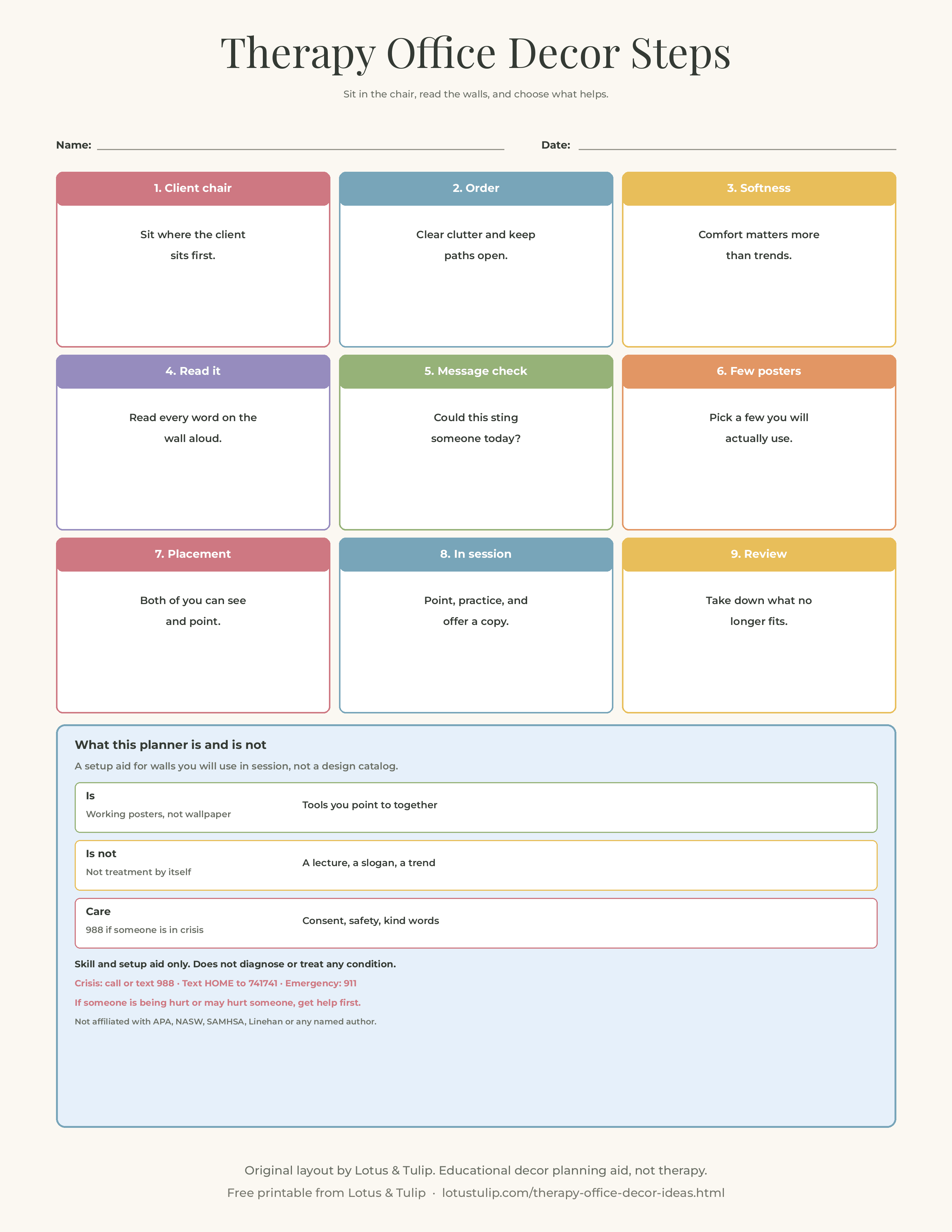
- Sit in the client chair. Before you buy or hang anything, sit where the client sits. Notice the door, the light, the clutter, the smell and the first words your eyes land on. If you would not want to tell a hard story there, fix the seating and the sight lines first.
- Restore order. Clear floors, stacks and leftover session materials. People judging office photos in Nasar and Devlin (2011) were especially consistent about disliking cluttered, cramped rooms. Order is not the same as emptiness.
- Add softness you can maintain. A cushion that stays clean, a lamp that actually gets used, a plant you can keep alive or a good artificial one, and a rug that does not trip anyone will do more than a trend color.
- Read every word on the wall out loud. Quotes, posters, certificates and children's drawings all count. If a sentence could sting after a raw session, take it down or move it out of the sight line.
- Run a message check. Ask whether each item teaches a skill, offers a choice or issues a command. Keep tools. Drop lectures. The free Room Planner on this page has lines for that check.
- Choose a few working posters. Pick two to four you will point to this month, matched to your caseload (for example window of tolerance and 5 4 3 2 1 for a trauma heavy week, or CBT triangle and thinking traps for a CBT block). Store the rest and rotate.
- Place them where both of you can see and point. Check glare, height and the path to the door. In a school office, use student height. In telehealth, plan a screen share instead of a tiny background poster.
- Use them in session. Point, ask the client to point, practice the skill, and offer a paper copy when a take-home would help. A poster you never mention is only wallpaper.
- Review the walls each season. Take down what you no longer teach, what clients have asked to hide and what has faded or curled. Update language if your caseload has changed.
Which page or product fits which job
| Page or product | Best when | What you get |
|---|---|---|
| This page | You want to plan the room and use posters as session tools | Decor principles, twelve poster how-tos, HowTo, free planner |
| Therapy Office Decor Posters (paid) | You want twelve ready psychoeducation posters | US Letter and 18 x 24 in PDFs of the twelve titles above |
| Window of tolerance worksheet | You are teaching the window on paper | A worksheet and a teaching guide |
| CBT triangle worksheet | You want a paper triangle, not only a wall map | Worksheet plus how-to |
| Feelings wheel printable | Kids or families need a take-home wheel | Printable wheel and guide |
| Anger iceberg worksheet | You are exploring feelings under anger | Single worksheet |
| 5 4 3 2 1 grounding worksheet | You want a scripted sensory practice | Script and printable |
| Cognitive distortions worksheet | You are teaching thinking traps in more detail | List, examples and printable |
| Circle of control worksheet | A client feels flooded by what they cannot change | Worksheet and how-to |
| TIPP worksheet and distress tolerance worksheets | You are teaching STOP or TIPP with medical cautions | Skill pages and safety notes |
| Self care plan template | A wheel on the wall needs a written plan | A three page plan |
| Trauma worksheets | Early phase stabilization work | Grounding, window, triggers, with no trauma narrative prompts |
Tips that keep posters useful
- Introduce one new poster at a time so it becomes a shared language rather than wallpaper.
- Keep paper copies of the same diagrams in a folder. Some people will not look up at a wall when they are ashamed or shut down.
- Match the reading level to the youngest or most distressed person who uses the room.
- If a client winces at a poster, thank them and change it. That moment is the work.
- Clean frames and dust plants. Neglected decor quietly undoes the message that this room is cared for.
- In shared offices, agree as a team which posters stay, so clients do not meet a different ideology every Tuesday.
Common mistakes
- Decorating for Instagram instead of for the person in the chair. If a photo of the room would outperform a session in that room, start over from the chair.
- Hanging skills you cannot explain. If you cannot teach TIPP with its cautions, do not display TIPP.
- Using posters as proof that you are a certain kind of therapist. Clients need clarity, not a brand board.
- Leaving up seasonal slogans. "New year, new you" is a rough greeting in January for someone with depression.
- Ignoring telehealth. A perfect office helps in-person clients only. Have a digital copy ready to share.
- Forgetting consent for recording or photos. Never post a picture of your office that includes client belongings, schedules or anything identifiable.
Myths about therapy office decor
- "Clients do not notice the room." Nasar and Devlin (2011) found that strangers formed fairly consistent impressions of care, comfort and qualifications from office photos alone. Clients notice.
- "More psychology posters mean a more clinical room." Past a few working tools, more posters usually mean more noise.
- "Inspirational quotes are always harmless." They are harmless until they contradict the story in the room.
- "A perfect office will make therapy work." The relationship and the method do the work. The office can help someone stay long enough for that to happen.
- "Minimal rooms are always more professional." A bare room can look cold. Softness and modest personalization helped friendliness ratings in the 2011 study.
Three fictional examples
Maya, LPC, private practice. Maya's office had a beautiful gallery wall of quotes she had collected in graduate school. A client who had recently miscarried stared at "Everything happens for a reason" for an entire session and said almost nothing. Maya sat in the client chair that evening, took down every quote, and hung a window of tolerance poster and a feelings wheel where both chairs could see them. The next week she asked the client whether those two felt all right to look at. The client said the wheel was fine and asked that the window poster stay a little higher, out of her direct stare. That is decor doing its job: fewer words, more choice.
Andre, school counselor. Andre's small office shared a wall with a busy hallway. He printed a feelings wheel and a circle of control on US Letter, framed them at fifth grade height, and kept stacks of the matching worksheets in a drawer. When a student came in furious about recess, they pointed at the iceberg poster (which he rotated in during an anger group) and named "embarrassed" underneath. Andre did not lecture about sportsmanship. He used the wall as a third point in the conversation so the student did not have to look only at him.
Priya, doing mostly telehealth. Priya had spent money on art behind her desk that looked lovely in person and turned into a muddy stripe on camera. She moved a lamp forward, cleared the background, and began screen-sharing a box breathing poster for the last three minutes of anxious sessions. Clients could see the four sides of the box without trying to read a wall over her shoulder. The art went in her waiting area instead.
When not to use these ideas this way
- Crisis. If someone is in active crisis, follow safety procedures. Use 988, HOME to 741741 and 911 as needed. Do not pivot to interior design.
- A client who finds visuals overstimulating or shaming. Turn posters around or take them down. Collaboration beats your plan for the room.
- Skills you are not prepared to teach safely. Especially TIPP and any cold water or intense exercise suggestion.
- Rooms you do not control. If facilities staff will remove unapproved items, use portable boards or screen shares rather than fighting the wall.
- As a stand-in for access. Posters cannot fix a room that a wheelchair cannot enter or a door that does not close.
Free 3 page therapy office decor printable (US Letter)
Download the free printable and use it when you set up a new office, share a room or review your walls at the change of a season.
- Page 1: Therapy Office Decor Steps. Nine steps that match the HowTo above, what this planner is and is not, and crisis resources including 988, the Crisis Text Line and 911.
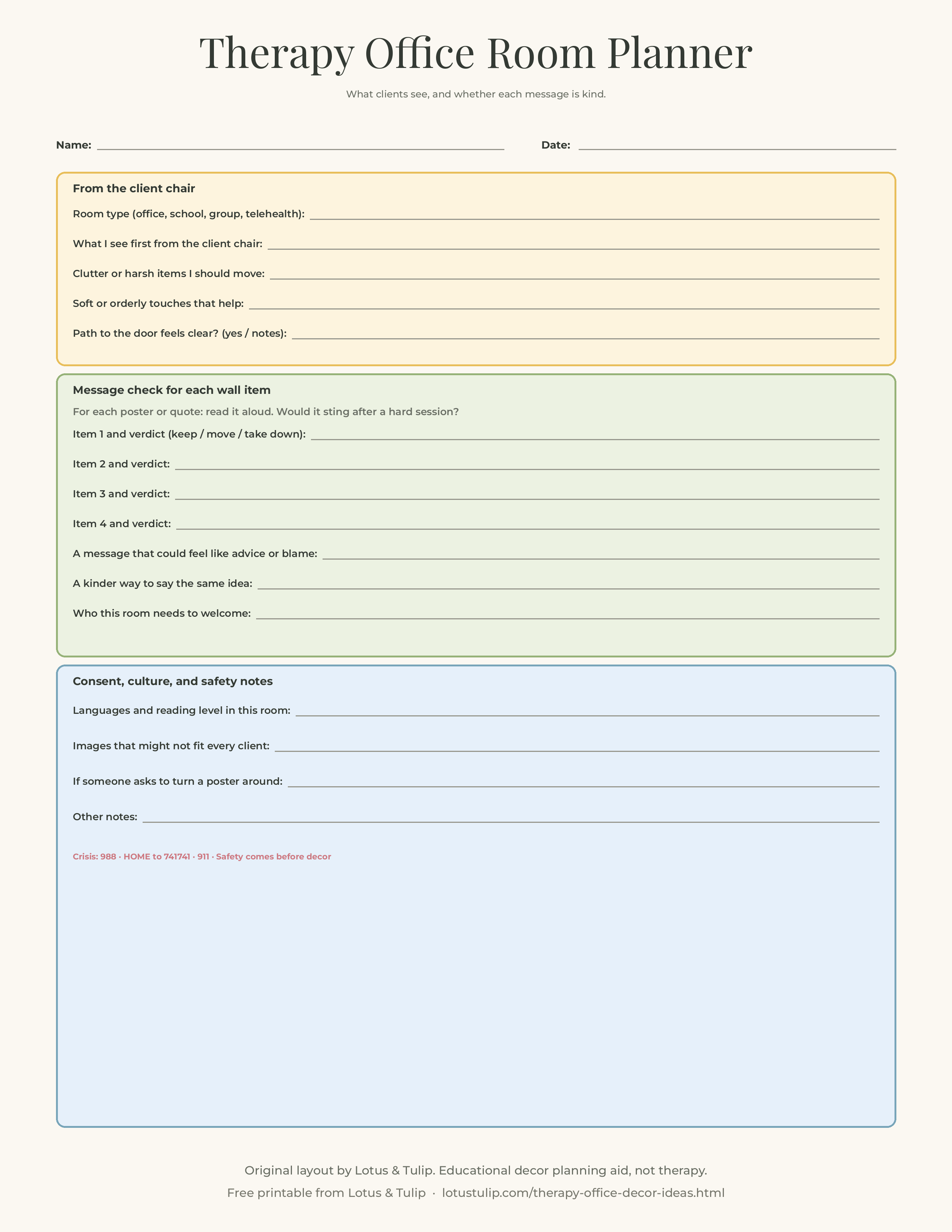
- Page 2: Therapy Office Room Planner. A view from the client chair, a message check for each wall item and notes on consent, culture and safety.
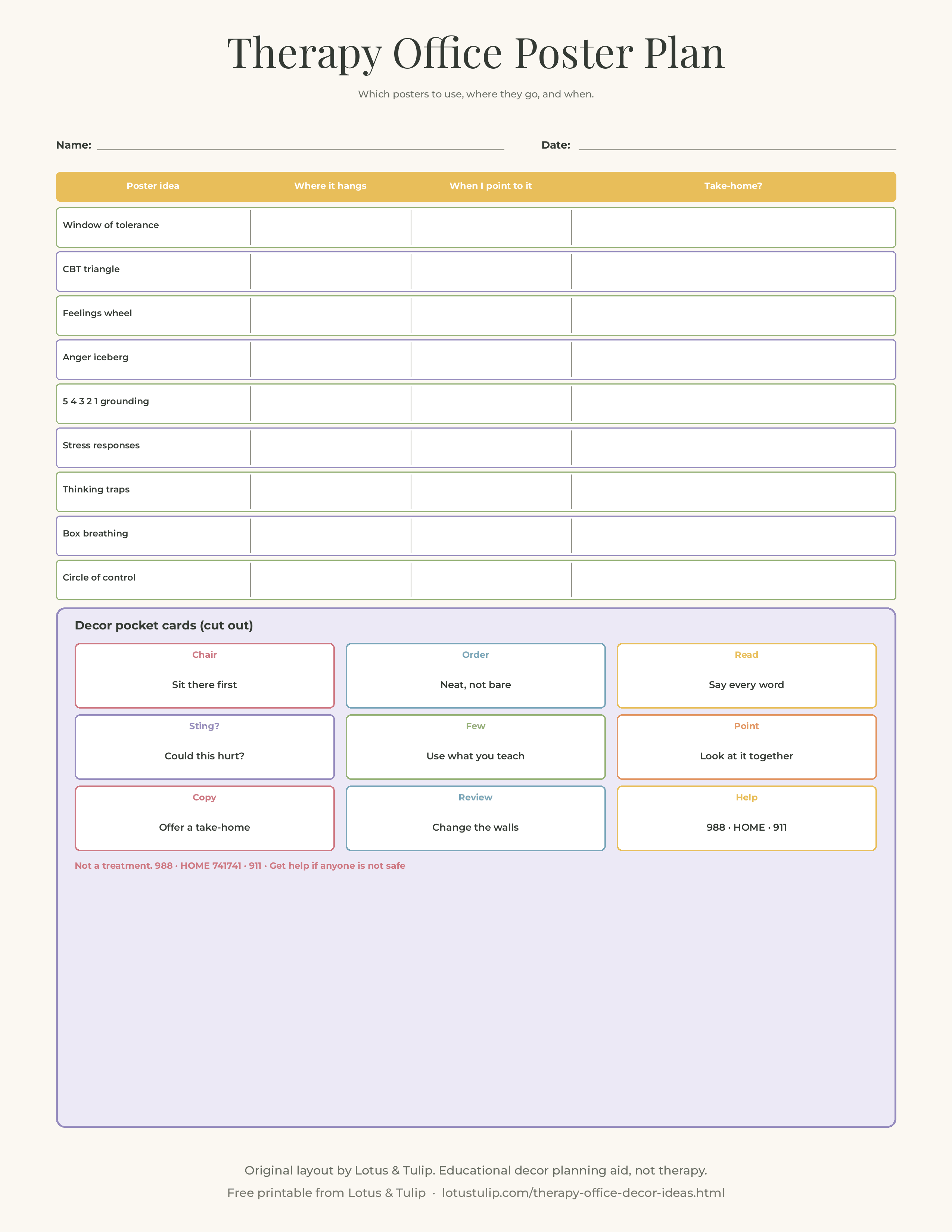
- Page 3: Therapy Office Poster Plan. A table for nine poster ideas (where each hangs, when you point to it and whether it has a take-home) plus nine pocket cards to cut out.
Download free PDF · Page 1 PNG · Page 2 PNG · Page 3 PNG
Research notes (verified, with caveats)
- Nasar JL, Devlin AS. Impressions of psychotherapists' offices. Journal of Counseling Psychology. 2011;58(3):310-320. doi:10.1037/a0023887. The authors used 30 color photographs of real Manhattan psychotherapist offices, viewed from the client's seat, and collected ratings from 242 college students across several tasks (expected quality of care and comfort; how qualified, bold and friendly the therapist would seem; office choices and open-ended reactions). As softness/personalization and order increased, so did expected quality of care, comfort, perceived qualifications and boldness, and the likelihood of choosing the therapist based on the office. Friendliness increased with softness/personalization. People agreed more about disliked offices (cluttered, cramped, messy) than about favorites. Caveat: these were first impressions of still photos by students, not measures of therapy outcome over time. The study supports tidy, reasonably soft, modestly personalized rooms; it does not evaluate this page or any Lotus and Tulip product.
- Substance Abuse and Mental Health Services Administration. SAMHSA's Concept of Trauma and Guidance for a Trauma-Informed Approach. HHS Publication No. SMA 14-4884. Rockville, MD: SAMHSA; 2014. The six principles are safety; trustworthiness and transparency; peer support; collaboration and mutuality; empowerment, voice and choice; and cultural, historical and gender issues. We apply them here to wall choices. No affiliation with SAMHSA.
- Siegel DJ. The Developing Mind. New York: Guilford. Siegel's window of tolerance is a widely taught map of hyperarousal, a workable middle zone and hypoarousal. We name it only as the source of that teaching picture. This page is not affiliated with Siegel and does not reproduce a copyrighted figure from his books.
- Linehan MM. DBT Skills Training Manual. 2nd ed. New York: Guilford; 2015. Describes the crisis survival skills STOP and TIPP (Temperature, Intense exercise, Paced breathing, Paired muscle relaxation). Any wall display of those skills should carry medical and safety cautions. This page is not a DBT training, not a substitute for Linehan's manuals and not affiliated with Behavioral Tech.
- Fight, flight and freeze are long standing descriptions of threat responding in physiology and clinical teaching. The additional term "fawn" (appeasing to stay safe) is used in trauma education, including writing by Pete Walker, and should be taught as a clinical description with less laboratory status than the first three. We mention it because many office posters now include it; naming a pattern is not the same as diagnosing a personality type.
- Beck AT. Cognitive Therapy and the Emotional Disorders. New York: International Universities Press; 1976. And Beck's earlier cognitive papers. The CBT triangle is a teaching simplification of how thoughts, feelings and behaviors relate. It is not a complete account of emotion.
Our paid poster set is a psychoeducation aid built around these general ideas. It has not been tested in its own randomized trial. Hanging it on a wall is not a therapy method.
Therapy office decor ideas: FAQ
What are the best therapy office decor ideas on a budget?
Start with order and seating: clear the clutter, make the client chair comfortable and add a lamp if the overhead light is harsh. Then print two or three working psychoeducation posters at US Letter size and frame them simply. Softness and order influenced first impressions more than expensive art in Nasar and Devlin's 2011 photo study, which used real offices rather than staged showrooms.
Do printable therapy office posters actually help in session?
They help when you use them as a third point in the conversation: you and the client look at the same map (a window of tolerance, a feelings wheel, a CBT triangle) and practice a skill. They do not help if they are too small to read, too many to take in or filled with slogans that lecture the person in the chair.
How many posters should I hang in a therapy office?
Two to four working posters is a practical range for most private offices. School and group rooms may do better with one large visual plus paper copies. Store the rest and rotate what you are teaching this month so the walls stay readable.
What should I avoid hanging in a counseling office?
Avoid clutter, toxic positivity ("good vibes only"), graphic or startling images, other clients' confidential work, copyrighted pages you do not have the right to display, and any quote you would not want to sit under after a raw session. Sit in the client chair and read every word out loud before you leave it up.
What size should therapy office posters be?
US Letter is fine beside a desk, on a door or in a small school office. For a true wall poster, 18 x 24 in is a common print shop size; 12 x 16 and 9 x 12 also work. Choose type large enough to read from the client chair, and prefer matte finishes that do not glare on camera.
Are these posters appropriate for telehealth?
Yes, if the license allows on-screen use. Share the file on screen when you need the diagram, then return to your face. A row of small posters behind you is usually harder to read than one clear share. Keep your background calm and well lit.
Is the free printable a copy of the paid poster set?
No. The free three page set is an original companion with decor steps, a room planner and a poster use plan plus pocket cards. The paid Therapy Office Decor Posters set is twelve psychoeducation posters in two PDF sizes. The printable is not a preview of that PDF and is not material from any named program or author.
Can office decor replace trauma informed care?
No. SAMHSA's 2014 principles (safety, trustworthiness, peer support, collaboration, empowerment and attention to culture, history and gender) describe how a whole service behaves. Walls can support those principles or undermine them, but they cannot stand in for consent, choice, competent treatment or a path to 988 and emergency care when someone is unsafe.