
Therapist practice · Updated 2026-11-09
Biopsychosocial Assessment Template: What to Include, with an Example (Free Printable)
Ready-made printable: Therapy Progress Notes and Intake Templates Fillable PDF: includes a full client intake packet, plus intake, notes and safety plan pages (20 pages)
Holiday 20% off: about $7.36, was $9 (EUR 8) · instant digital download
Try it free first: download a fillable sample (SOAP note and DAP note, PDF, 226 KB). Type into it on screen, then get the full pack. No email needed.

A biopsychosocial assessment is the part of the intake where you stop collecting answers and start understanding a person. The intake forms tell you that a client sleeps five hours, drinks most nights, lost a job in July and has a supportive partner. The biopsychosocial assessment puts those facts side by side, asks how they connect, and turns them into a working explanation of why this person is struggling now and what is likely to help. It is the document a supervisor reads first, the one a covering clinician leans on, and the foundation the treatment plan is built on.
This guide is for counselors, therapists, clinical social workers, marriage and family therapists, psychologists, substance use counselors and trainees in the US. It covers what a biopsychosocial assessment is and where the idea comes from, how it differs from an intake form and a diagnostic evaluation, each section in plain language with what to ask and what to write, how to write a biopsychosocial formulation with the 4 Ps, a step by step process, a full fictional biopsychosocial assessment example, five short examples (a teenager, an older adult, substance use, a client with a trauma history, and an assessment spread over two sessions), screening measures that fit, billing and privacy notes, words to watch and common mistakes. At the end you can download a free three page printable: a blank one page biopsychosocial assessment, a filled fictional example, and a before you sign checklist with a blank 4 Ps formulation grid.
Jump to the free biopsychosocial assessment template
This is educational information about documentation for licensed clinicians and trainees. It is not clinical, legal, billing or compliance advice. Assessment requirements differ by state, license, payer, agency and setting; follow your licensing board, your payers' current policies and your agency's procedures. Every client and clinician on this page is fictional.
What a biopsychosocial assessment is
The term comes from the psychiatrist George Engel, who argued in a 1977 paper in Science, "The Need for a New Medical Model: A Challenge for Biomedicine," that the dominant biomedical model left no room for the social, psychological and behavioral dimensions of illness. He proposed a biopsychosocial model as a blueprint for research, a framework for teaching and a design for action in health care. Mental health practice took the idea and made it routine: before you treat a problem, you look at the body, the mind and the life around the person.
In everyday practice a biopsychosocial assessment (often shortened to BPS, or called a psychosocial assessment, comprehensive assessment or diagnostic assessment depending on the agency) is a structured write up completed at the start of treatment. It usually covers:
- Biological factors: physical health, medications, sleep, appetite, energy, substance use, family history of mental illness, and anything medical that could explain or worsen the symptoms.
- Psychological factors: current symptoms, mood, thinking patterns, past mental health treatment, trauma history, coping style, personality, and a mental status summary.
- Social factors: family, relationships, culture and identity, faith, education and work, money, housing, legal issues, access to care and community.
- Risk, strengths and goals: safety concerns, protective factors and what the client wants from treatment.
- Synthesis: a formulation that explains how these factors connect, a diagnostic impression where your license allows it, and recommendations.
The last part is what makes it an assessment rather than a questionnaire. Plenty of charts have every intake box filled and no clinical thinking anywhere. A good biopsychosocial assessment answers a simple question in a paragraph or two: why this person, why this problem, why now, and what is likely to help.
Biopsychosocial assessment vs intake form vs diagnostic evaluation
These terms overlap, and agencies use them differently. A useful way to keep them apart:
| Document | Who fills it in | What it is |
|---|---|---|
| Intake form or packet | Usually the client, before or at the first visit | Raw information: contact details, insurance, concerns, history, medications, emergency contact, consents. See what to include in a therapy intake form. |
| Biopsychosocial assessment | The clinician, from the interview plus the forms and records | A clinical write up of biological, psychological and social factors, with a formulation, risk, strengths, a diagnostic impression and recommendations. |
| Psychiatric diagnostic evaluation (CPT 90791 or 90792) | The clinician | The billable service in which an assessment like this is usually done. A Medicare local coverage determination describes it as an integrated biopsychosocial assessment (details in the billing section below). |
| Treatment plan | The clinician with the client | Goals, measurable objectives and interventions that follow from the assessment. See the treatment plan template. |
In a small private practice the intake form, the assessment and the treatment plan may all be written in the first two or three sessions. In an agency the assessment may be a long EHR form with dozens of required fields. Either way, the thinking is the same, and the free printable on this page works as a one page summary that sits on top of a longer intake or EHR record.
Biopsychosocial assessment sections at a glance
| Section | What to write | Why it matters |
|---|---|---|
| Identifying information | Name or ID, age, pronouns if shared, date(s) of assessment, clinician | Basic record keeping; age shapes almost everything else |
| Referral and sources | Who referred the client and where your information came from | Shows how reliable each piece of information is |
| Presenting problem | The concern in the client's words, then in clinical terms | Anchors the whole assessment and the treatment plan |
| History of the problem | Onset, course, triggers, what has been tried, impact on daily life | Separates a new episode from a long pattern |
| Biological | Health conditions, medications, sleep, appetite, energy, substance use, family psychiatric history | Medical causes and contributors; medication and substance interactions |
| Psychological | Symptoms, past treatment, trauma, coping, screening scores, mental status | Diagnosis, severity and treatment fit |
| Social | Family, relationships, culture, faith, education, work, money, housing, legal, access to care | Stressors, supports and practical barriers to treatment |
| Risk | Suicide, self harm, harm to others, abuse or neglect, safety at home | Immediate safety and duty of care |
| Strengths and supports | Specific people, skills, values and resources | What treatment can build on |
| Client goals | What the client wants to be different | Engagement and a person centered plan |
| Formulation | How the factors connect: the 4 Ps across bio, psycho and social | Turns facts into a treatment rationale |
| Impression and recommendations | Diagnostic impression (within scope), level of care, referrals, next steps | Medical necessity and the treatment plan |
Each section in detail
1. Identifying information and referral
Keep this short: name or client ID, age, the dates of the assessment sessions, and your name and credentials. Add pronouns and preferred name if the client shared them. Then write who referred the client and why: "Self referred after her primary care provider suggested therapy" or "Referred by school counselor for attendance problems." List your sources: "Information from client interview, intake packet and primary care letter received with signed release." When a parent, partner or another provider contributes, say who said what. A covering clinician needs to know whether "drinks most nights" came from the client or from a worried spouse.
2. Presenting problem
Write the concern twice. First in the client's own words, in quotation marks: "I can't switch my brain off." Then in clinical terms: "Excessive worry, insomnia and low mood for four months, with reduced social activity." The client's words keep the record human and help you check later whether treatment is working on what they care about. The clinical version links to diagnosis and medical necessity.
Add why they are coming now. Many people have struggled for years; something usually tipped the balance. "Came in after missing her niece's birthday party because she could not face people" tells you more than "symptoms worsened."
3. History of the presenting problem
Cover onset, course and pattern: when it started, whether it is getting better or worse, what makes it better or worse, previous episodes, and what the client has already tried. Ask about functioning in concrete terms: work or school attendance and performance, household tasks, relationships, self care. A sentence such as "Has applied for jobs but cancelled two interviews this month due to worry" shows impairment far better than "functioning impaired."
4. Biological factors
You are not doing a medical exam, but you are responsible for noticing when the body might be part of the story. Ask about and record:
- Health conditions and recent changes. Thyroid problems, chronic pain, diabetes, heart conditions, head injuries, pregnancy and postpartum, hormonal changes, seizures, sleep apnea. Some medical conditions can cause or worsen anxiety, depression or cognitive changes.
- Medications and supplements. Name, dose if known, who prescribes, and whether the client takes them as prescribed. Note recent starts, stops and changes.
- Last medical visit. "Saw PCP 9/2026; bloodwork normal per client." If the client has not seen a medical provider in years and has new physical symptoms, recommending a check up is part of a good assessment.
- Sleep, appetite and energy. Hours, pattern (trouble falling asleep, waking at 3 a.m., oversleeping), appetite and weight change, energy across the day.
- Substance use. Alcohol, cannabis, nicotine and vaping, prescription misuse, other drugs, and caffeine when sleep is an issue. Ask about amount, frequency, pattern, last use and consequences. Record any screening scores.
- Family history. Mental illness, substance use and suicide in biological relatives.
- Developmental history for children and teens: pregnancy and birth, milestones, early health.
Stay inside your scope. You can write "Client reports fatigue and weight gain; hypothyroidism diagnosed 2022; recommended client discuss current symptoms with PCP." You should not write "symptoms caused by thyroid" unless a medical provider has said so.
5. Psychological factors
- Current symptoms in enough detail to support a diagnosis: mood, anxiety, worry, panic, obsessions, trauma reactions, psychosis, mania, attention, eating, and how long each has lasted.
- Past mental health treatment: therapy (what kind, how long, what helped), psychiatric medication, hospitalizations, crisis visits, and the client's view of it. "Eight sessions of counseling in college, found it helpful" is a good sign for engagement.
- Trauma history, asked with care (see the section on sensitive areas below). You need to know whether trauma is part of the picture; you rarely need the details in the first session.
- Coping style: what the client does when things get hard, including the helpful (exercise, talking to a sister) and the costly (drinking, avoiding, overworking).
- Screening scores, with the measure and date: "PHQ-9 14, GAD-7 16 (11/12/2026)."
- Mental status summary. A short mental status line or section from your observation in the session. The mental status exam template has a word bank and examples.
6. Social factors
This is where the client's life comes into view. Cover what applies, not every possible topic:
- Family and relationships: who the client lives with, partner, children, parents and siblings, quality of relationships, recent losses, conflict, caregiving duties.
- Culture and identity: what parts of identity matter to the client, language, immigration experience, discrimination, and how their culture and family understand mental health and help seeking.
- Faith and meaning: religious or spiritual practice if the client sees it as relevant, and whether it is a support, a stress, or both.
- Education and work: highest education, current work or school, performance, stress, recent changes, military service.
- Money and housing: financial pressure, housing stability, food security, transportation.
- Legal: current or past legal problems, court involvement, custody, probation, and whether the referral is mandated.
- Access to care: insurance, ability to pay, schedule limits, childcare, internet for telehealth.
- Social connection and leisure: friends, community, activities the client used to enjoy.
Healthy People 2030, the federal health promotion framework, groups the social determinants of health into five domains: economic stability, education access and quality, health care access and quality, neighborhood and built environment, and social and community context. It is a helpful checklist for the social section, especially in community mental health, because practical barriers often explain missed sessions better than motivation does.
7. Risk
Ask directly about suicidal thoughts and behavior, self harm, thoughts of harming others, access to firearms and other lethal means, and safety at home, including abuse, neglect and intimate partner violence where relevant. Write what you asked and what the client said: "Asked directly about suicidal thoughts, now and in the past: denies current thoughts; one period of passive thoughts in 2019 during a breakup, no plan or attempt." If risk is present, document your structured risk assessment and any safety plan in the risk section or on a separate page, and follow your agency's procedures. The safety plan worksheet is a free printable. In the US, the 988 Suicide and Crisis Lifeline can be reached by call or text at 988.
Mandated reporting obligations (for suspected child abuse, elder or dependent adult abuse, and in some states other situations) come from state law and your license. If the assessment brings one up, document what you learned, what you reported, to whom and when.
8. Strengths and protective factors
Write strengths as specifically as problems. "Good support system" is filler. "Partner is supportive and came to the first session; sister lives ten minutes away and calls daily; ran three times a week until July; found counseling helpful in college" gives you a treatment plan. Strengths include people, skills, values, past successes, faith, pets, routines, humor and reasons for living.
9. Client goals
Ask what the client wants to be different, in their words: "I want to sleep and stop dreading the phone." Goals here become the treatment plan goals, and you can check later whether they were met. If a parent, court or employer wants something different from the client, record both.
10. Formulation
The formulation is a short paragraph that explains the problem. It is the most valuable part of the assessment and the part most often missing. The next section shows how to write one with the 4 Ps.
11. Diagnostic impression
Record a diagnostic impression if your license and setting allow it, with the reasoning and anything to rule out: "Generalized anxiety disorder considered: excessive worry most days for more than six months per client, restlessness, poor sleep, irritability. Rule out major depressive disorder. Alcohol use to monitor; AUDIT-C 6." Many payers need a diagnosis to establish medical necessity. If you are a trainee or your scope does not include diagnosis, write a clinical impression and route it to your supervisor.
12. Recommendations and plan
End with what happens next: level of care, type and frequency of therapy, referrals (medical check, psychiatric evaluation, substance use services, support groups, case management), any further assessment, and who needs to be contacted with a signed release. The recommendations should follow from the formulation. If the formulation says alcohol is keeping the sleep problem going, the plan should say what you will do about the alcohol.
How to write a biopsychosocial formulation with the 4 Ps
A formulation turns a list into an explanation. A common and practical way to build one is the 4 Ps grid: for each of the biological, psychological and social areas, ask what made the person vulnerable, what set this off, what keeps it going and what protects them.
| Biological | Psychological | Social | |
|---|---|---|---|
| Predisposing (what made them vulnerable) | Family history of anxiety; hypothyroidism | Anxious temperament since childhood; high standards for self | Grew up as the "responsible one"; identity tied to providing |
| Precipitating (what set it off now) | Sleep loss after the layoff | Belief "I've failed my family" | Layoff in July; severance ending in December |
| Perpetuating (what keeps it going) | Wine most nights to sleep, worse sleep after 3 a.m. | Nightly worry, avoidance of interviews and family events | Less contact with friends; no daily structure |
| Protective (what helps) | Generally healthy; used to run | Insight; did well in therapy before | Supportive partner and sister; stable housing |
You do not paste the grid into the chart. You use it to write two to five sentences:
"R.M. is a 34 year old with an anxious temperament and a family history of anxiety (predisposing) whose worry, insomnia and low mood began after a layoff in July that challenged his sense of himself as the family provider (precipitating). Nightly worry, drinking wine to fall asleep, and avoidance of interviews and family events are keeping the symptoms going (perpetuating). He has a supportive partner and sister, stable housing, good insight and a good past response to therapy (protective), which support outpatient CBT focused on worry, sleep and re-engaging with job search and family."
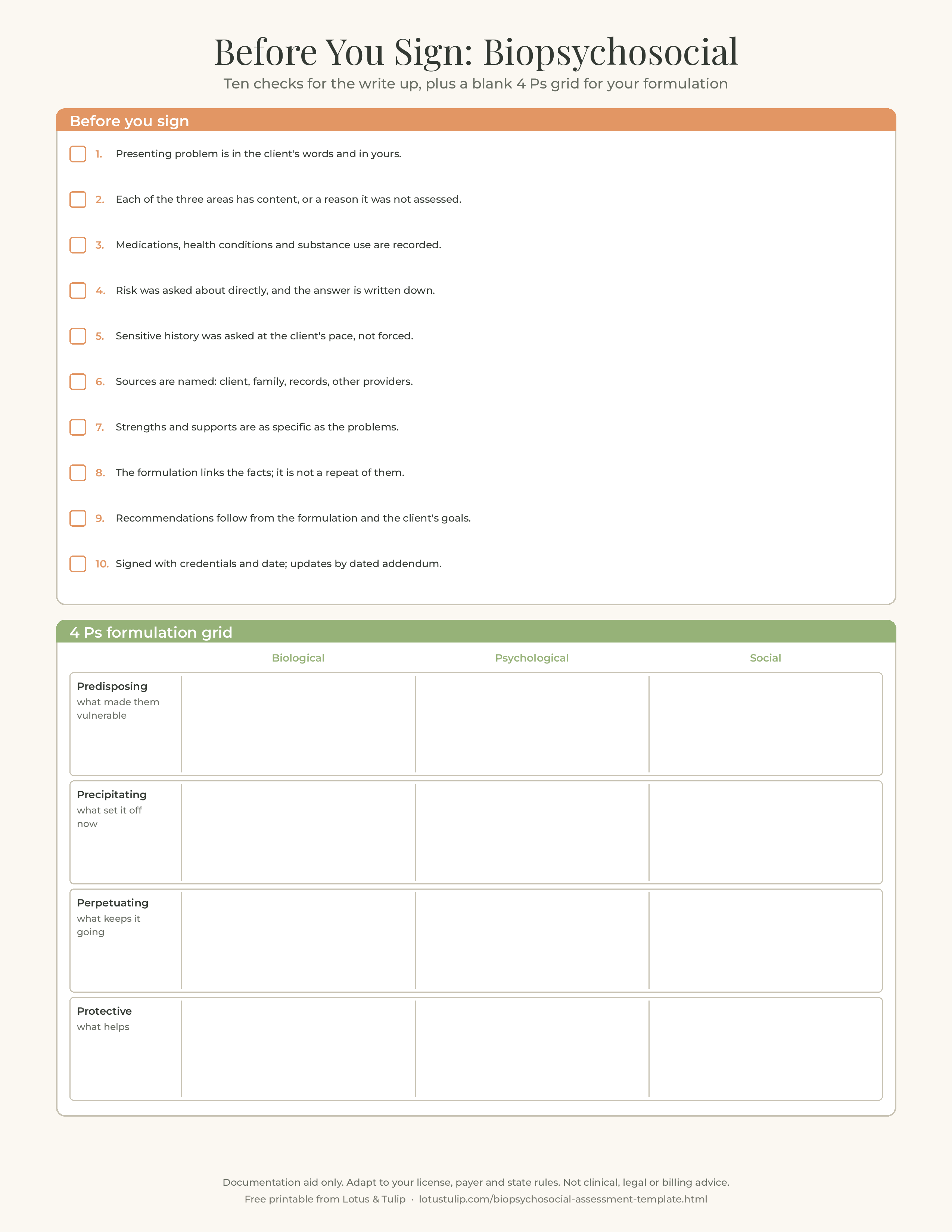
A good formulation makes treatment choices obvious. Notice that each perpetuating factor in the example points to a target: worry, sleep and alcohol, and avoidance. The protective factors point to what to use: the partner, the sister, the client's past success in therapy. The grid is on page 3 of the free printable.
The 4 Ps are not the only approach. Some clinicians formulate within a single model (a CBT case conceptualization, a psychodynamic formulation, a family systems view), and the DSM-5-TR Outline for Cultural Formulation adds the cultural dimension. Whatever model you use, the test is the same: does the paragraph explain the problem and point to the plan?
How to write a biopsychosocial assessment, step by step
- Read what you already have. Before the first session, review the intake packet, referral letter and any records you have a release for. Note gaps and anything urgent, such as a risk item checked on the intake form.
- Open with the client's story. Start the interview with an open question about what brings them in and why now. Let the client talk before you move to structured questions; you will get better information and a better relationship.
- Cover the three areas with a light structure. Work through biological, psychological and social questions, following the client's lead where you can and filling gaps at the end. Use your intake pages or the free template as a checklist, not a script.
- Ask about risk directly. Ask about suicidal thoughts, self harm, harm to others and safety at home in every assessment, and document the answers. If risk is present, complete a structured risk assessment and a safety plan before the client leaves.
- Use brief screening measures. Add standardized measures such as the PHQ-9, GAD-7 or AUDIT-C where they fit, and record scores with dates so you can repeat them later.
- Ask about strengths and goals. Before you finish, ask what has helped before, who is on the client's side and what they want to be different. Write it down in their words.
- Write the formulation. Sketch the 4 Ps grid, then write two to five sentences explaining how the factors connect and what that means for treatment.
- Record the impression and recommendations. Write a diagnostic impression within your scope, then the level of care, type and frequency of treatment, referrals and next steps, each tied to the formulation.
- Review, sign and update. Check the write up against the before you sign checklist, sign with credentials and date, and add dated updates when you learn something important later.
Biopsychosocial assessment example (fictional, full)
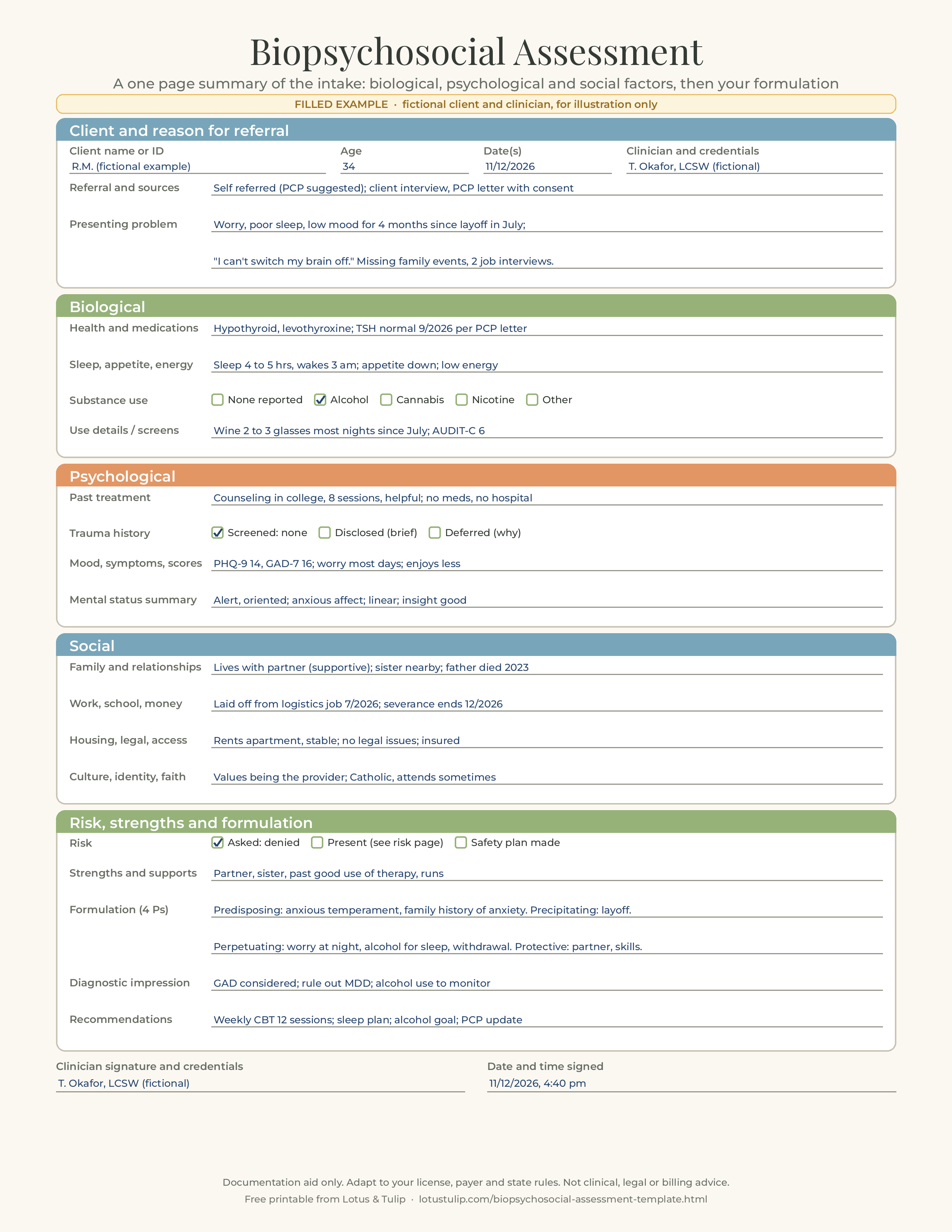
Below is a complete biopsychosocial assessment for "R.M.," a fictional 34 year old seen in outpatient private practice. It is the narrative version of page 2 of the free printable. Your agency's version may have more required fields; the clinical thinking should look like this.
Biopsychosocial assessment · R.M. (fictional) · age 34 · assessment 11/12/2026 · T. Okafor, LCSW (fictional)
Identifying information and referral: 34 year old man, he/him, lives with his partner in a rented apartment. Self referred after his primary care provider suggested therapy at an annual visit. Sources: client interview (60 minutes), intake packet, PCP letter received 11/10/2026 with signed release.
Presenting problem: "I can't switch my brain off." Excessive worry, trouble sleeping and low mood for about four months, since being laid off in July. Came in now because he missed his niece's birthday party last weekend and "realized I'm hiding from everyone."
History of presenting problem: Describes himself as "a worrier since I was a kid," but says worry was manageable until the layoff. Since July: worries most of the day about money, finding work and "letting my family down"; lies awake until 1 a.m. and wakes around 3 a.m. Has applied for about 15 jobs; cancelled two interviews this month because of worry about "blowing it." Has stopped running and sees friends rarely. Partner says he is "short with everyone" (reported by client).
Biological: Hypothyroidism diagnosed 2022, takes levothyroxine daily as prescribed; PCP letter notes thyroid levels in normal range 9/2026. No other medical conditions or medications. Sleep 4 to 5 hours a night with early waking. Appetite reduced, about 8 lb weight loss since July per client. Low energy, worse in the afternoon. Alcohol: one or two beers on weekends before July; now two to three glasses of wine most nights "to fall asleep." AUDIT-C 6. Denies cannabis, nicotine or other drug use. Coffee three to four cups a day, last cup around 4 p.m. Family history: mother treated for anxiety; paternal uncle with alcohol problems. No known family suicide.
Psychological: Worry most days, restlessness, irritability, poor concentration, reduced enjoyment, low mood most days for about two months. No panic attacks. Denies symptoms of mania or psychosis. Past treatment: eight sessions of counseling in college for stress, "really helped"; no psychiatric medication, no hospitalizations. Trauma screen: denies history of abuse, assault or other traumatic events. Father died in 2023 after a long illness; describes grief as "sad but okay." Coping: running (stopped), talking to his sister (less often), wine at night. PHQ-9 14, GAD-7 16. Mental status: alert and oriented; casually dressed, good hygiene; restless, frequently shifting in chair; speech normal rate and volume; mood "stressed and flat"; affect anxious, mildly constricted, congruent; thought process linear; thought content focused on worry about money and work; no perceptual disturbances reported or observed; insight and judgment good.
Social: Lives with partner of six years, who is supportive and "wants me to get help." No children. Sister lives nearby, close relationship. Mother lives in another state; father deceased. Worked eight years in logistics management; laid off with severance through December 2026; partner works full time. Rent is manageable for now; client worries about January. Health insurance through partner's employer. No legal issues. Catholic, attends Mass occasionally, describes faith as "comforting." Values being a provider; feels shame about the layoff and has not told some friends.
Risk: Asked directly about suicidal thoughts now and in the past: denies current or past suicidal thoughts, plans or attempts; denies self harm; denies thoughts of harming others. No firearms in the home. Feels safe at home. Protective factors: partner, sister, faith, future orientation (wants to find work, plans to marry). Given 988 information by call or text.
Strengths: Insight, motivation, previous good response to therapy, supportive partner and sister, stable housing and insurance, eight years of steady work history, used to run regularly.
Client goals: "Sleep through the night," "stop dreading every phone call," "go to interviews and family stuff again."
Formulation: R.M. has an anxious temperament and a family history of anxiety (predisposing). His symptoms began after a layoff that challenged his identity as the family provider (precipitating). Nightly worry, drinking wine to fall asleep, avoidance of interviews and family events, and the loss of running and social contact are maintaining the anxiety, sleep problems and low mood (perpetuating). A supportive partner and sister, insight, stable housing and a good past response to therapy are significant strengths (protective). This picture supports outpatient CBT for worry and insomnia, reduction of alcohol use, and graded return to avoided activities.
Diagnostic impression: Generalized anxiety disorder considered (worry difficult to control, restlessness, irritability, poor concentration and sleep disturbance, with lifelong worry intensifying over the past four months). Rule out major depressive disorder; monitor depressive symptoms with PHQ-9. Alcohol use increased since July; AUDIT-C positive; monitor and address in treatment.
Recommendations: Weekly individual CBT, about 12 sessions, then review. Targets: worry, sleep (CBT for insomnia strategies), alcohol (goal set with client: no wine on weeknights for two weeks, then review), and graded return to interviews, running and family events. Client agreed to update his PCP on sleep and alcohol; release on file. Repeat PHQ-9, GAD-7 and AUDIT-C at session 6. Treatment plan to be completed at session 2.
Signed: T. Okafor, LCSW (fictional) · 11/12/2026, 4:40 p.m.
What makes this example useful: the presenting problem is in the client's words and in clinical language; every section has specific facts with sources; risk was asked directly and answered; the formulation explains rather than repeats; and each recommendation traces back to a perpetuating factor or a goal. A covering clinician could pick up this case tomorrow.
Five short biopsychosocial assessment examples
Example 1: a teenager, with a parent's view
Fictional client "K.L.," 15, referred by school counselor for missing 14 school days this semester. Sources: client interview alone (40 minutes) and with mother (20 minutes); school attendance record with release. Biological: stomachaches most school mornings; pediatrician visit 10/2026 found no medical cause per mother; sleeps 1 a.m. to 11 a.m. on missed days; no substance use per client, interviewed alone. Psychological: client: "Everyone stares at me since the thing in the group chat." Worry about classmates, avoidance of the cafeteria; GAD-7 13. Social: lives with mother and younger brother; parents divorced 2024, sees father every other weekend; group chat conflict with former friends in September; plays guitar, one close friend outside school. Formulation: social anxiety and possible peer bullying (precipitating) in a teen who already had a sensitive temperament and a recent family change (predisposing), maintained by school avoidance and late sleep (perpetuating); close friend, music and an engaged mother are protective.
With minors, label who said what, and interview the young person alone for part of the session when appropriate, especially for substance use, relationships and risk. Confidentiality rules for minors vary by state and by type of service.
Example 2: an older adult
Fictional client "D.S.," 74, widowed eight months. Biological: type 2 diabetes, high blood pressure, arthritis; six medications managed by daughter with a pill organizer; reports forgetting appointments "more lately"; hearing aids, wears one. Psychological: sadness, loss of interest, "no point cooking for one"; PHQ-9 12; no prior mental health treatment. Social: lives alone in a two story house; stopped driving at night; daughter visits twice a week; was active in church until husband's illness. Recommendations: weekly therapy for grief and depression; client agreed to a PCP visit to review memory concerns and medications; explore senior center and church volunteer group.
Medical conditions, medications, hearing and memory carry more weight here. Note what you recommended rather than trying to explain the memory changes yourself.
Example 3: substance use as part of the picture
Fictional client "J.T.," 41, court referred after a second DUI. Biological: drinks 8 to 10 beers on weekend days, 3 to 4 on weekdays; last drink yesterday evening; morning shakes on two occasions this month; elevated liver enzymes per recent labs (client report). Psychological: irritability, poor sleep; prior outpatient treatment 2019, completed. Social: separated, sees children on weekends; license suspended; job at risk. Plan: referral for medical evaluation of withdrawal risk before any change in drinking; substance use assessment using the ASAM Criteria dimensions; release signed for probation officer, limited to attendance and participation.
In substance use settings the assessment often follows the ASAM Criteria. The fourth edition (2023) uses six dimensions: intoxication, withdrawal and addiction medications; biomedical conditions; psychiatric and cognitive conditions; substance use related risks; recovery environment interactions; and person centered considerations. Withdrawal symptoms such as morning shakes are a medical issue; document them and refer for medical assessment. If the program is covered by 42 CFR Part 2 (federally assisted substance use disorder programs), records have additional federal confidentiality protections.
Example 4: a client with a trauma history
Fictional client "A.N.," 28. Trauma history: when asked whether she had experienced events that were frightening or harmful, client said "yes, in my last relationship," became tearful and said she did not want to go into it today. Clinician thanked her, said she can choose what and when to share, and moved on. Client denies current contact with former partner; feels safe at home now; lives with a roommate. Plan: revisit at client's pace; consider a trauma symptom measure at session 3 if client agrees.
"Disclosed, details deferred at client request" is a complete and respectful entry. You need to know that trauma is part of the picture and whether the client is safe now; you do not need the story in session one.
Example 5: an assessment completed over two sessions
Fictional client "B.O.," 52, multiple stressors. Session 1 (11/3): presenting problem, history, risk (denies SI or HI, asked directly), biological history, PHQ-9 and GAD-7. Session 2 (11/10): social history, culture and faith, strengths and goals; formulation and recommendations completed and reviewed with client. Note: assessment completed over two sessions due to length of history; treatment plan to follow at session 3.
Many clinicians spread a full assessment over two sessions. Ask about risk in the first one, write a brief interim note, and date each part. Billing rules for an evaluation that spans more than one visit vary by payer, so check before you bill.
Asking about sensitive areas: trauma, culture and identity
Much of a biopsychosocial assessment asks about painful or private things on the first or second meeting. A few principles help:
- Explain why you are asking. "I ask everyone about their health, their history and their life, so I can understand the whole picture. You can skip anything."
- Screen, do not dig. For trauma, a screening question and a few follow ups usually tell you enough to plan. Details can come later, when the client chooses.
- Use a trauma informed lens. SAMHSA's guidance for a trauma informed approach lists six key principles: safety; trustworthiness and transparency; peer support; collaboration and mutuality; empowerment, voice and choice; and cultural, historical and gender issues. In an assessment interview that mostly means telling the client what you are doing, letting them set the pace, and noticing distress.
- Know what adverse childhood experiences are. The CDC describes ACEs as potentially traumatic events that occur in childhood (0 to 17 years), such as violence, abuse or neglect, witnessing violence, or a family member attempting or dying by suicide, plus household conditions such as substance use problems, mental health problems or instability from parental separation or a household member being in jail or prison. It is a useful frame for a childhood history, not a diagnosis.
- Ask about culture in the client's terms. The DSM-5-TR Cultural Formulation Interview is a free, semi structured interview with 16 core questions across four areas: cultural definition of the problem; cultural perceptions of cause, context and support; cultural factors affecting self coping and past help seeking; and cultural factors affecting current help seeking. Even two or three of its questions ("What do you think is causing this?" "What kind of help would be most useful?") improve the social section.
- Write neutrally. Record what the client said, not your judgment of it: "Client describes faith as comforting" rather than "client is very religious."
Screening measures that fit in a biopsychosocial assessment
Brief, standardized measures add a baseline you can repeat. Use them alongside the interview, not instead of it, and only measures you are trained and allowed to use.
| Measure | What it screens | Notes |
|---|---|---|
| PHQ-9 | Depression symptoms over the past two weeks | Nine items (Kroenke, Spitzer and Williams, 2001). Scores of 5, 10, 15 and 20 mark mild, moderate, moderately severe and severe depression. Item 9 asks about thoughts of death or self harm; follow up any positive answer. |
| GAD-7 | Anxiety symptoms over the past two weeks | Seven items (Spitzer and colleagues, 2006). Scores of 5, 10 and 15 mark mild, moderate and severe anxiety. |
| AUDIT-C | Unhealthy alcohol use | Three questions, scored 0 to 12. A score of 3 or more for women and 4 or more for men is commonly treated as a positive screen. |
| C-SSRS screener | Suicidal ideation and behavior | The Columbia Lighthouse Project offers the Columbia Suicide Severity Rating Scale screener free for health care and community settings. |
Write the score, the date and what you did about it: "PHQ-9 14 (11/12/2026), item 9 scored 0; will repeat at session 6."
Billing: where the biopsychosocial assessment fits
In outpatient mental health, the initial assessment is commonly billed as a psychiatric diagnostic evaluation:
| Code | Description | Notes |
|---|---|---|
| 90791 | Psychiatric diagnostic evaluation (no medical services) | Used by many licensed mental health professionals for the initial evaluation. Which credentials can bill it depends on the payer. |
| 90792 | Psychiatric diagnostic evaluation with medical services | Includes medical services such as physical examination elements, prescribing or ordering labs; billed by prescribers. |
| 90785 | Interactive complexity (add on) | Reported with 90791 or 90792 (and some psychotherapy codes) only when specific communication factors complicate the service, such as managing maladaptive communication, caregiver emotions or behavior that interfere with treatment, a sentinel event requiring a third party report, or the use of play equipment, devices or interpreters to overcome a communication barrier. |
The Medicare local coverage determination on psychiatric diagnostic evaluation and psychotherapy services (LCD L33252) describes the psychiatric diagnostic evaluation as "an integrated biopsychosocial assessment" that includes a complete medical history (past, family and social), psychiatric history, a complete mental status exam, a tentative diagnosis, and an evaluation of the patient's ability and willingness to participate in the proposed treatment plan, and notes that information may come from the patient, other clinicians, community providers or family members. That is a good description of what your write up should contain if you bill 90791 to Medicare.
Payer and state caveat. This section describes common CPT descriptions and one Medicare coverage policy as of November 2026. Medicaid programs, Medicare Advantage plans and commercial insurers set their own rules on who can bill 90791, how often, whether it can be split across visits, whether it can be done by telehealth and what documentation they expect, and these change. Check each payer's current written policy, and ask a billing professional when in doubt. This page does not guarantee that any claim will be paid. CPT is a registered trademark of the American Medical Association.
Privacy and records
- It belongs in the clinical record. Under HIPAA, "psychotherapy notes" are a narrow, separately kept category. The definition in 45 CFR 164.501 excludes medication prescription and monitoring, session start and stop times, modalities and frequencies of treatment, results of clinical tests, and any summary of diagnosis, functional status, treatment plan, symptoms, prognosis and progress. A biopsychosocial assessment is made of exactly those things, so it is part of the regular record.
- Write for a reader. Clients can generally request access to their records, and records may be shared with payers or, with authorization, other providers. Write in plain, respectful language you would be comfortable having the client read.
- Include what is relevant. A biopsychosocial assessment invites detail about other people (a partner's affair, a sibling's addiction). Record what matters clinically, and leave out gossip.
- Get releases before you contact others. Collateral information from family, schools or other providers needs the right authorization; note it in the sources line.
- Retention. HHS explains that the HIPAA Privacy Rule does not set a retention period for medical records; state laws generally do. Check your state's rules and your license board's requirements, which often differ for minors.
- Substance use records. Federally assisted substance use disorder programs covered by 42 CFR Part 2 have additional rules. State law and your license board can add more.
Words to watch in a biopsychosocial assessment
| Instead of | Try |
|---|---|
| "Client has good support." | "Partner supportive, attended session 1; sister nearby, calls daily." |
| "Social drinker." | "Two to three glasses of wine most nights since July; AUDIT-C 6." |
| "No trauma." | "Asked about traumatic experiences; client denies." Or "Disclosed; details deferred at client request." |
| "Denies SI." (not asked) | "Asked directly about suicidal thoughts now and in the past; denies." |
| "Noncompliant with meds." | "Takes sertraline about half the days; says it makes her nauseous." |
| "Poor historian." | "Unsure of dates of past treatment; records requested with release." |
| "Client is in denial." | "Client does not see drinking as a problem; partner reports concern." |
| "Unremarkable." | Say what you asked and what you found, briefly. |
Common biopsychosocial assessment mistakes
- No formulation. Ten pages of history and no paragraph explaining how it fits together.
- A formulation that repeats the history. If it does not explain why now and what will help, it is a summary, not a formulation.
- Biological section left blank. No medications, no sleep, no substance use, no medical follow up.
- "Denies SI" without asking. Write what you asked and what the client answered.
- Pushing for trauma details in the first session, or recording more detail than the plan needs.
- Vague strengths such as "motivated" or "good support," when specifics would guide treatment.
- No sources. Mixing the client's account, a parent's view and old records without saying which is which.
- Diagnosing outside your scope, or writing medical conclusions instead of recommending a medical evaluation.
- Recommendations that do not follow from the assessment. The formulation names alcohol and sleep; the plan says only "weekly therapy."
- Copying from the intake form word for word, including errors, without clinical review.
- Judgmental language that you would not want the client or a jury to read.
- Never updating it. A major new fact (a diagnosis, a disclosure, a move) belongs in a dated update.
A faster way to write good biopsychosocial assessments
- Send the intake packet ahead. Let the client fill in the factual history at home so the session can focus on understanding.
- Use one page as your map. Keep the free template beside you in the session and tick off areas as you cover them.
- Jot the 4 Ps while you listen. A rough grid during the session makes the formulation take five minutes instead of thirty.
- Write the formulation first. Once you know your explanation, the rest of the write up is easier to organize and shorter.
- Write the client's words down as they say them. Two or three direct quotes make the record more accurate and more human.
- Link straight to the plan. Turn each perpetuating factor into a treatment target and each goal into a plan goal the same day.
Free printable: biopsychosocial assessment template, filled example and checklist
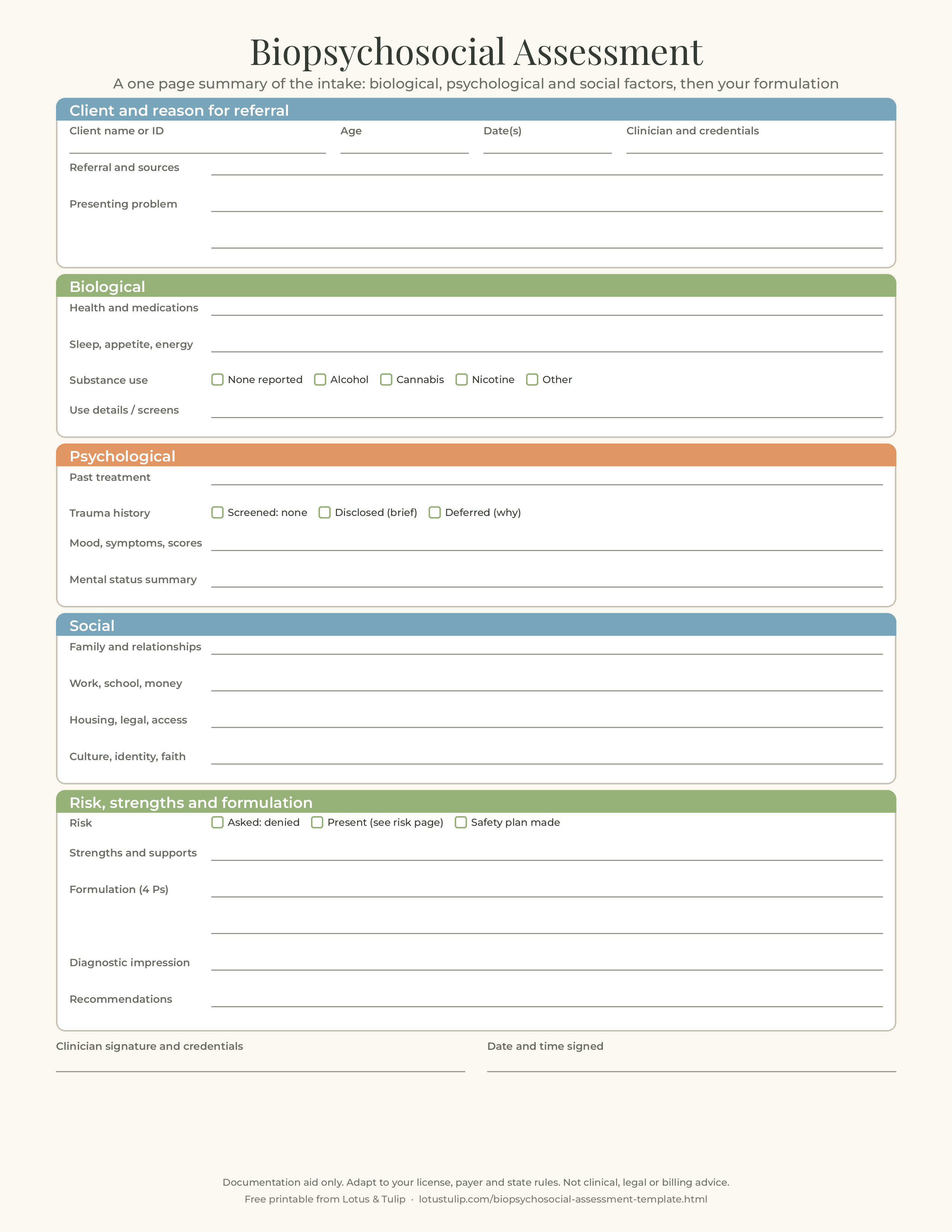
The free printable has three US Letter pages. Page 1 is a blank one page biopsychosocial assessment summary: client and referral details, referral and information sources, presenting problem, a biological section (health and medications, sleep, appetite and energy, substance use tick boxes and screening details), a psychological section (past treatment, trauma history screened, disclosed or deferred, symptoms and scores, mental status summary), a social section (family and relationships, work, school and money, housing, legal and access, culture, identity and faith), then risk, strengths and supports, a 4 Ps formulation, diagnostic impression, recommendations and signature lines. Page 2 is a filled example for the fictional client "R.M." from this page. Page 3 is a ten point before you sign checklist plus a blank 4 Ps formulation grid (predisposing, precipitating, perpetuating and protective, across biological, psychological and social).
Download the free biopsychosocial assessment template (PDF, 3 pages)
Rather type than handwrite? The free PDF above is for printing. Therapy Progress Notes and Intake Templates comes as a fillable PDF you type straight into (604 fields in Adobe Acrobat Reader), plus the printable version: SOAP, DAP and BIRP notes, intake, treatment plan and safety plan, 20 pages. Holiday 20% off: about $7.36, was $9 (EUR 8) · instant digital download
Buy on EtsyPrefer single images? Page 1: blank biopsychosocial assessment (PNG) · Page 2: filled biopsychosocial assessment example (PNG) · Page 3: before you sign checklist and 4 Ps grid (PNG)
Free to print and use in your own practice or program. Please link to this page rather than re-uploading the file. The template is a documentation aid: adapt it to your license, setting, payer and state rules, and use your own clinical judgment. Using it does not guarantee that any payer, auditor or board will accept your documentation.
Related resources
- Closing a therapy private practice: checklist, timeline, client letters, records plan and free printable
- HIPAA risk assessment for therapists: security risk analysis, filled example and free worksheet
- Business associate agreement for therapists: which vendors need a BAA, breach duties, filled vendor log and free printable
- Professional will for therapists: clinical executor, records custodian, client notification scripts, filled example and free printable
- Couples therapy informed consent form: no secrets policy, individual sessions, records access, safety screening, filled example and free printable
- Treatment summary template for therapists: how to write a treatment summary letter, transfer records under HIPAA, filled example and free printable
- Notice of privacy practices for therapists: HIPAA 164.520 elements, 2026 Part 2 update, filled example and free printable
- Parental consent form for therapy of a minor: who can consent, custody orders, state minor consent laws, HIPAA, filled example and free printable
- Credit card authorization form for therapists: card on file consent, PCI DSS rules, filled example and free printable
- Sliding scale fee policy for therapists: 2026 poverty guideline tiers, copay waiver rules, filled example and free printable
- Therapy cancellation policy template: late cancellation and no show fees, Medicare and Medicaid rules, filled example and free printable
- Release of information form for therapists: HIPAA authorization elements, psychotherapy notes, Part 2, filled example and free printable
- Superbill template for therapists: every field insurers need, CPT and POS codes, filled example and free printable
- Good Faith Estimate template for therapists: No Surprises Act rules, filled example and free printable
- Psychotherapy notes vs progress notes: what HIPAA says, what goes where and free printable
- Therapy termination letter template: how to end therapy ethically, sample letters and free printable
- Informed consent for therapy template: what to include, sample consent and free printable
- What to include in a therapy intake form (checklist)
- Mental status exam template: examples, word bank and free printable
- Therapy treatment plan template with SMART objectives (free printable)
- Telehealth progress note template: examples, checklist and free printable
- BIRP notes for therapists: template, 5 examples and free printable
- GIRP notes for therapists: template, 5 examples and free printable
- SOAP vs DAP notes for therapists, with examples
- Group therapy progress notes: template, examples and free printable
- Therapy discharge summary template: example and free printable
- Safety plan worksheet (free printable)
- Therapy progress notes and intake templates
Sources: Engel GL, "The Need for a New Medical Model: A Challenge for Biomedicine," Science 196(4286):129 to 136, 1977; CMS Medicare Coverage Database, LCD L33252 Psychiatric Diagnostic Evaluation and Psychotherapy Services and billing article A57520; CPT descriptors for 90791, 90792 and 90785 as summarized in payer coding guides; ASAM, The ASAM Criteria, Fourth Edition (2023), dimensions overview; American Psychiatric Association, DSM-5-TR Cultural Formulation Interview; SAMHSA, Concept of Trauma and Guidance for a Trauma-Informed Approach (HHS Publication SMA14-4884); CDC, About Adverse Childhood Experiences; ODPHP, Healthy People 2030 Social Determinants of Health; Kroenke K, Spitzer RL, Williams JBW, The PHQ-9, J Gen Intern Med 2001; Spitzer RL et al., A Brief Measure for Assessing Generalized Anxiety Disorder: the GAD-7, Arch Intern Med 2006; NIAAA and NIDA CTN, AUDIT-C scoring; The Columbia Lighthouse Project, C-SSRS screener; 45 CFR 164.501 (psychotherapy notes definition); HHS, HIPAA FAQ on medical record retention. CPT is a registered trademark of the American Medical Association. Rules change; check the current versions and your payers' policies.
FAQ
What is a biopsychosocial assessment in counseling?
It is a structured clinical assessment, usually done at the start of treatment, that looks at the biological, psychological and social factors in a client's life and how they connect. It covers the presenting problem and its history, physical health, medications and substance use, symptoms and past treatment, family, culture, work and living situation, risk and strengths, and ends with a formulation, a diagnostic impression where your scope allows, and recommendations.
What should be included in a biopsychosocial assessment?
Identifying information and referral source, the presenting problem in the client's words, history of the problem, biological factors (health, medications, sleep, appetite, substance use, family history), psychological factors (symptoms, past treatment, trauma, coping, screening scores, mental status), social factors (family, relationships, culture, faith, education, work, money, housing, legal, access to care), risk, strengths, client goals, a formulation, a diagnostic impression and recommendations.
What is the difference between an intake form and a biopsychosocial assessment?
An intake form is usually completed by the client and gathers raw information. A biopsychosocial assessment is written by the clinician from the interview, the intake form and any records, and adds clinical judgment: risk, a formulation that explains the problem, a diagnostic impression and recommendations.
How long should a biopsychosocial assessment take?
Many outpatient clinicians complete it in one 60 to 90 minute session, and many spread it over two sessions when the history is long. Agency forms may take longer. What matters is that risk is assessed in the first contact and that each part is dated.
What are the 4 Ps in a biopsychosocial formulation?
Predisposing factors (what made the person vulnerable), precipitating factors (what set the problem off now), perpetuating factors (what keeps it going) and protective factors (what helps). Looking at each across biological, psychological and social areas gives a twelve box grid that you can turn into a short explanatory paragraph.
What CPT code is used for a biopsychosocial assessment?
The initial assessment in outpatient mental health is commonly billed as a psychiatric diagnostic evaluation, CPT 90791 (without medical services) or 90792 (with medical services, for prescribers), sometimes with the 90785 interactive complexity add on when specific communication factors apply. Payers set their own rules on who can bill these codes and how often, so check each payer's policy.
Is a biopsychosocial assessment a psychotherapy note under HIPAA?
No. HIPAA psychotherapy notes are a narrow, separately kept category, and the definition excludes things such as test results and summaries of diagnosis, functional status, symptoms, treatment plan and prognosis. A biopsychosocial assessment is part of the regular clinical record.
Is this biopsychosocial assessment template free?
Yes. The three page printable (blank one page biopsychosocial assessment, filled fictional example, and a before you sign checklist with a 4 Ps formulation grid) is free to print and use in your own practice or program. Please link to this page rather than re-uploading the file, and adapt it to your setting, payer and state.